Consumer prices rose 0.4% in August, up from 0.2% in July, lifting...

Sam Williamson@SWilliamsonEcon
20 views
Sep 11, 2025
~3 min read
Advertisement
1
Consumer prices rose 0.4% in August, up from 0.2% in July, lifting the annual inflation rate to 2.9%--the highest since the start of 2025.
The upside surprise came from food and energy, both of which posted solid monthly gains. Core inflation, which strips out those volatile components, rose 0.3% on the month and held steady at 3.1% year-over-year. Core goods saw modest increases, led by new/used cars and apparel, while core services cooled slightly, helped by a decline in medical care services.
Despite the firmer headline, the latest data likely sets up the Fed for a conservative 25bp cut at next week's meeting, while offering little in the way of justification for a 50bp move.
Additional details to follow in the thread below.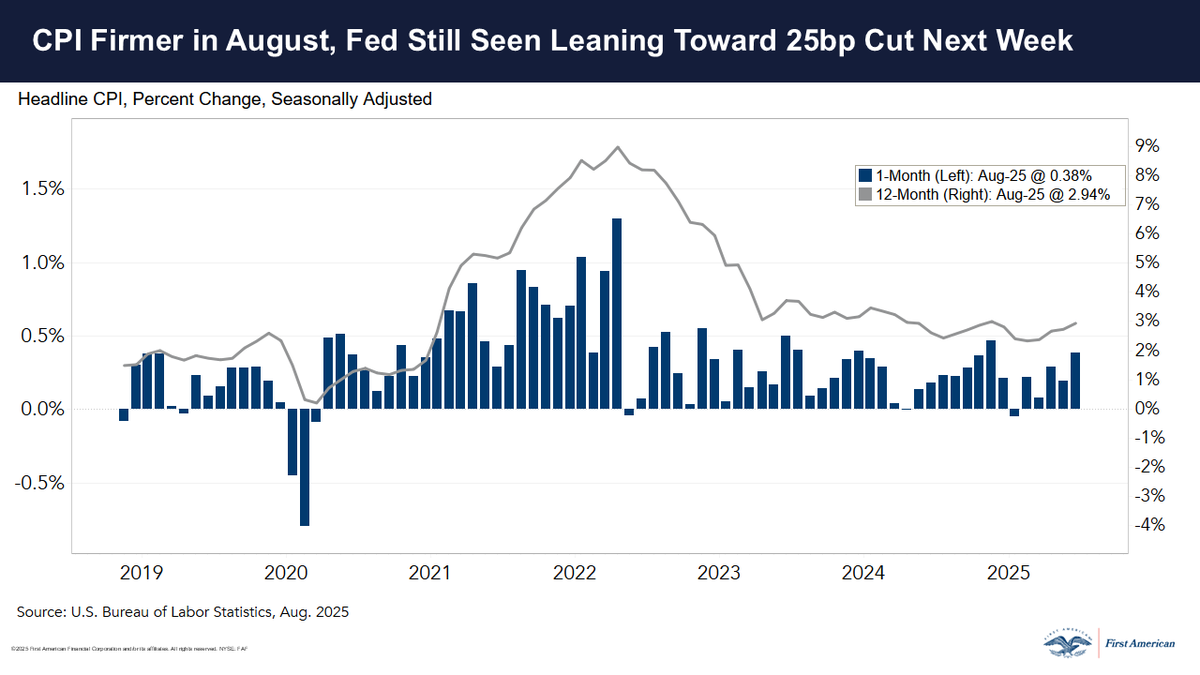
The upside surprise came from food and energy, both of which posted solid monthly gains. Core inflation, which strips out those volatile components, rose 0.3% on the month and held steady at 3.1% year-over-year. Core goods saw modest increases, led by new/used cars and apparel, while core services cooled slightly, helped by a decline in medical care services.
Despite the firmer headline, the latest data likely sets up the Fed for a conservative 25bp cut at next week's meeting, while offering little in the way of justification for a 50bp move.
Additional details to follow in the thread below.
2
Headline inflation rose 2.94% year-over-year in August, just shy of January’s 3.00% pace, while core inflation ticked up to 3.11%, just below February’s 3.14%. The headline figure is being driven by renewed pressure from food and energy, but the Fed typically focuses on core, which strips out those volatile components.
Even with core inflation ticking up, labor market signals—like today’s rise in initial claims—point to growing risks to the other side of the Fed’s dual mandate: maximum employment. A September rate cut would likely be positioned as a rebalancing move in response to emerging downside risks.
Even with core inflation ticking up, labor market signals—like today’s rise in initial claims—point to growing risks to the other side of the Fed’s dual mandate: maximum employment. A September rate cut would likely be positioned as a rebalancing move in response to emerging downside risks.
3
Core goods inflation is picking up speed, rising 0.3% in August and 1.5% year-over-year—the fastest pace since May 2023. That acceleration may reflect the early impact of recent tariff policy changes, with price pressures emerging in categories like apparel, vehicles, and furniture.
For much of the past year, core services—which account for roughly 60% of the CPI by weight—acted as a counterbalance, offsetting volatility in goods. But that dynamic is shifting: core services inflation rose 0.36% in July and 0.35% in August, and has held steady around 3.6% year-over-year since April.
For much of the past year, core services—which account for roughly 60% of the CPI by weight—acted as a counterbalance, offsetting volatility in goods. But that dynamic is shifting: core services inflation rose 0.36% in July and 0.35% in August, and has held steady around 3.6% year-over-year since April.
4
Inflation in August was broad-based, with most categories posting increases. Food prices rose 0.5%, energy rose 0.7% driven by gasoline, which pulled up the headline figure.
Goods inflation showed signs of tariff-related pressure, particularly in import-heavy categories like furniture (+0.3%), appliances (+0.4%), tools (+0.8%), housekeeping supplies (+0.4%), and new vehicles (+0.3%) as well as used vehicles (+1.0%). However, the impact wasn’t uniform. Prices declined in other import-reliant categories such as pet food and toys, suggesting that not all sectors are experiencing the same cost pass-through—possibly due to inventory buffers, pricing strategies, or competitive dynamics.
Services inflation also picked up, driven by strong increases in transportation services like motor vehicle maintenance (+2.4%) and airline fares (+5.9%). Shelter inflation also ticked up slightly to 0.4%, driven by an uptick in owners' equivalent rent.
While the rise in inflation likely won't be enough to deter a 25-basis point cut in September, it will likely keep policymakers cautious on pace of rate cuts. Further signs of inflation heating up could make it more difficult for the Fed to justify cutting rates, even if labor market conditions continue to soften.
Goods inflation showed signs of tariff-related pressure, particularly in import-heavy categories like furniture (+0.3%), appliances (+0.4%), tools (+0.8%), housekeeping supplies (+0.4%), and new vehicles (+0.3%) as well as used vehicles (+1.0%). However, the impact wasn’t uniform. Prices declined in other import-reliant categories such as pet food and toys, suggesting that not all sectors are experiencing the same cost pass-through—possibly due to inventory buffers, pricing strategies, or competitive dynamics.
Services inflation also picked up, driven by strong increases in transportation services like motor vehicle maintenance (+2.4%) and airline fares (+5.9%). Shelter inflation also ticked up slightly to 0.4%, driven by an uptick in owners' equivalent rent.
While the rise in inflation likely won't be enough to deter a 25-basis point cut in September, it will likely keep policymakers cautious on pace of rate cuts. Further signs of inflation heating up could make it more difficult for the Fed to justify cutting rates, even if labor market conditions continue to soften.
5
Shelter inflation, which makes up roughly 35% of the CPI by weight, rose sharply in August. Rent of shelter increased 0.4% on the month, driven in part by a 2.6% jump in hotel and motel prices. Owners’ equivalent rent also accelerated, rising from 0.3% in July to 0.4% in August. Together, these gains pushed overall shelter inflation to 0.44%—its highest monthly reading in a year.
Similar spikes have occurred, most recently last August, suggesting this could be a seasonal outlier rather than a reversal of the broader cooling trend seen over the past two and a half years. Still, given shelter’s outsized weight in the CPI basket, even short-lived increases can have a meaningful impact on the overall inflation picture in any given month.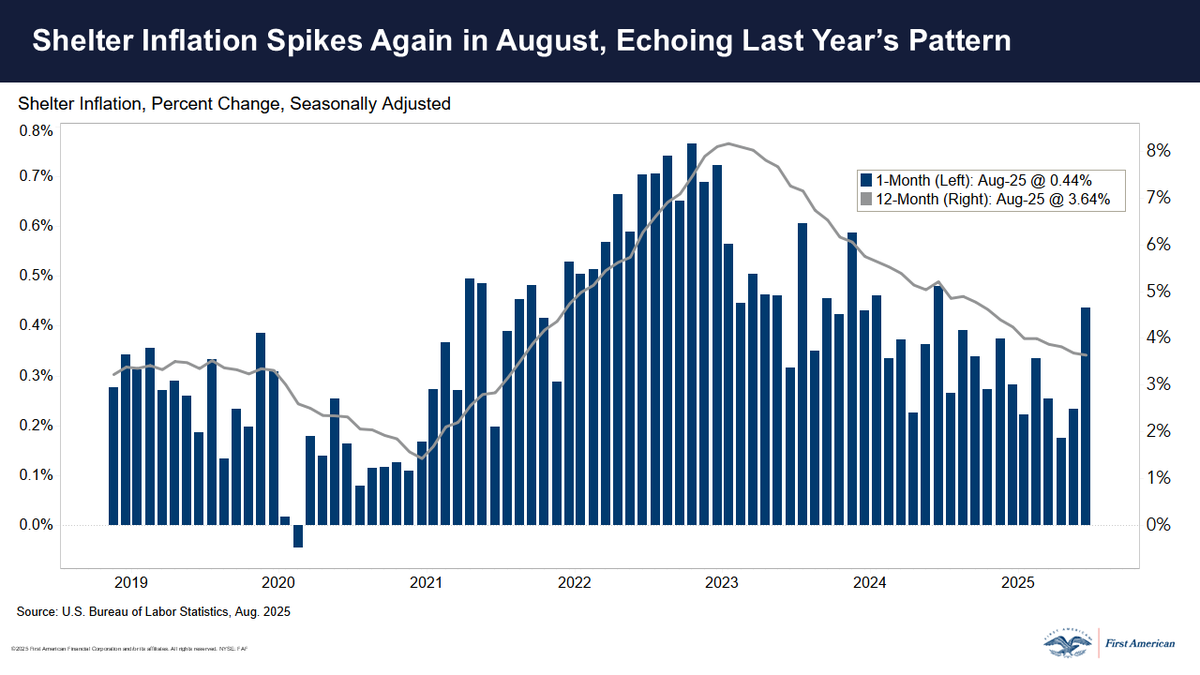
Similar spikes have occurred, most recently last August, suggesting this could be a seasonal outlier rather than a reversal of the broader cooling trend seen over the past two and a half years. Still, given shelter’s outsized weight in the CPI basket, even short-lived increases can have a meaningful impact on the overall inflation picture in any given month.