The Fed holds rates steady in July but downgrades its economic...

Sam Williamson@SWilliamsonEcon
18 views
Jul 30, 2025
~3 min read
Advertisement
1
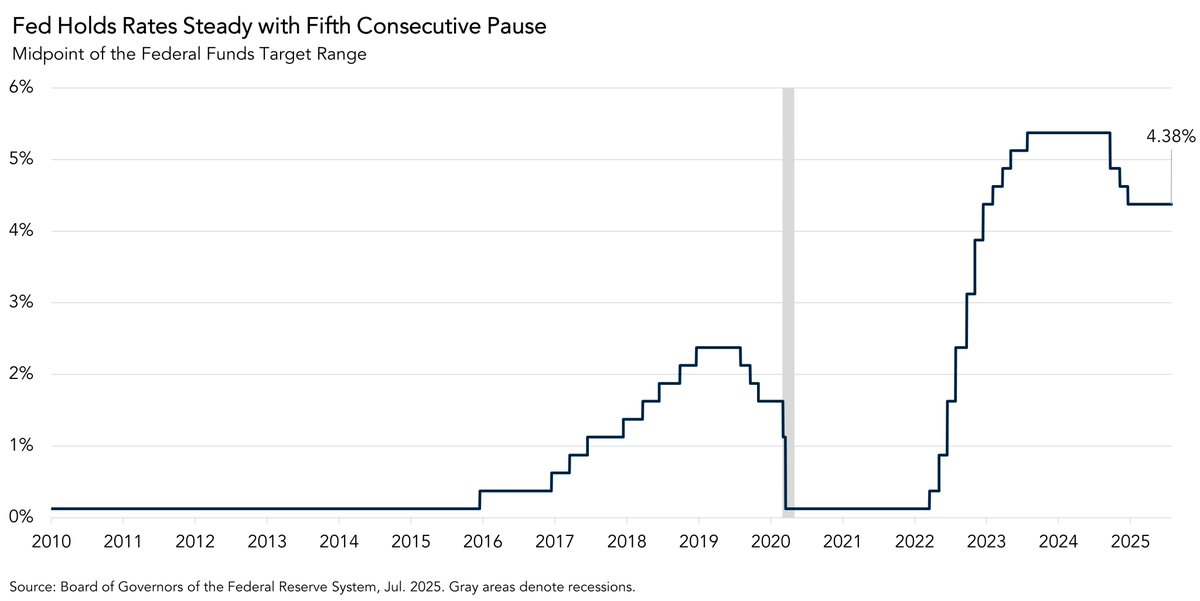
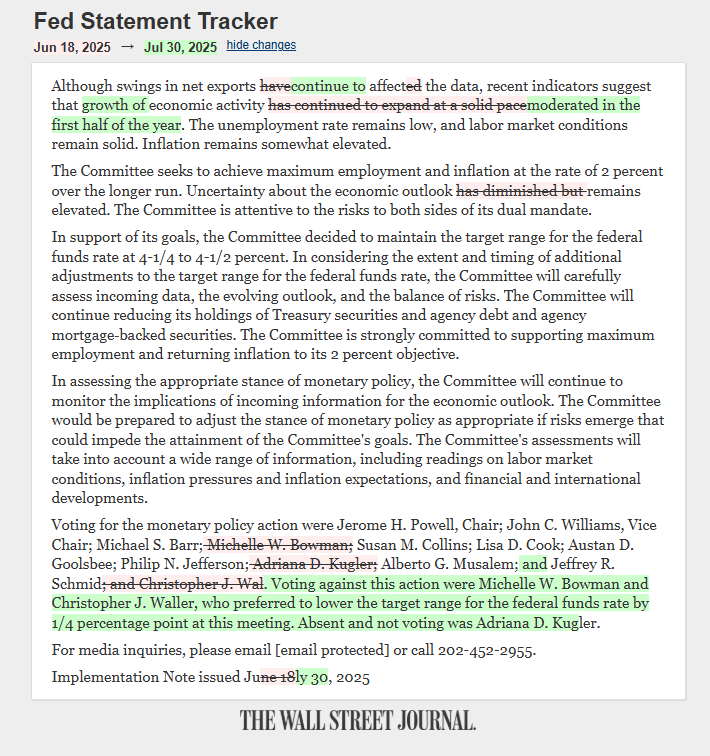
The Fed holds rates steady in July but downgrades its economic assessment—now sees growth as 'moderated in the first half of the year,' a shift from June’s view of 'solid' expansion. Notably, Govs. Waller and Bowman dissented—the first such high-level split since 1993. More commentary to follow from Chairman Powell’s press conference.
2
On economic growth, the Fed’s downgrade aligns with this morning’s GDP data, reflecting slower consumer spending in the first half of 2025. Business investment showed improvement, but the housing sector remains 'weak'—a point Chairman Powell emphasized in his opening comments.
3
On the labor market, Chairman Powell noted conditions remain solid and broadly consistent with full employment. Job gains have averaged 150K over the past three months, unemployment remains low and stable within a narrow range, and wage growth continues to moderate while still outpacing inflation.
4
On inflation, Chairman Powell said it remains above target with little change since the start of the year. The composition, however, has shifted: services inflation is easing, while tariffs have pushed up some goods prices. Short-term inflation expectations have risen in response to tariffs, but longer-term views remain anchored near the Fed’s 2% goal.
5
On tariffs, Powell said their effects are starting to emerge in goods prices but the broader impact on growth and inflation is still uncertain. A one-time price increase is a "reasonable" base case, though sustained inflationary pressure remains a risk. For now, the Fed considers itself well-positioned to monitor developments and maintain flexibility before adjusting policy.
6
Asked about a potential September rate cut, Chairman Powell said current policy isn’t holding back the economy and remains modestly restrictive—appropriate given elevated inflation. He emphasized no decisions have been made, and the Fed will have two more rounds of data before the next meeting to assess the outlook and balance of risks.
7
On the tariff landscape, Powell said trade policy remains highly uncertain, with negotiations still unfolding. While estimates of effective tariff levels have stabilized somewhat, it’s too early to tell where things will ultimately settle. Powell also noted it seems like there's "much more to come" before the outlook becomes clearer.
8
On employment, Powell noted the labor market shows no signs of further weakening, with quits, job openings, and unemployment rates largely unchanged from a year ago. He acknowledged some softening in job creation and labor supply, but noted that demand and supply appear to be easing at a similar pace. While conditions remain stable, Powell flagged downside risks and pointed to Friday’s unemployment rate as the key number to watch.
9
On tariff-related inflation, Powell said it’s still “early days” for tariff-related inflation. Firms are absorbing costs for now, but surveys show plans to pass them on. The process playing out more slowly than the Fed expected, and there’s a long way to go. He also emphasized the Fed aims to prevent persistent inflation by acting efficiently—not too soon, not too late.
10
On housing affordability, Powell said the housing market is a special case, shaped by a long-term shortage and years of underbuilding. While the Fed doesn’t set mortgage rates, he emphasized that the best contribution it can make is to maintain 2% inflation and maximum employment—creating the stable economic backdrop needed to support housing over time.