The July jobs report showed clear signs of cooling. Payrolls rose...

Sam Williamson@SWilliamsonEcon
17 views
Aug 01, 2025
~3 min read
Advertisement
1
The July jobs report showed clear signs of cooling. Payrolls rose just +73k vs. ~110k expected, while downward revisions to May and June (-258k) dragged the 3-month average to ~35k. Unemployment ticked up to 4.2%. Slower hiring and deep revisions point to a softening labor market, raising the odds of a September Fed rate cut and potential relief for mortgage rates. More details below.

2
Private employers added 83k jobs in July, a substantial increase from the downwardly revised +3k in June and above the +69k added in May.
Good-producing sectors have shed 13k jobs in each of the last 3 months, led by manufacturing. Construction remains resilient, adding around 2-3k jobs per month.
Education and health services continue to drive gains on the services side, adding 79k jobs and comprising 95% of net jobs added by private employers last month. Professional and business services jobs continue to decline, losing 16k jobs on average the last 3 months. Retail recouped some of the jobs lost in May and June but remains negative over the last 3 months, and Financial Activities jobs grew by 15k.
The government shed 10k jobs in July, driven by -12k losses in Federal government and -3k in local government, which was partially offset by state governments adding 5k jobs.
Good-producing sectors have shed 13k jobs in each of the last 3 months, led by manufacturing. Construction remains resilient, adding around 2-3k jobs per month.
Education and health services continue to drive gains on the services side, adding 79k jobs and comprising 95% of net jobs added by private employers last month. Professional and business services jobs continue to decline, losing 16k jobs on average the last 3 months. Retail recouped some of the jobs lost in May and June but remains negative over the last 3 months, and Financial Activities jobs grew by 15k.
The government shed 10k jobs in July, driven by -12k losses in Federal government and -3k in local government, which was partially offset by state governments adding 5k jobs.
3
The unemployment rate rose to 4.2% in July, with the unrounded figure reaching 4.248%—its highest level since October 2021. At the same time, labor force participation declined to 62.2%, marking its lowest point since November 2022.
While the labor force has remained essentially flat—at around 170,000 since the start of the year—the number of unemployed individuals has climbed by roughly 350,000 since December, a 5% increase. If these trend persist, it would place additional upward pressure on the unemployment rate in the coming months.
While the labor force has remained essentially flat—at around 170,000 since the start of the year—the number of unemployed individuals has climbed by roughly 350,000 since December, a 5% increase. If these trend persist, it would place additional upward pressure on the unemployment rate in the coming months.
4
Correction: 170,000k individuals in the labor force, not 170,000.
5
On the homebuilding side, residential construction employment declined by 1,400 jobs in July, with an additional 3,000 jobs lost among specialty trade contractors. Despite these cuts—and headwinds from potential tariffs on building materials and rising housing inventory—both sectors remain near cyclical highs. Residential construction employment is just 0.3% below its recent peak in March, while specialty contractors are down only 1.2% from their September high.
This resilience suggests that, even amid growing challenges, underlying demand for housing and construction labor remains solid. The modest pullback in employment may reflect a recalibration rather than a downturn, offering a bright spot for the housing market outlook.
This resilience suggests that, even amid growing challenges, underlying demand for housing and construction labor remains solid. The modest pullback in employment may reflect a recalibration rather than a downturn, offering a bright spot for the housing market outlook.
6
Another glimmer of good news following today's jobs report is the decline in the 10-year Treasury Note, which mortgage rates loosely follow. The likelihood of a September rate cut has also risen, with markets now pricing in roughly an 81% chance, along with increased odds for October and December.
This could be beneficial, as markets often move ahead of official Fed actions—pricing in more cuts and lowering mortgage rates even before any policy changes occur. Combined with rising housing supply and more stable home prices, lower rates could help improve affordability and support a gradual recovery in the housing market in the back half of 2025.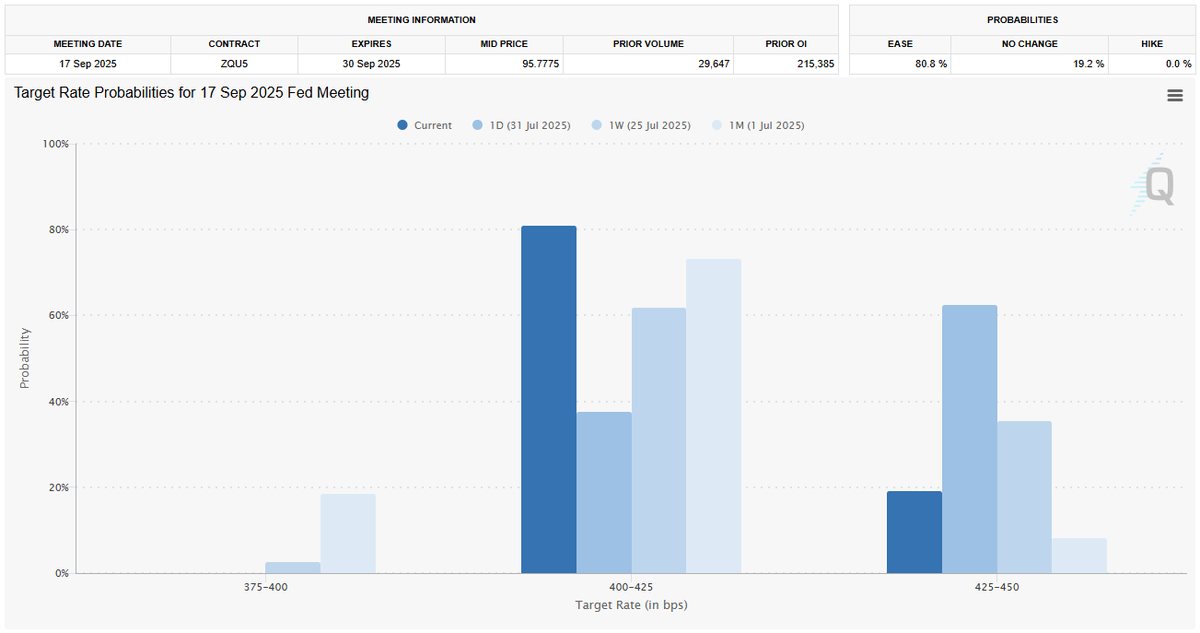

This could be beneficial, as markets often move ahead of official Fed actions—pricing in more cuts and lowering mortgage rates even before any policy changes occur. Combined with rising housing supply and more stable home prices, lower rates could help improve affordability and support a gradual recovery in the housing market in the back half of 2025.
