As football season kicks off, August’s jobs report may be the...

Sam Williamson@SWilliamsonEcon
19 views
Sep 05, 2025
~3 min read
Advertisement
1
As football season kicks off, August’s jobs report may be the turnover that forces the Fed to change its playcalling—starting with a 25 basis point rate cut at its September meeting.
Employers added only 22,000 jobs last month, well below the 75,000 expected, reinforcing the picture of a labor market that’s losing momentum without collapsing. The three-month average now stands at 29,000, a clear slowdown from earlier in the year.
Revisions to prior months added to the softness: June’s figure was revised down to a 13,000 job loss, while July was revised up to 79,000, resulting in a net two-month revision of -21,000. The unemployment rate rose to 4.3%, the highest since October 2021, and a key metric the Fed is watching closely for signs of slack. Meanwhile, labor force participation ticked up to 62.3%, suggesting more workers are entering the game even as hiring slows.
With inflation not reaccelerating and job growth fading, the Fed may see this as an opportunity to recalibrate—shifting policy back toward neutral rather than launching a full pivot to stimulus. A rate cut in September would mark the first step in that adjustment, and could put downward pressure on long-term yields, offering some relief to prospective homebuyers facing elevated mortgage rates and prices. For those still on the sidelines, this could be the opening drive that begins to move the chains on affordability—especially if inventory improves and price growth continues to moderate.
Additional details to follow in the thread below.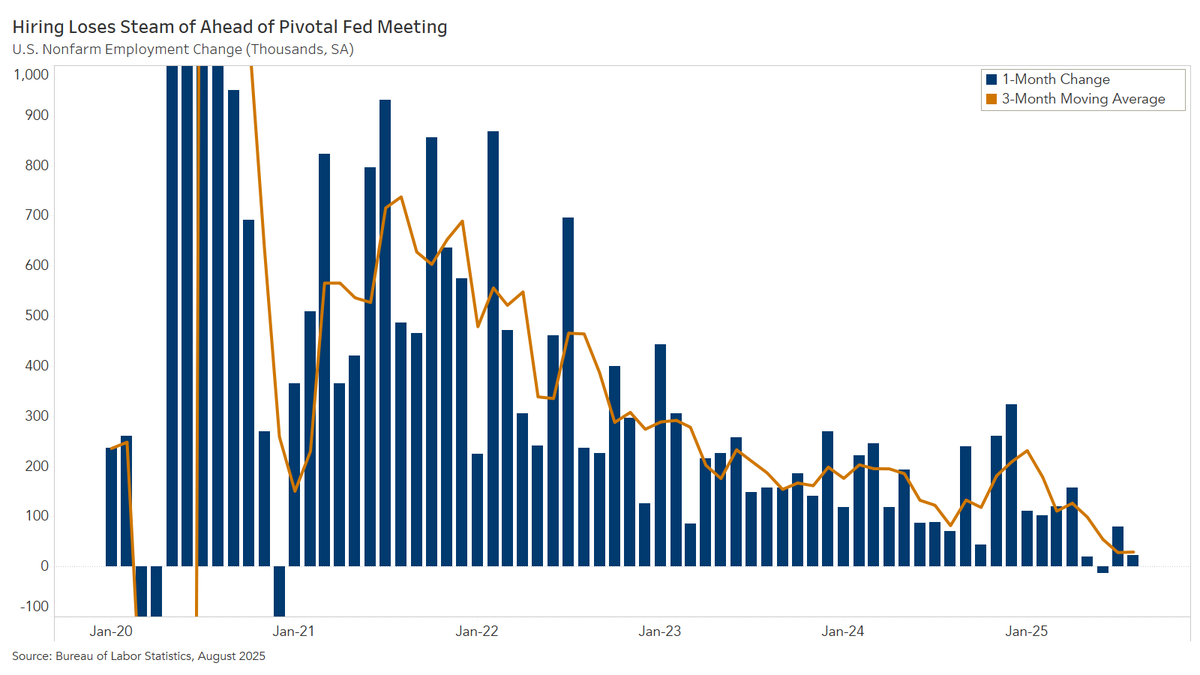
Employers added only 22,000 jobs last month, well below the 75,000 expected, reinforcing the picture of a labor market that’s losing momentum without collapsing. The three-month average now stands at 29,000, a clear slowdown from earlier in the year.
Revisions to prior months added to the softness: June’s figure was revised down to a 13,000 job loss, while July was revised up to 79,000, resulting in a net two-month revision of -21,000. The unemployment rate rose to 4.3%, the highest since October 2021, and a key metric the Fed is watching closely for signs of slack. Meanwhile, labor force participation ticked up to 62.3%, suggesting more workers are entering the game even as hiring slows.
With inflation not reaccelerating and job growth fading, the Fed may see this as an opportunity to recalibrate—shifting policy back toward neutral rather than launching a full pivot to stimulus. A rate cut in September would mark the first step in that adjustment, and could put downward pressure on long-term yields, offering some relief to prospective homebuyers facing elevated mortgage rates and prices. For those still on the sidelines, this could be the opening drive that begins to move the chains on affordability—especially if inventory improves and price growth continues to moderate.
Additional details to follow in the thread below.
2
August’s job gains were narrowly concentrated, highlighting a labor market increasingly dependent on a few resilient service sectors.
Service-providing industries added 63,000 jobs, driven by health care and leisure and hospitality—together accounting for most of the 38,000 net private-sector increase. Other service sectors saw declines, including professional and business services and wholesale trade, both posting their third-straight job loss for the month.
Meanwhile, goods-producing sectors shed 25,000 jobs, with losses in manufacturing, construction, and mining and logging.
Government employment also declined by 16,000, led by cuts at the federal and state levels. Local government employment rose, driven by gains in education as schools reopened for the fall.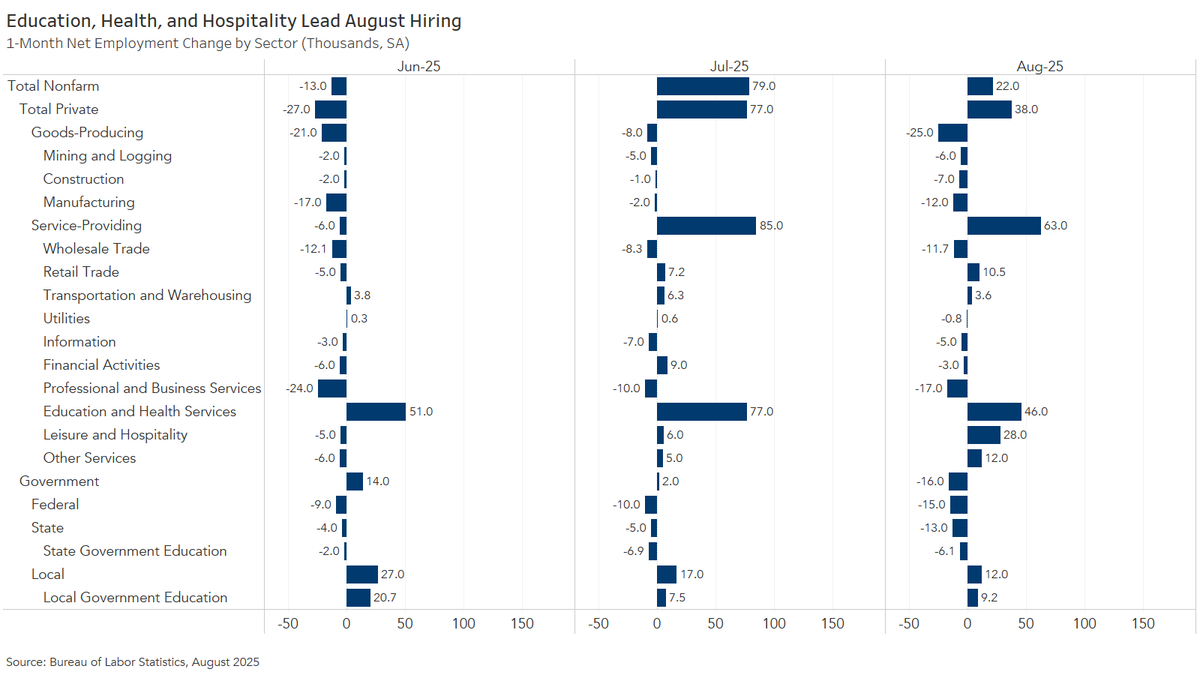
Service-providing industries added 63,000 jobs, driven by health care and leisure and hospitality—together accounting for most of the 38,000 net private-sector increase. Other service sectors saw declines, including professional and business services and wholesale trade, both posting their third-straight job loss for the month.
Meanwhile, goods-producing sectors shed 25,000 jobs, with losses in manufacturing, construction, and mining and logging.
Government employment also declined by 16,000, led by cuts at the federal and state levels. Local government employment rose, driven by gains in education as schools reopened for the fall.
3
Unemployment ticked up to 4.3% in August amid weak hiring, driven by a rise in permanent layoffs and reentrants. This suggests those who lost jobs are finding it harder to secure new ones, even as more people reenter the labor force.
The labor force participation rate rebounded to 62.3%, back to its June level but still ~0.3 ppt below earlier in the year. Prime-age participation (25-54 years) remains strong at 83.7%, pointing to a labor market with steady engagement but limited hiring momentum.

The labor force participation rate rebounded to 62.3%, back to its June level but still ~0.3 ppt below earlier in the year. Prime-age participation (25-54 years) remains strong at 83.7%, pointing to a labor market with steady engagement but limited hiring momentum.
4
Residential construction employment remains elevated, but builders are trimming on the margins. In August, payrolls declined by 0.9K in residential building and 5.2K in specialty trade contracting.
Residential building employment is now 0.5% below its March 2024 peak, while contractor employment is down 1.8% from its September 2024 high. The 3-month moving average indicates a moderate acceleration in job losses for building construction, while employment among specialty trade contractors, though slightly improved from earlier in the year, remains firmly in negative territory—suggesting stabilization, but not recovery.
The slowdown in hiring likely reflects a housing market where demand remains tepid, even with builders leaning heavily on incentives to attract buyers. Despite this, inventory continues to build—months’ supply of new homes rose to 9.2 in July, the highest since the Global Financial Crisis—underscoring the challenge of moving product in a high-price, high-rate environment. In this scenario, homebuilders aren't in a rush to expand hiring.
Still, the outlook may not be entirely bearish. If the Fed begins cutting rates, as markets increasingly expect, it could help prevent a deeper pullback in construction. Homebuilder stocks rose after the jobs report, suggesting optimism that lower rates could support demand and keep projects moving. But with inventory still elevated, a meaningful rebound in activity may depend on buyers stepping back in.
Residential building employment is now 0.5% below its March 2024 peak, while contractor employment is down 1.8% from its September 2024 high. The 3-month moving average indicates a moderate acceleration in job losses for building construction, while employment among specialty trade contractors, though slightly improved from earlier in the year, remains firmly in negative territory—suggesting stabilization, but not recovery.
The slowdown in hiring likely reflects a housing market where demand remains tepid, even with builders leaning heavily on incentives to attract buyers. Despite this, inventory continues to build—months’ supply of new homes rose to 9.2 in July, the highest since the Global Financial Crisis—underscoring the challenge of moving product in a high-price, high-rate environment. In this scenario, homebuilders aren't in a rush to expand hiring.
Still, the outlook may not be entirely bearish. If the Fed begins cutting rates, as markets increasingly expect, it could help prevent a deeper pullback in construction. Homebuilder stocks rose after the jobs report, suggesting optimism that lower rates could support demand and keep projects moving. But with inventory still elevated, a meaningful rebound in activity may depend on buyers stepping back in.
