Psilocybin led to increased brain complexity & spontaneous...

Nicholas Fabiano, MD@NTFabiano
64 views
Apr 26, 2025
~1 min read
Advertisement
1
Psilocybin led to increased brain complexity & spontaneous behaviour in a person with a post-comatose disorder of consciousness.
🧵1/10
🧵1/10
2
These findings are from a case report in @ClinicalNeuroph which describe the first-ever administration of psilocybin, a classic psychedelic, to a patient in a minimally conscious state. sciencedirect.com/science/articl… 2/10

3
With very few treatments available, post-comatose disorders of consciousness (DoC) pose one of the hardest challenges in modern neurology. 3/10
4
This case features a 41-year-old woman diagnosed with a minimally conscious state one-year post-traumatic brain injury, without other significant comorbidities. 4/10
5
Different pharmacological and brain stimulation interventions were previously tested, such as zolpidem, amantadine, ketamine, and transcranial direct current stimulation without any clinical improvement. 5/10
6
On the recording day, the caregiver administered a single dose of 2.5 g liquid tincture (estimate psilocybin: 25 mg) via the gastric tube of the patient who was sitting in a reclined chair. 6/10

7
Some spontaneous behaviours emerged that were never exhibited at rest without psilocybin; she lifted both legs, her right leg was shivering, and both her eyes and mouth remained wide open. 7/10
8
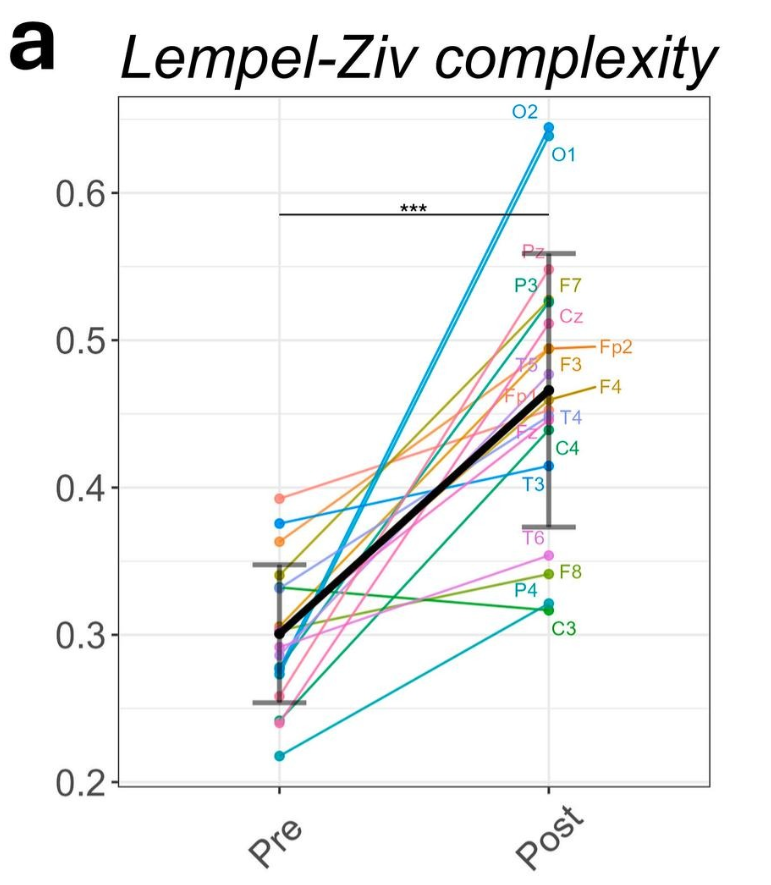
There was a general increase in whole-brain entropy/complexity and relative power spectrum after psilocybin intake - the EEG showed no sign of seizure at any point. 8/10
9
In particular, there was a decrease in slow oscillations (e.g., delta), and an increase in higher frequency (e.g., gamma), that underlies this significant interaction effect. 9/10

10
Overall, this case report contributes to future investigations exploring the use of psychedelics in DoC, enriching the discussion surrounding the role of psychedelics in medicine, and the link between brain complexity and consciousness. 10/10

