Two Nobel Prize winners proved that normal LDL does not cause heart...

Mark Kaplan@markkaplan20
5 views
Nov 18, 2026
~6 min read
Advertisement
1
Two Nobel Prize winners proved that normal LDL does not cause heart disease.
Every medical student is taught this.
Then the guidelines buried it.
In 1985, Brown and Goldstein won the Nobel Prize in Physiology or Medicine.
They proved that macrophages, the immune cells that build arterial plaque, cannot recognize normal LDL. Only oxidized, damaged LDL triggers the disease.
This should have changed everything.
Instead, the pharmaceutical industry built a $26 billion drug around lowering the molecule that the Nobel Prize proved was not the problem.
This is the 170-year timeline they do not want you to see.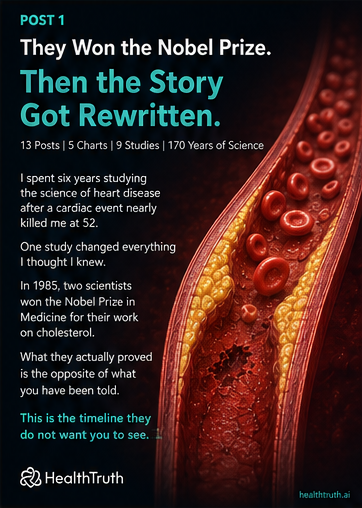
Every medical student is taught this.
Then the guidelines buried it.
In 1985, Brown and Goldstein won the Nobel Prize in Physiology or Medicine.
They proved that macrophages, the immune cells that build arterial plaque, cannot recognize normal LDL. Only oxidized, damaged LDL triggers the disease.
This should have changed everything.
Instead, the pharmaceutical industry built a $26 billion drug around lowering the molecule that the Nobel Prize proved was not the problem.
This is the 170-year timeline they do not want you to see.
2
It starts in 1856.
Rudolf Virchow, the father of modern pathology, examined diseased arteries and described atherosclerosis as an inflammatory process.
Not a cholesterol storage problem. An injury response.
The arterial wall was damaged. The body was trying to repair it.
That was 170 years ago.
(Virchow R. Cellular Pathology, 1858)
Rudolf Virchow, the father of modern pathology, examined diseased arteries and described atherosclerosis as an inflammatory process.
Not a cholesterol storage problem. An injury response.
The arterial wall was damaged. The body was trying to repair it.
That was 170 years ago.
(Virchow R. Cellular Pathology, 1858)
3
In 1973, Russell Ross and John Glomset published a paper in Science that would become one of the most cited in cardiovascular medicine.
They called it the Response to Injury Hypothesis.
The thesis was simple. Damage to the endothelial lining comes first. Everything else, the cholesterol, the plaque, the heart attack, follows the injury.
No injury. No disease.
(Ross R, Glomset JA. Science, 1973)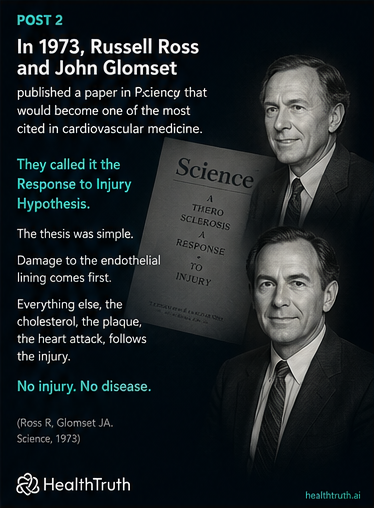
They called it the Response to Injury Hypothesis.
The thesis was simple. Damage to the endothelial lining comes first. Everything else, the cholesterol, the plaque, the heart attack, follows the injury.
No injury. No disease.
(Ross R, Glomset JA. Science, 1973)
4
In 1985, Michael Brown and Joseph Goldstein won the Nobel Prize in Physiology or Medicine.
Their discovery: the LDL receptor. The mechanism by which cells take up cholesterol from the blood.
This is where the story gets rewritten.
The medical establishment used their work to build the case that LDL cholesterol causes heart disease. Lower the LDL. Save the patient.
But that is not what Brown and Goldstein actually showed.
Their discovery: the LDL receptor. The mechanism by which cells take up cholesterol from the blood.
This is where the story gets rewritten.
The medical establishment used their work to build the case that LDL cholesterol causes heart disease. Lower the LDL. Save the patient.
But that is not what Brown and Goldstein actually showed.
5
Here is what Brown and Goldstein proved that nobody talks about.
They demonstrated that macrophages, the immune cells that form the basis of arterial plaque, do NOT take up native LDL.
Read that again.
The white blood cells that build plaque cannot recognize normal, healthy LDL particles. They proved that macrophages only engulf LDL that has been chemically modified. Oxidized. Damaged.
Native LDL is invisible to the immune system. Only oxidized LDL triggers the disease process.
The Nobel Prize itself proved that LDL in its natural state is not the problem.
(Brown MS, Goldstein JL. Nobel Lecture, 1985. Goldstein JL et al. PNAS, 1979)
They demonstrated that macrophages, the immune cells that form the basis of arterial plaque, do NOT take up native LDL.
Read that again.
The white blood cells that build plaque cannot recognize normal, healthy LDL particles. They proved that macrophages only engulf LDL that has been chemically modified. Oxidized. Damaged.
Native LDL is invisible to the immune system. Only oxidized LDL triggers the disease process.
The Nobel Prize itself proved that LDL in its natural state is not the problem.
(Brown MS, Goldstein JL. Nobel Lecture, 1985. Goldstein JL et al. PNAS, 1979)
6
Four years later, Daniel Steinberg published the oxidative modification hypothesis.
He showed that LDL must cross into a damaged arterial wall and be modified by free radicals and oxidative stress before it becomes dangerous.
The environment inside the wall determines whether LDL becomes a problem. Not the amount of LDL in your blood.
A healthy arterial wall with normal LDL traffic: no disease.
A damaged, inflamed arterial wall: LDL gets oxidized, macrophages attack, foam cells form, plaque builds.
Same LDL. Different outcome. The wall decides.
(Steinberg D et al. NEJM, 1989)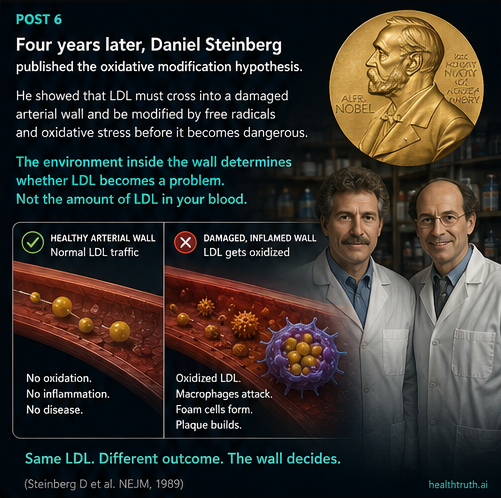
He showed that LDL must cross into a damaged arterial wall and be modified by free radicals and oxidative stress before it becomes dangerous.
The environment inside the wall determines whether LDL becomes a problem. Not the amount of LDL in your blood.
A healthy arterial wall with normal LDL traffic: no disease.
A damaged, inflamed arterial wall: LDL gets oxidized, macrophages attack, foam cells form, plaque builds.
Same LDL. Different outcome. The wall decides.
(Steinberg D et al. NEJM, 1989)
7
In 1999, Russell Ross published the definitive paper in the New England Journal of Medicine.
Title: "Atherosclerosis: An Inflammatory Disease."
340:115-126. One of the most cited cardiology papers in history.
Ross laid out the complete 5-step chain:
1. The arterial wall is damaged by insulin resistance, inflammation, hypertension, toxins, or smoking.
2. Damaged endothelium becomes permeable. LDL enters the wall.
3. Inside the damaged wall, LDL is oxidized by free radicals.
4. Macrophages engulf the oxidized LDL via scavenger receptors. They become foam cells.
5. Foam cells accumulate. Plaque forms over decades.
Break any link in that chain and the disease process stops.
This was published in the most prestigious medical journal on earth 27 years ago.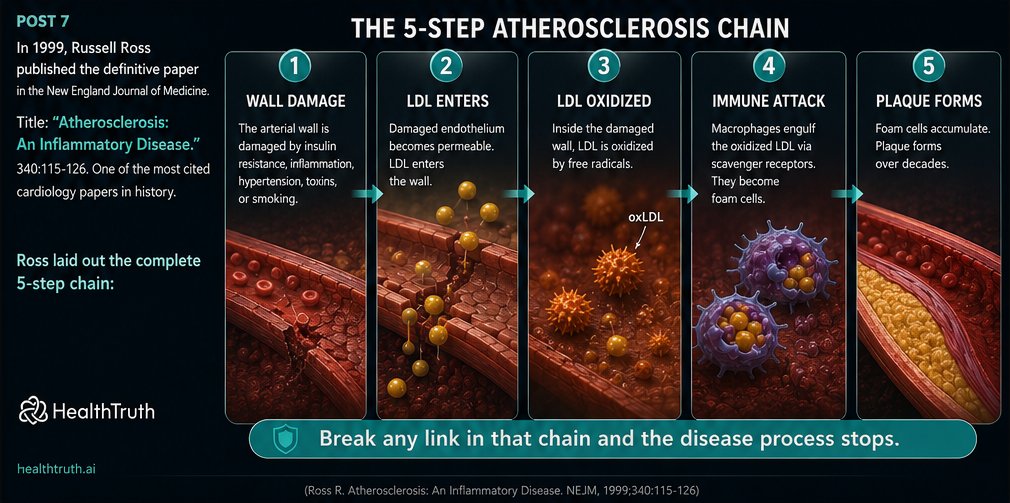
Title: "Atherosclerosis: An Inflammatory Disease."
340:115-126. One of the most cited cardiology papers in history.
Ross laid out the complete 5-step chain:
1. The arterial wall is damaged by insulin resistance, inflammation, hypertension, toxins, or smoking.
2. Damaged endothelium becomes permeable. LDL enters the wall.
3. Inside the damaged wall, LDL is oxidized by free radicals.
4. Macrophages engulf the oxidized LDL via scavenger receptors. They become foam cells.
5. Foam cells accumulate. Plaque forms over decades.
Break any link in that chain and the disease process stops.
This was published in the most prestigious medical journal on earth 27 years ago.
8
Then something happened.
Statins arrived. And they were worth $26 billion a year.
The pharmaceutical industry did not fund research into how to protect the arterial wall. They did not fund research into reducing oxidative stress. They did not fund research into reversing insulin resistance.
They funded research into lowering one number. LDL.
The question shifted from "what is damaging the wall" to "how low can we push this number."
The mechanism that Ross described, that Brown and Goldstein proved, that Steinberg confirmed, that every medical student studies in Robbins Pathology, was quietly moved to the background.
The money changed the question.
Statins arrived. And they were worth $26 billion a year.
The pharmaceutical industry did not fund research into how to protect the arterial wall. They did not fund research into reducing oxidative stress. They did not fund research into reversing insulin resistance.
They funded research into lowering one number. LDL.
The question shifted from "what is damaging the wall" to "how low can we push this number."
The mechanism that Ross described, that Brown and Goldstein proved, that Steinberg confirmed, that every medical student studies in Robbins Pathology, was quietly moved to the background.
The money changed the question.
9
So what happened when they built a $26 billion industry around lowering the molecule instead of healing the wall?
In 2023, Ennezat and colleagues published a meta-regression of 60 cholesterol-lowering trials. 323,950 patients. Statins, PCSK9 inhibitors, ezetimibe. Every drug class. Every dose.
They plotted LDL reduction against mortality benefit.
Look at this chart.
The dots cluster around zero. Some trials reduced LDL by 20%. Some by 60%. Some by 80%.
Nobody was saved.
In some trials, more people died.
They spent billions lowering a number that two Nobel Prize winners proved was not the cause. And the data shows exactly what you would expect when you treat the wrong target for 40 years.
The wall was always the answer. They medicated the molecule instead.
(Ennezat PV et al. J Cardiovasc Pharmacol. 2023;81(1):35-44. N=323,950. 60 trials.)
In 2023, Ennezat and colleagues published a meta-regression of 60 cholesterol-lowering trials. 323,950 patients. Statins, PCSK9 inhibitors, ezetimibe. Every drug class. Every dose.
They plotted LDL reduction against mortality benefit.
Look at this chart.
The dots cluster around zero. Some trials reduced LDL by 20%. Some by 60%. Some by 80%.
Nobody was saved.
In some trials, more people died.
They spent billions lowering a number that two Nobel Prize winners proved was not the cause. And the data shows exactly what you would expect when you treat the wrong target for 40 years.
The wall was always the answer. They medicated the molecule instead.
(Ennezat PV et al. J Cardiovasc Pharmacol. 2023;81(1):35-44. N=323,950. 60 trials.)
10
In 2009, Sachdeva published a study in the American Heart Journal.
136,905 patients hospitalized for heart disease. They looked at their cholesterol levels on admission.
75% had LDL levels their doctor would have called normal.
Three out of four people having heart attacks had "normal" cholesterol.
If LDL was the primary driver, this chart would look completely different.
It does not. Because the wall was the problem. Not the molecule.
(Sachdeva A et al. American Heart Journal, 2009. N=136,905)
136,905 patients hospitalized for heart disease. They looked at their cholesterol levels on admission.
75% had LDL levels their doctor would have called normal.
Three out of four people having heart attacks had "normal" cholesterol.
If LDL was the primary driver, this chart would look completely different.
It does not. Because the wall was the problem. Not the molecule.
(Sachdeva A et al. American Heart Journal, 2009. N=136,905)
11
In 2017, the CANTOS trial answered the question nobody in pharma wanted asked.
What happens if you reduce inflammation without touching cholesterol at all?
They used canakinumab, an anti-inflammatory drug that targets IL-1 beta. It does not lower LDL. It does not affect cholesterol in any way.
Result: cardiovascular events dropped 15%.
No cholesterol reduction. Just inflammation reduction. 15% fewer heart attacks.
This is the Response to Injury hypothesis proven in a randomized controlled trial with 10,061 patients.
Ross was right. The wall was always the answer.
(Ridker PM et al. CANTOS Trial, NEJM 2017. N=10,061)
What happens if you reduce inflammation without touching cholesterol at all?
They used canakinumab, an anti-inflammatory drug that targets IL-1 beta. It does not lower LDL. It does not affect cholesterol in any way.
Result: cardiovascular events dropped 15%.
No cholesterol reduction. Just inflammation reduction. 15% fewer heart attacks.
This is the Response to Injury hypothesis proven in a randomized controlled trial with 10,061 patients.
Ross was right. The wall was always the answer.
(Ridker PM et al. CANTOS Trial, NEJM 2017. N=10,061)
12
So if the science is this clear, why do the guidelines still say "lower LDL"?
In 2017, Mendelson and colleagues published a study examining financial conflicts of interest among authors of major cardiovascular clinical practice guidelines.
81% had direct financial ties to the pharmaceutical industry.
The people writing the rules were being paid by the companies selling the drugs.
The science never changed. The money changed who told the story.
(Mendelson TB et al. BMJ, 2017)
In 2017, Mendelson and colleagues published a study examining financial conflicts of interest among authors of major cardiovascular clinical practice guidelines.
81% had direct financial ties to the pharmaceutical industry.
The people writing the rules were being paid by the companies selling the drugs.
The science never changed. The money changed who told the story.
(Mendelson TB et al. BMJ, 2017)
13
In 1856, Virchow said it was inflammation.
In 1973, Ross said it was injury to the wall.
In 1985, Brown and Goldstein proved native LDL is not recognized by immune cells.
In 1989, Steinberg showed LDL must be oxidized first.
In 1999, Ross published the complete chain in the NEJM.
170 years of science. All pointing in the same direction.
Then $26 billion a year in statin revenue pointed the guidelines somewhere else.
Every doctor learned the mechanism.
The guidelines erased it.
The science never changed.
The money did.
Reviewed and co-signed by:
@ifixhearts (Dr. Philip Ovadia, MD, Cardiac Surgeon)
@DrAseemMalhotra (Dr. Aseem Malhotra, MD, Cardiologist)
@carbaddictiondr (Dr. Robert Cywes, MD, PhD, Metabolic Surgeon)
@ProfTimNoakes (Prof. Tim Noakes, Head of Science)
The truth heals
In 1973, Ross said it was injury to the wall.
In 1985, Brown and Goldstein proved native LDL is not recognized by immune cells.
In 1989, Steinberg showed LDL must be oxidized first.
In 1999, Ross published the complete chain in the NEJM.
170 years of science. All pointing in the same direction.
Then $26 billion a year in statin revenue pointed the guidelines somewhere else.
Every doctor learned the mechanism.
The guidelines erased it.
The science never changed.
The money did.
Reviewed and co-signed by:
@ifixhearts (Dr. Philip Ovadia, MD, Cardiac Surgeon)
@DrAseemMalhotra (Dr. Aseem Malhotra, MD, Cardiologist)
@carbaddictiondr (Dr. Robert Cywes, MD, PhD, Metabolic Surgeon)
@ProfTimNoakes (Prof. Tim Noakes, Head of Science)
The truth heals