Human hair greying is reversible. 🧵1/12

Nicholas Fabiano, MD@NTFabiano
53 views
Jan 04, 2025
~1 min read
Advertisement
1
Human hair greying is reversible.
🧵1/12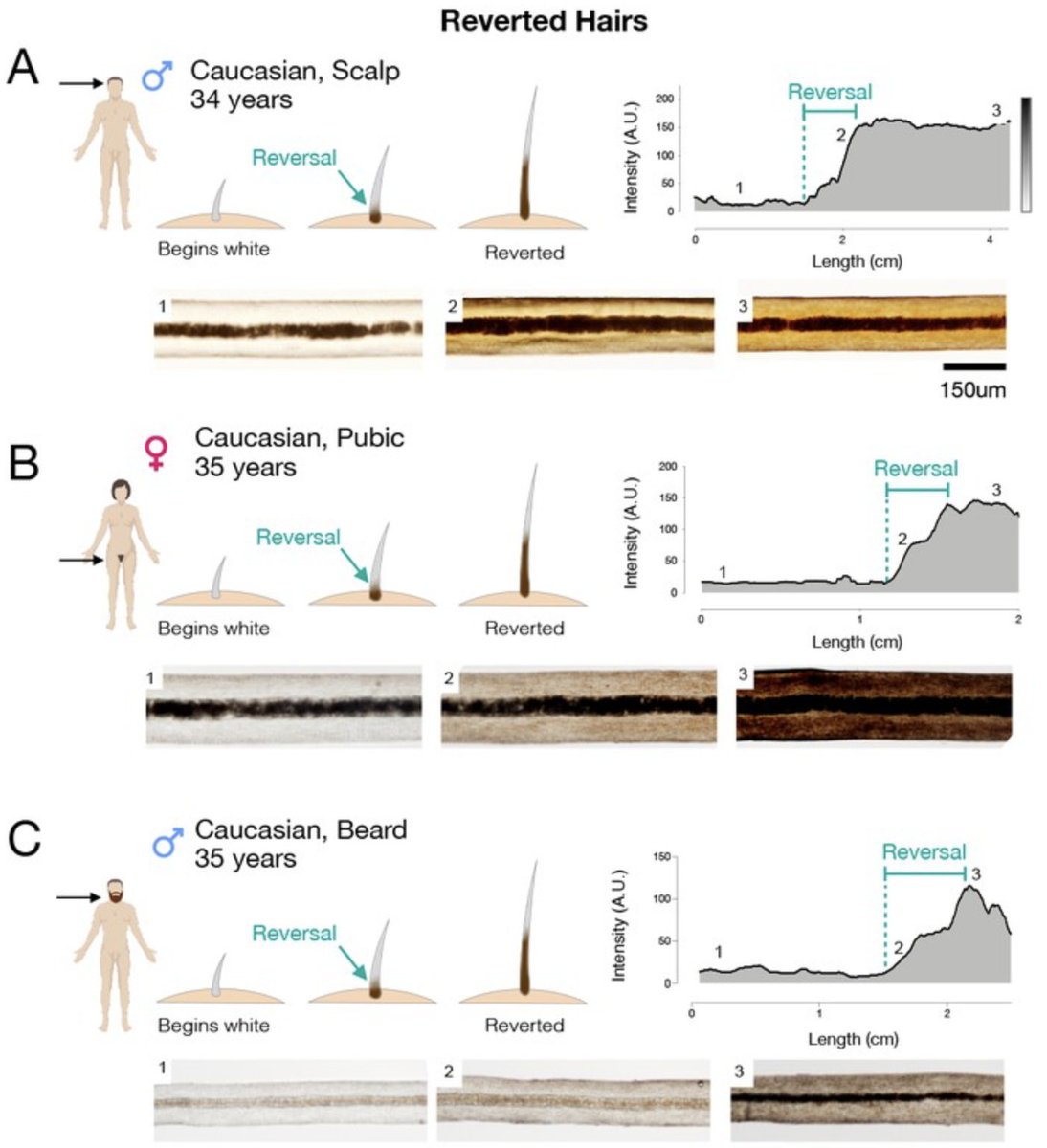
🧵1/12
2
These findings are from a study in @eLife which developed an approach to profile hair pigmentation patterns (HPPs) along individual human hair shafts, producing quantifiable physical timescales of rapid greying transitions. elifesciences.org/articles/67437 2/12

3
Hair greying is a visible sign of aging that affects everyone; the loss of hair color is due to the loss of melanin, a pigment found in the skin, eyes and hair. 3/12

4
Research in mice suggests stress may accelerate hair greying, but there is no definitive research on this in humans. 4/12
5
Hair growth is an active process that happens under the skin inside hair follicles; it demands lots of energy, supplied by structures inside cells called mitochondria. 5/12

6
While hairs are growing, cells receive chemical and electrical signals from inside the body, including stress hormones. 6/12
7
As the hair grows out of the scalp, it hardens, preserving these molecules into a stable form; this preservation is visible as patterns of pigmentation. 7/12
8
It was found that white/grey hairs naturally regain pigmentation across sex, ethnicities, ages, and body regions, thereby quantitatively defining the reversibility of greying in humans. 8/12

9
Molecularly, grey hairs upregulate proteins related to energy metabolism, mitochondria, and antioxidant defenses. 9/12
10
Combining HPP profiling and proteomics on single hairs, hair greying and reversal that was found to occur in parallel with psychological stressors. 10/12

11
To generalize these observations, a computational simulation was developed, which suggests a threshold-based mechanism for the temporary reversibility of greying. 11/12

12
Overall, this new method to quantitatively map recent life history in HPPs provides an opportunity to longitudinally examine the influence of recent life exposures on human biology. 12/12
13
More on muscles and aging:

14
@davidasinclair @bryan_johnson

