There are six biotypes of depression. 🧵1/10

Nicholas Fabiano, MD@NTFabiano
54 views
Feb 02, 2025
~1 min read
Advertisement
1
There are six biotypes of depression.
🧵1/10
🧵1/10
2
These findings are from a study in @NatureMedicine which derived personalized and interpretable scores of brain circuit dysfunction grounded in a theoretical taxonomy to subdivide participants into distinct biotypes. nature.com/articles/s4159… 2/10

3
The dominant ‘one-size-fits-all’ diagnostic approach in psychiatry leads to cycling through treatment options by trial and error, which is lengthy, expensive and frustrating, with 30–40% of patients not achieving remission after trying one treatment. 3/10
4
Using an image-processing system, 41 measures of activation and connectivity of 6 brain circuits of interest for each participant were obtained, and ‘regional circuit scores’ were derived. 4/10

5
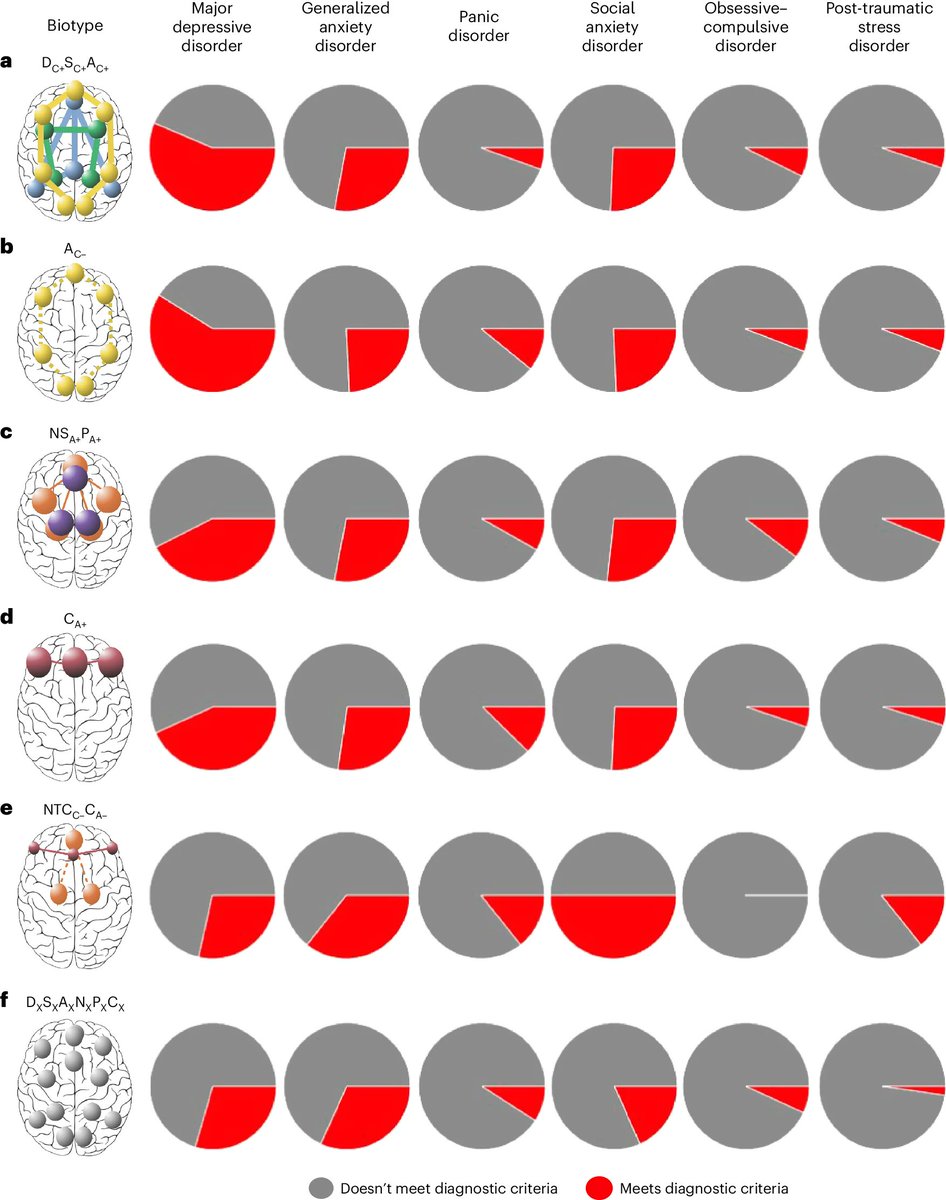
From this, six distinct biotypes were identified. 5/10

6
The distinct clinical and treatment profiles that distinguish the six biotypes indicate that these circuit-derived biotypes dissect the heterogeneity of the traditional diagnostic classification of depression. 6/10
7
Although the identification of six biotypes is one of many possible solutions to disentangling heterogeneity, these biotypes indicate that there may be multiple neural pathways that result in the clinical manifestation of depression and anxiety. 7/10
8
These findings highlight the importance of including task fMRI measures in future precision psychiatry studies and the value of using multimodal approaches to achieve more precise diagnoses in depression. 8/10
9
This approach allowed for the comparison of efficacy of different treatment options (e.g., antidepressants, behavioural intervention, etc) for each biotype, in an attempt to predict optimal response. 9/10
10
Overall, these results validate a new theory-driven method for depression biotyping as well as a promising approach to advancing precision clinical care in psychiatry. 10/10
11
See this great post by @awaisaftab for a more in depth discussion psychiatrymargins.com/p/biotypes-in-…