This is a map of repetition among all symptoms in the DSM-5. 🧵1/10

Nicholas Fabiano, MD@NTFabiano
48 views
Jan 11, 2025
~2 min read
Advertisement
1
This is a map of repetition among all symptoms in the DSM-5.
🧵1/10
🧵1/10
2
These findings are from a descriptive study published in Psychological Medicine which mapped the repetition among the 1419 symptoms described in 202 diagnoses of adult psychopathology in section II of the DSM-5. cambridge.org/core/journals/… 2/10

3
The first stage of coding aimed to distil the constituent symptoms of the diagnoses in chapters 1–19 of section II of the DSM-5. The resulting list of symptoms was then coded for content overlap using both qualitative content coding and natural language processing. 3/10
4
In total, 202 diagnoses were represented, including 135 primary disorders and 76 specifiers or other specified disorders with additional symptoms. While repetition appeared to be pervasive, the majority (63.2%) of the 628 distinct symptoms were unique to a single diagnosis. 4/10

5
Overall, of the 202 diagnoses represented, 140 (69.3%) had at least one symptom that repeated in another diagnosis – 118 (58.4%) in a diagnosis in another chapter. 5/10

6
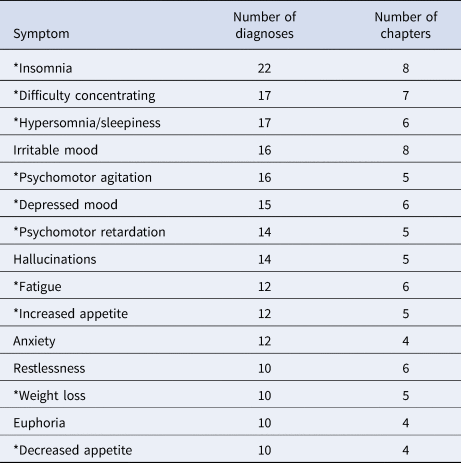
A noteworthy finding was that the symptoms in the DSM-5 that repeat most frequently, and that repeat across most chapters, are dominated by symptoms of major depressive disorder (MDD). 6/10

7
Specifically, 10 of the top 15 most non-specific symptoms in the DSM-5 appeared in the diagnostic criteria for MDD. 7/10
8
Perhaps MDD symptoms are psychological responses to stress, similar to how fever – a symptom that also cuts across numerous diagnostic categories – reflects an inflammatory response to cell damage or stress. 8/10
9
The pervasiveness of MDD symptoms throughout the DSM-5 likely hampers diagnostic accuracy through misattribution of symptoms in other diagnoses to MDD, and inflation of the rates of comorbidity due to symptom overlap with other diagnoses. 9/10
10
Ultimately, more empirical work on fine-grained clinical phenomena promises to improve on the reliability and validity of the DSM-5 constructs that frame much research and practice. 10/10

