61+ tweets and threads that can help you get better at conflict:...

Pep@peptalksblog
55 views
Sep 26, 2025
~9 min read
Advertisement
1
61+ tweets and threads that can help you get better at conflict:
(Consider this thread a growing library on the topic)🧵
(Consider this thread a growing library on the topic)🧵
2
How to use this thread:
1) Find an aspect of conflict that is challenging for you (facing it? resolving it? standing up for yourself? decreasing reactivity?)
2) Scroll through thread to find things that address it.
3) Test during next conflict, bookmark thread for later.
1) Find an aspect of conflict that is challenging for you (facing it? resolving it? standing up for yourself? decreasing reactivity?)
2) Scroll through thread to find things that address it.
3) Test during next conflict, bookmark thread for later.
3
This initial collection of tweets is roughly sorted from:
1) Things that help before conflict.
2) Meta-skills that improve our conflict skills.
3) Communication during conflict.
4) Reactivity.
5) Resolution.
(Anything I add after today won't be sorted.)
1) Things that help before conflict.
2) Meta-skills that improve our conflict skills.
3) Communication during conflict.
4) Reactivity.
5) Resolution.
(Anything I add after today won't be sorted.)
4
0/ Why getting good at conflict matters.

Visakan Veerasamy@visakanv
painful lesson over the past ~20 years of relationships: in the medium run it’s exciting to feel hype about people who seem to relate strongly in specific ways,
but in long run it’s really how you handle misunderstandings, conflict, confusion, disagreement that go the distance
but in long run it’s really how you handle misunderstandings, conflict, confusion, disagreement that go the distance
5
1/ Most conflicts aren’t about conflicting interests (and even when they are, that’s often no longer true when you dig deeper).
Before seeing the other as an enemy, it’s a good idea to get clear on the true nature of the conflict.
Before seeing the other as an enemy, it’s a good idea to get clear on the true nature of the conflict.
Pep@peptalksblog
Conflict can be about many things.
Yet if you look closely, most aren't actual conflict:
1) Misunderstanding
2) Affirming our worldview
3) Unacknowledged impact
4) Resentment for unmet needs
5) Pure projection of another conflict
6) Actual conflict (irreconcilable interests)
Yet if you look closely, most aren't actual conflict:
1) Misunderstanding
2) Affirming our worldview
3) Unacknowledged impact
4) Resentment for unmet needs
5) Pure projection of another conflict
6) Actual conflict (irreconcilable interests)
6
2/ Related: its not uncommon to think we’re in conflict with someone when we just need to have a difficult conversation.
The conflict is happening inside us and our feelings about the conversation are conflated with our feelings about the person.

The conflict is happening inside us and our feelings about the conversation are conflated with our feelings about the person.
nibras ꩜@heynibras
@virgo0namission Agree fully. And difficult conversations don’t have to = conflict. Honest difficult conversations can be tough* but they have a different flavour to conflict and they ideally leave you feeling connected to one another.
*tough in the way a good hike can be described as tough
*tough in the way a good hike can be described as tough
7
3/ Before entering conflict, ask yourself “What’s my intention?”
- Improve our relationship?
- Win this dispute?
- Be heard?
Sure, conflict avoidance isn’t always a great pattern. But pick your battles.
Conflict can be taxing. Know why it matters to you & if it’s of service.
- Improve our relationship?
- Win this dispute?
- Be heard?
Sure, conflict avoidance isn’t always a great pattern. But pick your battles.
Conflict can be taxing. Know why it matters to you & if it’s of service.
8
4/ When you’re about to discuss a conflict, revealing the context to the other person can increase the sense of safety.
“I want to have this conversation with you because our relationship is important to me.” feels much less than an attack or a threat of abandonment.
“I want to have this conversation with you because our relationship is important to me.” feels much less than an attack or a threat of abandonment.
9
5/ Know how many conflicts are in the room.
Pep@peptalksblog
Gearing up for a difficult conversation?
Step 0 is self-regulation.
If there's an inner conflict or struggle within yourself, that's the 50% you bring into the interaction.
If the other person has the same issue, now you have 4 or more parts in conflict. Rather than 2.
Step 0 is self-regulation.
If there's an inner conflict or struggle within yourself, that's the 50% you bring into the interaction.
If the other person has the same issue, now you have 4 or more parts in conflict. Rather than 2.
10
6/ Avoiding conflict actually brings it closer to you.
(This doesn’t mean everything needs to be addressed with the other person.
The feelings can be reconciled within yourself too. But it’s helpful to know what you’re choosing.)
(This doesn’t mean everything needs to be addressed with the other person.
The feelings can be reconciled within yourself too. But it’s helpful to know what you’re choosing.)
Pep@peptalksblog
There's no such thing as avoiding conflict.
Either the conflict plays out between people, or it plays out silently inside one of them.
One option isn't always "better" compared to the other.
But either way, it will continue to look for resolution until it's given the space.
Either the conflict plays out between people, or it plays out silently inside one of them.
One option isn't always "better" compared to the other.
But either way, it will continue to look for resolution until it's given the space.
11
7/ If you want to lean into facing conflict but aren’t ready yet to practice being more disagreeable, try this.
Pep@peptalksblog
Want to share your feelings/thoughts but you fear it might create disconnect?
It can help to establish a shared reality/intention first.
- What do we both agree on?
- What makes us treasure this relationship?
- If things would get heated, which desired outcome do we share?
It can help to establish a shared reality/intention first.
- What do we both agree on?
- What makes us treasure this relationship?
- If things would get heated, which desired outcome do we share?
12
8/ If disagreement is hard for you, you can exploriment with having more fights.
(Don't just fight for its own sake. Find little things that bother you & address them. Progressively pick harder things.
You can use the rest of this thread to also learn to resolve the fights.)

(Don't just fight for its own sake. Find little things that bother you & address them. Progressively pick harder things.
You can use the rest of this thread to also learn to resolve the fights.)
Halina.eth 💎@halina_eth
For 2025, I resolve to start 100 fights online 🧵
I’ve always been a super agreeable person & it’s harmed me in so many ways.
So this year I want to experiment with overcorrecting & picking fights- basically practicing “disagreeable-ness”.
check them out here ⬇️
I’ve always been a super agreeable person & it’s harmed me in so many ways.
So this year I want to experiment with overcorrecting & picking fights- basically practicing “disagreeable-ness”.
check them out here ⬇️
13
9/ If you’re already great at starting fights, you can exploriment with learning to STFU instead.
Observe how it feels to do this. What feelings come up when you give yourself full permission to STFU?
Observe how it feels to do this. What feelings come up when you give yourself full permission to STFU?
Visakan Veerasamy@visakanv
friend: what is your #1 social skill?
me: knowing when to stfu
friend: LOL what?? but you never stfu
me: 😂 right, that’s how it looks like to you. Online you can play dozens of hands simultaneously. But you don’t see the hands I fold. I fold hands better than you
friend: 🤔
me: knowing when to stfu
friend: LOL what?? but you never stfu
me: 😂 right, that’s how it looks like to you. Online you can play dozens of hands simultaneously. But you don’t see the hands I fold. I fold hands better than you
friend: 🤔
14
(Side note, you may find that 8 and 9 eventually take you to the same point.)

occam’s river@occamsriver
The last few years I got trained in and practiced with how to enter into any conflict with minimal fear and maximal presence and there aren’t any interactions that deter me nor any truths I can’t utter to another but mostly I just want to be sweet with people
15
10/ Conflict is a doorway to deeper intimacy.
Pep@peptalksblog
What if conflict wasn’t a breakdown of intimacy but a doorway to it?
Before conflict, you don’t know where each other’s edges are. Is it true alignment—or people-pleasing with resentment brewing?
Conscious, non-destructive conflict can demonstrate your differences are respected
Before conflict, you don’t know where each other’s edges are. Is it true alignment—or people-pleasing with resentment brewing?
Conscious, non-destructive conflict can demonstrate your differences are respected
16
11/ Conflict is also a doorway to self-intimacy.
Pep@peptalksblog
What if each (non-violent) argument was a gift?
The potential gift of increased self-awareness for all parties.
Revealing parts of us that long to be felt, acknowledged and healed.
Using this technique helps you find those gifts and unwrap them.
The potential gift of increased self-awareness for all parties.
Revealing parts of us that long to be felt, acknowledged and healed.
Using this technique helps you find those gifts and unwrap them.
17
12/ Practice the stance of equanimity.
Pep@peptalksblog
Ever felt torn between people-pleasing or being a jerk, not knowing how to be neither?
Here’s a thread on why that happens, how to build self-respect without losing care for others—and be kind without betraying yourself 🧵
Here’s a thread on why that happens, how to build self-respect without losing care for others—and be kind without betraying yourself 🧵
18
13/ Emotional intelligence is another meta-skill that can help with all aspects of conflict.

Joe Hudson@FU_joehudson
How to be more emotionally intelligent (without trying so hard)
🧵 for @threadapalooza
🧵 for @threadapalooza
19
14/ In a lot of ways, conflict skills ultimately boil down to building the capacity to feel.
Higher capacity to feel =
* Lower reactivity
* Grounding for the other
* Lower chances of perceiving conflict where it isn’t
Higher capacity to feel =
* Lower reactivity
* Grounding for the other
* Lower chances of perceiving conflict where it isn’t
Pep@peptalksblog
One of the most powerful life skills you can develop:
Building the capacity to feel.
So many issues across life are downstream of low feeling capacity that I think this should be core curriculum.
Here's why it matters and how to practice it: 🧵
Building the capacity to feel.
So many issues across life are downstream of low feeling capacity that I think this should be core curriculum.
Here's why it matters and how to practice it: 🧵
20
15/ In conflict, nonresistance is key.
If we are in conflict with reality too, conflict keeps compounding.
(Btw, if you’re reading this thread you will probably enjoy following Ann & checking out her work in general.)

If we are in conflict with reality too, conflict keeps compounding.
(Btw, if you’re reading this thread you will probably enjoy following Ann & checking out her work in general.)
Ann Pierce@itsannpierce
@TylerAlterman The conclusions I’ve reached about conflict have everything to do with nonattachment and nonresistance
21
16/ In any conflict, we must collaborate with reality.
E.g.
We can complain that the other person should be fighting differently, but the reality is that they’re behaving the way they are.
Now it’s up to us to respond wisely.
E.g.
We can complain that the other person should be fighting differently, but the reality is that they’re behaving the way they are.
Now it’s up to us to respond wisely.
Pep@peptalksblog
If we reject reality, demanding this moment to be different, we make it impossible to collaborate with it.
And if we want the next moment to be different, we must first collaborate with the current one.
(Which includes our unwillingness to do so, as that is part of the moment.)
And if we want the next moment to be different, we must first collaborate with the current one.
(Which includes our unwillingness to do so, as that is part of the moment.)
22
17/ Many communication modes (including language itself) are lossy. As a result, misunderstandings are common.
Whenever possible, have your conflict face to face.
Whenever possible, have your conflict face to face.
Visakan Veerasamy@visakanv
conflict that happens via text can often be substantially because of different people are reading the same texts differently, or not even reading correctly at all. and lots of people don't even think to consider that this might be happening. seen friendships torn apart over this
23
18/ Give each other grace.
Pep@peptalksblog
A large amount of arguments are simply misunderstandings.
So when someone starts arguing with you, it's useful to assume a misunderstanding & get curious about their perspective.
If it is, now you can collaborate to find clarity.
If it's an actual conflict, you'll find out too
So when someone starts arguing with you, it's useful to assume a misunderstanding & get curious about their perspective.
If it is, now you can collaborate to find clarity.
If it's an actual conflict, you'll find out too
24
19/ Listening is a great place to start in conflict. Even if you have a lot to say.
When both people are fighting to be heard, nobody gets heard.
When both people are fighting to be heard, nobody gets heard.
Pep@peptalksblog
“You’re not listening to me!”
Sounds familiar?
I got you.
A thread on becoming a top-tier listener🧵
Sounds familiar?
I got you.
A thread on becoming a top-tier listener🧵
25
20/ Sometimes we hear each other’s words, but we don’t attribute the same meaning to them.
I recommend Defender’s “Anatomy of an Internet Argument” series to dig into clear examples of this.

I recommend Defender’s “Anatomy of an Internet Argument” series to dig into clear examples of this.
Could Be Defender@DefenderOfBasic
"convinced not speaking the language of each other’s worldview is one of the top causes of conflict" 💯 this is (1) literally true (2) the whole premise of "anatomy of an internet argument". Love seeing people converge on this!!
26
21/ Even when we understand the language of each other’s worldview, our understanding of the worldview can be off.
Generally speaking, conflict benefits from suspension of the idea that we understand, and curiosity about how the other person sees things.
Generally speaking, conflict benefits from suspension of the idea that we understand, and curiosity about how the other person sees things.
Visakan Veerasamy@visakanv
People typically have high-res models of their own lives and lower-res models of other people’s. We are all born clueless with incredibly low-res models of the world - then we tweak and upgrade our models. Different people do this to different degrees depending on many variables
27
22/ Thread about exploring each other’s worldviews.
Pep@peptalksblog
The best communicators don't always speak in a "better" or "more advanced" way.
But here's one thing most of them have in common:
They meet the other person in their world:
🧵
But here's one thing most of them have in common:
They meet the other person in their world:
🧵
28
23/ We can argue with how accurately things are expressed during conflict (and yes, generally good idea to keep insults off the table). But generally, playing language police isn’t as helpful as trying to understand what the other person means.

Heidi Priebe ✈️🌞@HeidiPriebe1
I think a problem behind the whole therapy speak phenomenon is that people are trying to like.. Yang the Yin. As in: people feel like the only way to get their feelings taken seriously is to present them as firm & objective fact, which ends up vibing incongruent/condescending.
29
24/ In fact: Instead of arguing with what we perceive as someone’s incoherence, why not collaborate to help all sides craft a coherent argument?
Could Be Defender@DefenderOfBasic
@eshear this is a HUGE critical piece of theory for productive internet arguments. This is why pointing out people's inconsistency & attacking them for it makes things worse. Helping them figure out their position helps both sides
x.com/not_a_hot_girl…
x.com/not_a_hot_girl…
30
25/ Conflict arises from care.
But most people don't voice what they care about. They argue at the level of strategy (HOW to care for it) & make an enemy of those opposing the strategy.
The underlying concerns are often compatible, but left unexplored. Find what you care about.
But most people don't voice what they care about. They argue at the level of strategy (HOW to care for it) & make an enemy of those opposing the strategy.
The underlying concerns are often compatible, but left unexplored. Find what you care about.
Pep@peptalksblog
Often overlooked step in conflict:
Figuring out if you're both fighting about the same thing.
Just because we use the same words doesn't mean we attribute the same meaning to those topics.
Getting clear on underlying values & needs is crucial, and often already the solution.
Figuring out if you're both fighting about the same thing.
Just because we use the same words doesn't mean we attribute the same meaning to those topics.
Getting clear on underlying values & needs is crucial, and often already the solution.
31
26/ Related: Strong emotions also arise from intense care.
You can use your emotions to understand what it is you care about, and communicate that directly.

You can use your emotions to understand what it is you care about, and communicate that directly.
Pep@peptalksblog
"Negative" emotions aren't bad for you.
All emotions offer love, wisdom & power in their own way.
Once you allow them to do so, everything changes.
How to find the love inside your feelings:
🧵
All emotions offer love, wisdom & power in their own way.
Once you allow them to do so, everything changes.
How to find the love inside your feelings:
🧵
32
27/ Undamn the other people.
Pep@peptalksblog
If the people around us feel shallow & one-dimensional, there's a good chance we're unconsciously damning them.
This causes us to miss deeper intimacy and see conflict that isn't always there.
A thread about “undamning”—and why I think everyone benefits from learning it🧵
This causes us to miss deeper intimacy and see conflict that isn't always there.
A thread about “undamning”—and why I think everyone benefits from learning it🧵
33
28/ Increase your capacity for empathy.
Pep@peptalksblog
Empathy is often misunderstood (I know, ironic).
Some call it a weakness or energy drain, others an essential trait.
The confusion stems from fuzzy or conflated definitions.
A thread on what empathy is (and isn't) 🧵
Some call it a weakness or energy drain, others an essential trait.
The confusion stems from fuzzy or conflated definitions.
A thread on what empathy is (and isn't) 🧵
34
29/ Own your reality as yours.
Pep@peptalksblog
One mindset shift that significantly decreases drama in your life:
Owning your experience.
This is often dismissed as therapy speak.
But in reality, it’s more about changing how you relate to things than how you phrase them:🧵
Owning your experience.
This is often dismissed as therapy speak.
But in reality, it’s more about changing how you relate to things than how you phrase them:🧵
35
30/ Meet in a shared reality.
Pep@peptalksblog
A common cause of conflicts is fighting for who has the correct interpretation of reality (past or present).
One way to resolve this is to establish a shared reality in which both co-exist.
For example:
One way to resolve this is to establish a shared reality in which both co-exist.
For example:
36
31/ Avoid phrases that generally escalate things.
Pep@peptalksblog
When someone's upset, saying "relax" or "calm down" often makes things worse.
Because these phrases—in that situation—embody their exact opposite.
Energetically, they're saying: "Don't be the way you are right now! It's wrong!"
What you can do instead:
1) Regulate yourself first
2) Welcome their experience as valid
3) Nonverbally invite them to follow you (voice tone, body language)
If step 3 doesn't help, there might be a dissonance in energies (e.g. they feel annoyed that you're so relaxed about the situation which prompted their panic).
In that case it can be beneficial to meet them at their level of energy first.
But doing so will still be a lot easier to navigate when you put on your own oxygen mask first.
Because these phrases—in that situation—embody their exact opposite.
Energetically, they're saying: "Don't be the way you are right now! It's wrong!"
What you can do instead:
1) Regulate yourself first
2) Welcome their experience as valid
3) Nonverbally invite them to follow you (voice tone, body language)
If step 3 doesn't help, there might be a dissonance in energies (e.g. they feel annoyed that you're so relaxed about the situation which prompted their panic).
In that case it can be beneficial to meet them at their level of energy first.
But doing so will still be a lot easier to navigate when you put on your own oxygen mask first.
37
32/ Recognize where your patterns create what you’re trying to avoid.
Ann Pierce@itsannpierce
Afraid of conflict → contorts to avoid disagreement → constant inner conflict
Afraid of getting yelled at → acts slippery/dismissive/defensive → the other person yells to be heard
Afraid of losing → dominates and pushes people → loses their trust, generosity, cooperation
Afraid of getting yelled at → acts slippery/dismissive/defensive → the other person yells to be heard
Afraid of losing → dominates and pushes people → loses their trust, generosity, cooperation
38
33/ Learn to separate facts from stories
Pep@peptalksblog
A major cause of conflict and frustration is failing to separate facts from stories.
It baffles me that this isn’t taught in schools.
A thread on the basics, and how this awareness can save you from unnecessary drama or inner tension: 🧵
It baffles me that this isn’t taught in schools.
A thread on the basics, and how this awareness can save you from unnecessary drama or inner tension: 🧵
39
34/ Break reactivity by practicing the pause.
Pep@peptalksblog
A tiny habit that can make a huge difference:
Pausing.
Just a fraction of a moment.
Before speaking, to digest what you heard & your internal response to it.
Before action, to notice the intention that gave rise to it.
1 conscious breath to move from conditioning to choice🧵
Pausing.
Just a fraction of a moment.
Before speaking, to digest what you heard & your internal response to it.
Before action, to notice the intention that gave rise to it.
1 conscious breath to move from conditioning to choice🧵
40
35/ Track your attraction and aversion responses.
Pep@peptalksblog
One subtle sign of not understanding something fully is having a strong response of aversion, attraction or attachment to certain statements about it.
When we allow our inner peace to depend on something being true or false, we are not willing to face its truth without bias yet.
When we allow our inner peace to depend on something being true or false, we are not willing to face its truth without bias yet.
41
36/ Learn about the drama triangle and its inversions.

Pep@peptalksblog
"Victim mentality" is a common buzzword in personal development.
...but did you know it’s just one piece of a larger, often dysfunctional dynamic, and it rarely exists in isolation?
This is the Drama Triangle—and how to transcend it: 🧵
...but did you know it’s just one piece of a larger, often dysfunctional dynamic, and it rarely exists in isolation?
This is the Drama Triangle—and how to transcend it: 🧵
42
37/ Observe where your identity keeps the conflict stuck.
Pep@peptalksblog
The paradox of identity:
The aspects of you that make you feel most like an individual are the ones that exist because of other people.
Here's why (and how you can use this to resolve conflicts or unblock stuck patterns)🧵
The aspects of you that make you feel most like an individual are the ones that exist because of other people.
Here's why (and how you can use this to resolve conflicts or unblock stuck patterns)🧵
43
38/ Observe where collective identities using your fight as a proxy for theirs.
Pep@peptalksblog
Eckhart Tolle is widely cited on social media for ideas like “living in the present” and "inner stillness".
But while those concepts are found in many spiritual traditions, the part of his work that really rocked my world is one I rarely see referenced:
Collective pain bodies🧵
But while those concepts are found in many spiritual traditions, the part of his work that really rocked my world is one I rarely see referenced:
Collective pain bodies🧵
44
39/ Observe where trying to be be above it all keeps the conflict stuck.
Joe Hudson@FU_joehudson
And it completely broke our connection.
Every fight was stuck. I couldn’t be vulnerable, couldn’t be seen, couldn’t feel what my triggers were asking me to feel.
Why?
Because I was too busy trying to stay above it.
Every fight was stuck. I couldn’t be vulnerable, couldn’t be seen, couldn’t feel what my triggers were asking me to feel.
Why?
Because I was too busy trying to stay above it.
45
40/ But also know when to bow out.
Ann Pierce@itsannpierce
Relationship conflict game theory ("Partner's Dilemma"):
Both partners seek to understand and collaborate with the other. Deep trust, blissful intimacy (feels like love).
If neither partner seeks to understand, the relationship devolves into avoidance or war.
If one person seeks to understand while the other is defensive or dismissive, the understanding partner suffers greatly, in turn creating suffering in the defensive person. This continues to devolve unless both partners change course.
Strategy: Armoring oneself *seems* like a good move but actually isn't - it leads to certain failure. Being understanding but receiving dismissal in return is the worst outcome and a good place to bow out if possible.
Both partners seek to understand and collaborate with the other. Deep trust, blissful intimacy (feels like love).
If neither partner seeks to understand, the relationship devolves into avoidance or war.
If one person seeks to understand while the other is defensive or dismissive, the understanding partner suffers greatly, in turn creating suffering in the defensive person. This continues to devolve unless both partners change course.
Strategy: Armoring oneself *seems* like a good move but actually isn't - it leads to certain failure. Being understanding but receiving dismissal in return is the worst outcome and a good place to bow out if possible.
46
41/ Recognize your fight-flight-freeze-fawn responses (& learn to track them in other people).


Forth ❤️🔥@forthrighter
Supposing someone has one of these sensitivities, and a stress response is triggered, there are generally 4 responses: fight, flight, freeze, and fawn. (Some people list a 5th: "flop" which is to pass out)
47
(Here’s one of the reasons why.)
Heidi Priebe ✈️🌞@HeidiPriebe1
Something I'm thinking about almost obsessively today is how hard it is to access and tell the truth anytime your 4F responses (fight, flight, freeze or fawn) are online. These responses overwhelm the emotional system and temporarily block access to higher-level processing.
48
42/ Learn to feel your sense of boundaries in your body, and respect those of others.
Pep@peptalksblog
21 counter-intuitive tweets that illustrate how boundaries can benefit everyone involved:🧵
49
43/ Accept that your position (and that of other people) may shift.
(And if you pay close attention, is subtly shifting during almost every interaction.)
(And if you pay close attention, is subtly shifting during almost every interaction.)
Pep@peptalksblog
“Should you try to be consistent with your past self?
Should a newspaper try to be consistent with past news?”
- Derek Sivers
Should a newspaper try to be consistent with past news?”
- Derek Sivers
50
(Just realized I don’t know of any good thread on alchemizing your triggers. Will write one soon and add it later. Let’s move to some threads & post about resolution.)
51
44/ Argue in good faith. (And remember, you are under no obligation to argue in the first place.)
Could Be Defender@DefenderOfBasic
Everyone's always "*I* engage in good faith, but the other guy doesn't". It doesn't matter. You can do better, you can make ALL arguments better for yourself even if no one else adopts these ideals.
52
45/ Recently discovered conflict resolution diagrams through Tasshin’s work.
Even if you just make these by yourself it can be useful.

Even if you just make these by yourself it can be useful.
Friend Tasshin@tasshinfogleman
🧵🌨 Evaporating Clouds (conflict resolution diagrams), a dialogue:
53
46/ Focus on the part that is within your responsibility.
Pep@peptalksblog
In every conflict, there are (at least) 2 sides.
It's natural to focus on what the other side should do differently (after all, you're in conflict).
But a more empowering (and often more helpful) place to start is to find what your part is, and what you can do with that.
It's natural to focus on what the other side should do differently (after all, you're in conflict).
But a more empowering (and often more helpful) place to start is to find what your part is, and what you can do with that.
54
47/ Nourish the invisible relational entities (not as woo as it sounds, lol)
Pep@peptalksblog
Most relationship advice focuses on the people inside the relationship.
But here's an entirely different, surprisingly powerful perspective I rarely see discussed: 🧵
But here's an entirely different, surprisingly powerful perspective I rarely see discussed: 🧵
55
48/ Step out of the role of “arbiter of truth”. Step into the role of love.

Lulie@reasonisfun
I realise I’m going to have to back this up because I’m starting to sound like the woowoo feelsy people who always annoyed me, but:
Love is epistemologically necessary.
🧵
Love is epistemologically necessary.
🧵
56
49/ Be weary of vibe restrictions.
Skilled manipulators with bad intent can do harm in ways that look well-intended.
But if bad vibes aren’t allowed, many people with good intent will respect that, which often stops them from responding.
This applies to 1:1 interactions too.
Skilled manipulators with bad intent can do harm in ways that look well-intended.
But if bad vibes aren’t allowed, many people with good intent will respect that, which often stops them from responding.
This applies to 1:1 interactions too.
Pep@peptalksblog
The danger of creating a space that is "only peace & love":
- Good faith actors must hide their dark side which gives it free reign to act in sneaky/covert ways
- Bad faith actors w. dark triad traits can easily invade, prey on, or control the space without facing confrontation
- Good faith actors must hide their dark side which gives it free reign to act in sneaky/covert ways
- Bad faith actors w. dark triad traits can easily invade, prey on, or control the space without facing confrontation
57
50/ Never tried this. But love the idea.
Heidi Priebe ✈️🌞@HeidiPriebe1
New conflict resolution tactic from your friendly neighborhood double-assertive couple:
At the end of each fight, play an accountability game. Take turns naming things you’re responsible for regarding the argument that just happened. After each one, take a shot.
At the end of each fight, play an accountability game. Take turns naming things you’re responsible for regarding the argument that just happened. After each one, take a shot.
58
51/ Related:
Pep@peptalksblog
I’d love to see a political debate where each party was only allowed to argue in favor of the opposition and the concluding statements had to start with:
“One thing I learned from you today is…”
“One thing I learned from you today is…”
59
52/ Resolution isn’t always the goal. And sometimes the other party isn’t even interested in it.
You can always decide you’re no longer in for the type of argument that’s happening.

You can always decide you’re no longer in for the type of argument that’s happening.
Sivori@sivori
Things I say so that I don’t have to debate or argue with someone:
“Hm, maybe you are right.” (And maybe you are a fool.)
“Hm, not sure. what do you think?”
“Hm. I’ll have to think more about that.”
“Hm. That’s interesting. Let me get back to you.”
“Hm, maybe you are right.” (And maybe you are a fool.)
“Hm, not sure. what do you think?”
“Hm. I’ll have to think more about that.”
“Hm. That’s interesting. Let me get back to you.”
60
53/ Forgive. Let go.
Pep@peptalksblog
If you can handle years of repeating the same argument and having it ruin your night, believe me:
You can handle:
- forgiveness
- dropping your resentment
- letting go of "winning" the fight
- starting over with love & compassion
- leaving something that doesn't serve you
You can handle:
- forgiveness
- dropping your resentment
- letting go of "winning" the fight
- starting over with love & compassion
- leaving something that doesn't serve you
61
54/ …speaking of forgiveness.
Friend Tasshin@tasshinfogleman
in any given relationship, it may not be time yet for a spoken, verbal or written apology. but U can always have an apology and forgiveness ceremony in your heart, in your journals, in the privacy of your own home
62
55/ Make conflict generative again (what does it generate, you ask?)

rachel (is sending love and warmth your way)@rachelclif
relational conflict becomes generative when both parties stop making the other wrong and become willing to see where the other is coming from
63
56/ ...it connection. There’s a case to be made that until 2 people have been in conflict, they haven’t met.
It's hard to know whether the connection is 100% genuine, until you’ve had a moment of meeting each other’s capacity for disconnect.
It's hard to know whether the connection is 100% genuine, until you’ve had a moment of meeting each other’s capacity for disconnect.
Friend Tasshin@tasshinfogleman
i think friendships, relationships, connections of any kind are in a certain way not real until they have experienced and survived conflict. they go through a maturation process and enter a new phase of security and possibility, baptized by the fire of honesty
64
57/ The first step to move from disconnection to connection, is connecting to the disconnect.
peptalksblog.com/how-to-turn-co…
peptalksblog.com/how-to-turn-co…
65
58/ A frame that has made conflict an increasingly beautiful experience for me is the idea of it being a “parts work session for God”.
peptalksblog.com/what-if-you-we…
peptalksblog.com/what-if-you-we…
66


67
60/ Post-conflict journal prompts.
Pep@peptalksblog
Post-conflict journal prompts:
1) Which feelings drove me?
2) What was my (real) intented outcome for the conversation?
3) Which needs, boundaries or values was I protecting?
4) Do I know which ones they were protecting?
5) How might we have honored everyone involved?
1) Which feelings drove me?
2) What was my (real) intented outcome for the conversation?
3) Which needs, boundaries or values was I protecting?
4) Do I know which ones they were protecting?
5) How might we have honored everyone involved?
68
61/ Consider getting a neutral mediator.
In fact, even a neutral, silent observer can benefit the conflict. Because it makes everyone show up differently.
In fact, even a neutral, silent observer can benefit the conflict. Because it makes everyone show up differently.
69
Wishlist for things to add here:
- Steelman vs. Strawman
- Awareness of power dynamics (using power responsibily)
- Emotional Aikido
Might write these myself someday. But today is not that day. Maybe you know someone who already did?
(Feel free to add your wishlist too.)
- Steelman vs. Strawman
- Awareness of power dynamics (using power responsibily)
- Emotional Aikido
Might write these myself someday. But today is not that day. Maybe you know someone who already did?
(Feel free to add your wishlist too.)
70
62/ Lovingly invite the elephant in the room to the party, too.


71
63/ Learn about conflict styles.
Sometimes where the conflict jams is that the styles themselves are in conflict.
Sometimes where the conflict jams is that the styles themselves are in conflict.


72
64/ Use triggers as opportunities for increased (self-)connection.
Pep@peptalksblog
Triggers can feel like frustrating patterns that overpower us and sabotage our interactions.
But what if they could be doorways to deeper intimacy and wisdom?
A thread harvesting the gold from your triggers (in 7 steps)🧵
But what if they could be doorways to deeper intimacy and wisdom?
A thread harvesting the gold from your triggers (in 7 steps)🧵
73
65/ Many words are relative to the speaker’s frame.
So it’s not always possible to reach mutual understanding.
Pay attention to your idea of a good outcome for conflict (eg. Understanding).
Can you identify other good outcomes that don’t include it?
So it’s not always possible to reach mutual understanding.
Pay attention to your idea of a good outcome for conflict (eg. Understanding).
Can you identify other good outcomes that don’t include it?
Pep@peptalksblog
Crazy to think that everyone we interact with communicates within the context of paradigms invisible to us, e.g:
- Reference scales: 1 person's peak happiness is another's bad mood
- Amount of duality distinctions: 1 can obsess over something that for another doesn't even exist
- Reference scales: 1 person's peak happiness is another's bad mood
- Amount of duality distinctions: 1 can obsess over something that for another doesn't even exist
74
66/
The initial impact of your words may not be the same as the long-term impact.
- Something may arouse anger initially but benefit the person overall
- Something may increase peace in the conflict but not in the long-term relationship
Think long-term too.
The initial impact of your words may not be the same as the long-term impact.
- Something may arouse anger initially but benefit the person overall
- Something may increase peace in the conflict but not in the long-term relationship
Think long-term too.
Pep@peptalksblog
Don’t be too quick to judge the outcome of a decision as “bad”.
It might just be amazing when looked at on a longer timeline.
It might just be amazing when looked at on a longer timeline.
75
67/
Winning arguments sometimes means losing them.
May we always find truth within the context of love.
Winning arguments sometimes means losing them.
May we always find truth within the context of love.
Pep@peptalksblog
You didn't win that argument.
You gained a silent enemy.
You gained a silent enemy.
76
68/
Conflict doesn’t have to be problematic.
If you see it as life unfolding, it takes some of the weight off.
Conflict doesn’t have to be problematic.
If you see it as life unfolding, it takes some of the weight off.
occam’s river@occamsriver
Conflict is a signal that something wants to grow or change, not necessarily that something is broken
77
69/
Align moral grammar.
(In general: comparing definitions is useful.
It’s not uncommon for people to think they have a problem with each other when it’s just 1 or 2 words they use a lot & define differently.)

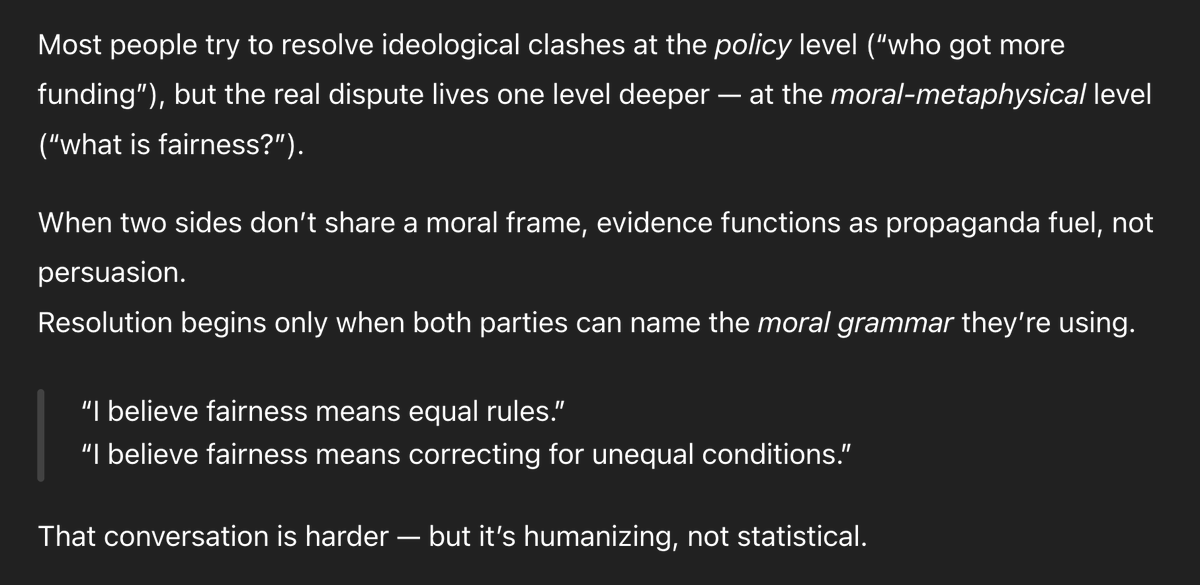
Align moral grammar.
(In general: comparing definitions is useful.
It’s not uncommon for people to think they have a problem with each other when it’s just 1 or 2 words they use a lot & define differently.)
Joshua 💫@workflowsauce
"When two sides don’t share a moral frame, evidence functions as propaganda fuel, not persuasion.
Resolution begins only when both parties can name the moral grammar they’re using."
Resolution begins only when both parties can name the moral grammar they’re using."
78
70/
Argue compassionately.

Argue compassionately.
Renee Solana@ReneeSolana
I think people who argue compassionately and well kind of do a public service— it gives polarized opinions an opportunity to come up against each other and be changed, work themselves out, find a middle ground. That may not always happen, but the compassion really helps
79
71/
Sometimes, what seems to be a series of conflicts is simply 2 people who are not fully compatible but desire to make it so.

Sometimes, what seems to be a series of conflicts is simply 2 people who are not fully compatible but desire to make it so.
Callan@callanable
I thought I was bad at conflict until I found someone who I'm actually compatible with, who also handles conflict well.
turns out it's easy if you: actually like each other, have the same values + goals, and trust the other has your back. embarrassingly low bar, and yet.
turns out it's easy if you: actually like each other, have the same values + goals, and trust the other has your back. embarrassingly low bar, and yet.
80
72/
Step 1 is shifting stance.

Step 1 is shifting stance.
Could Be Defender@DefenderOfBasic
this is one reason I stopped writing "Anatomy of an Internet Argument" - because there's 1 single lesson that predicts the trajectory of 90% of arguments - whether they recognize this & shift stance to successfully *BEGIN* to talk, or not
81
73/
Argue over 1 topic at a time.


Argue over 1 topic at a time.
Dr. Stan Tatkin@DrStanTatkin
This simple agreement will drastically improve your chances of resolving disagreements with your partner: "We only argue over one topic at a time. The first topic introduced wins."
82
74/
Make sure the conflict is indeed interpersonal, not intrapsychic.

Make sure the conflict is indeed interpersonal, not intrapsychic.
Ava@noampomsky
a lot of times people try to solve relational problems that are actually just problems you have with yourself or they have with themselves. there’s nothing to be done or said; it’s not an interpersonal issue
83
75/
Translate to the other person’s verbal preferences if needed.

Translate to the other person’s verbal preferences if needed.
Plesleron 🌦 | 🍩💐🐉🏆@Plesleron
It's amazing how much sense you can talk into someone by just avoiding the buzzwords they're allergic to
84
76/
Treat feelings like feelings, facts like facts, and don't succumb to the temptation to use one to invalidate the other.
(QT is a beautiful example of doing this well!)
Treat feelings like feelings, facts like facts, and don't succumb to the temptation to use one to invalidate the other.
(QT is a beautiful example of doing this well!)
rachel (is sending love and warmth your way)@rachelclif
story time:
I told my beloved that I felt betrayed by him for something recently
it wasn't rational. it wasn't proportionate. it wasn't “fair”
but it was deeply felt (on my end)
and very painful
and instead of shutting me down or getting defensive, he listened
and saw me
I told my beloved that I felt betrayed by him for something recently
it wasn't rational. it wasn't proportionate. it wasn't “fair”
but it was deeply felt (on my end)
and very painful
and instead of shutting me down or getting defensive, he listened
and saw me
85
77/
Invite a mutually known and trusted third party.
Invite a mutually known and trusted third party.
Friend Tasshin@tasshinfogleman
i try my best to debug interpersonal problems one on one but as soon as that's not possible i like to bring in a mutually-known-and-trusted third party