🧵 YouTube loves copycats. Every big creator on YouTube is copying...

Abu (YouTube Strategist)@NotNotAbu2
30 views
Sep 02, 2025
~5 min read
Advertisement
1
🧵 YouTube loves copycats.
Every big creator on YouTube is copying someone else, and they're all being rewarded by YouTube.
Here's how: (thread)
Every big creator on YouTube is copying someone else, and they're all being rewarded by YouTube.
Here's how: (thread)
2
Almost every new creator falls into the same trap of thinking the best way to grow is to “be different.” They want to invent a completely new style of content, an editing format no one has seen before, or an entirely new niche.
But there's a MASSIVE problem with this approach.
It's that YouTube doesn’t care about originality, it cares about proof. The algorithm doesn’t take risks on untested formats. It plays favorites with what already works. If you look around, the biggest channels didn’t win because they invented something brand new. They won because they took proven ideas and executed them better.
But there's a MASSIVE problem with this approach.
It's that YouTube doesn’t care about originality, it cares about proof. The algorithm doesn’t take risks on untested formats. It plays favorites with what already works. If you look around, the biggest channels didn’t win because they invented something brand new. They won because they took proven ideas and executed them better.
3
Just take a look at MrBeast. Everyone knows him as the biggest innovator on YouTube. But was he really the first to do challenges? No. Challenges existed long before him.
What made him stand out was scale and execution. He looked at formats that were already like the last person to leave, survival challenges, game-style competitions and simply did it on a bigger budget, with higher stakes, and cleaner packaging.
That’s copying strategically.
What made him stand out was scale and execution. He looked at formats that were already like the last person to leave, survival challenges, game-style competitions and simply did it on a bigger budget, with higher stakes, and cleaner packaging.
That’s copying strategically.
4
Same thing with Dream? He wasn’t the first Minecraft creator. He wasn’t even the first to do “manhunt” type videos. But he saw the power of that idea, turned it into a repeatable format and optimized everything from pacing, to commentary, to thumbnail storytelling until manhunts became his format.
He didn’t reinvent anything new, he just refined and scaled it.
He didn’t reinvent anything new, he just refined and scaled it.
5
Alex Hormozi was also not the first person teaching online business. His entire video strategy is modeled on what already works in short, direct, educational content. Clean thumbnails, direct delivery, data-backed titles and repackaged value.
He just produces it at scale with relentless consistency.
Again, it’s not new, it’s strategic copying with his own twist.
He just produces it at scale with relentless consistency.
Again, it’s not new, it’s strategic copying with his own twist.
6
So here's what you need to understand, innovating on YouTube is a huge gamble, and you have 99% chances of losing.
Viewers want the videos to be entertaining, engaging, and easy to consume.
Proven formats already check those boxes, so just replicate them, don't make your job harder.
Viewers want the videos to be entertaining, engaging, and easy to consume.
Proven formats already check those boxes, so just replicate them, don't make your job harder.
7
This is why you constantly see waves of almost identical videos dominating at once. A certain title formula blows up, suddenly dozens of creators copy it. A thumbnail design goes viral, then your entire feed is filled with versions of it.
It’s not an accident. It’s the algorithm showing that people want more of that exact thing. Creators who rush to replicate are simply feeding the demand. Creators who resist and try to be original get left behind.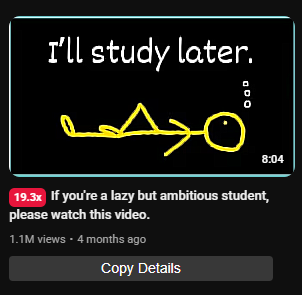
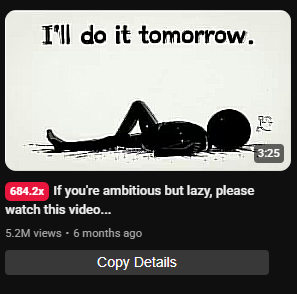
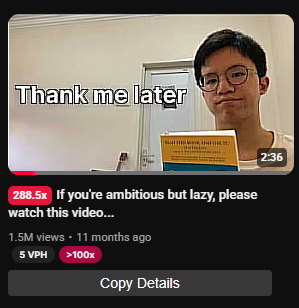

It’s not an accident. It’s the algorithm showing that people want more of that exact thing. Creators who rush to replicate are simply feeding the demand. Creators who resist and try to be original get left behind.
8
So ask yourself:
> What topics create repeatable success?
> What title formats show up again and again?
> What thumbnails are getting clicked most in my niche?
> How do the top 1% creators hook viewers in the first 30 seconds?
> What topics create repeatable success?
> What title formats show up again and again?
> What thumbnails are getting clicked most in my niche?
> How do the top 1% creators hook viewers in the first 30 seconds?
9
Let’s break this down into practical steps you can take right now to copy like a pro without feeling like a fraud:
10
Step 1. Build A Watchlist
Pick the top 5–10 direct competitors in your niche. Create a system to track them (Notion, Google Sheet, whatever works).
Every time they upload, log the title, thumbnail style, topic, and performance. Over time, patterns will emerge and you’ll see exactly what’s clicking with viewers.
Pick the top 5–10 direct competitors in your niche. Create a system to track them (Notion, Google Sheet, whatever works).
Every time they upload, log the title, thumbnail style, topic, and performance. Over time, patterns will emerge and you’ll see exactly what’s clicking with viewers.
11
Step 2: Look For Outliers
Don’t just copy everything. Look at their last 20 uploads and isolate the 2–3 that significantly outperformed the rest. Those are the outliers.
Ask yourself why those worked. Was it the packaging? The topic? The stakes? The format length? This is where you’ll find which part of the video actually made the difference.
Don’t just copy everything. Look at their last 20 uploads and isolate the 2–3 that significantly outperformed the rest. Those are the outliers.
Ask yourself why those worked. Was it the packaging? The topic? The stakes? The format length? This is where you’ll find which part of the video actually made the difference.
12
Step 3: Create A Bank
Every time you see a successful format or title, add it to a “bank”. This is your personal swipe file of proven YouTube content.
Over weeks and months, you’ll build a massive list of ideas with actual evidence that they work. When you need your next video idea, you don't need to spend hours, you can pull from the bank.
Every time you see a successful format or title, add it to a “bank”. This is your personal swipe file of proven YouTube content.
Over weeks and months, you’ll build a massive list of ideas with actual evidence that they work. When you need your next video idea, you don't need to spend hours, you can pull from the bank.
13
Step 4: Put Your Own Spin On It
This is the part where people misunderstand copycat strategy. You don’t carbon copy. You take the skeleton of the format and make your own version. Change the context, add your personality, raise the stakes, shift the angle.
For example: if your competitor did “Surviving 24 Hours With Only $1,” maybe you do “Surviving 48 Hours With Only $1 In [specific country]” It’s familiar enough for viewers to click, but unique enough to be yours.
This is the part where people misunderstand copycat strategy. You don’t carbon copy. You take the skeleton of the format and make your own version. Change the context, add your personality, raise the stakes, shift the angle.
For example: if your competitor did “Surviving 24 Hours With Only $1,” maybe you do “Surviving 48 Hours With Only $1 In [specific country]” It’s familiar enough for viewers to click, but unique enough to be yours.
14
Step 5: Execute consistently
You should now be doing this for all of your new uploads. You have to feed the algorithm what it already knows people want until you become the authority in your space. That’s how you win long term.
You should now be doing this for all of your new uploads. You have to feed the algorithm what it already knows people want until you become the authority in your space. That’s how you win long term.
15
Some people will still resist. They'll say “I don’t want to be like everyone else”.
Here’s the irony is that everyone they look up to had to blend in first and copy other people before they could stand out.
Once you’ve built leverage, once you’ve become the niche leader, then you can experiment and innovate. Until then, put your ego down and start replicating what's already working.
Here’s the irony is that everyone they look up to had to blend in first and copy other people before they could stand out.
Once you’ve built leverage, once you’ve become the niche leader, then you can experiment and innovate. Until then, put your ego down and start replicating what's already working.
16
TL;DR: YouTube doesn't like innovation, nor do your viewers. So you have to copy strategically by studying your competitors, tracking what works, building your own personal swipe file, adding your own twists into the videos and consistently repeating the process.
That is how EVERYONE else succeeded on YouTube, and that's the only way you can succeed.
That is how EVERYONE else succeeded on YouTube, and that's the only way you can succeed.


