#F1 Season 2022-2024 Car Development Recap 🟥 Floor Development -...

Vanja H@AeroTechVH
65 views
Jan 25, 2025
~10 min read
Advertisement
1
#F1 Season 2022-2024 Car Development Recap
🟥 Floor Development - Ferrari 🟥
"This is where the fun begins!"
Photo credit - none of the photos are my own, only some illustrations and wording. Large
majority comes from @AlbertFabrega @RosarioGiuliana @Auto_Racer_it @xavigazquez @Motorsport
@Giorgio_Piola
Ferrari's 1st floor iteration during preseason testing revealed a few important design features
that set them apart from other teams. Namely, their floor leading edge was unusually sharp which
was quite unexpected - especially since Red Bull (among others) brought a floor with a fairly
thick leading edge.
The 2nd thing was quite a small outboard floor fence (apparently as small as rules allowed it to
be), which grew a lot later on. The 3rd thing were innovative diffuser corner bulges which added
lateral curvature to help accelerate the flow (and increase suction) near the diffuser roof -
where the downforce is actually created.
2
Ferrari were testing quite a lot of floor edge designs near the rear corner. They also had some trouble with aggressive porpoising, which was most likely caused by trying out extreme setup solutions.


3
All of this testing ultimately put them on Bahrain 2022 pole position and a 1-2 race result with their 2nd floor spec introduced already at the first race. The biggest difference was the rear corner treatment and introduction of a proto-version of future floor edge wing that Red Bull stretched all the way forward


4
The 3rd floor spec was reavealed in Imola (some changes were made in diffuser area) when the car
went off track and got lifted up. The floor appeared surprisingly simple (especially compared to Red Bull as we saw later) and the main downforce generator appeared to be the throat with the lowest tunnel height located just behind the turning vanes. This was another big difference compared to Red Bull design
went off track and got lifted up. The floor appeared surprisingly simple (especially compared to Red Bull as we saw later) and the main downforce generator appeared to be the throat with the lowest tunnel height located just behind the turning vanes. This was another big difference compared to Red Bull design
5
Racecar Engineering published an article with some CFD results using their model of the upcoming F1 car. Geometry was fairly simple, but the Cp distribution on the floor is useful for visualisation in comparison to Red Bull's design. In my view, this is probably the closest Cp distribution to what Ferrari's actual distribution looks like, especially on the 2022 F1-75 where everything was still fairly simple
The point here is that the bulk of the downforce generated on Ferrari is at the front of the floor, based on everything we have seen so far in these 3 years. While Red Bull, and later Mclaren, Aston Martin and others, use a floor where the bulk of the downforce is generated around the diffuser kick.
The point here is that the bulk of the downforce generated on Ferrari is at the front of the floor, based on everything we have seen so far in these 3 years. While Red Bull, and later Mclaren, Aston Martin and others, use a floor where the bulk of the downforce is generated around the diffuser kick.
6
The 4th spec floor was introduced in Spain and was heavily revised all around. New inlet, new rear corner treatment, new ouboard fence, new diffuser and also a new shape on the underside
New inlet and new outboard fence are very cosely connected development areas. You could put a slightly modfied diffuser and it could work with otherwise the same floor, but if you want to make changes at the front you'll likely need to change everything at once. These two made a big change to the amount of air entering the floor and how the outwash effect was improved.

New inlet and new outboard fence are very cosely connected development areas. You could put a slightly modfied diffuser and it could work with otherwise the same floor, but if you want to make changes at the front you'll likely need to change everything at once. These two made a big change to the amount of air entering the floor and how the outwash effect was improved.
7
It also made sense to make updates to rear corner and diffuser as well, since these tow areas form vortices which ultimately either merge or strongly interact with one another. Rear corner now had the same ice skate solution that Red Bull (seemed to) have adopted the first, while the diffuser got rid of the rear keel kick and focused seemingly on pressure recovery to cut down on drag. Another possibility is that this kick with the rest of the floor moved the balance too much to the rear, so they removed it.


8
At Monaco, we saw the underside of this floor too and the biggest difference was the introduction of vertical kicks on the boat section. Not surprisingly, they were located at the longitudinal position where the bulk of the floor downforce was most likely generated.

9
Another new floor was brought to France and this was the 5th spec introduced. Again there were big changes to the inlet and outboard floor fence. The idea of the inlet was most likely the reduction of drag and lift of outboard section of the floor, between the floor fence and the vane next to it.
These 3 sections between vanes actually generate pressure locally (resulting in lift and high drag), because they trap the air in a converging channel. This pressurisation feeds the strong underfloor vortex (and several smaller vortices) which is what contributes substantially to massive floor downforce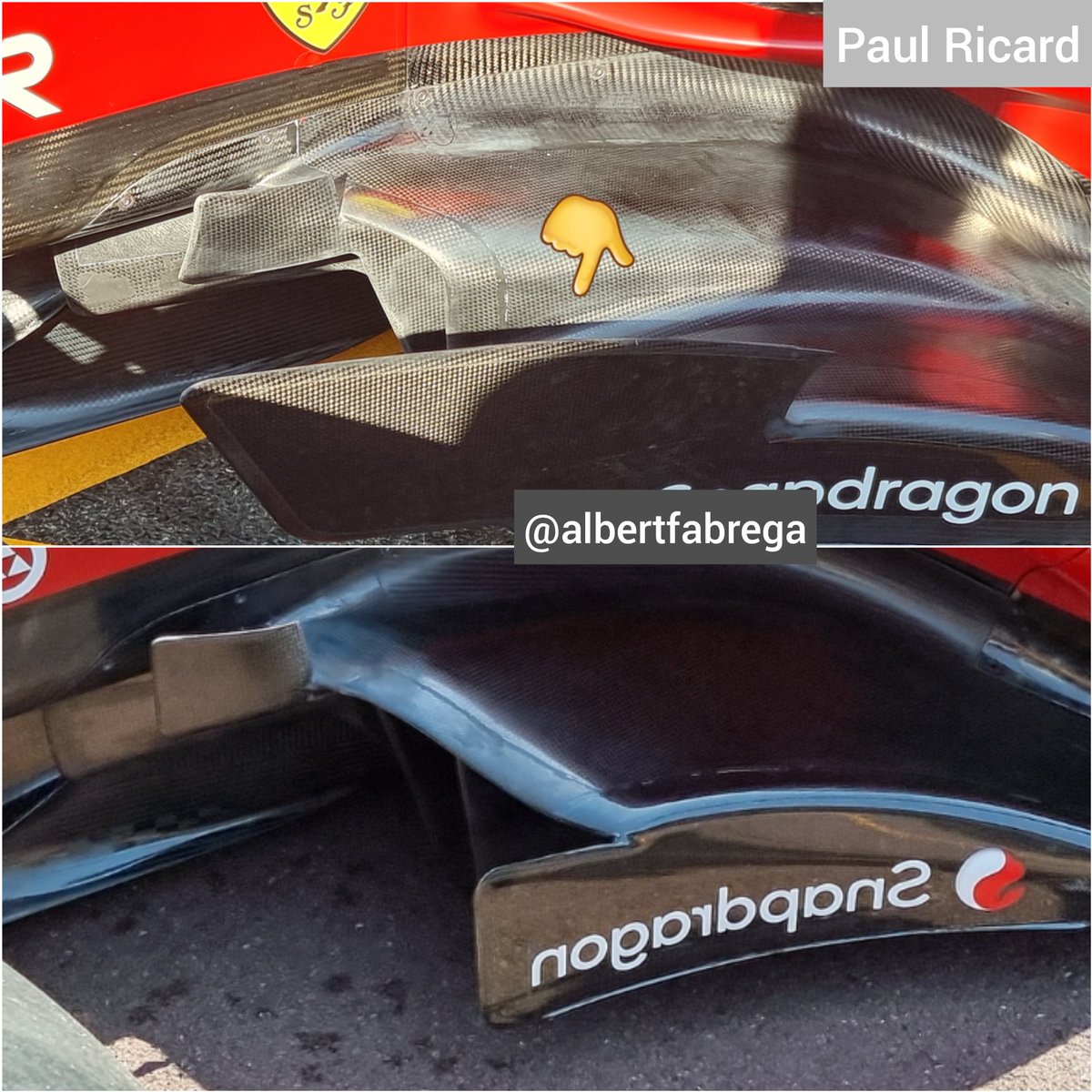

These 3 sections between vanes actually generate pressure locally (resulting in lift and high drag), because they trap the air in a converging channel. This pressurisation feeds the strong underfloor vortex (and several smaller vortices) which is what contributes substantially to massive floor downforce
10
The bg difference with this floor spec again was on the less visible side, although we got to see it again in France. Ferrari removed the boat section vertical kick and swapped it with a lateral kick. These lateral kicks introduce local flow acceleration on the outside which also means more suction locally. It's not ride-height sensitive, making it a more stable alternative to vertical kicks (as we saw 2 years later, in 2024)
The geometry of diffuser keel got a further addition of geometry that boosts pressure recovery for added drag reduction, which was still an issue for F1-75 due to sidepod geometry they implemented.

The geometry of diffuser keel got a further addition of geometry that boosts pressure recovery for added drag reduction, which was still an issue for F1-75 due to sidepod geometry they implemented.
11
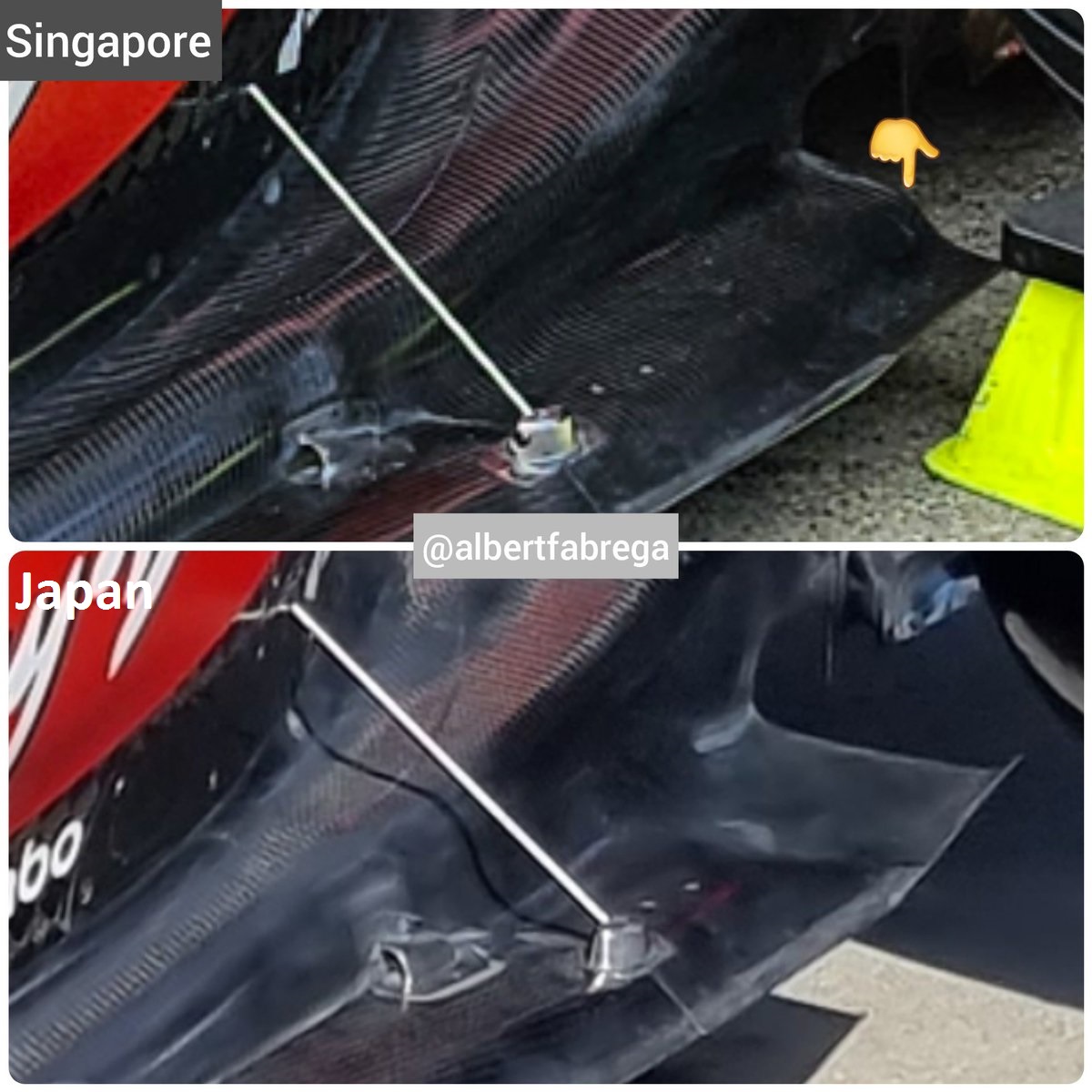
The 6th and final floor spec arrived in Japan with small tweaks to outboard fence and rear corner floor stay. There may have been some small tweaks to the front bib (central bow of the boat section) as well

12
Launch-spec floor of SF23 saw some minor changes to the inlet area (return to gradual change in inlet height between inboard and outboard section), a very simplified floor edge solution and a return to the rear keel vertical diffuser kick.
In Qualifying trim, the floor managed to generate substantial amount of downforce, perhaps even more than Red Bull. However, once the race started the heavy car was unable to go quickly through corners - this also meant there was less compression load on springs, which meant greater ride height - it lost a lot of downforce and dropped down considerably. This became apparent to Ferrari immediately, which made them commit to switching to a different floor philosophy as soon as possible.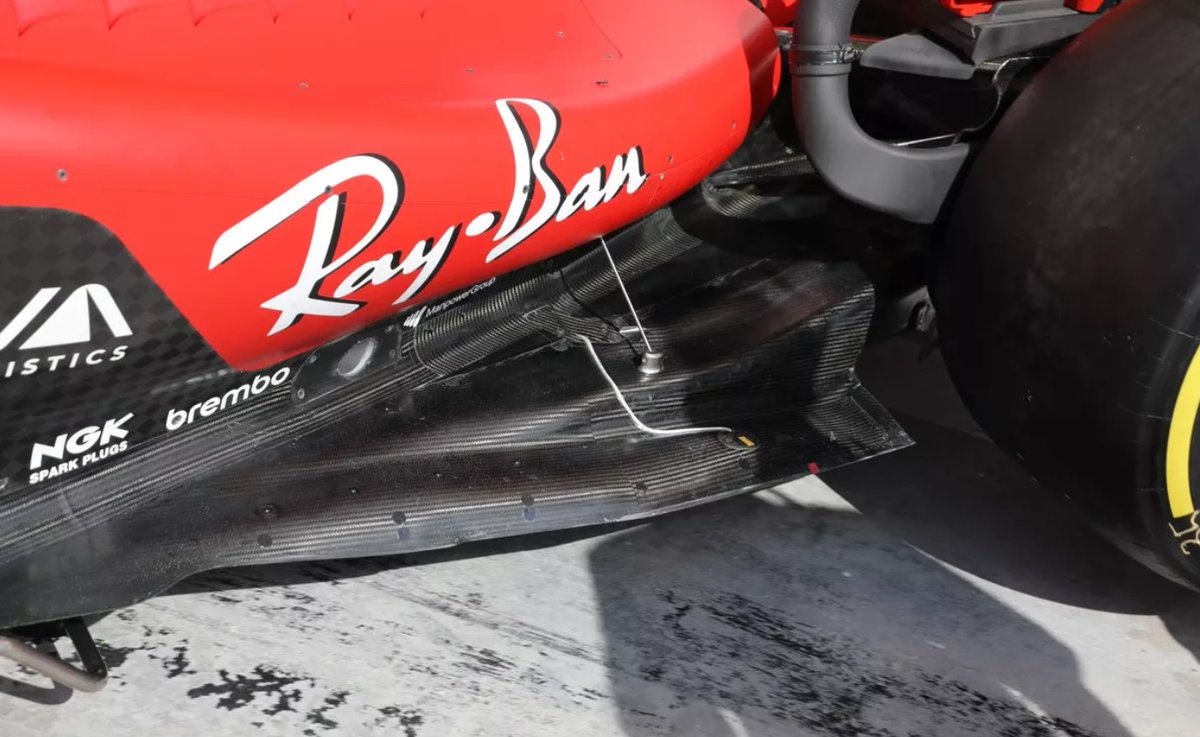


In Qualifying trim, the floor managed to generate substantial amount of downforce, perhaps even more than Red Bull. However, once the race started the heavy car was unable to go quickly through corners - this also meant there was less compression load on springs, which meant greater ride height - it lost a lot of downforce and dropped down considerably. This became apparent to Ferrari immediately, which made them commit to switching to a different floor philosophy as soon as possible.
13
Until then, they brough a small floor update in Miami, which was already in the pipeline for manufacturing once the season started. The diffuser (changed a few rounds earlier) and the inlet together with outboard vane were changed, making it a 3rd spec of the season already


14
And again in Monaco we got to see this floor from the underside. In essence, the main part of the floor didn't change too much compared to the France update in 2022 and it seemingly relied even more on extremely low ride height for the Ground Effect to work at its best - making it clear why it suffered so much when the race started


15
With the 4th spec brought to Barcelona, the floor edge treatment was dramatically different, which makes sense since the sidepods changed so much and with them the topside flow structures changed as well. We did see that the inwashing around the rear corner was kept, most likely because of how the rear suspension was designed.
The tunnel geometry wasn't changed too much (if at all) for now, but changes made to the floor edge and rear corner surely had a big effect on how the floor operated altogether.


The tunnel geometry wasn't changed too much (if at all) for now, but changes made to the floor edge and rear corner surely had a big effect on how the floor operated altogether.
16
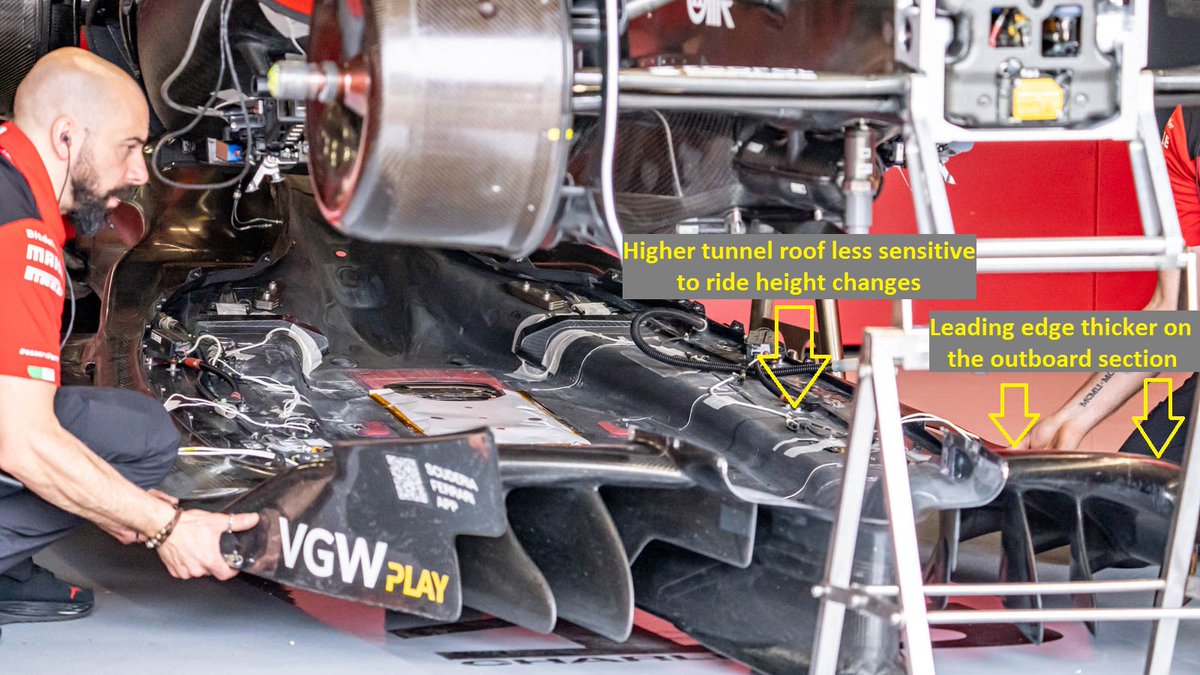
In Austria, Ferrari brought the 5th floor spec on SF23, which saw substantial changes to the front end and sidepod undercut. The floor edge was changed again and the horizontal slit at the rear dissapeared. It marked a return to the podium after Baku and was only the 2nd podium of the season.


17
With big changes to the vanes and the floor fence also came a whole new geometry of the tunnels themselves. We didn't see the from the underside, but we did get a good shot from the top, showing higher tunnels and the new leading edge with variable thickness


18
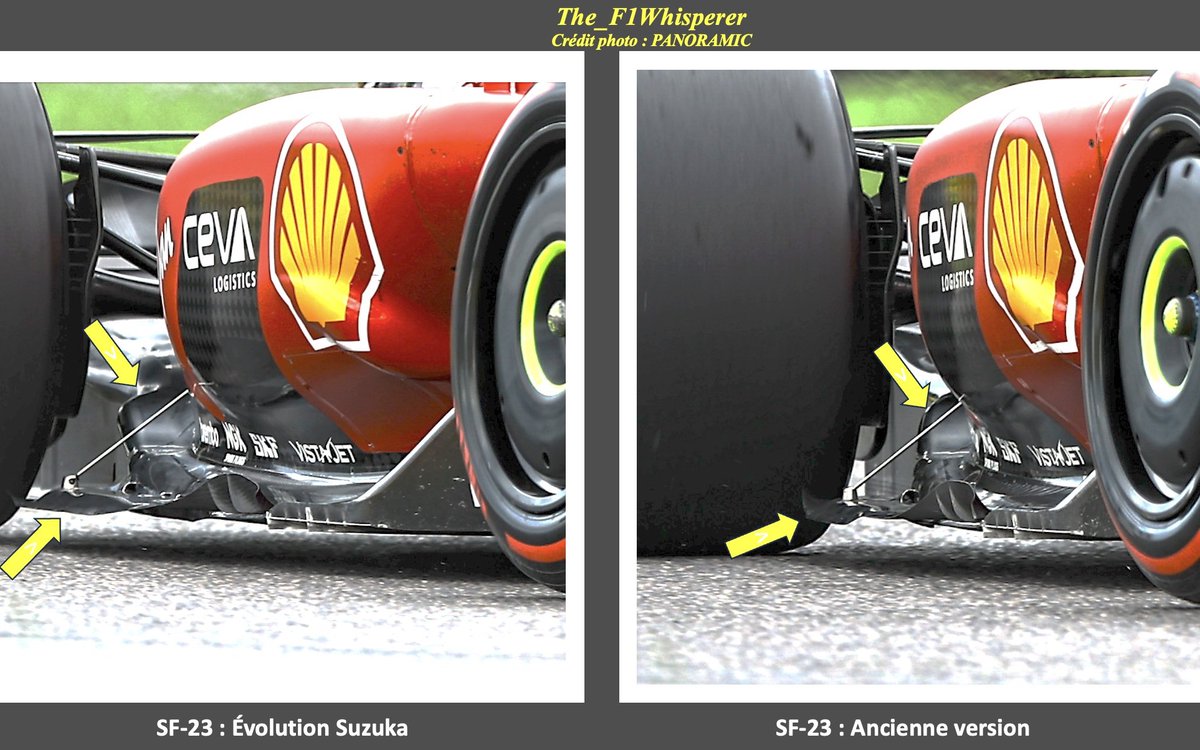
The 6th and final spec came in Japan, which marked a new step forward for Ferrari. After this spec update came some strong results on tracks like Texas, Mexico, Vegas and Abu Dhabi. We don't have any indication about the shape of the tunnels with this spec and whether it was changed or not compared to Austria spec

19
The floor of SF24 was the first floor of Ferrari to feature the SIS Tube inside of it, while on the previous 2 cars the SIS Tube was inside the sidepods. This lead to some specific changes on the look of the floor at the front end, while changes to the leading edge and vanes was most likely a natural evolution of the final SF23 floor.
SF24 also featured a new type of diffuser roof geometry, where a new curve on each side was introduced, bringing a small local load increase.


SF24 also featured a new type of diffuser roof geometry, where a new curve on each side was introduced, bringing a small local load increase.
20
We also soon got a look at the tunnel geometry, although from the top side. I've circled the areas wehre we have geometry features that bring local load increase in blue, while pressure recovery area in diffuser is circled in yellow, such as added bumps and kicks. There was no indication of Ferrari switching to Red Bull's floor philosophy and this remained to be the case even with the final floor spec

21
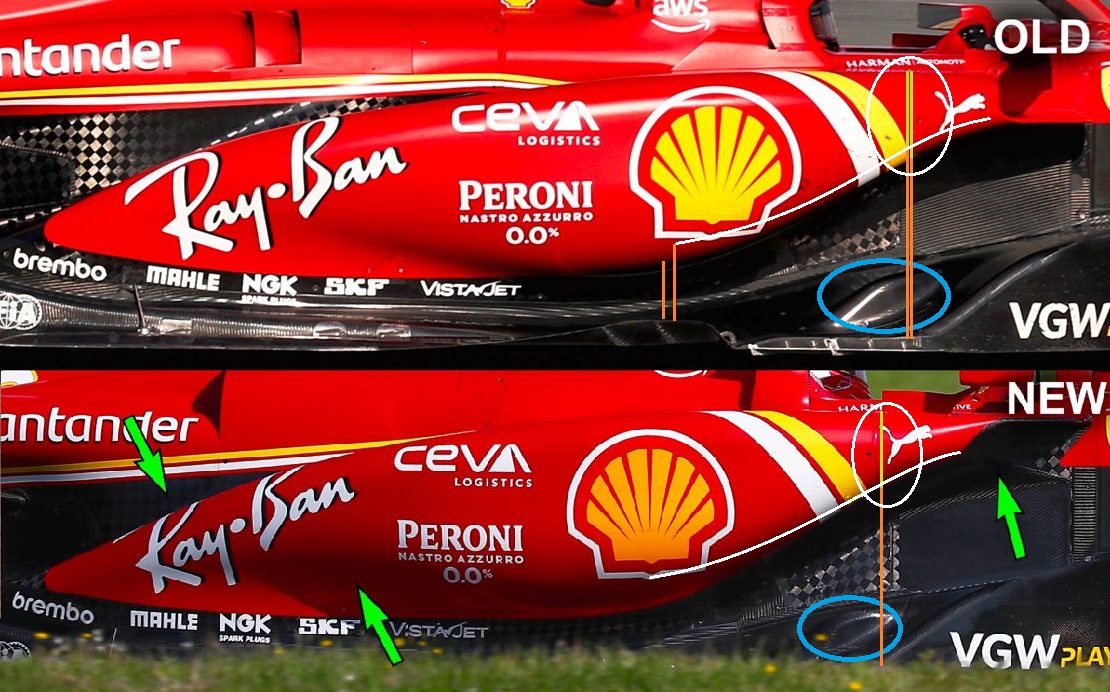
Imola floor spec updates weren't as big as sidepod updates and were mostly focused on the front end and the floor edge treatment.


22
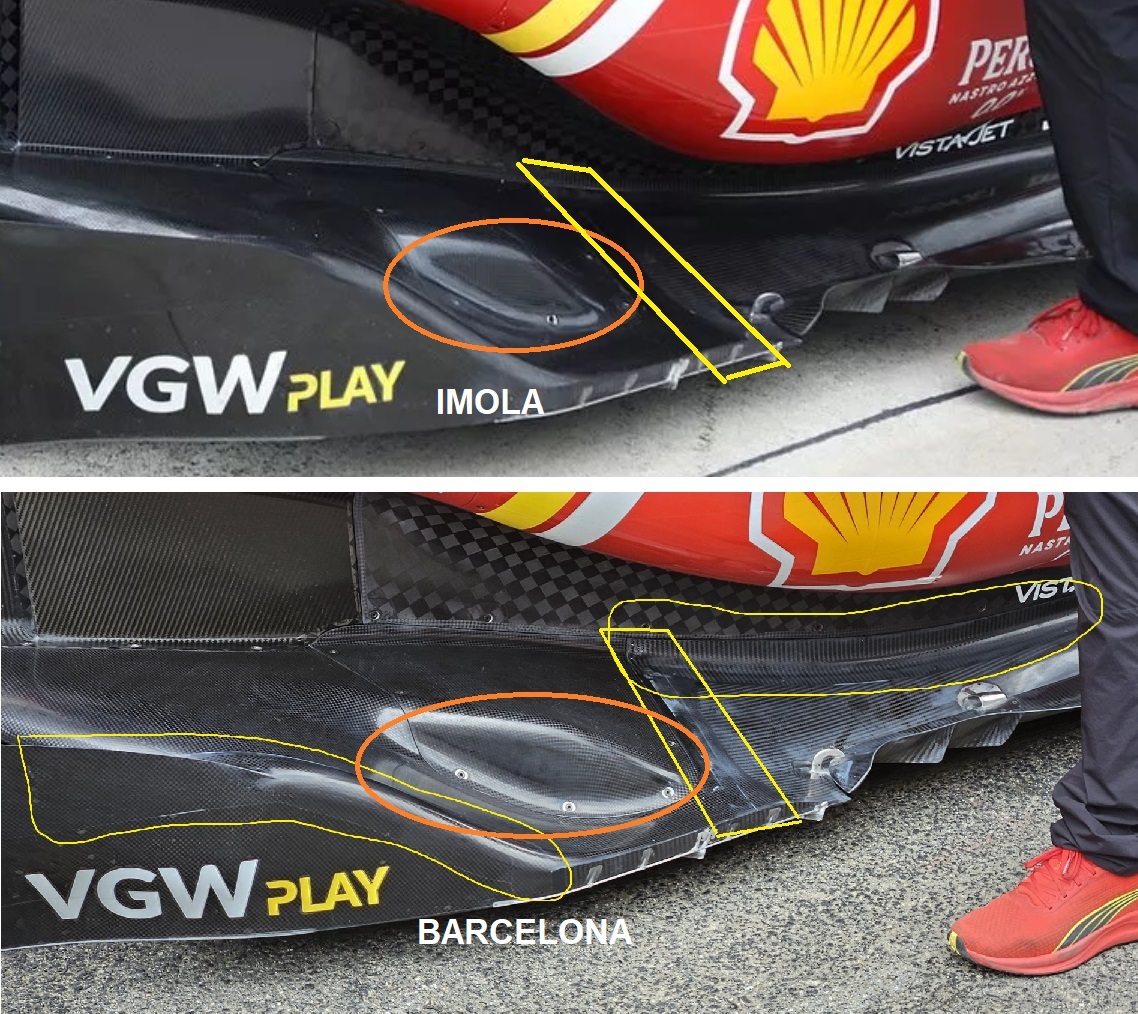
The notorious Barcelona spec was the 3r iteration in 2023. The floor was heavily revised everywhere, including reintroduction of boat section vertical kicks. On paper, these updates brought a lot of downforce, but it turned out it wasn't usable downforce in the slightest. High speed bouncing reappeared, also while cornering, which required the team to raise the car and lose valuable amount of downforce with it


23
In Hungary, Ferrari removed the vertical kicks and replaced the with simple lateral kicks, as they were on the launch car

24
There we also got a chance to see what the floor now looks like from bellow. I've marked some areas of interest on this fantastic shot from @xavigazquez
1) the SIS tube bulge, which we saw already in early season on photos from top side. It's very prominent and a local suction-generating surface no doubt. This area is very delicate due to interaction with the main turning-vane vortex
2) this seems to be the area where the throat is, ie where the tunnel roof is the shortest. This section seems to be going down towards the floor edge wing, which generates extraction and local suction in this area
3) the junction area with outboard tunnel wall, I think this area is very important for cornering performance and flow stability in critical conditions. It just so happens this is the area where Ferrari will be making a big change for next year it seems
4) the diffuser kick, fairly tall compared to RB and McL, if Ferrari really move the cockpit and everything behind backwards to move the CoG back - this area may go down a bit to bring more rear load and more load overall obviously
5) the outboard diffuser geometry has been changed since the start of the season, Ferrari seem to have found a way to introduce a bigger local curvature here to increase local load in an area without critical ride-height sensitivity
25
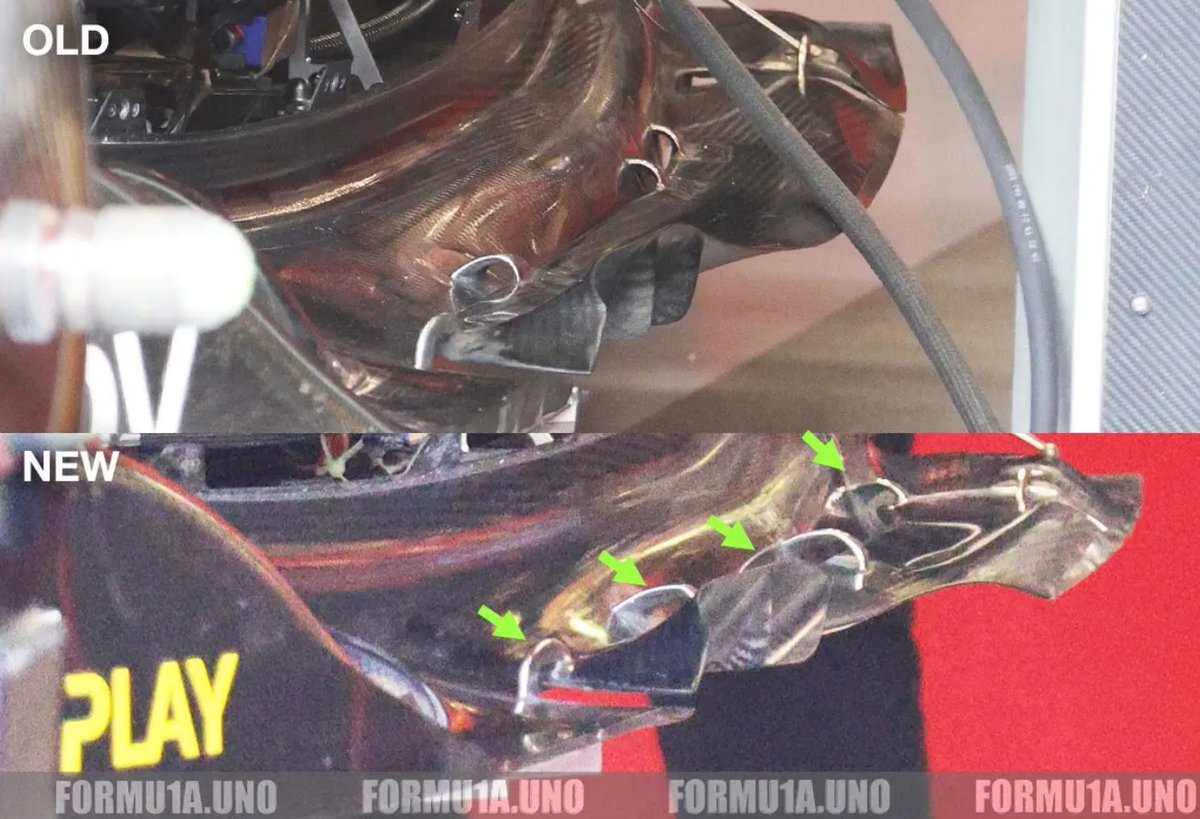
Monza spec came and brought many changes with it. The entire floor geometry was all new, although some areas only saw small changes. The most important change overall was removal of all vertical kicks, including the rear keel kick which returned in shape to something far more similar to what Ferrari used for the longest part in 2022.
The 6th and final floor spec was the experimental Vegas unit, only 1 of which was made. It was a good solution and Leclerc even used it for the whole Qatar weekend, even though it was a very risky move since only one piece was made. I've made a detailed thread about this floor earlier this month
This is the final post for today, tomorrow I will cover Ferrari Engine Cover development 2022-2024. On Sunday, I will make a summary on each of these 3 cars and I will share some of my expectations for SF-25.
Thanks for reading!
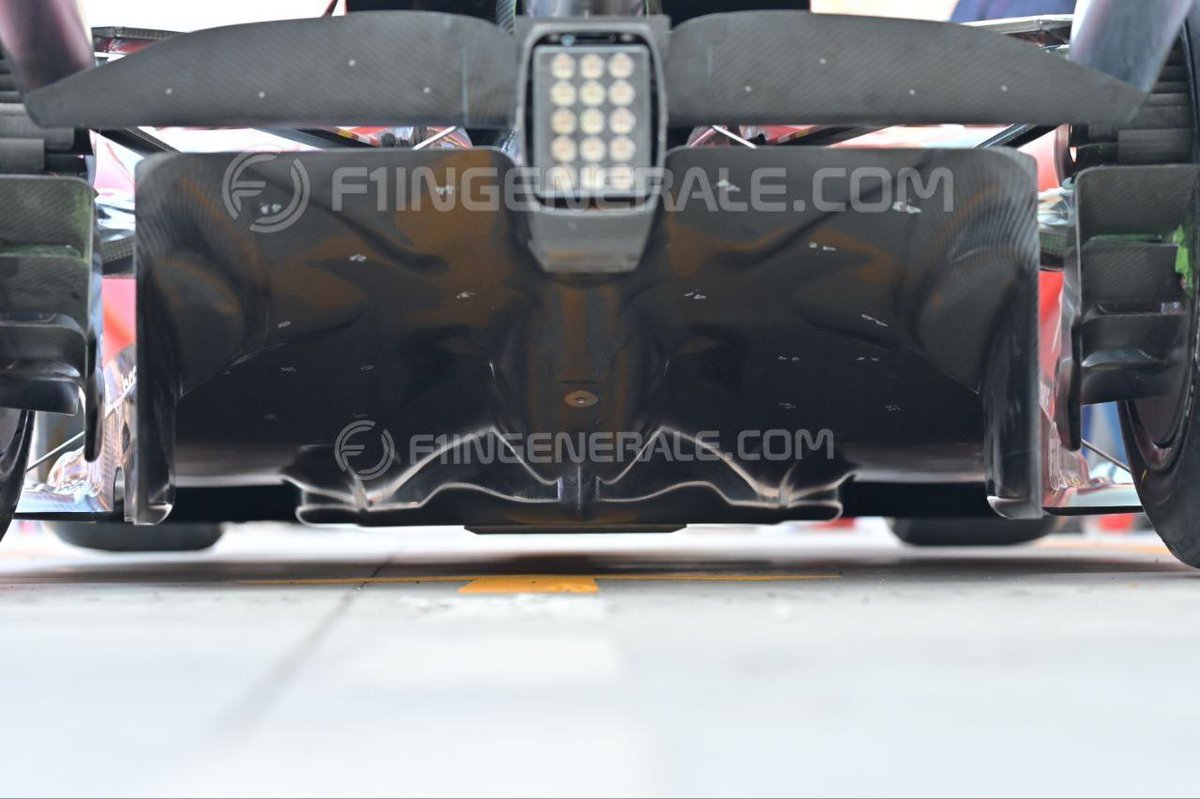


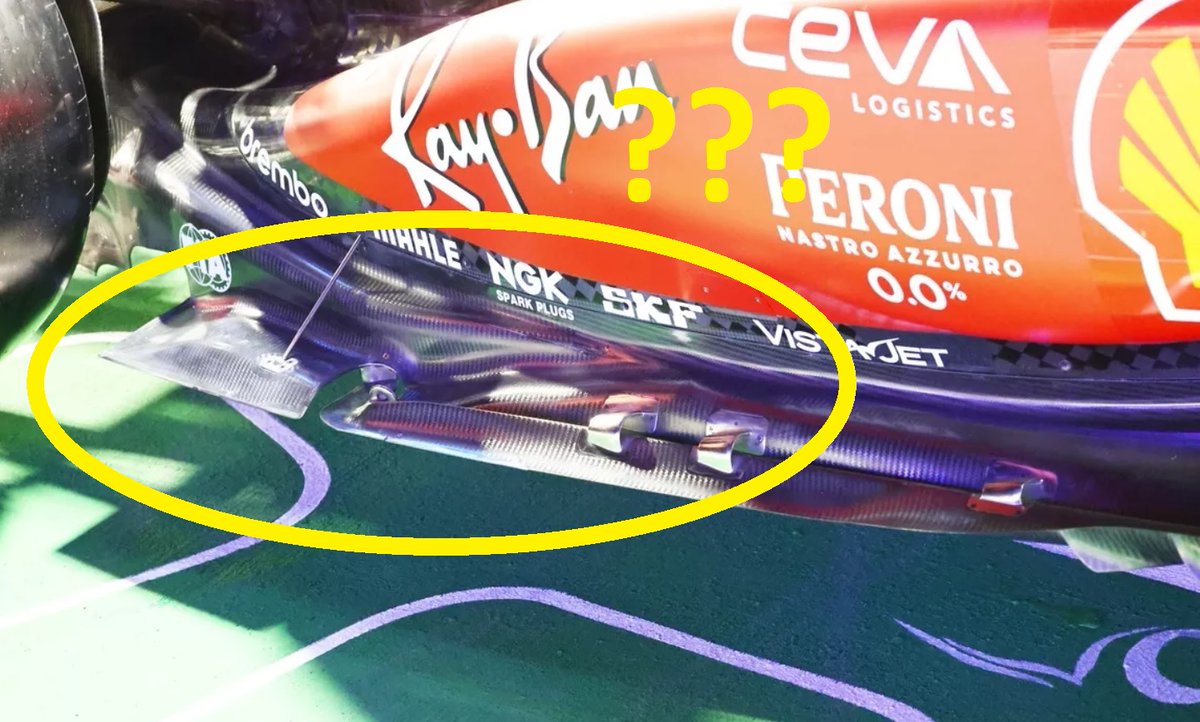
The 6th and final floor spec was the experimental Vegas unit, only 1 of which was made. It was a good solution and Leclerc even used it for the whole Qatar weekend, even though it was a very risky move since only one piece was made. I've made a detailed thread about this floor earlier this month
This is the final post for today, tomorrow I will cover Ferrari Engine Cover development 2022-2024. On Sunday, I will make a summary on each of these 3 cars and I will share some of my expectations for SF-25.
Thanks for reading!
Vanja H@AeroTechVH
So what's going on with #Ferrari 's experimental floor? 🤔
Is it really still experimental if they used it in #F1 Qatar race? Will they use it in Abu Dhabi again?
Those are not the question's I will try to answer in this thread. Rather, I will focus on aerodynamic consequences and why Ferrari said it doesn't add downforce, but it does expand the working window and stability
Apparently, @dr_obbs @brakeboosted @organicmeasure @f1net and other's think I should decode Ferrari's top secrets 😂
So, let's get into it! 👇
PS Do bear with me, I've prepared a lot of illustrations 😅