#F1 Season 2022-2024 Car Development Recap In 2022, a new "Ground...

Vanja H@AeroTechVH
65 views
Jan 11, 2025
~5 min read
Advertisement
1
#F1 Season 2022-2024 Car Development Recap
In 2022, a new "Ground Effect" Era started in Formula 1 and with it came - all new cars. This generation of cars features simplified geometry of Front Wings, no Barge Boards, complex Sidepods and Engine Covers, unique Rear Wing design and finally - massive Floors with tunnels. To review all 30 cars from all 10 teams across last 3 seasons, I will be posting a specific Topic covering each team until mid-February before new 2025 cars are unveiled:
🔸 Monday - Front Wings
🔸Tuesday - Rear Wings
🔸 Wednesday - Beam Wings
🔸 Thursday - Sidepods
🔸 Friday - Floor
🔸 Saturday - Shoulders + Engine cover
🔸 Sunday - Summary of the 3 cars
Photo credit - none of the photos are my own, only some illustrations and wording. Large majority comes from @AlbertFabrega @RosarioGiuliana @Auto_Racer_it @xavigazquez @Motorsport @Giorgio_Piola
If you like this kind of F1 Tech content, hit that Like button and Follow me for much more in 2025 🧐
Front Wings - Red Bull Racing
In 2022, Red Bull started development further back than they wanted, being in a season-long Championship fight in 2021. Their RB18 developed A LOT over the season and became the most dominant F1 car ever in 2023.
Unsurprisingly, their Front Wing design was fairly simple at the start, featuring a common (at the time) mid-span loading that forced an outwash flow towards the front tyre and beyond. This effect is significantly lower than it was with 2021 cars, let alone 2018 cars when there was all sorts of mad bits on them.
They also were one of several teams to leave the 1st flap unattached to the nose, leaving them with a wider central slot to feed the air that will end up in the floor eventually. This costs a bit of drag, but seems to be an overall benefit since most cars use it since 2022.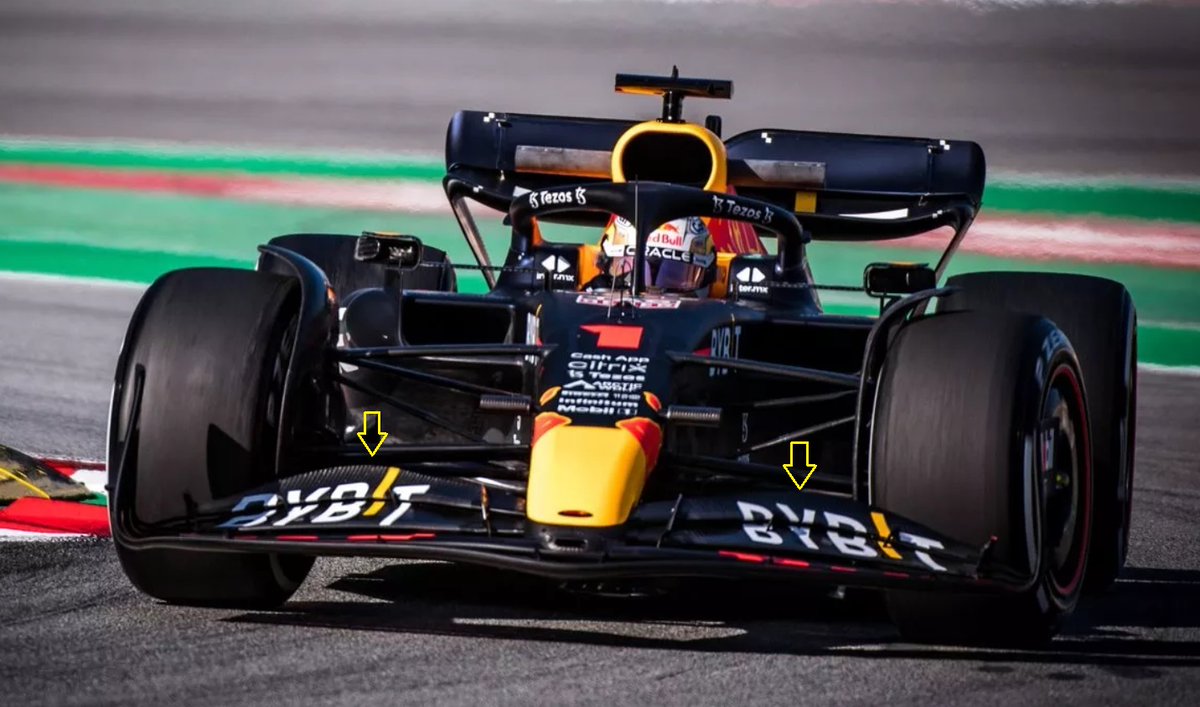

In 2022, a new "Ground Effect" Era started in Formula 1 and with it came - all new cars. This generation of cars features simplified geometry of Front Wings, no Barge Boards, complex Sidepods and Engine Covers, unique Rear Wing design and finally - massive Floors with tunnels. To review all 30 cars from all 10 teams across last 3 seasons, I will be posting a specific Topic covering each team until mid-February before new 2025 cars are unveiled:
🔸 Monday - Front Wings
🔸Tuesday - Rear Wings
🔸 Wednesday - Beam Wings
🔸 Thursday - Sidepods
🔸 Friday - Floor
🔸 Saturday - Shoulders + Engine cover
🔸 Sunday - Summary of the 3 cars
Photo credit - none of the photos are my own, only some illustrations and wording. Large majority comes from @AlbertFabrega @RosarioGiuliana @Auto_Racer_it @xavigazquez @Motorsport @Giorgio_Piola
If you like this kind of F1 Tech content, hit that Like button and Follow me for much more in 2025 🧐
Front Wings - Red Bull Racing
In 2022, Red Bull started development further back than they wanted, being in a season-long Championship fight in 2021. Their RB18 developed A LOT over the season and became the most dominant F1 car ever in 2023.
Unsurprisingly, their Front Wing design was fairly simple at the start, featuring a common (at the time) mid-span loading that forced an outwash flow towards the front tyre and beyond. This effect is significantly lower than it was with 2021 cars, let alone 2018 cars when there was all sorts of mad bits on them.
They also were one of several teams to leave the 1st flap unattached to the nose, leaving them with a wider central slot to feed the air that will end up in the floor eventually. This costs a bit of drag, but seems to be an overall benefit since most cars use it since 2022.
2
For tracks with less downforce, their major intervention on the front wing in 2022 was used in pair with low-load rear wing, with cutouts to the 4th flap to cut drag and downforce in order to get the optimal balance
Other than that, Red Bull managed to use their base wing spec with adjustments to flap angle and adding G-flap when needed to get the downforce and balance right on most tracks. Their focus over the years was mostly on sidepod and floor development, and this was clearly visible with a limited amount of updates on front and rear wings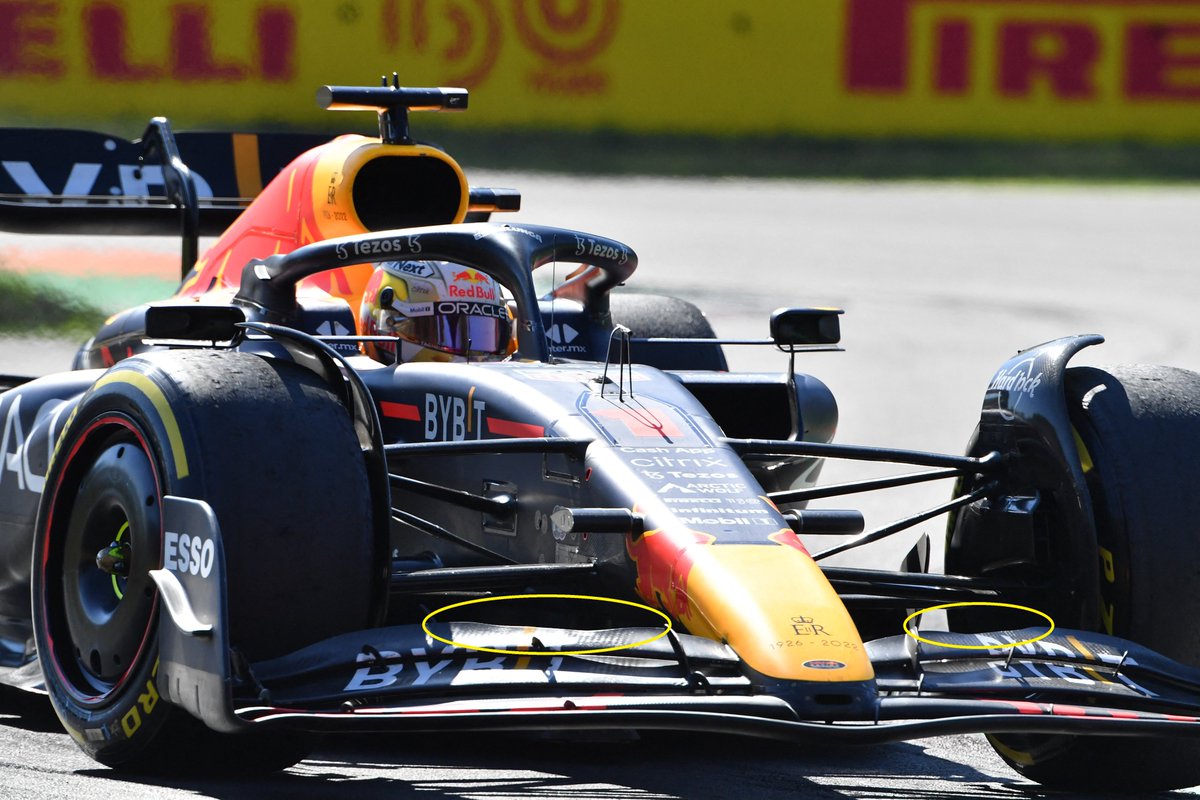
Other than that, Red Bull managed to use their base wing spec with adjustments to flap angle and adding G-flap when needed to get the downforce and balance right on most tracks. Their focus over the years was mostly on sidepod and floor development, and this was clearly visible with a limited amount of updates on front and rear wings
3
For tracks with max downforce, Red Bull used a wing with extended maximum flap height further outboard across the span. This was seen in tracks like Monaco and Hungary. This design increased load and outwash in a way that harmed the floor the least

4
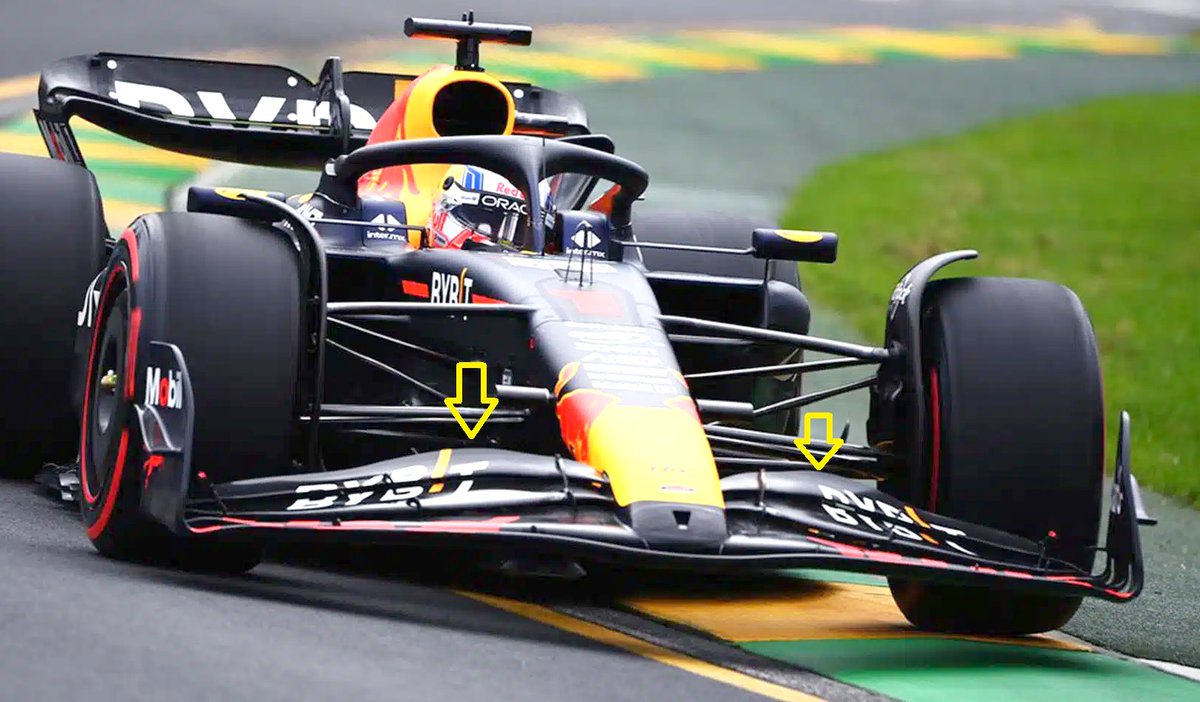
In 2023, Red Bull changed their philosophy and focused on a far more even 4th flap trailing edge design on RB19, meaning lowered outwash effect and a more central wing loading. This was also a change on how the airflow was treated before it reached the floor. The front wing section next to the nose was significantly less loaded than RB18 design

5
For more loaded wing design, Red Bull extended the load of the central part of the wing span. Other than loading the underside, it also affects the amount of outwash that helps with flow conditioning around the front tyre

6
BONUS FEATURE: There's a CFD analysis where results show a curious trend - a more loaded front wing can also help with floor performance. What did it mean for RB19 design? 🤔
tameaero.wordpress.com/2024/11/22/get…
tameaero.wordpress.com/2024/11/22/get…
7
For some high-load circuits, Red Bull also had a 4th flap with a g-flap and a more loaded outboard section in 2023
8
Final front wing spec seen on RB19 was the Monza-spec used in Las Vegas as well. From every angle, it seems only the 4th flap was trimmed severely and no changes were made to 3rd flap though. This spec was paired with a trimmed mid-low load rear wing as you can see on the photo

9
For 2024, Red Bull made some changes on the front wing again. Primarily, the nose attachement now featured a cover over the 1st flap which was a complete U-turn compared to previous 2 cars. In my view, this was done to cut some drag at the front, possibly even some downforce. It would fit well in a design where RB20 had a more forward floor CoP position, meaning they can unload the front wing without losing balance.
Additional change was one of the bigger controversies of 2024, where Red Bull moved their flap adjuster inboard. This was done to reduce the flap flexing, a feature that helps both with shedding drag on straights as well as naturally moving the balance to the rear in high-speed corners. I still don't understand why RB20 was designed with a more rigid front wing in mind, they may have been told by FIA there will be more scrutiny over wing flexing in 2024 and this made them over-react to it
Other than these two things, basic design remained very much aligned with RB19 base design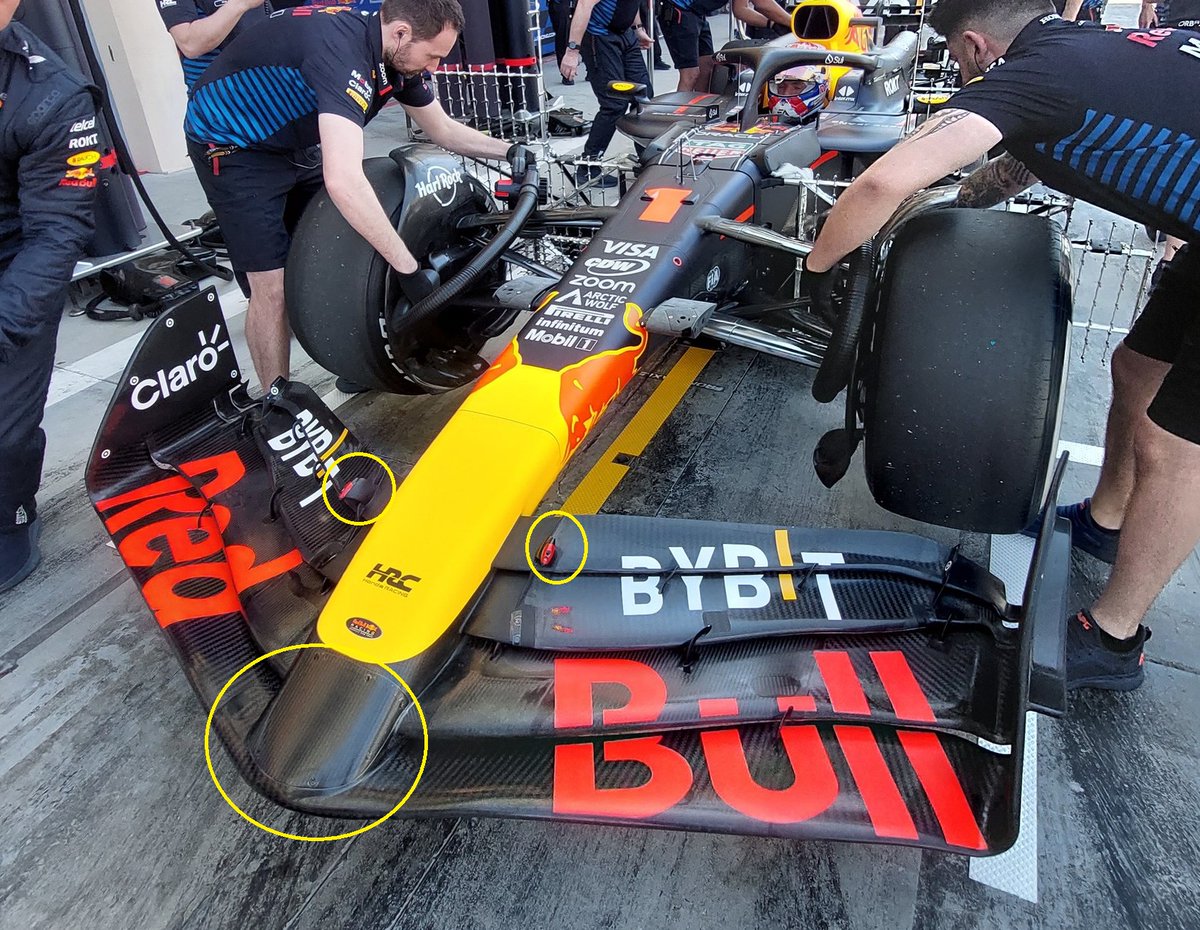

Additional change was one of the bigger controversies of 2024, where Red Bull moved their flap adjuster inboard. This was done to reduce the flap flexing, a feature that helps both with shedding drag on straights as well as naturally moving the balance to the rear in high-speed corners. I still don't understand why RB20 was designed with a more rigid front wing in mind, they may have been told by FIA there will be more scrutiny over wing flexing in 2024 and this made them over-react to it
Other than these two things, basic design remained very much aligned with RB19 base design
10
For less loaded tracks, like Jeddah, Miami etc, RB20 had a different, smaller 4th flap design not too different from RB19 Monza-spec wing

11
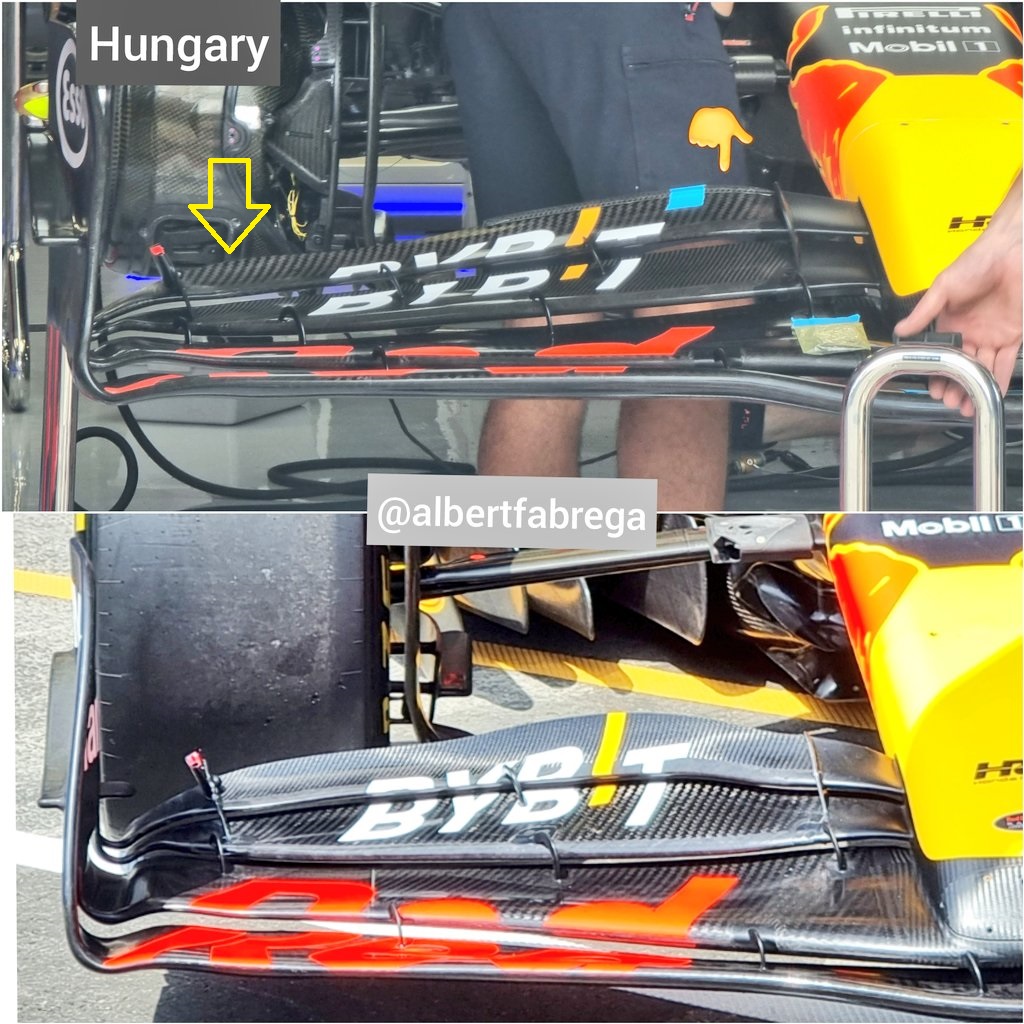
After hitting mid-season trouble with car balance and driveability, as well as persistent challenge from McLaren, Red Bull made a significant front wing redesign starting from Hungary. They've exteded the frontal scoop outwards, presumably to increase the load substantially. The nose shape became pointier, going towards 2022 Ferrari F1-75 nose design.
Additionally, after several tests carried over the races before, Red Bull made a final change to move the flap adjuster to the outside. This significantly increased the flap flexing seen on RB20 and seems to have made a bigger step forward starting from Austin weekend.
On this photo comparison, the spec above was used on high-load tracks before Hungary - namely Monaco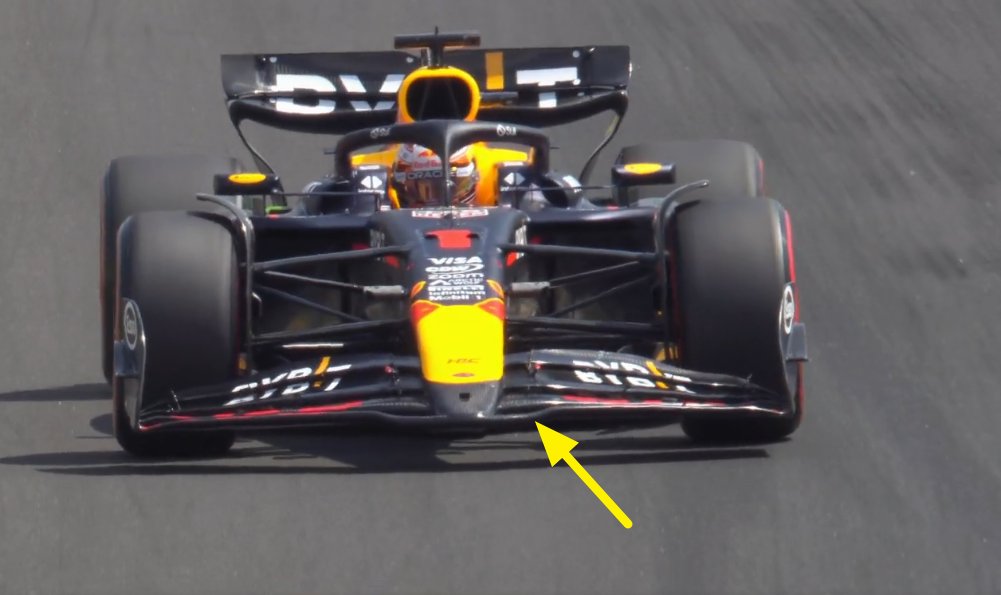
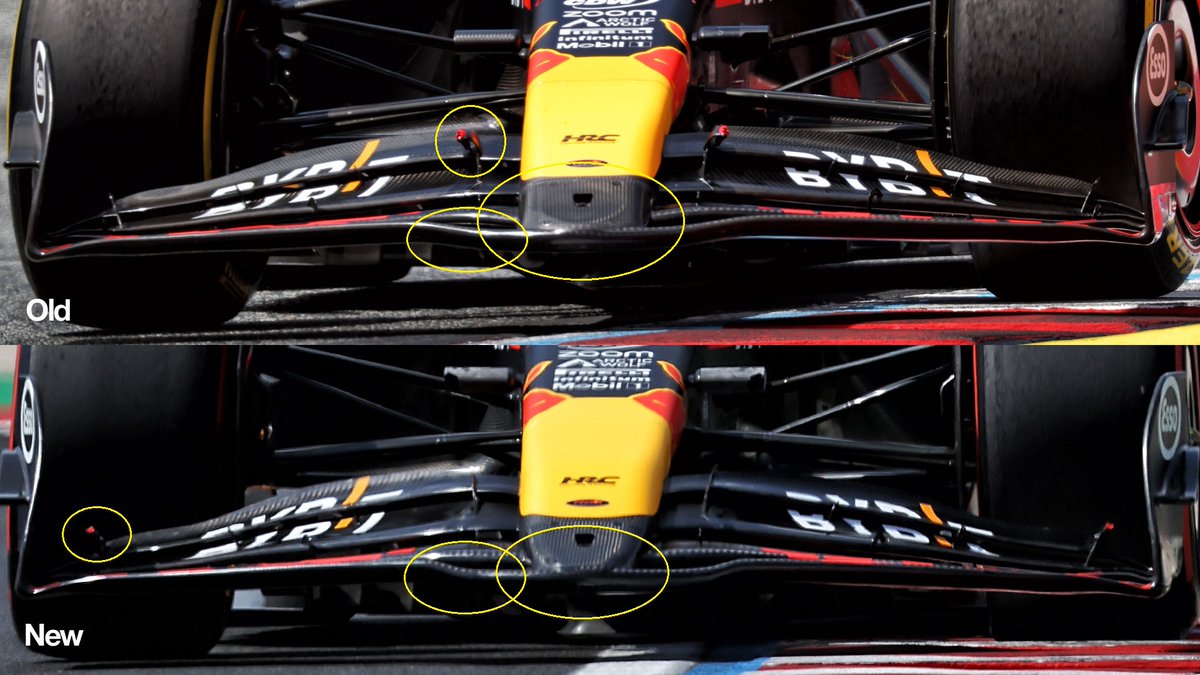
Additionally, after several tests carried over the races before, Red Bull made a final change to move the flap adjuster to the outside. This significantly increased the flap flexing seen on RB20 and seems to have made a bigger step forward starting from Austin weekend.
On this photo comparison, the spec above was used on high-load tracks before Hungary - namely Monaco
12
Final front wing spec on RB20 came again on Monza and was used in Las Vegas too. Massive cuts on the 4th flap to accompany those massive cuts made on rear wing too.
This is the final post for today, tomorrow I will cover Red Bull Rear Wings 2022-2024. On Sunday, I will make a summary on each of these 3 cars and I will share some of my expectations for RB21. 🤓
Thanks for reading!
This is the final post for today, tomorrow I will cover Red Bull Rear Wings 2022-2024. On Sunday, I will make a summary on each of these 3 cars and I will share some of my expectations for RB21. 🤓
Thanks for reading!
13
@Rolando_tillit @JagisinhoV2 Could be 🤔
14
@Rolando_tillit @JagisinhoV2 One of several reasons, at least

