#F1 Season 2022-2024 Car Development Recap 🔥 How F1 Aero Kings did...

Vanja H@AeroTechVH
53 views
Jan 12, 2025
~8 min read
Advertisement
1
#F1 Season 2022-2024 Car Development Recap
🔥 How F1 Aero Kings did it again! 🔥
🟦 Floor Development - Red Bull Racing 🟦
In 2022, a new "Ground Effect" Era started in Formula 1 and with it came - all new cars. This generation of cars features massive Floors with venturi tunnels, which can make up more than 70% of total downforce of today's F1 cars.
Photo credit - none of the photos are my own, only some illustrations and wording. Large majority comes from @AlbertFabrega @RosarioGiuliana @Auto_Racer_it @xavigazquez @Motorsport @Giorgio_Piola
If you like this kind of F1 Tech content, hit that Like button and Follow me for much more in 2025 ✌️😎
As soon as the latest (2022-2025) F1 rules were released, everyone who follows F1 and knows the basics of race car aerodynamics understood that floors will be more important than ever and their design will be the determining factor that separates the Champions from Also-rans.
First pre-season test reminded us of aerodynamic bouncing effect, aka porpoising. This became one of several important performance factors of F1 cars today. Seemingly, F1's aero team lead by Adrian Newey understood them all even before they started sketching the 2022 car. The most important of these performance factors are
🔸 ability to run the car low to the ground without bouncing
🔸 having a suspension setup that keeps the car stable and level at all time
🔸 versatile floor design that's resistant to dirty air and flow instability
🔸 excellent balance across the entire cornering speed range - from low to high-speed corners
No, I won't give you a full explanation of Red Bull's floor and this CFD just yet, keep reading to find out 😉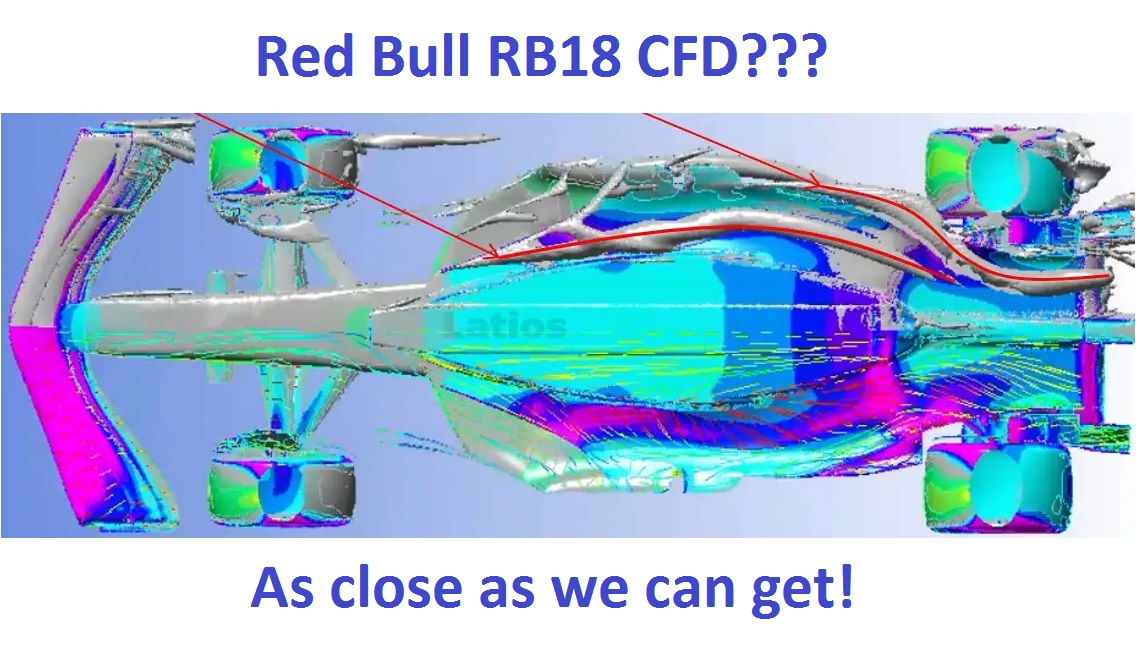
🔥 How F1 Aero Kings did it again! 🔥
🟦 Floor Development - Red Bull Racing 🟦
In 2022, a new "Ground Effect" Era started in Formula 1 and with it came - all new cars. This generation of cars features massive Floors with venturi tunnels, which can make up more than 70% of total downforce of today's F1 cars.
Photo credit - none of the photos are my own, only some illustrations and wording. Large majority comes from @AlbertFabrega @RosarioGiuliana @Auto_Racer_it @xavigazquez @Motorsport @Giorgio_Piola
If you like this kind of F1 Tech content, hit that Like button and Follow me for much more in 2025 ✌️😎
As soon as the latest (2022-2025) F1 rules were released, everyone who follows F1 and knows the basics of race car aerodynamics understood that floors will be more important than ever and their design will be the determining factor that separates the Champions from Also-rans.
First pre-season test reminded us of aerodynamic bouncing effect, aka porpoising. This became one of several important performance factors of F1 cars today. Seemingly, F1's aero team lead by Adrian Newey understood them all even before they started sketching the 2022 car. The most important of these performance factors are
🔸 ability to run the car low to the ground without bouncing
🔸 having a suspension setup that keeps the car stable and level at all time
🔸 versatile floor design that's resistant to dirty air and flow instability
🔸 excellent balance across the entire cornering speed range - from low to high-speed corners
No, I won't give you a full explanation of Red Bull's floor and this CFD just yet, keep reading to find out 😉
2
When RB18 hit the track in Barcelona for the 1st preseason test, we didn't really understand what we are looking at even if we could see a lot. In hindsight, some of the more important features of RB18 floor were noticeable - boat section keel with a big vertical kick (mini-diffuser basically) and the low diffuser throat pushed all the way to the back as far as rules allowed


3
The very first floor edge design was very rudimentary (even compared to some cars on the same test) and it was clear Red Bull was behind schedule after a season-long development battle with Mercedes in 2021. Another thing that was clear was how big of n undercut they have and how much this will help with drag reduction and sending clean flow to the back of the floor.

4
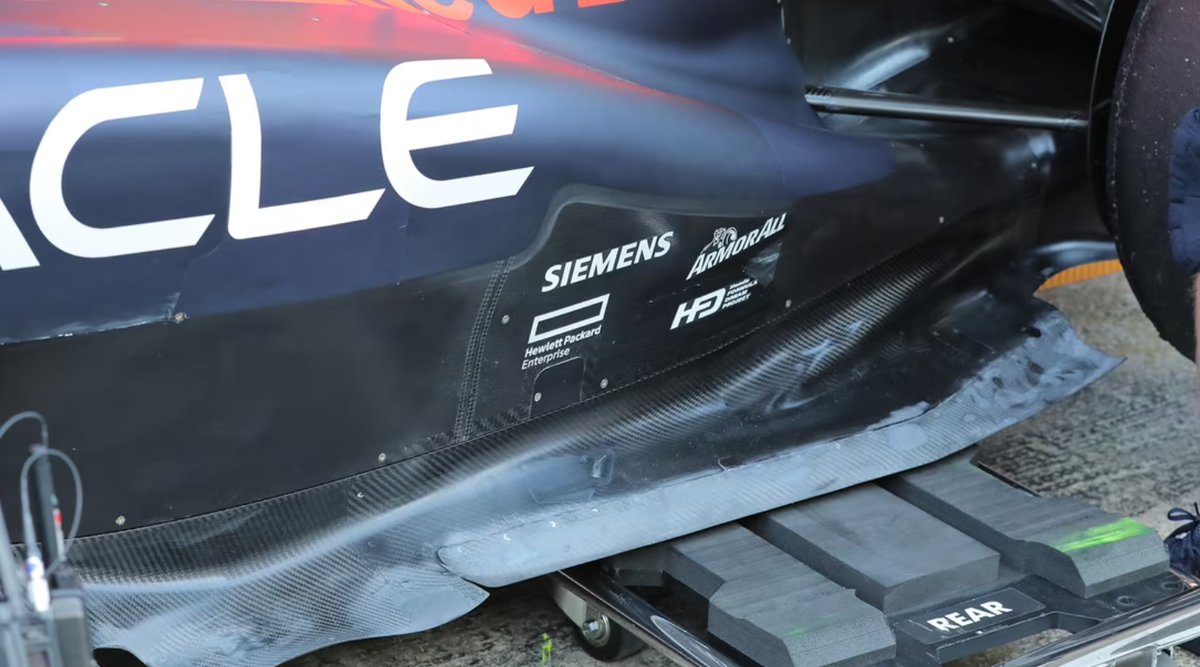
After solving some of the teething issues in early races, RB18 proved it had a lot of pace and was always competing with Ferrari for the win. In the mean time, we also got more than a few shots of the floor from top, but those photo angles were always a bit too limiting to get any decent conclusion on main aerodynamic features.
One thing that set RB18 aside from other cars was having a low position of the leading edge of the floor. This reduced the amount of air going in, which undoubtedly reduced peak performance. However, this is the catch, RB18 was designed for versatile and usable downforce, not peak figures which may only be used in a narrow setup window.
Another design feature that supports this was having two outboard fences very close together and almost forming a single fence. I strongly believe this was another design choice made to carefully add load to the floor in order to keep the balance and wide operating window just right. The whole leading edge and floor fences were completely changed on final RB18 floor spec.
5
And then it happened, we finally got a peek under the car in Monaco. It was clear immediately that the floor was very different from any other on the grid - at that time. There was a lot of nuance to it, a lot of finesse and a lot of areas with geometry that didn't really make complete sense right away. One of the first things that struck me was how low their diffuser throat is and how different it was from Ferrari and Mercedes.
I believed, and this was later confirmed, that their peak downforce was in this area since the main floor performance driver is the ride height and how low the throat is to the ground. Presence of additional kicks in this area (red arrows) only fortified this theory which left me wondering - with so much downforce in the rear, how do they balance the floor and where do they generate forward floor downforce?
If you look carefully, you'll notice that the front of the floor has a distinct arch design that transitions to the flat diffuser throat section. Not only is it arched, it's very high as well and this could only mean a few things. The most likely explanation was Red Bull designing this section of the floor to optimize the flow and strength of the floor fence vortex on each side, by allowing it to expand in a circular domain where it can use the high vorticity to substantially lower the pressure for a huge downforce boost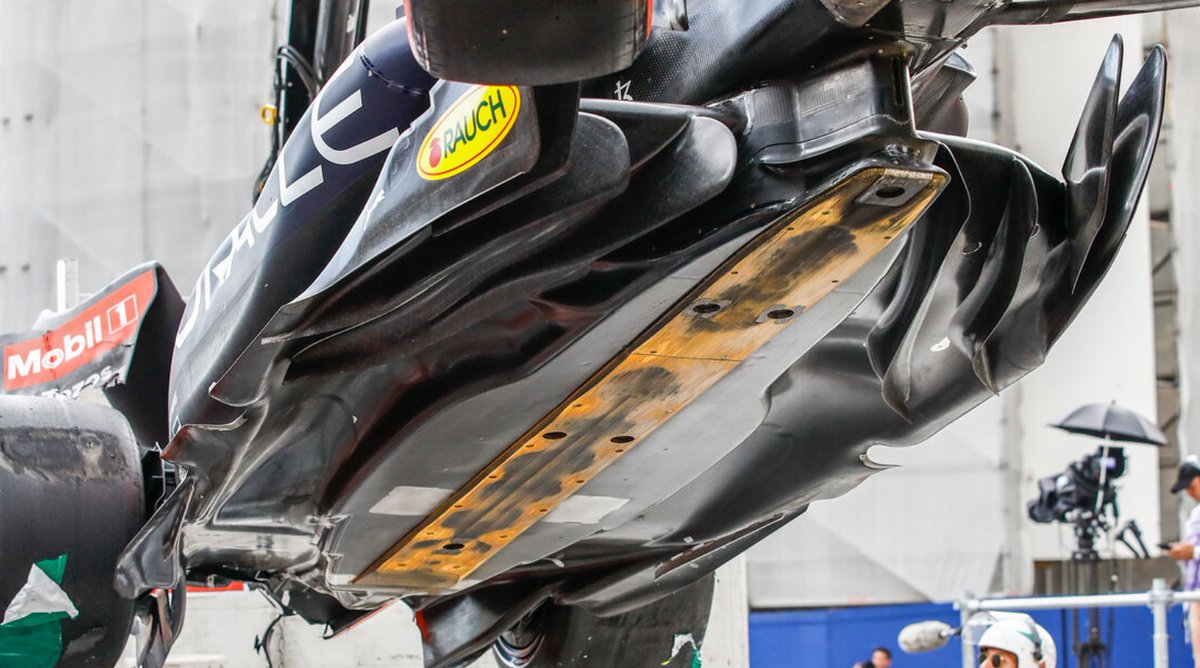

I believed, and this was later confirmed, that their peak downforce was in this area since the main floor performance driver is the ride height and how low the throat is to the ground. Presence of additional kicks in this area (red arrows) only fortified this theory which left me wondering - with so much downforce in the rear, how do they balance the floor and where do they generate forward floor downforce?
If you look carefully, you'll notice that the front of the floor has a distinct arch design that transitions to the flat diffuser throat section. Not only is it arched, it's very high as well and this could only mean a few things. The most likely explanation was Red Bull designing this section of the floor to optimize the flow and strength of the floor fence vortex on each side, by allowing it to expand in a circular domain where it can use the high vorticity to substantially lower the pressure for a huge downforce boost
6
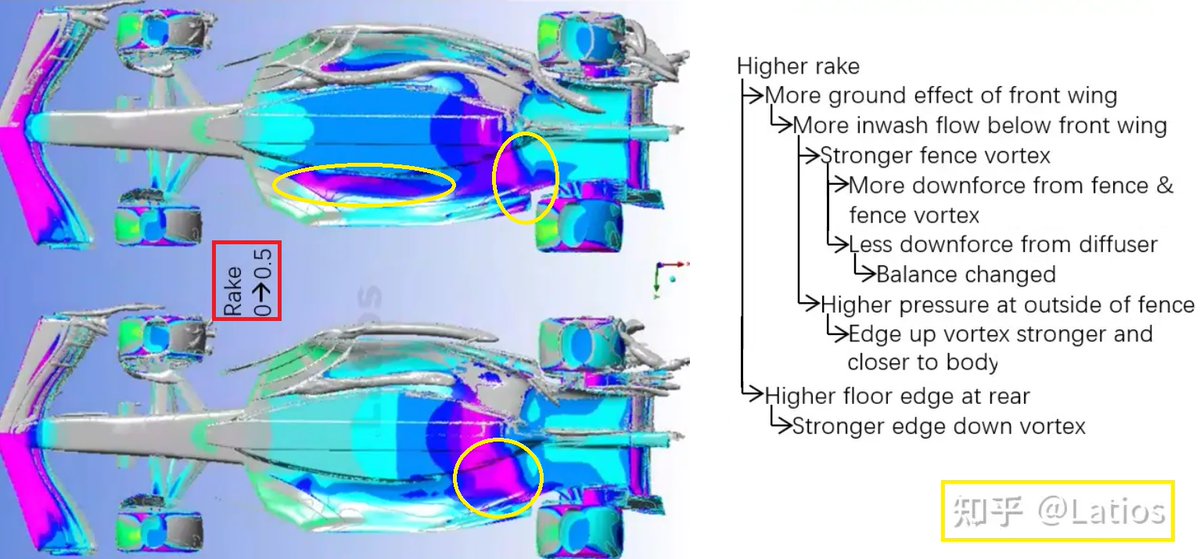
The absolute best visualisation of this effect is Latios' CFD simulations he shared on @f1technical forum here:
f1technical.net/forum/viewtopi…
Latios design a model as close to RB18 as possible and ran a lot of simulations on it. Step by step, he managed to design a floor where the fence vortex goes all the way to diffuser and merges with diffuser vortex low pressure area. I guess that's why he landed an aero engineer position in Williams soon after sharing his work 😉
In diffuser, these two vortices merge completely. Here, you can also see why mouse holes are so important for these floors, feeding diffuser vortex with air to give it that extra boost. This is also a critical performance area, if you feed it with dirty air you will lose performance - so you need to keep front and rear tyre turbulence away from this area at all costs!
Relying on vortices to add stable downforce is a vintage feature right now, they are able to absorb turbulence if they are big and strong enough in the first place. However, if the turbulence is also strong enough it can weaken or even break them apart - so you need to be careful with them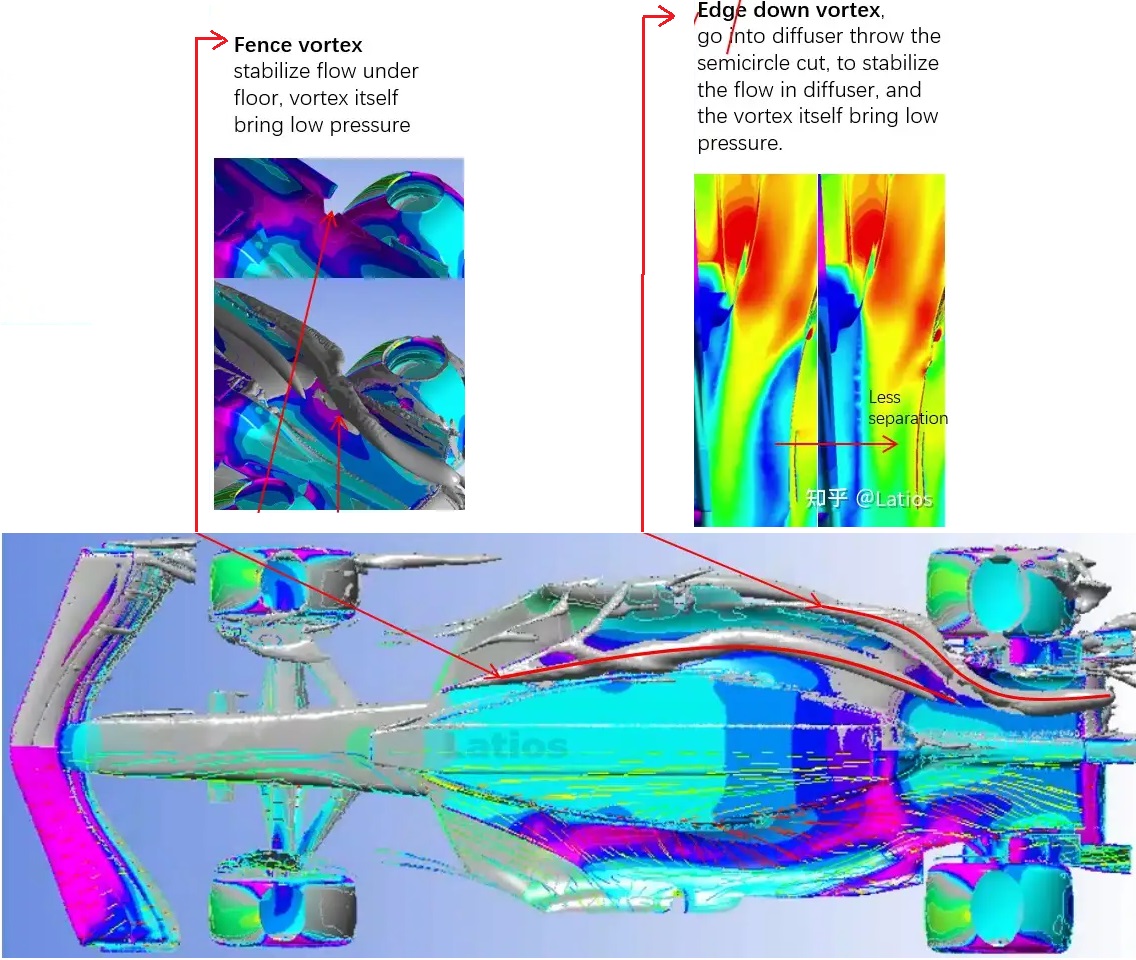
f1technical.net/forum/viewtopi…
Latios design a model as close to RB18 as possible and ran a lot of simulations on it. Step by step, he managed to design a floor where the fence vortex goes all the way to diffuser and merges with diffuser vortex low pressure area. I guess that's why he landed an aero engineer position in Williams soon after sharing his work 😉
In diffuser, these two vortices merge completely. Here, you can also see why mouse holes are so important for these floors, feeding diffuser vortex with air to give it that extra boost. This is also a critical performance area, if you feed it with dirty air you will lose performance - so you need to keep front and rear tyre turbulence away from this area at all costs!
Relying on vortices to add stable downforce is a vintage feature right now, they are able to absorb turbulence if they are big and strong enough in the first place. However, if the turbulence is also strong enough it can weaken or even break them apart - so you need to be careful with them
7
Latios also experimented with some rake angles and you can read his conclusion on the picture
8
Final piece of the puzzle from Latios, how the floor from the top of the floor influences the bottom side. If we didn't know any better, we'd consider this level of aero performance and flow interaction to be a new branch of Black Arts 😂

9
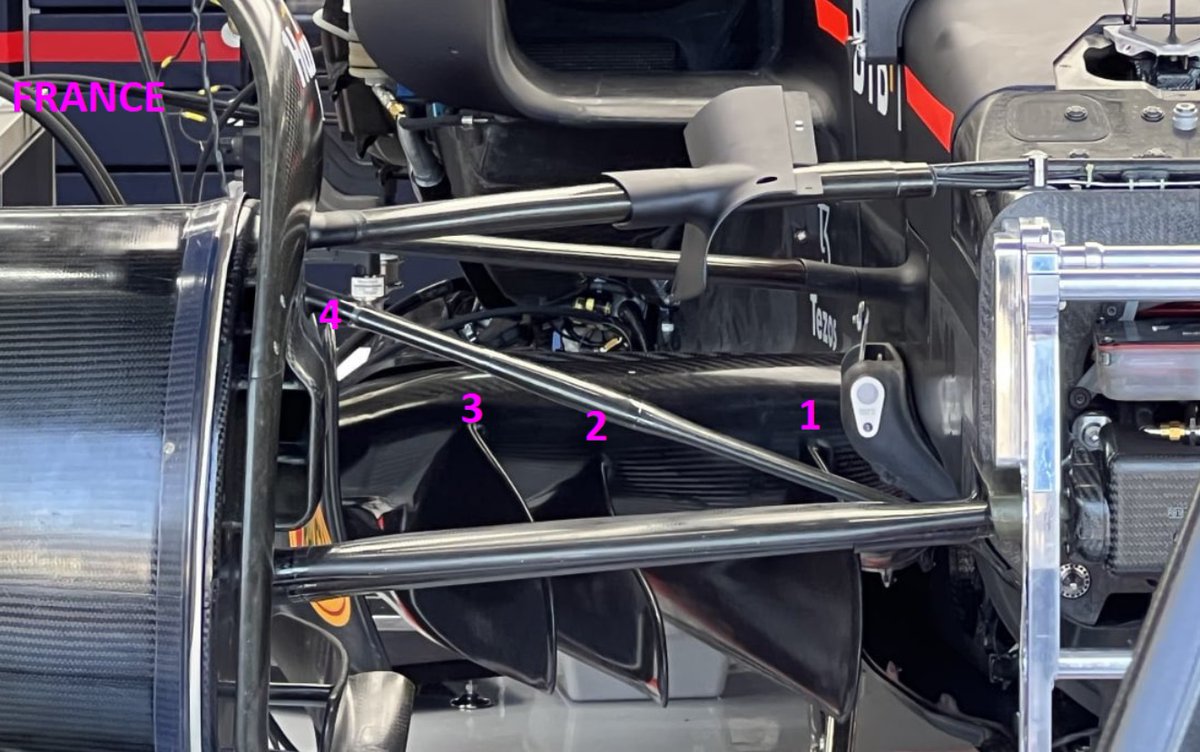
For the final floor iteration, RB18 saw some changes made to vertical boat kicks as well as substantial changes to the front. Leading edge changes suggest RB18 was now ready to get a boost of front floor downforce and by this time the car became the dominant force of the field.

10
On RB19, the 2023 challenger, there weren't a lot of changes to the rear in terms of concept design. Neither was there any change at the front, but there was a big change on the sides
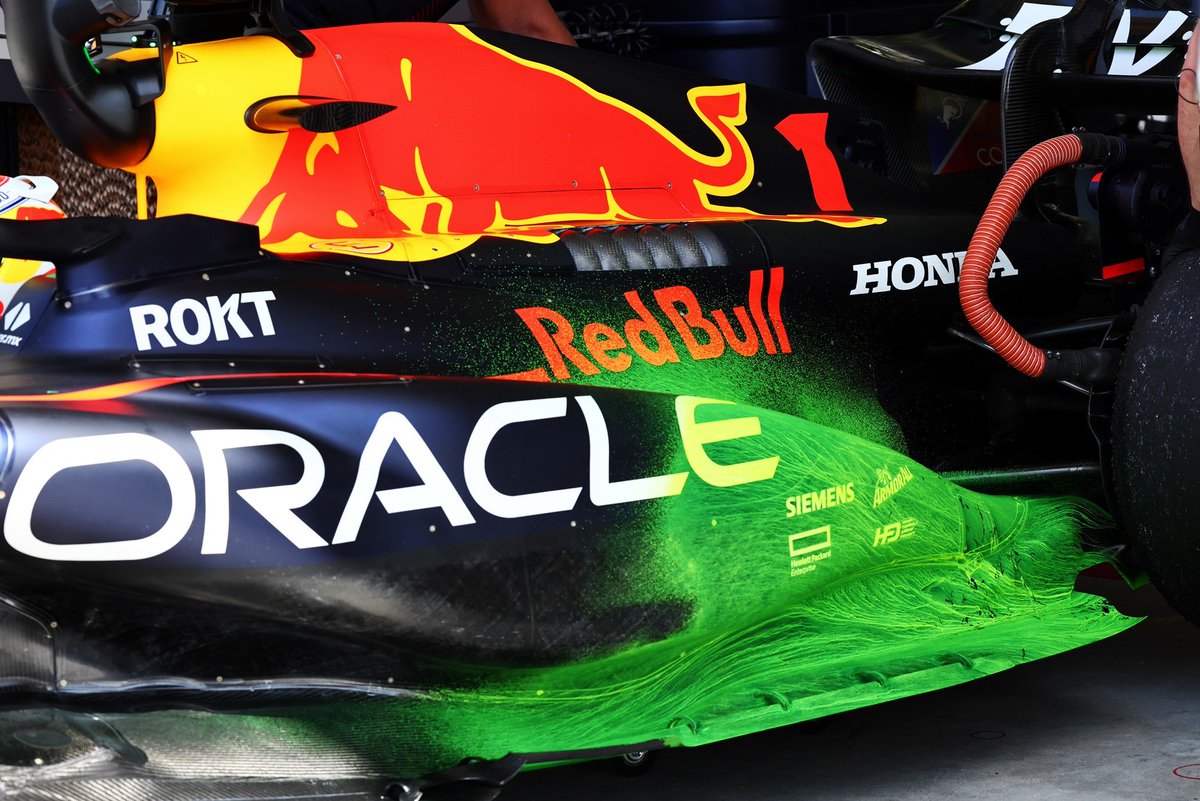
Red Bull also introduced the floor edge wing for the first time and it was another trend setter all across the grid. It became one of the more important development areas in '23 and '24 and it will probably be so next year as well. Floor edge wings are an important feature that enhances flow stability and prevents the turbulence from entering the underside of the floor - by forcing the air from the underside to flow out with great energy
On the 2nd photo you can see the subtle interaction with the sidepods via flow vis paint
Red Bull also introduced the floor edge wing for the first time and it was another trend setter all across the grid. It became one of the more important development areas in '23 and '24 and it will probably be so next year as well. Floor edge wings are an important feature that enhances flow stability and prevents the turbulence from entering the underside of the floor - by forcing the air from the underside to flow out with great energy
On the 2nd photo you can see the subtle interaction with the sidepods via flow vis paint
11
And again, in Monaco, we saw the details of RB19 floor design. It was definitely a further evolution of RB18 floor with some new features. They were undoubtedly added to ensure stable downforce across a wide operating window and it was a huge success with 21/22 wins in 2023.


12
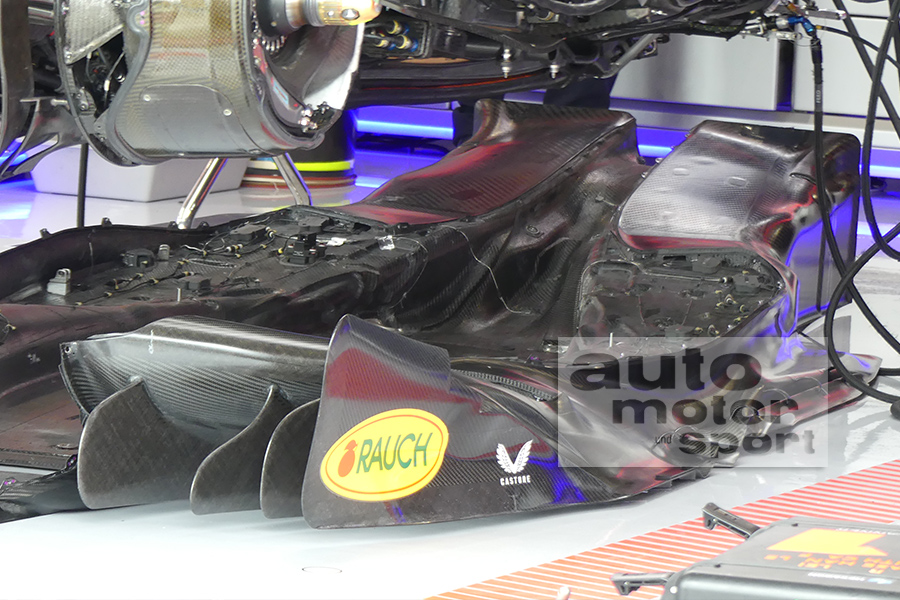
The final few RB19 floor specs saw some changes made to the diffuser roof and trailing edge area. Red Bull stepped away from their original design and towards a concept Ferrari pioneered at the start of 2022. This demonstrated Red Bull engineers don't shy from looking for better solutions on other cars, the key is to find and keep the performance advantage and no engineer decision can be made against this


13
The first RB20 floor spec carried on from the final RB19 spec, no reason to change the winning formula - right?

14
In the coming races, Red Bull started struggling more and more with driveability and floor performance stability. We don't have any specific information what was changed on the underside, unfortunately
They kept introducing updates, but none seemed to work as they should. This culminated during Monza weekend, when Verstappen was visibly furious with how the car behaved after the race.

They kept introducing updates, but none seemed to work as they should. This culminated during Monza weekend, when Verstappen was visibly furious with how the car behaved after the race.
15
A quick fix introduced during the Baku weekend was made by removing the vertical keel kicks completely. A key diffuser feature for 2 and a half years was wiped away, seemingly inspired by Ferrari's Monza floor specification.
Another step was made in Austin with changes on the underside surfaces we couldn't see at any time. Final addition was an extension to the floor fences in a shape of a vortex generator - seemingly put there to ensure flow stability on the upper floor surface.
There are many question marks for Red Bull ahead of season 2025 and most of them concern the floor design and how best to integrate it with the new 2025 suspension. Especially the front suspension will be of huge importance, with RB20 suffering greatly with excessive front stiffness and poor kerb-riding ability compared to McLaren and Ferrari.
This is the final post for today, tomorrow I will cover Red Bull Engine Cover Development 2022-2024. On Sunday, I will make a summary on each of these 3 cars and I will share some of my expectations for RB21.
Thanks for reading!

