#F1 Season 2022-2024 Car Development Recap 🟦 Sidepod Development -...

Vanja H@AeroTechVH
53 views
Jan 12, 2025
~6 min read
Advertisement
1
#F1 Season 2022-2024 Car Development Recap
🟦 Sidepod Development - Red Bull Racing 🟦
You don't want to miss this one! 🔥
Sidepods will be the hot topic of this regulation set. On one hand, there is a lot of freedom for their design. On the other hand, everything else is so regulated which forces all teams to find performance or performance enhancement wherever they can. This way, even if sidepods are basically a necessary evil on an F1 car - they turned out to be quite a necessary tool to find a good amount of performance.
Photo credit - none of the photos are my own, only some illustrations and wording. Large majority comes from @AlbertFabrega @RosarioGiuliana @Auto_Racer_it @xavigazquez @Motorsport @Giorgio_Piola
If you like this kind of F1 Tech content, hit that Like button and Follow me for much more in 2025 🚀
Today, everyone will say Red Bull is the team everyone copied with downwash sidepods on this generation of F1 cars. However, Red Bull's sister team Alpha Tauri also used them and, more importantly - Alpine also used such a design
The key feature of this design is maximised top surface area to guide the flow all the way down to the floor ahead of rear suspension and beam wing. The second feature is the huge undercut for lower drag and exactly the right amount of pressurisation that generates front tyre wake outwash
2
At the time, I made some simplified CFD studies to determine the key features of different sidepod shapes. Red Bull design was clearly the lowest drag generator and there was a discreet amount of frontal pressurisation even without stagnation (which causes the most drag). Rear end managed to get a full pressure recovery to atmospheric pressure levels (yellow colour areas on simuation results)
It also turned out the high-quality and highly stable flow to the rear corner is very important. At the time, evidence of such flow behaviour wasn't of interest and I understood this only by looking back at these results.

It also turned out the high-quality and highly stable flow to the rear corner is very important. At the time, evidence of such flow behaviour wasn't of interest and I understood this only by looking back at these results.
3
Early testing days weren't the most positive for Red Bull, apparently the car wasn't well balanced and there were other issues. One part of the package that arrived on the final day of testing were news sidepods with the same general idea as the launch-spec. However, there were also many fine details that made a lot of difference and all of them were present on the car in the next 2 years.
The more important one was the outwashing hump on the top surface, which made sure a maximal amount of air was sent down the side wall and towards the rear corner - where stable airflow is crucial. The other detail is a smoother transition between chassis and sidepod and a pronounced undercut tunnel all the way to the rear corner.

The more important one was the outwashing hump on the top surface, which made sure a maximal amount of air was sent down the side wall and towards the rear corner - where stable airflow is crucial. The other detail is a smoother transition between chassis and sidepod and a pronounced undercut tunnel all the way to the rear corner.
4
The final 2022 sidepod specification was a further fine tune, adding a small bubble on the junction between sidepod and engine cover - exactly the area where my simulations showed some separation issues. Additionally, the inlet was slightly widened and the outboard rear bump was now wider - presumably extended all the way to the maximum allowed width.

5
Where final RB18 spec stopped, RB19 carried on - with some further changes and careful tightening where it was needed. Obviously, with the evolution of the floor there was a need to make some changes on sidepods to re-optimise every flow interaction
Bigger amount of airflow was allowed under the sidepod intake, only to be pressured with a steeper downward wall. Compared to launch-spec RB18 sidepods (the ones only for testing and never raced) these launch-spec RB19 sides were a lot wider and with a good reason - to optimise outwash and minimise drag penalty.
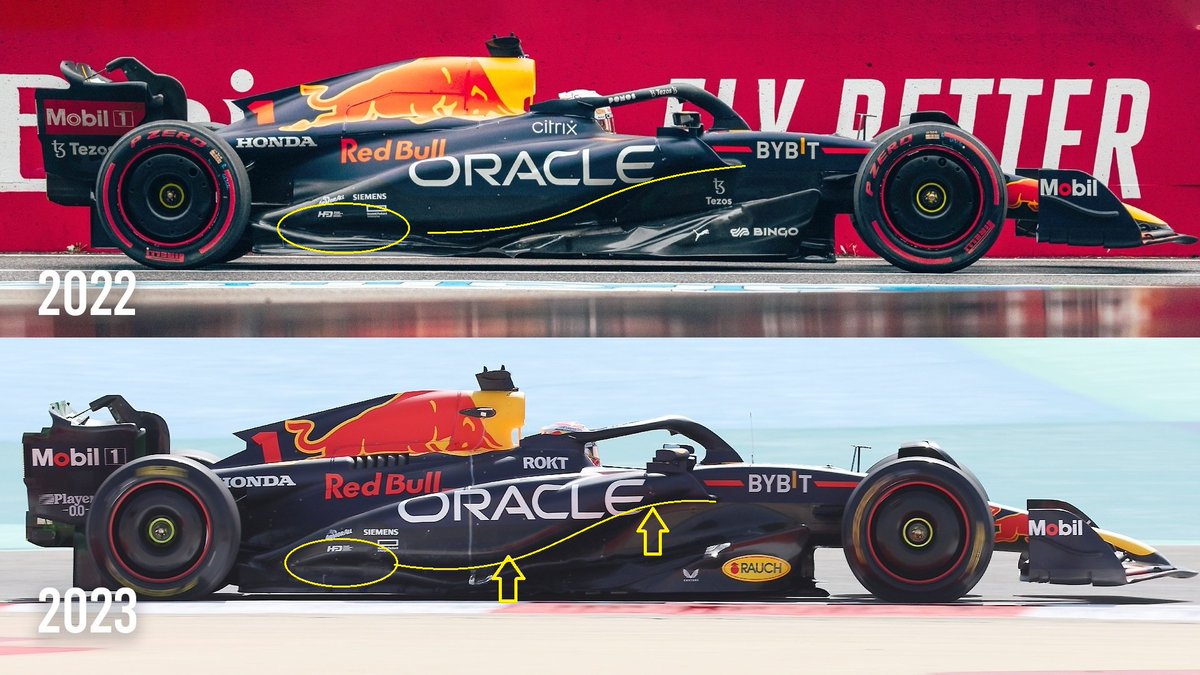
Bigger amount of airflow was allowed under the sidepod intake, only to be pressured with a steeper downward wall. Compared to launch-spec RB18 sidepods (the ones only for testing and never raced) these launch-spec RB19 sides were a lot wider and with a good reason - to optimise outwash and minimise drag penalty.
6
A lot of attention was paid to the rear corner area during pre-season tests, demonstrating the importance of correlation of the flow in this area between WT and CFD results with actual airflow of the car on track. Red Bull made a more aggressive sculpting in this transition area than ever seen on RB18

7
With the 2nd spec of sidepods, RB19 started visually transforming and stepping away from RB18. Obviously, the idea is to increase the amount of air going under the sidepods and through to diffuser and Red Bull was quite literal about it - just lift the inlet higher up step by step
On top of that, reducing the frontal area of the radiator inlet is a drag bonus. A win-win situation, but you need to be careful not to mess up the flow to the radiator or you will cook the car from the inside out - quite literally

On top of that, reducing the frontal area of the radiator inlet is a drag bonus. A win-win situation, but you need to be careful not to mess up the flow to the radiator or you will cook the car from the inside out - quite literally
8
The other thing you now need to do - once you've taken more air in the undercut, you need to do something with it. Red Bull decided they will, by extending the lower outer surface of the sidepod hump they made sure their pressurisation is maximised.
Also, there's a very good chance there is a local venturi throat effect here - increasing the velocity on this curvature surface means lower pressure and this means local downforce!
Also, there's a very good chance there is a local venturi throat effect here - increasing the velocity on this curvature surface means lower pressure and this means local downforce!
9
What started in Baku got finished in Hungary with a further increase of bottom inlet lip height. You'll notice this was accompanied by an increase in inlet width. You need to compensate the loss of height by extending the inlet to maintain the same frontal surface area, right?
Another thing that's happening here to some extent is the added vorticity - the wide and highly angled inlet lip start behaving like a wing tip which forms the wing tip vortex which increases downwash. This means additional airflow to the radiator, allowing a smaller frontal area and cutting the drag with it.
This was the final iteration of sidepods on RB19 and nothing could have prepared us for what happened next
10
In a complete U-turn, Red Bull decided to switch their sidepod design from underbite to overbite inlet. The top lip of the inlet is now extended and the bottom one is retracted.
To do this and reduce the inlet frontal area substantially, RB20 featured small shoulder radiators behind the Halo and larger airbox intake than RB19. They also borrowed Ferrari's 2023 S-duct solution to take some air from along the chassis and use it for cooling

To do this and reduce the inlet frontal area substantially, RB20 featured small shoulder radiators behind the Halo and larger airbox intake than RB19. They also borrowed Ferrari's 2023 S-duct solution to take some air from along the chassis and use it for cooling
11
Taking a further step with this design was adding an extra inlet around the Halo on each side. This was a negative drag trade off in my view, but Red Bull's engineers surely saw some benefits to in making the floor work better.
With several back-and-forth on some floor designs, they never removed this inlets actually, so they worked as expected in the end
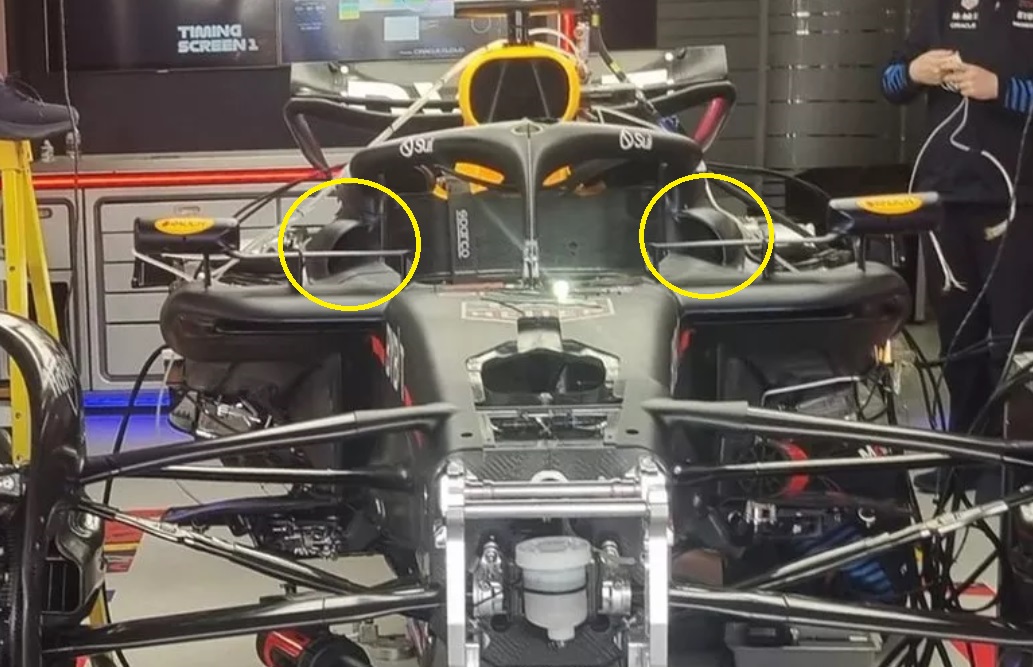
With several back-and-forth on some floor designs, they never removed this inlets actually, so they worked as expected in the end
12
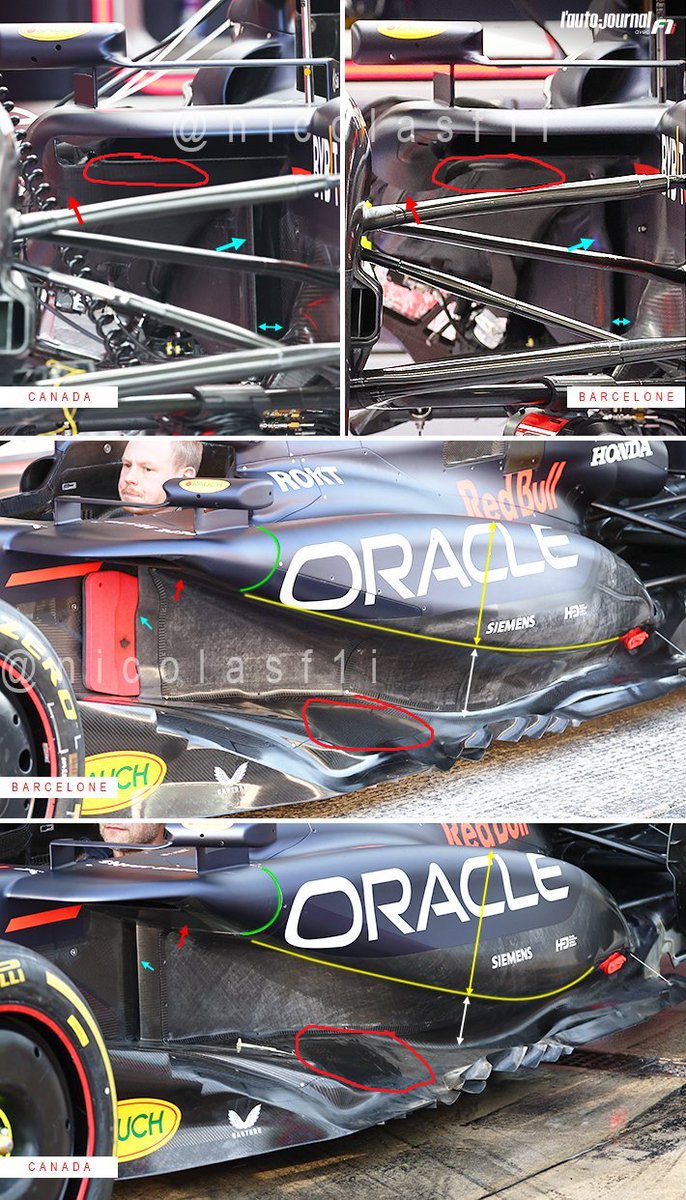
In the next step, sidepods were further slimmed down and there were several small but substantial changes to the inlet area. All of this was beautifully illustrated by the author of the picture bellow @carpentiers_f1
13
The final tweak of RB20 came fairly late in the season, where Red Bull extended the side wall rear further up. Red Bull wasn't the only team tweaking this area in 2024, Ferrari also went back-and-forth here
This is the final post for today, tomorrow I will cover Red Bull Floor Development 2022-2024. On Sunday, I will make a summary on each of these 3 cars and I will share some of my expectations for RB21.
Thanks for reading!
This is the final post for today, tomorrow I will cover Red Bull Floor Development 2022-2024. On Sunday, I will make a summary on each of these 3 cars and I will share some of my expectations for RB21.
Thanks for reading!

