First born children have higher IQ than their siblings. 🧵1/9

Nicholas Fabiano, MD@NTFabiano
60 views
Jan 18, 2025
~1 min read
Advertisement
1
First born children have higher IQ than their siblings.
🧵1/9
🧵1/9
2
These findings are from a study in @PNASNews which examined the long-standing question of whether a person’s position among siblings has a lasting impact on that person’s life course. pnas.org/doi/full/10.10… 2/9
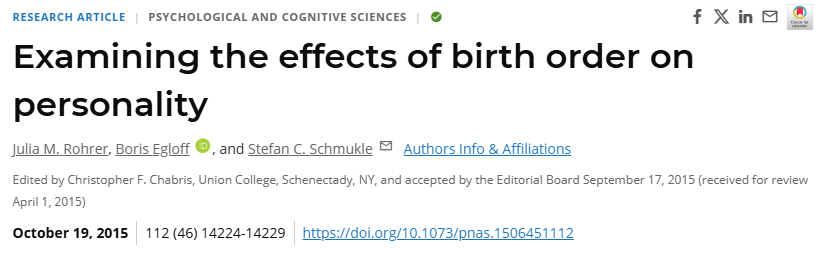
3
The question of whether a person’s position among siblings has a lasting impact on their course has fascinated both the scientific community and the general public for over 100 years. 3/9
4
On the basis of evolutionary considerations, in 1996, Frank Sulloway argued that adapting to divergent roles within the family system reduces competition and facilitates cooperation, potentially enhancing a sibship’s fitness—thus, siblings are like Darwin’s finches. 4/9

5
Birth order reflects disparities in age, size, and power and should therefore determine the niches that siblings occupy within the family system. 5/9
6
These specific adaptations to family dynamics are assumed to translate into stable intelligence and personality differences between siblings that depend on birth order. 6/9
7
In this study, there was an observed effect of ∼1.5 IQ points (i.e., 10% of a SD) for each increase in birth-order position. 7/9
8
Most important, however, there consistently were no birth-order effects on extraversion, emotional stability, agreeableness, conscientiousness, or imagination. 8/9

9
Overall, on the basis of the high statistical power and the consistent results across samples and analytical designs, it was concluded that birth order does not have a lasting effect on broad personality traits outside of the intellectual domain. 9/9
10
Read more about walking speed and IQ:

11
Conflicts of interest: I am a first born