This is Dr. Nathan Bryan. A biochemist recruited by a Nobel...

no.mind@the_no_mind
2 views
Nov 17, 2026
~29 min read
Advertisement
1
This is Dr. Nathan Bryan.
A biochemist recruited by a Nobel laureate, with 25+ years studying nitric oxide.
His message? Losing nitric oxide is the earliest event in heart disease, diabetes & Alzheimer’s.
Here’s what destroys it & how to restore it without supplements: 🧵

A biochemist recruited by a Nobel laureate, with 25+ years studying nitric oxide.
His message? Losing nitric oxide is the earliest event in heart disease, diabetes & Alzheimer’s.
Here’s what destroys it & how to restore it without supplements: 🧵
2
1/ Bryan: “Loss of nitric oxide is the earliest event in the onset and progression of most, if not all, chronic diseases.”
It sits upstream of blood flow, blood pressure, insulin signaling, mitochondrial function, stem-cell mobilization, telomere maintenance, immune defense, sexual function & blood flow to the brain.
Its loss shows up years, even decades, before the disease it causes gets diagnosed.
Erectile dysfunction, which affects about 40% of men by age 40.
High blood pressure, which affects about half of American adults.
Insulin resistance. Getting out of breath on the stairs. Memory starting to slip.
Nathan Bryan is a biochemist who has spent more than 25 years researching nitric oxide.
In 2006, he was recruited to the University of Texas by Ferid Murad, one of three scientists who won the 1998 Nobel Prize for discovering that nitric oxide acts as a signal in the body.
Yet very few people, including the physicians treating patients, know about it.
Louis Ignarro, another of the three Nobel laureates, once told Bryan that figuring out how to restore nitric oxide would revolutionize medicine.
Most people don’t need to chase nitric oxide.
They need to stop destroying the pathways their body already uses to make it.
1:10
3
2/ Nitric oxide is a gas that tells your blood vessels to relax, then disappears in under a second. Nathan Bryan used it to heal wounds that hadn't closed in 4 years.
Nitric oxide is a molecule made of one atom of nitrogen & one atom of oxygen.
Your body produces it as a gas.
People often confuse it with nitrous oxide, the laughing gas at the dentist. They are different molecules.
When a cell releases nitric oxide, the gas passes straight into the cells next to it & delivers a signal.
Then, in less than a second, the gas is gone.
In your blood vessels, that signal tells the muscle in your artery walls to relax.
The vessel widens. More blood, oxygen & nutrients reach your tissues. Blood pressure comes down.
Nitric oxide also protects the inside of your arteries. It stops platelets from clumping & keeps immune cells from sticking to artery walls, which reduces plaque buildup.
Outside your blood vessels, nitric oxide is required for insulin to move glucose into your cells.
Nitric oxide also tells immune cells to kill bacteria, & it lets brain cells communicate.
Nitric oxide is one of the main ways your cells talk to each other.
That is why losing it touches so many diseases at once.
Scientists only discovered nitric oxide’s role in the body in the late 1970s & early 1980s.
It is one of the newest discoveries in medicine.
Nathan Bryan has seen what restoring nitric oxide can do firsthand.
In 1984, his father was paralyzed in a car accident.
Decades later, he developed severe pressure ulcers that standard medicine failed to close for 4 years.
Bryan formulated a topical nitric oxide serum to restore blood flow to the tissue and kill the infection.
Within 6 months, the wound had completely healed.
2:04
4
3/ Your body relies on two distinct pathways to make nitric oxide: one inside your blood vessels and one through your mouth and stomach.
The first pathway runs inside your blood vessels.
The second starts in your mouth & finishes in your stomach.
Pathway 1: your blood vessels
Every blood vessel is lined with a single layer of cells called the endothelium.
Those cells contain an enzyme — endothelial nitric oxide synthase, or eNOS.
eNOS converts an amino acid — L-arginine — into nitric oxide.
eNOS also needs oxygen to make it.
Here is how it works:
Blood moves across the vessel wall.
That friction — shear stress — switches eNOS on.
Nitric oxide is released.
The muscle around the artery relaxes.
The artery widens.
Blood flow increases.
But this pathway weakens with age.
Nathan Bryan puts the decline at roughly 10–12% per decade.
As it fades, your blood vessels lose their ability to relax & widen.
Pathway 2: your mouth & stomach
The second pathway starts with food.
Green leafy vegetables & root vegetables like beets contain nitrate.
After you eat them, the nitrate is absorbed in your gut.
Your salivary glands then pull that nitrate back out of your blood & concentrate it.
Within about 90 minutes, the nitrate in your saliva is up to 100 times higher than in your blood.
Bacteria living in the crypts of your tongue convert that nitrate into nitrite.
The bacteria keep converting it for several hours, every time you salivate.
Then you swallow.
Your stomach acid turns the nitrite into nitric oxide gas.
That last step requires an acidic stomach.
So the chain looks like this:
Nitrate → oral bacteria → nitrite → stomach acid → nitric oxide
Nitrate and nitrite sound almost identical, and most people confuse them.
Nitrate is what you eat. Nitrite is what bacteria on your tongue make from it.
Humans lack the enzyme to convert nitrate themselves, so your body relies on bacteria living on your tongue to turn nitrate into nitrite.
You swallow that nitrite, & your stomach acid converts it into nitric oxide.
Without the right bacteria in your mouth, the nitrate in your vegetables does nothing.
You can see this in critically ill patients who are intubated & tube-fed.
Because they are not eating through the mouth, they are not chewing, moving food through saliva or swallowing it normally.
The food bypasses the mouth, so these patients get no nitric oxide from this pathway at all.
That is why your mouth & stomach matter so much.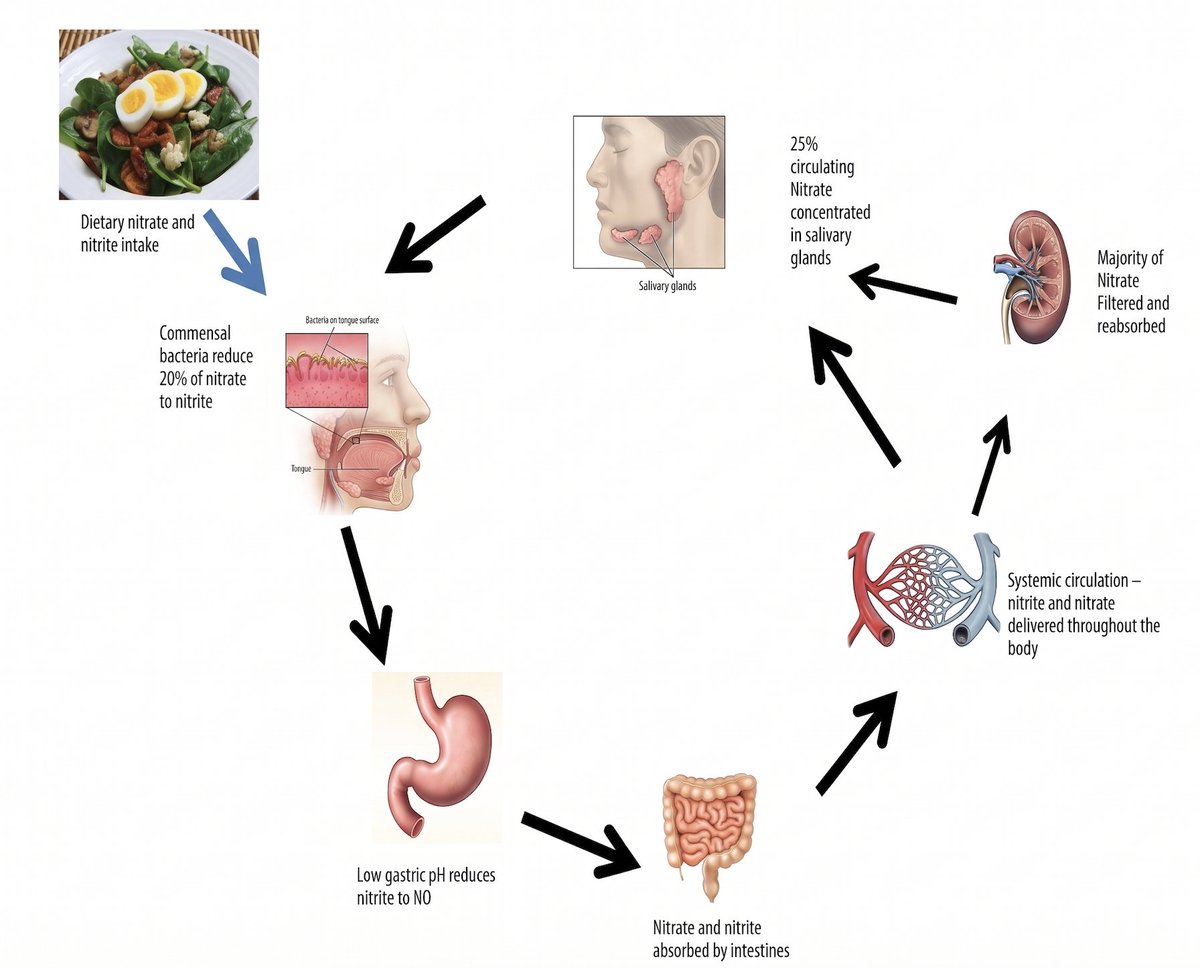
The first pathway runs inside your blood vessels.
The second starts in your mouth & finishes in your stomach.
Pathway 1: your blood vessels
Every blood vessel is lined with a single layer of cells called the endothelium.
Those cells contain an enzyme — endothelial nitric oxide synthase, or eNOS.
eNOS converts an amino acid — L-arginine — into nitric oxide.
eNOS also needs oxygen to make it.
Here is how it works:
Blood moves across the vessel wall.
That friction — shear stress — switches eNOS on.
Nitric oxide is released.
The muscle around the artery relaxes.
The artery widens.
Blood flow increases.
But this pathway weakens with age.
Nathan Bryan puts the decline at roughly 10–12% per decade.
As it fades, your blood vessels lose their ability to relax & widen.
Pathway 2: your mouth & stomach
The second pathway starts with food.
Green leafy vegetables & root vegetables like beets contain nitrate.
After you eat them, the nitrate is absorbed in your gut.
Your salivary glands then pull that nitrate back out of your blood & concentrate it.
Within about 90 minutes, the nitrate in your saliva is up to 100 times higher than in your blood.
Bacteria living in the crypts of your tongue convert that nitrate into nitrite.
The bacteria keep converting it for several hours, every time you salivate.
Then you swallow.
Your stomach acid turns the nitrite into nitric oxide gas.
That last step requires an acidic stomach.
So the chain looks like this:
Nitrate → oral bacteria → nitrite → stomach acid → nitric oxide
Nitrate and nitrite sound almost identical, and most people confuse them.
Nitrate is what you eat. Nitrite is what bacteria on your tongue make from it.
Humans lack the enzyme to convert nitrate themselves, so your body relies on bacteria living on your tongue to turn nitrate into nitrite.
You swallow that nitrite, & your stomach acid converts it into nitric oxide.
Without the right bacteria in your mouth, the nitrate in your vegetables does nothing.
You can see this in critically ill patients who are intubated & tube-fed.
Because they are not eating through the mouth, they are not chewing, moving food through saliva or swallowing it normally.
The food bypasses the mouth, so these patients get no nitric oxide from this pathway at all.
That is why your mouth & stomach matter so much.
5
4/ Your blood vessels lose nitric oxide with age. Your mouth & stomach don’t.
The decline in your blood vessels shows up decade by decade.
In one Italian study, people aged 31 to 45 had 11% weaker blood vessel widening than those 30 & under.
At 46 to 60, it was another 13% weaker.
After 60, another 28%.
Added up, people over 60 had roughly 44% weaker blood vessel widening than people 30 & under.
In another study, a 23-year-old’s coronary artery expanded to more than five times its width when stimulated.
A 70-year-old’s expanded a little more than two times.
The reason is oxidative stress.
eNOS, the enzyme that makes nitric oxide in your blood vessels, needs a helper molecule called BH4 to work properly.
Oxidative stress damages BH4.
Without it, the enzyme stops making nitric oxide & starts producing superoxide, a damaging free radical, instead.
You didn’t just stop producing a protective molecule.
The machinery itself flipped direction.
The enzyme that should protect your blood vessels now adds to the oxidative stress.
That creates a vicious cycle:
Uncoupled eNOS → superoxide → more oxidative stress → more BH4 damage → even less nitric oxide.
1:14
6
5/ Nitric oxide influences 3 major mechanisms of longevity: stem cells, telomeres & mitochondria.
As you age, dietary nitrate & oral bacteria become increasingly important for maintaining it.
First, stem cells.
Nitric oxide signals stem cells in your bone marrow & fat to wake up, travel & repair damaged tissue.
Second, telomeres.
Nitric oxide activates telomerase, the enzyme that keeps your telomeres, the protective ends of your chromosomes, from shortening.
Third, mitochondria.
Nitric oxide tells your cells to build new mitochondria, & helps them make more energy with less oxygen.
As nitric oxide falls, the losses stack:
Less nitric oxide → less blood flow → weaker repair → fewer, less efficient mitochondria
But the decline only hits one pathway.
According to Bryan, the mouth-and-stomach pathway does not decline with age, as long as you preserve it.
Peter Anderson, a citizen scientist who publishes research on atherosclerosis & eNOS, adds a second reason this matters.
The nitrate pathway doesn’t use eNOS at all.
When age or disease has uncoupled the enzyme, the pathway through your mouth & stomach still produces nitric oxide.
Which is why, as the blood vessel pathway fades, older people have to rely more & more on nitrate from their diet.
The older you get, the more your nitric oxide depends on what you eat & on the bacteria in your mouth.
3:09
7
6/ Erectile dysfunction is often the first sign your blood vessels are losing nitric oxide.
According to Nathan Bryan, sexual dysfunction is the earliest outward sign of nitric oxide loss, in both men & women.
And it is common.
About 40% of men are affected by erectile dysfunction by age 40.
Bryan believes the real number is higher because many men will not admit it.
The mechanism is straightforward.
An erection is a blood flow event.
Nitric oxide tells the muscle around the arteries of the penis to relax.
The arteries widen. Blood flows in. The tissue fills.
In women, nitric oxide plays the same role in engorgement, lubrication & orgasm.
Bryan argues that sexual function reveals nitric oxide loss early because an erection requires blood vessels to widen rapidly, on demand.
When nitric oxide falls, that response begins to fail.
Unlike the early changes happening silently inside your arteries, erectile dysfunction is difficult to ignore.
And the damage is not isolated to one part of the body.
If eNOS is uncoupled in the arteries of the penis, Bryan says the same dysfunction is present in the arteries of your heart, brain & kidneys.
Erectile dysfunction is the canary in the coal mine for heart disease.
This also explains why Viagra does not work for everyone.
Viagra does not make nitric oxide.
Nitric oxide activates a messenger molecule called cyclic GMP, which relaxes the smooth muscle around the blood vessels.
An enzyme called PDE-5 breaks cyclic GMP down.
Viagra blocks PDE-5, allowing the signal to last longer.
But it can only prolong a signal that already exists.
If nitric oxide production is low, there is little signal to prolong.
Bryan says this is why Viagra fails in about half of the people who take it.
Viagra amplifies the nitric oxide signal. It does not restore the nitric oxide that is missing.
3:40
8
7/ Losing nitric oxide shows up as high blood pressure, diabetes, heart disease & Alzheimer’s.
According to Nathan Bryan, 8 of the 10 leading causes of death in the US have a clear mechanism involving nitric oxide.
1) High blood pressure
Nitric oxide controls how relaxed or constricted your blood vessels are.
When nitric oxide is available, vessels relax & widen.
When nitric oxide falls, they tighten.
The same volume of blood now has to move through a smaller space, so blood pressure rises.
More than half of people taking blood pressure medication get no response from it.
Bryan says that is because the drugs don’t address the missing nitric oxide.
2) Insulin resistance & type 2 diabetes
Bryan’s lab showed in 2011 that insulin needs nitric oxide to work.
For glucose to move from your blood into your cells, a transporter called GLUT4 has to travel to the surface of the cell.
Without nitric oxide, GLUT4 never reaches the cell surface.
Glucose stays in the blood. Blood sugar rises. Insulin rises with it.
Bryan says the result is high blood sugar, high insulin & inflamed blood vessels.
This is why Bryan treats insulin resistance & nitric oxide loss as two sides of the same problem.
3) Heart disease
Peter Anderson, a citizen scientist who publishes research on atherosclerosis & eNOS describes nitric oxide production as a bank account.
High blood pressure, smoking, insulin resistance, obesity, stress, poor sleep & age all draw it down.
His argument is simple: if you could keep youthful nitric oxide levels your whole life, the damage to your artery lining could never start.
Because nitric oxide does far more than widen arteries.
According to Bryan, it also reduces inflammation & oxidative stress inside the vessel wall, prevents smooth muscle from overgrowing, keeps platelets from clumping & stops immune cells from sticking to the artery lining.
That becomes especially important in atherosclerosis, the buildup of plaque in your arteries.
A heart attack is not simply an artery slowly clogging until blood can no longer get through.
Often, soft unstable plaque ruptures.
Platelets rush to the site.
A clot forms.
The artery gets blocked.
50% of sudden cardiac deaths happen in people whose arteries are less than 50% blocked.
Nitric oxide helps keep plaque stable while suppressing the inflammation, immune activity & platelet aggregation that can turn a rupture into a clot.
4) Alzheimer’s
Bryan applies the same model to Alzheimer’s & vascular dementia.
In his view, both involve focal ischemia: specific regions of the brain that don’t get enough blood.
He also describes Alzheimer’s as insulin resistance inside the brain.
Low nitric oxide worsens both problems.
Less blood reaches those regions.
Less glucose gets into the brain cells.
Bryan argues that restoring nitric oxide can therefore address both at once: improve blood flow to the brain & improve glucose uptake.
Viagra points in the same direction.
It keeps the nitric oxide signal active longer & increases blood flow.
Long-term Viagra users show lower rates of Alzheimer’s & vascular dementia.
5) Low stamina
The same blood-flow problem shows up much earlier in everyday life.
Less nitric oxide means less blood flow.
Less blood flow means less oxygen reaching your muscles.
You get out of breath sooner, even climbing stairs.
6) Infections
Nitric oxide also plays a direct role in immune defense.
It shuts down bacterial respiration & stops viruses from copying themselves inside your cells.
So if losing nitric oxide sits upstream of all of this, can restoring it slow the damage, or even reverse some of it?
Bryan’s research suggests that it can.
His lab was the first to show that removing nitrate & nitrite from the diet made heart attack injury worse, while restoring them reversed the effect.
And in his trials on early vascular dementia, the goal is to stop progression at worst & reverse it at best.
2:28
9
8/ Excess sugar shuts down nitric oxide production in three ways: glycation, oxidative stress & disruption of your oral microbiome.
Nathan Bryan describes sugar as glue.
When blood glucose stays elevated, it binds to proteins & changes their structure. This is called glycation.
HbA1c, the standard long-term blood sugar test, measures glucose bound to hemoglobin.
According to Bryan, glucose also binds to eNOS, the enzyme that produces nitric oxide in your blood vessels.
The enzyme needs to change shape to transfer electrons & produce nitric oxide.
Glycation locks it in place, preventing it from doing its job.
But that's only the first mechanism.
Second, oxidative stress.
eNOS needs a helper molecule called BH4 to function properly.
Excess sugar increases oxidative stress, which damages BH4.
Without it, eNOS becomes uncoupled.
Instead of producing nitric oxide, it starts producing superoxide, a damaging free radical.
That creates a vicious cycle:
High blood sugar → oxidative stress → BH4 damage → eNOS uncoupling → more superoxide → less nitric oxide.
Third, your oral microbiome.
Excess sugar also changes the bacterial environment in your mouth.
It favors acid-producing bacteria that disrupt the nitrate-reducing bacteria your body needs to convert dietary nitrate into nitrite.
So sugar interferes with both pathways: nitric oxide production in your blood vessels & the nitrate pathway through your mouth.
And the consequences feed back into blood sugar regulation.
Nitric oxide is involved in insulin signaling & the movement of GLUT4 transporters to the cell surface.
Less nitric oxide means impaired glucose uptake, higher blood sugar & further glycation.
Bryan's rule is simple: cut the sugar.
2:22
10
9/ Antiseptic mouthwash raises your blood pressure by killing the bacteria that make nitric oxide.
Most nitric oxide advice starts with what to add.
Nathan Bryan starts with what to remove.
His philosophy is simple: give the body what it needs, remove what it doesn’t, & the body heals itself.
For nitric oxide, that means removing four things: antiseptic mouthwash, fluoride, acid-blocking drugs & sugar.
Each one breaks nitric oxide production at a different point.
Bacteria in the crypts of your tongue turn the nitrate from vegetables into nitrite.
Without them, your body can’t use that nitrate.
Antiseptic mouthwash kills them.
And once they are gone, the chain collapses:
Mouthwash → fewer oral bacteria → less nitrite in your saliva → less nitrite in your blood → higher blood pressure.
Bryan’s own research shows this.
In a 2019 study he co-authored, healthy adults used an antiseptic mouthwash twice a day for 7 days.
Their blood pressure rose.
In interviews, Bryan describes one participant, a 21-year-old triathlete, whose blood pressure jumped by 21 mmHg in that single week.
Bryan estimates that 30 to 40% of people already lack the right oral bacteria, mainly because of antibiotics & antiseptic mouthwash.
In 2011, 188.2 million Americans used mouthwash.
Most people use it to fight bad breath.
But bad breath itself is a sign of dysbiosis: the beneficial bacteria have been disrupted, allowing odor-producing bacteria to overgrow.
Antiseptic mouthwash may mask the smell temporarily, but by killing the beneficial bacteria that normally keep those organisms in check, it makes the underlying imbalance worse.
The good news is that the oral microbiome recovers fast.
Stop using mouthwash, & your oral bacteria repopulate within about 4 days.
1:48
11
10/ Fluoride in your toothpaste kills the bacteria your body needs to make nitric oxide.
Fluoride is in most toothpastes, & about 72% of Americans served by community water systems receive fluoridated water.
Nathan Bryan says it is added for one reason: it is an antiseptic.
And an antiseptic doesn’t choose.
Fluoride kills the harmful bacteria in your mouth, & it kills the nitrate-reducing bacteria you need.
That shuts down the oral pathway, & blood pressure rises.
Bryan’s concerns go beyond the mouth.
He calls fluoride a neurotoxin.
The National Toxicology Program concluded with moderate confidence that higher fluoride exposure, such as above 1.5 mg/L, is associated with lower IQ in children.
It says the evidence is insufficient to determine whether the U.S. target of 0.7 mg/L affects IQ.
Bryan also calls it a thyroid disruptor.
Fluoride is a halogen, like iodine.
It competes with iodine in the thyroid & blocks the conversion of the thyroid hormone T4 into its active form, T3.
The result is hypothyroidism.
And according to Bryan, you don’t need to swallow it.
Fluoride is a tiny molecule, so it absorbs straight through the lining of your mouth.
The toothpaste tube tells you how seriously to take it.
For children under 6, the label instructs parents to use a pea-sized amount to minimize swallowing.
It also says: “If more than used for brushing is accidentally swallowed, get medical help or contact a Poison Control Center right away.”
By Bryan’s math, a pea-sized amount is about 0.5 mg of fluoride. Most people cover the entire brush, which is 10 to 20 times that dose, 5 to 10 mg per brushing.
Bryan also points out that sodium fluoride is the active ingredient in rat poison.
1:48
12
11/ Proton pump inhibitors (PPIs), commonly used for acid reflux, shut down both pathways your body uses to produce nitric oxide.
When you eat nitrate-rich vegetables, bacteria on your tongue convert nitrate into nitrite.
You then swallow that nitrite, & your stomach acid turns it into nitric oxide.
That last step needs a very acidic stomach, a pH below 3 for full nitric oxide production.
PPIs are drugs like Prilosec & Prevacid.
Their entire job is to shut down stomach acid.
No acid, no nitric oxide from that pathway.
But PPIs also hit your blood vessels.
Your blood contains a compound called ADMA that shuts down eNOS, the enzyme that makes nitric oxide in your blood vessel walls.
Normally, an enzyme called DDAH clears ADMA away.
According to Nathan Bryan, PPIs block DDAH.
So ADMA builds up in your blood, & eNOS in your blood vessel walls shuts down.
That means PPIs hit both nitric oxide pathways at once: they remove the stomach acid the mouth-and-stomach pathway needs, while also suppressing eNOS activity in your blood vessels.
That shows up in the long-term numbers.
According to Bryan, people who take PPIs for 3 to 5 years have a 30 to 40% higher incidence of heart attacks, strokes & Alzheimer’s disease.
That matters because of how PPIs are actually used.
PPIs are the third-largest drug class in the world.
Bryan argues that they were designed primarily for short-term use.
The FDA says over-the-counter PPIs are intended for 14-day courses, up to three times per year.
Once they went over the counter, millions of people started taking them daily for 10, 20, even 30 years.
That is why Bryan calls them potentially the most dangerous drugs on the market for long-term use.
If you have been on a PPI for years, Bryan does not recommend stopping cold.
He recommends tapering off slowly, while taking a tablespoon of apple cider vinegar before meals to bring the stomach’s acidity back.
4:09
13
12/ To get the full blood pressure & performance benefits of nitrate from food, you need 300–500 mg in a single serving.
More than 80% of dietary nitrate comes from leafy & root vegetables.
Only about 5% comes from cured meat.
The highest-nitrate foods Nathan Bryan lists:
Arugula. Bok choy. Spinach. Kale. Beets. Cabbage. Celery.
But eating these vegetables does not guarantee you are eating enough nitrate.
When Bryan’s lab measured celery bought in 5 US cities, nitrate levels differed by 50 to 80 times.
The difference came from the soil, geography & even lightning storms, which fix nitrogen from the air into the ground.
The dose matters too.
Bryan says the clinical trials show you need about 400 mg of nitrate in a single serving.
The average American gets 40 to 100 mg a day.
And spreading small amounts across the day doesn’t work.
By Bryan’s math, only about 25% of the nitrate you eat gets concentrated in your saliva.
The bacteria on your tongue convert about 20% of that.
So 100 mg of nitrate at a meal ends up as only about 5 mg of nitrite.
That is not enough to widen your blood vessels.
A single large serving is different.
About 90 minutes later, the nitrate is concentrated in your saliva, & your body keeps producing nitric oxide for the next 6 to 10 hours.
That is why most nitric oxide research uses beetroot juice: the nitrate dose can be standardized.
In healthy adults, a single bottle lowers blood pressure 6 hours later.
Across studies, blood pressure drops by 2 to 10 mmHg, & exercise performance improves by 2 to 16%.
Bryan says the same nitrate explains the benefits of the vegetarian, Mediterranean, Japanese & DASH (Dietary Approaches to Stop Hypertension) diets.
The DASH diet can deliver up to 1,000 mg a day.
Traditional Japanese diets reach 1,500 to 2,000 mg.
Personally, I apply the same seasonal rule I use for the rest of my diet.
I live in Poland.
Beetroot is a staple of Polish cuisine.
It is harvested in autumn, stored through the winter & you can get it in almost any bar mleczny.
Polish monitoring puts beetroot at around 1,260 mg of nitrate per kilo.
Black radish, another traditional Polish winter root, is just as high.
In Germany, where I lived for a long time, Feldsalat, or lamb’s lettuce, grows outdoors through the winter & survives temperatures down to -15 °C
It is also among the highest in nitrate, at 1,900 to 2,500 mg per kilo.
Arugula is one of the most nitrate-rich greens there is.
But arugula is an Italian summer green.
It doesn’t grow in Poland in winter, so I don’t eat it then.
You don’t need to import an Italian summer into Warsaw in January.
In practice, 400 mg of nitrate in one serving looks like about 200 g of Feldsalat, or about 300 g of beetroot.
When I lived in Berlin, I made a big bowl of salad with dinner most evenings: Feldsalat, beets, a few walnuts, feta or burrata, lemon juice & extra virgin olive oil.
Two of the highest-nitrate winter foods in one bowl.
Choose the nitrate-rich vegetables that grow where you live, in the season you are in.
You might be avoiding oxalates.
If so, you still have low-oxalate, nitrate-rich options such as arugula, bok choy, kale & cabbage.
2:13
14
13/ Nitrate feeds the bacteria on your tongue that make nitric oxide. Chewing food, tongue scraping & avoiding unnecessary antibiotics help protect them.
According to Nathan Bryan, nitrate-reducing bacteria use nitrate as fuel to survive & settle on your tongue.
Eat too little nitrate, & they starve out.
The nitrite they produce also suppresses harmful bacteria.
So nitrate-rich greens feed the bacteria you need & push back the bacteria you don’t.
Bryan describes dietary nitrate as a prebiotic for your mouth.
But diet is only part of it.
His recommendations:
- Use fluoride-free toothpaste. One option is nano-hydroxyapatite, which remineralizes enamel without fluoride.
- Scrape your tongue. Bryan recommends a copper tongue scraper. He compares it to tilling the soil because it increases bacterial diversity.
- Chew your food. Chewing keeps food & saliva in your mouth longer, giving bacteria more time to convert nitrate into nitrite.
- Don't overuse antibiotics. They can wipe out the oral bacteria your body relies on.
One combination is particularly bad:
Scraping your tongue & then using antiseptic mouthwash.
Bryan says this drives mouthwash deeper into the freshly exposed tissue of your tongue.
He calls it the worst-case scenario.
1:55
15
14/ Breathing through your nose delivers nitric oxide straight to your lungs.
Every breath through your nose carries nitric oxide into your lungs.
Every breath through your mouth doesn’t.
The cells lining your nose & sinuses make nitric oxide themselves.
As air moves through your nose, they release nitric oxide into the air you breathe in.
That nitric oxide travels down into your lungs, where it widens your airways & the blood vessels around them.
More oxygen gets into your blood, & blood pressure comes down.
Nasal breathing → nitric oxide from your sinuses → wider airways & lung blood vessels → more oxygen in your blood.
Mouth breathing bypasses that nasal nitric oxide.
At night, it causes a second problem.
According to Nathan Bryan, it dries out your mouth, floods it with oxygen & drops the pH of your saliva.
That promotes tooth decay & gum disease, & it shuts down the bacteria that turn nitrate into nitrite.
Mouth breathing at night does to your oral bacteria what mouthwash does during the day.
Sleep apnea creates a separate problem.
Bryan says eNOS needs oxygen to mobilize stem cells for tissue repair while you sleep. When oxygen drops at night, as it does in sleep apnea, stem cell mobilization shuts down.
This is one reason I have used mouth tape for a long time. It keeps me breathing through my nose while I sleep.
Bryan is a big fan of mouth taping, provided your airway is physically open & unobstructed.
He explicitly warns against taping your mouth if you have obstructive sleep apnea or a structural airway blockage, such as a receded jaw.
In those cases, taping can cut off your air supply & cause severe drops in oxygen.
If you cannot breathe freely through your nose, fix the airway first.
Humming also raises nasal nitric oxide, & so does chanting “Om.” The vibration & airflow increase nitric oxide release from your sinuses.
Breathing through your nose protects two nitric oxide sources at once: your nose & your tongue.
2:09
16
15/ Exercise switches on the nitric oxide pathway that fades with age.
Exercise is the most direct way to switch the blood vessel pathway back on.
A workout makes your blood move fast.
The faster blood moves across the vessel wall, the more shear stress it creates, & shear stress switches on eNOS, the enzyme that makes nitric oxide in your blood vessels.
Exercise raises nitric oxide immediately, then changes your mitochondria over time.
During the workout, nitric oxide widens your blood vessels.
More oxygen & nutrients reach your working muscles, & more lactic acid gets flushed out.
According to Nathan Bryan, nitric oxide also helps your mitochondria make more energy with less oxygen.
Exercise also builds up nitrite in your blood, creating a reserve your body can use when oxygen gets low.
Once you push past your anaerobic threshold — the intensity where your muscles run low on oxygen — the stored nitrite converts back into nitric oxide.
Bryan says this extends your endurance & reduces lactic acid buildup.
Over weeks & months, the repeated nitric oxide signal tells your cells to build new mitochondria.
Exercise switches on the pathway that age switches off.
The dose Bryan recommends is modest.
He used to say 20 to 30 minutes of moderate exercise a day.
Now he says 4 to 5 minutes of high-intensity intervals a day is enough to switch on eNOS.
One habit cancels the blood pressure benefit of a workout.
Antiseptic mouthwash after exercise abolishes the blood pressure drop the workout normally produces.
The blood vessel pathway does its job during the workout, & the mouthwash shuts down the mouth pathway right after.
0:34
17
16/ Sunlight releases nitric oxide stored in your skin.
Your skin holds a reserve of nitric oxide.
Sunlight is what releases it.
In your skin, nitric oxide is stored bound to two things: sulfur-containing parts of proteins, called thiols, & metals in the tissue.
Different wavelengths of light free it from each.
UV light breaks nitric oxide loose from the thiols.
Red & infrared light free nitric oxide bound to metals.
Once released, that nitric oxide enters your circulation, widens your blood vessels & lowers your blood pressure.
Sunlight → nitric oxide released from your skin → wider blood vessels → lower blood pressure.
According to Peter Anderson, a citizen scientist who publishes research on atherosclerosis & eNOS, those skin stores depend on how much nitrate you eat over the long term.
He points to experiments where mice were placed on a completely nitrate-free diet.
In that state, sunlight could no longer rescue nitric oxide production.
His point is that sunlight can release nitric oxide already stored in the skin, but long-term dietary nitrate replenishes the reservoir.
Nathan Bryan recommends 20 to 30 minutes of morning sunlight a day.
The same molecule also protects the skin that releases it.
According to Bryan, nitric oxide helps limit skin damage from the sun.
Sunlight is a free way to release nitric oxide your body already stores.
1:03
18
17/ High-dose L-arginine can make nitric oxide production worse. L-citrulline doesn't fix the underlying problem either.
The obvious shortcut goes like this.
eNOS, the enzyme in your blood vessels, makes nitric oxide from L-arginine, an amino acid you get from protein.
So more L-arginine should mean more nitric oxide.
According to Nathan Bryan, that logic fails.
Your body is never deficient in L-arginine. It gets plenty from the protein you eat.
The problem is the enzyme.
With age & oxidative stress, eNOS uncouples & starts producing superoxide instead of nitric oxide.
Give an uncoupled enzyme more L-arginine, & it produces more superoxide.
The clinical trials show the damage.
When patients who had survived a heart attack were given high-dose L-arginine, more of them died than on placebo.
The trial was stopped early.
When patients with peripheral artery disease were given L-arginine, their claudication, the leg pain that comes from poor blood flow when walking, got worse.
There is a second problem.
High doses of L-arginine activate an enzyme called arginase, which sends L-arginine down a different pathway into urea, a waste product your kidneys excrete in urine, instead of into nitric oxide.
Compare that with nitrate.
In patients with peripheral artery disease, L-arginine did nothing for exercise performance.
Nitrate improved it.
L-citrulline does not solve the underlying problem either.
L-citrulline is an amino acid your body produces naturally.
It is also the byproduct eNOS leaves behind when it makes nitric oxide from L-arginine, & your body already makes plenty of it.
Bryan calls supplementing it unnecessary & a waste of money.
If sugar has locked up eNOS or oxidative stress has uncoupled it, adding more L-arginine or L-citrulline does not repair the enzyme.
Low nitric oxide comes from a damaged enzyme & a broken pathway. More amino acids fix neither.
4:33
19
18/ Bottom line:
Your blood vessels produce nitric oxide through eNOS.
Your mouth & stomach convert dietary nitrate into nitric oxide.
Your nose adds nitric oxide when you breathe through it.
Your skin releases stored nitric oxide when sunlight hits it.
What shuts nitric oxide production down:
- Mouthwash & fluoride kill the bacteria that convert nitrate into nitrite.
- Acid blockers remove the stomach acid the nitrate pathway needs & interfere with eNOS in your blood vessels.
- High blood sugar locks up eNOS.
- Mouth breathing bypasses nitric oxide from your sinuses & disrupts the oral bacteria that make nitrite.
What switches nitric oxide production on:
- Nitrate-rich greens provide the raw material.
- Exercise creates shear stress & switches on eNOS.
- Nasal breathing delivers nitric oxide from your sinuses into your lungs.
- Sunlight releases the nitric oxide stored in your skin.
Greens, exercise, nasal breathing & sunlight work through machinery your body already has, with no supplement stack required.
Nathan Bryan’s own day looks a lot like my blueprint:
- Fasts 18 hours a day, with his last meal at 6 p.m.
- Wakes between 5–5:30 a.m. & drinks coffee with a fermented beet shot from his own company (I skip both).
- Does 200 push-ups & 200 squats. Started at 100 each & doubled once it got easy.
- Spends 30 minutes in an infrared sauna at 76°C (169°F), followed by a 3-minute cold plunge at 3°C (37°F). (I prefer a Finnish sauna.)
- Spends 15–20 minutes outside watching the sunrise & works out barefoot in his yard.
Nitric oxide is not a silver bullet. There is no such thing as a silver bullet.
But it sits where many of your body’s systems meet: blood flow, blood pressure, insulin signaling, mitochondria, stem cells, telomeres, immune defense & sexual function.
Bryan follows his own advice.
At 51, his vascular age measured that of a 36-year-old.
He says he hasn’t been sick from an infection in more than 20 years.
Your body already knows how to make nitric oxide. The job is to stop getting in its way.
0:58
20
Thanks for reading.
If you found this valuable, repost the first tweet so more people can access this information.
Follow @the_no_mind for health & energy insights you won’t find anywhere else.
If you found this valuable, repost the first tweet so more people can access this information.
Follow @the_no_mind for health & energy insights you won’t find anywhere else.
21
P.S. Nitric oxide is only one piece of the puzzle.
If you want to understand the complete biological framework behind mitochondrial energy & how to apply it daily, I built a free 5-day email course.
No supplements. Just biology you can put into practice.
Get it here ↓
energy.no-mind.io
If you want to understand the complete biological framework behind mitochondrial energy & how to apply it daily, I built a free 5-day email course.
No supplements. Just biology you can put into practice.
Get it here ↓
energy.no-mind.io