1/ Capital Returns is a must-read for investors (more so in the...

Leandro@Invesquotes
138 views
Jul 15, 2026
~3 min read
Advertisement
1
1/ Capital Returns is a must-read for investors (more so in the current era) and is packed with lessons that should never be dismissed because it's rarely "different this time"!
Here are some of my thoughts after having read the book a couple of times
Long 🧵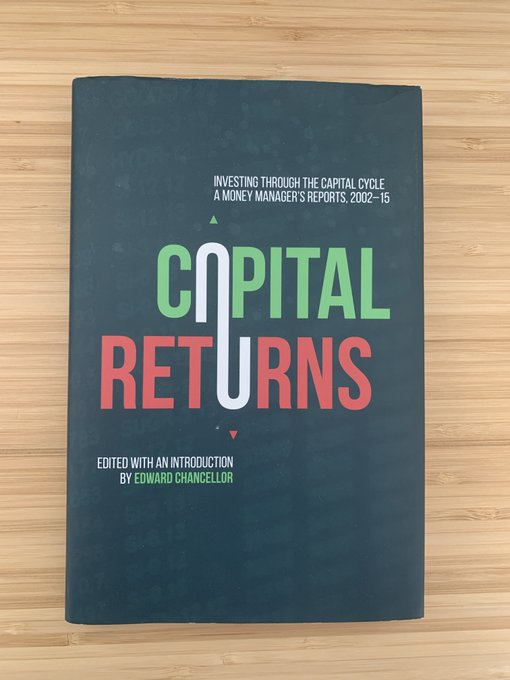
Here are some of my thoughts after having read the book a couple of times
Long 🧵
2
2/ Management teams don't tend to have a better psychology/foresight than investors.
They may be good operators, but this doesn't mean they are good/countercyclical investors/capital allocators: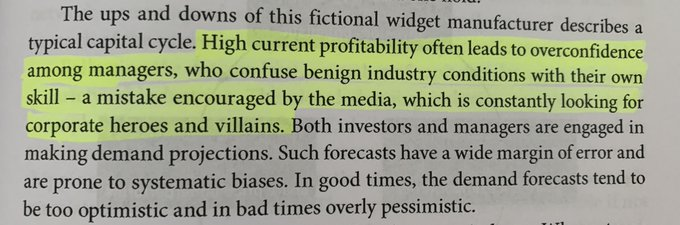
They may be good operators, but this doesn't mean they are good/countercyclical investors/capital allocators:
3
3/ Recency bias is common across analysts and investors:
"Both analysts and investors are given to extrapolating current trends. In a cyclical world, they think linearly."
It's common for investors to anchor their future expectations to recent performance. Good news here is that recency bias creates significant mispricings.
"Both analysts and investors are given to extrapolating current trends. In a cyclical world, they think linearly."
It's common for investors to anchor their future expectations to recent performance. Good news here is that recency bias creates significant mispricings.
4
4/ Almost any industry's capital cycle follows a similar pattern.
High returns attract new capital and this new capital brings more competition, eroding returns. Once returns have eroded, capital leaves, and returns come back up.
The cycle repeats over and over.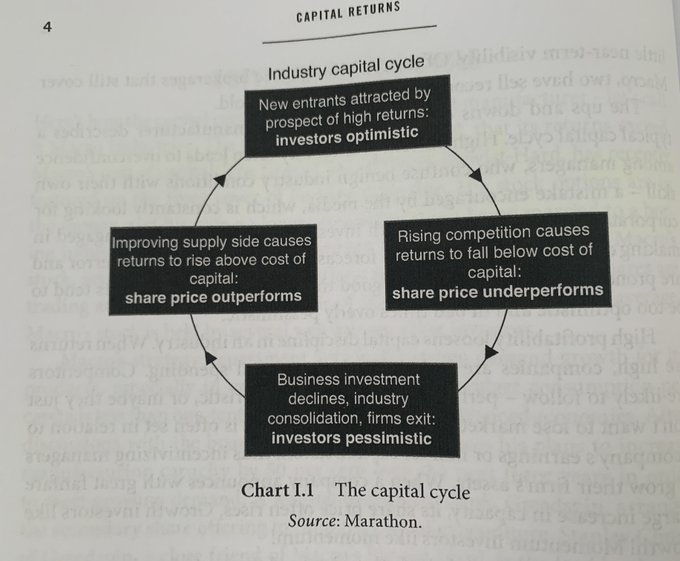
High returns attract new capital and this new capital brings more competition, eroding returns. Once returns have eroded, capital leaves, and returns come back up.
The cycle repeats over and over.
5
5/ The "asset-growth anomaly" states that those companies which have invested less have produced higher returns.
The rationale is that most companies typically increase investments when the stock is doing well, so they later underperform (ie., management is pro-cyclical)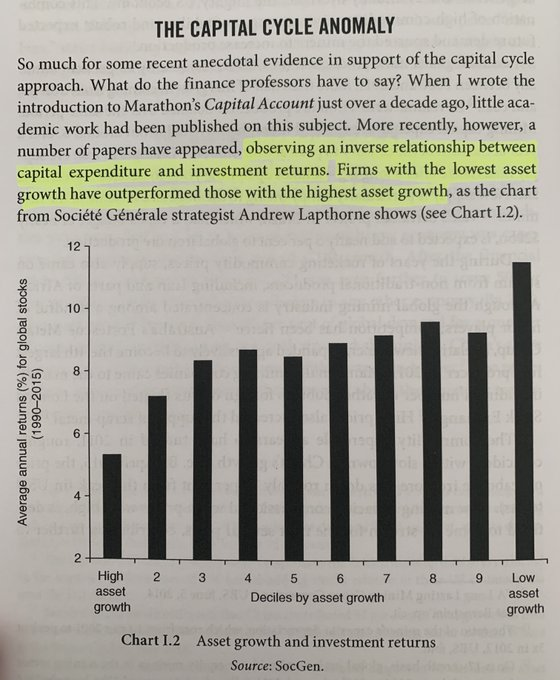
The rationale is that most companies typically increase investments when the stock is doing well, so they later underperform (ie., management is pro-cyclical)
6
6/ Asset expansion during good times typically comes from managers with lower ownership stakes, as their incentives are typically tied to company size.
However, managers with large ownership stakes typically take the opposite route.
Proactively shrinking a business to grow more profitably is a good capital allocation sign.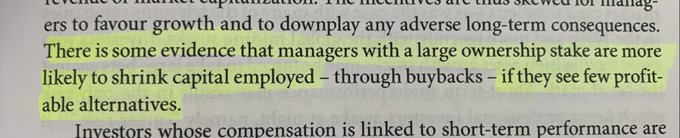
However, managers with large ownership stakes typically take the opposite route.
Proactively shrinking a business to grow more profitably is a good capital allocation sign.
7
7/ Many professional investors avoid being contra-cyclical because this might deviate their short term performance from that of indexes, which is not ideal to increase AUM.
Individual investors are free from this "risk":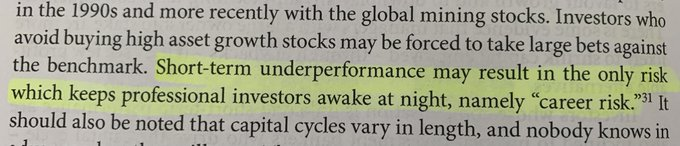
Individual investors are free from this "risk":
8
8/ Almost every company is subject to the capital cycle and diminishing returns due to competition, but some companies manage to avoid it.
These typically offer good investment opp because the market typically undervalues the time that returns can stay above the mean.
The worst possible situation is a stock that's priced for abnormal returns which quickly return to the mean.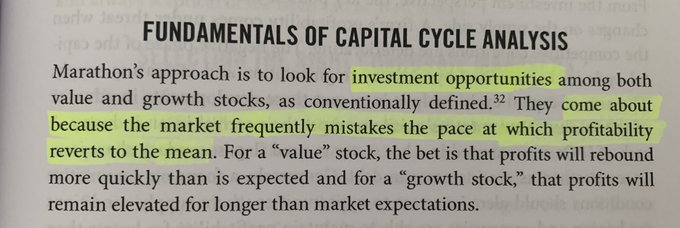
These typically offer good investment opp because the market typically undervalues the time that returns can stay above the mean.
The worst possible situation is a stock that's priced for abnormal returns which quickly return to the mean.
9
9/ Demand is much more difficult to forecast than supply, but stocks typically fail to estimate supply shocks:

10
10/ The primary driver of profitability is a favorable supply side, not high rates of demand growth. High demand with no cap on supply leads to diminishing returns.
Entry barriers are key to protect oneself from supply shocks: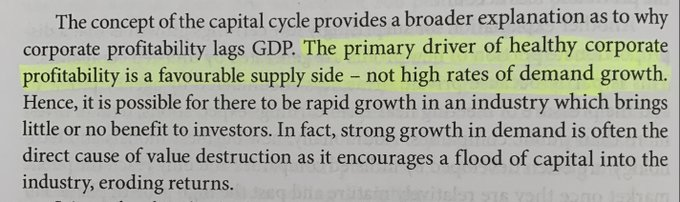
Entry barriers are key to protect oneself from supply shocks:
11
11/ Due to the capital cycle's impact on any business and the fact that capital employed drives a large portion of any business' performance over the LT, selecting the right management team should be given the importance it deserves:

12
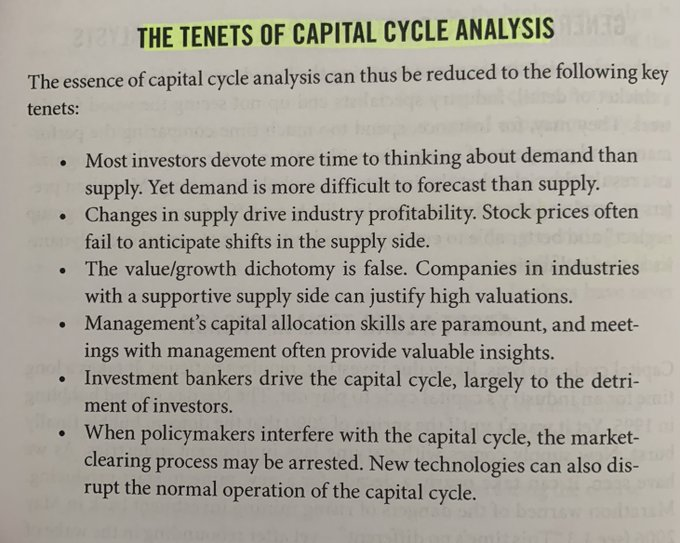
12/ Below you can find a summary of the tenets of capital cycle analysis:
13
13/ Sustainability should be a focus point for any long term investor. Only if a company survives all the economic cycles, will an investor be capable of reaping the returns it has to offer:

14
14/ Due to the general pro-cyclicality of management, large numbers of IPOs and high M&A activity typically come in the later stages of the capital cycle.
(It makes perfect sense in the case of IPOs)
Charts below belong to commodities, but applies to any industry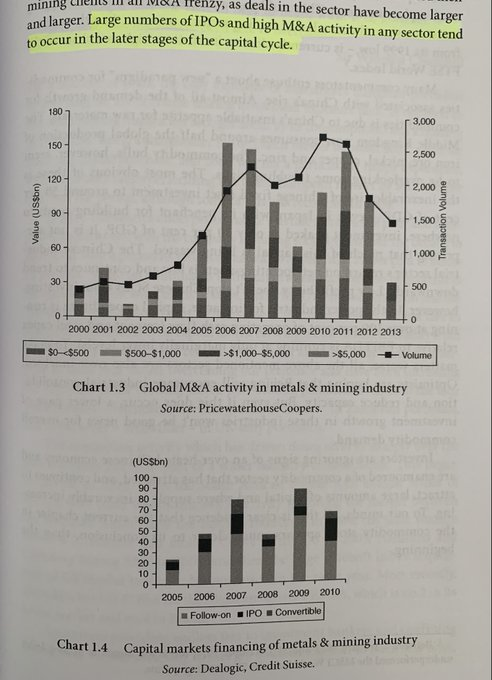
(It makes perfect sense in the case of IPOs)
Charts below belong to commodities, but applies to any industry
15
15/ When investing in "growth companies" (ie., those with higher valuations) an investor must study if its high returns are more sustainable than the market expects.
Everyone might perceive a great company to be great, but the key is for how long it will stay great:
Everyone might perceive a great company to be great, but the key is for how long it will stay great:
16
16/ The stock market often fails at analyzing superior fade characteristics.
High quality companies almost always appear overvalued in a two step DCF because the growth rate decreases abruptly after year x. These companies tend to prove that their DCFs are overly pessimistic: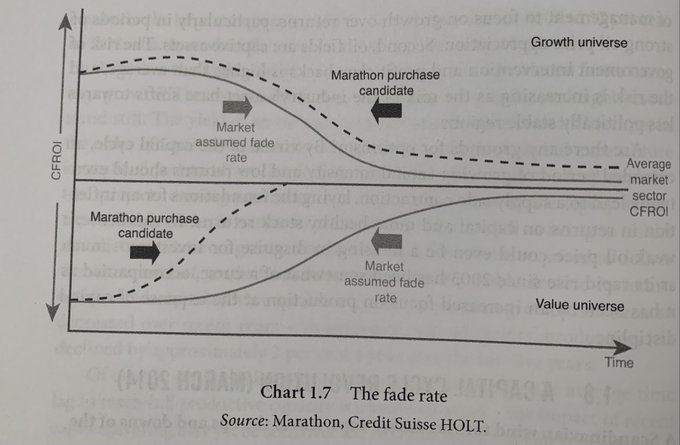
High quality companies almost always appear overvalued in a two step DCF because the growth rate decreases abruptly after year x. These companies tend to prove that their DCFs are overly pessimistic:
17
17/ Many investors typically overlook two other things:
a. Management's capital allocation skills
b. Boring companies
Good news in the current climate is that some of these companies are trading at attractive valuations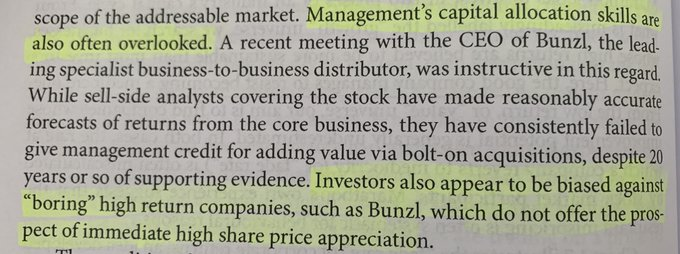
a. Management's capital allocation skills
b. Boring companies
Good news in the current climate is that some of these companies are trading at attractive valuations
18
18/ Capital Returns is a great book and it becomes even more relevant in the current Capex climate.
If you liked this thread, feel free to share the first post with your network and subscribe to Best Anchor Stocks on SS!
Cheers!
If you liked this thread, feel free to share the first post with your network and subscribe to Best Anchor Stocks on SS!
Cheers!
