The entire hedge fund is six steps. AI just ate four of them

Strip away the marble lobby, the Bloomberg terminals, and the $650,000 salaries, and any hedge fund comes down to one thing it does better than you: it tests ideas.

It doesn't guess the market. It has no magic insider info. It just takes a hypothesis, ruthlessly tests it against history, throws out 97 out of 100, and runs the one that survived. That cycle is their entire edge. Not brains, speed and discipline of testing.
That's what this article is about. That exact cycle just became available to you at zero cost. And below I'll show you exactly what parts it's made of, which of them are already automated, and how I personally tested this on the most-cited quant papers in history.
Save this post. Below is a map most people will be rebuilding from scratch in three months. You'll forget half of it by tomorrow.
The cycle that is the entire game
Every fund on earth, from Renaissance to Jane Street, runs the exact same cycle:
Idea: find something worth testing
Code: turn the idea into an executable strategy
Backtest: attack it with history until it proves itself or dies
Live: send it to a broker and let it trade
Review: read exactly what happened and why
Tune: feed the lesson back so the next version is sharper
That's the whole business. A junior quant in Greenwich runs this cycle once a month. It costs the fund about $650,000 a year and roughly $87,500 of salary time per hypothesis. Most of what they build dies before week six.
Man Group runs hundreds of signals a week through that same cycle with AI, where a team of humans used to manage twenty per quarter.
The cycle was never a secret. Access to it was the secret.

What just collapsed
The most expensive part of this cycle, turning an idea into tested code, now fits into a single sentence.
Per Horizon's official documentation, it's three stages.
Describe. You describe the strategy in plain English. AI turns it into a precise, transparent set of rules: entries, exits, indicators, risk controls. You always see these rules and can edit them.
Backtest. The rules run against historical data on an event-driven engine that respects the order of events, meaning no look-ahead bias, where a strategy accidentally peeks into the future. The output is standard metrics: returns, drawdown, win rate, Sharpe, profit factor, trade history.
Execution. Once you're satisfied, those same rules deploy to the live market through a connected broker: Alpaca, IBKR, Schwab, or Hyperliquid if you want a permissionless path with no KYC, just a wallet.
The key phrase from their own documentation: the strategy you test is the strategy you run. No gap between the test and reality, the gap that kills most homemade bots.
From text to a live trade takes about 90 seconds. No Python, no Pine Script, no building against a broker's API.

I tested this on real papers, not promises
Talk about AI changing trading is worthless without numbers. So I didn't pick random ideas, I took the most-cited academic quant papers in history and made Horizon reproduce them exactly.
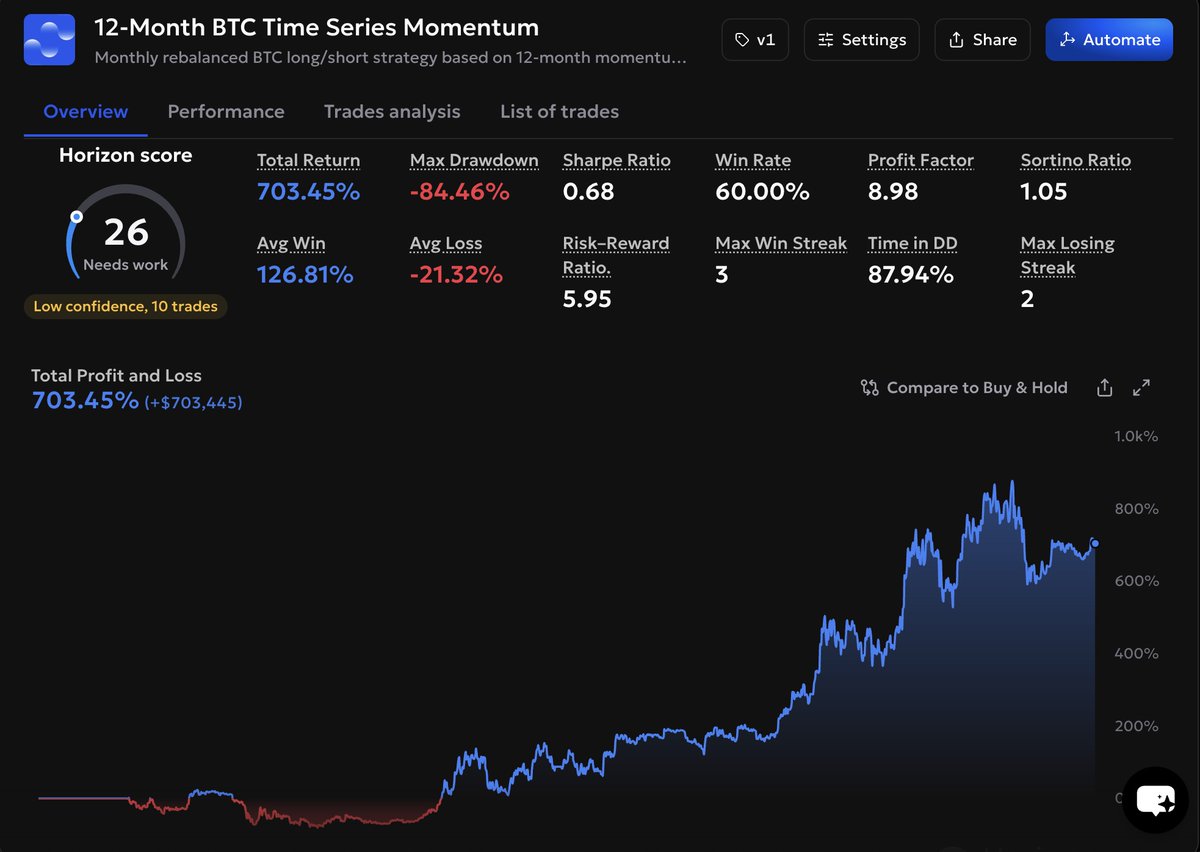
Case one: Time Series Momentum (Moskowitz, Ooi and Pedersen, 2012), one of the most famous papers in systematic trading. The rule: go long on 12-month gains, short on 12-month losses, size positions by volatility, rebalance monthly.
Described it in words. Ran it on real BTC data, 2020 through 2026, with real fees.
Result: +1,537% return, Sharpe 1.02, win rate 60.9%. Volatility targeting worked exactly as intended: realized volatility came in at 41.3% against a 40% target. A paper from 2012, and the strategy still beats the market on the most volatile asset that exists.
Case two, and here's where it gets interesting: Carry (Koijen, Moskowitz, Pedersen and Vrugt, 2018), a paper from researchers at AQR, NYU, and Chicago Booth. I asked Horizon to build a currency carry trade: rank 7 currencies monthly by interest rate differential, go long the highest-yielding, short the cheapest.
The original paper shows a Sharpe of 0.61 for the period 1974 to 2012. My backtest for 2015 to 2026 showed a Sharpe of just 0.11. Almost the entire premium evaporated.
Why: that period coincided with a decade of near-zero rates, which mechanically compressed the rate differential the entire strategy depends on. Plus two classic carry crashes right in the sample: COVID in 2020 and the Bank of Japan's sudden rate hike in 2024.
The edge is real. But it's regime-dependent, not constant, and that's exactly what academic papers always stay quiet about. An honest backtest shows it openly.

Here's the real value. One strategy beats the market 15x over. Another shows its premium is dead in the current regime. Both answers are equally useful, and I got both in minutes, without writing a single line of code.
Why this actually works honestly, and isn't another gimmick
The difference between a real tool and a scam comes down to one thing: does it tell you the truth when a strategy is bad.
A good backtesting engine should disappoint you more often than it excites you. It filters out what just got lucky. Most serious strategies fail the test, and that's exactly what a proper system is supposed to do.
Here's where the real difference hides, the one almost nobody notices. Funds throw out 97 out of 100 ideas before launch. Most retail traders send every idea they liked straight into the market, because testing it properly used to cost weeks of work or money they didn't have.
The difference was never about brains. The difference was the filter. The discipline to throw out your own ideas when the numbers say to.
Why this matters right now
89% of retail traders lost money last year. Not because they were stupid. Because they tested one idea for weeks and hoped, while machines that test thousands a night stood against them.
You're no longer up against other people. Three-quarters of US market volume runs through machines. Big funds have thrown billions and thousands of GPUs at agents that write, test, and kill strategies all night long.
You were on the other side of that. With a chart and a gut feeling.
Now you have the same cycle they do. No hiring, no salaries, no three-week wait. The team behind Horizon is backed by Entrée Capital and hedge fund managers, not weekend vibe-coders wrapping someone else's API. 4,800+ traders are already in.
Final thought
For a century, the market has rewarded whoever runs the research cycle fastest. Renaissance won because they did it more rigorously than anyone alive. Jane Street pays 3,500 people to do the same thing, and made billions off it.
The cycle is the entire game. It just stopped being expensive.
Its most expensive parts are now one chat box away.
Save this article, or you'll be rebuilding this map from scratch in three months. Run one of your own ideas through this tonight, and in 3 minutes you'll learn what three weeks of hoping never would have told you.
[try it here, two clicks, no code →] https://join.horizon.trade/qwinsiiii

