📕 Himmler's Hochverrat. (High Treason) Himmler, the only...

𝖍𝖎𝖙𝖑𝖊𝖗 𝖑𝖔𝖛𝖊𝖉 𝖈𝖍𝖗𝖎𝖘𝖙@GasMaskNat
52 views
Jan 17, 2026
~11 min read
Advertisement
1
📕 Himmler's Hochverrat. (High Treason)
Himmler, the only significant "neo-Pagan" in the regime, was guilty of "Hochverrat" or High Treason as early as 1942 while many good German men were expiring on the front against the Soviets in Stalingrad.
While spewing incoherent bile against the Church in secret, defying orders to shut down solstice festivals, and designing obscure castle decorations with mental patients, Himmler was trying to sell out the German people and HitIer exactly 1 year and 7 months before the famous July 20th bomb plot that's been turned into Hollywood movies.
Many people suggest that since HitIer didn't "get rid of Himmler" that this is somehow proof he condoned paganism, and they even go further and suggest that much of the unimportant minuta related to some wild over the top SS rhetoric constitutes "Official Nazi Policy".
The Truth is Hitler didn't know what he was up to half the time, let alone his cadre of pesudo-academics in the SS, as he was singularly focused on winning the war. This thread will prove this definitively: Himmler, instead of protecting HitIer, was plotting his downfall with the allies for his own personal power.
Here is a timeline of what we know.
Himmler, the only significant "neo-Pagan" in the regime, was guilty of "Hochverrat" or High Treason as early as 1942 while many good German men were expiring on the front against the Soviets in Stalingrad.
While spewing incoherent bile against the Church in secret, defying orders to shut down solstice festivals, and designing obscure castle decorations with mental patients, Himmler was trying to sell out the German people and HitIer exactly 1 year and 7 months before the famous July 20th bomb plot that's been turned into Hollywood movies.
Many people suggest that since HitIer didn't "get rid of Himmler" that this is somehow proof he condoned paganism, and they even go further and suggest that much of the unimportant minuta related to some wild over the top SS rhetoric constitutes "Official Nazi Policy".
The Truth is Hitler didn't know what he was up to half the time, let alone his cadre of pesudo-academics in the SS, as he was singularly focused on winning the war. This thread will prove this definitively: Himmler, instead of protecting HitIer, was plotting his downfall with the allies for his own personal power.
Here is a timeline of what we know.
2
🔻Decemeber 1942: Reaching out to the OSS
Carl Langbehn meets OSS officer Bruce C. Hopper in Stockholm with Himmler's full knowledge while the battle of Stalingrad was raging. Langbehn was sent to inquire about Allied peace intentions and explores Himmler's interest in negotiations.
Carl Langbehn was a personal friend of Himmler who had began to reject National Socialism after the Anschluss in 1938. Langbehn had also requested that Himmler release Fritzi Pringsheim from Dachau. Pringsheim was a jewish professor who focused on Roman law. Himmler agreed behind Hitler's back while allowing anti-Christian rhetoric in the SS.
Fritzi escaped to the UK in 1939 and began to argue for a shared legal tradition based on equality in Europe.
Carl Langbehn became a full blown partisan and in 1943 the Gestapo intercepted an allied message from Allen Dulles exposing his Swiss contacts. Himmler distanced himself behind the scenes and Carl was executed by hanging in Plotzensee Prison in Berlin.
> Langbehn is pictured below on trial before the People's Court in Berlin.
Carl Langbehn meets OSS officer Bruce C. Hopper in Stockholm with Himmler's full knowledge while the battle of Stalingrad was raging. Langbehn was sent to inquire about Allied peace intentions and explores Himmler's interest in negotiations.
Carl Langbehn was a personal friend of Himmler who had began to reject National Socialism after the Anschluss in 1938. Langbehn had also requested that Himmler release Fritzi Pringsheim from Dachau. Pringsheim was a jewish professor who focused on Roman law. Himmler agreed behind Hitler's back while allowing anti-Christian rhetoric in the SS.
Fritzi escaped to the UK in 1939 and began to argue for a shared legal tradition based on equality in Europe.
Carl Langbehn became a full blown partisan and in 1943 the Gestapo intercepted an allied message from Allen Dulles exposing his Swiss contacts. Himmler distanced himself behind the scenes and Carl was executed by hanging in Plotzensee Prison in Berlin.
> Langbehn is pictured below on trial before the People's Court in Berlin.
3
🔻August 1943: Serious subterfuge
Prominent Swedish businessman Jacob (or Jakob) Wallenberg tells Abram Hewitt (another OSS officer operating under cover as a U.S. Commercial Company representative in Stockholm) that German resistance groups are organizing to topple Hitler and the Third Reich. He expresses uncertainty about Himmler's intentions, speculating that Himmler might try to overthrow Hitler and negotiate a different peace with the West using the overblown SS power structure as leverage.
This opens the channel with Felix Kersten who was Heinrich Himmler's personal physician and masseur.
> Below is a declassified OSS document by Abram Hewitt from 1943 confirming these details. The document was declassified and approved for release on September 18, 2013.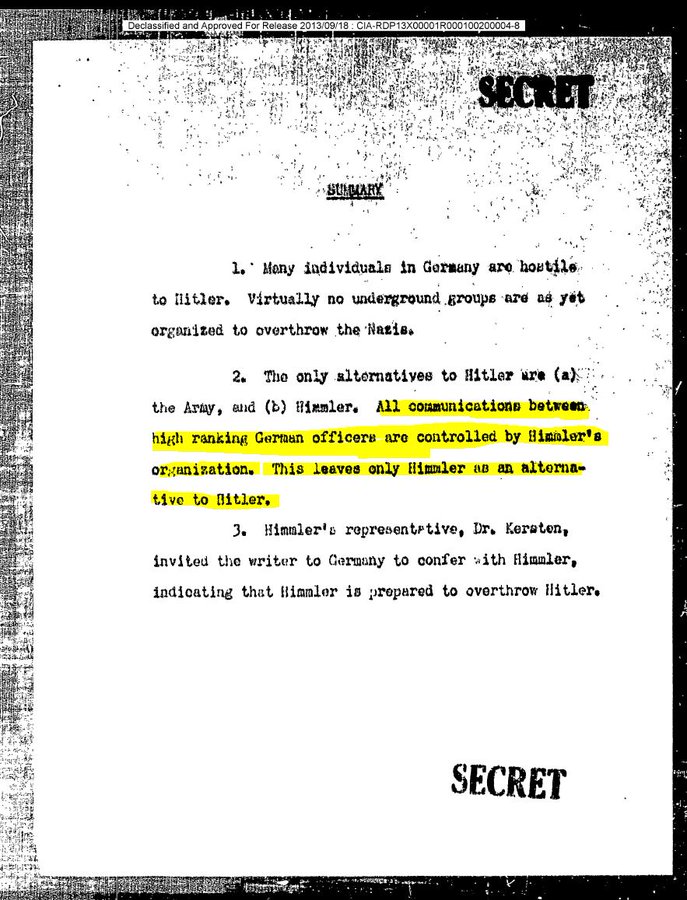
Prominent Swedish businessman Jacob (or Jakob) Wallenberg tells Abram Hewitt (another OSS officer operating under cover as a U.S. Commercial Company representative in Stockholm) that German resistance groups are organizing to topple Hitler and the Third Reich. He expresses uncertainty about Himmler's intentions, speculating that Himmler might try to overthrow Hitler and negotiate a different peace with the West using the overblown SS power structure as leverage.
This opens the channel with Felix Kersten who was Heinrich Himmler's personal physician and masseur.
> Below is a declassified OSS document by Abram Hewitt from 1943 confirming these details. The document was declassified and approved for release on September 18, 2013.
4
🔻Early October 1943: Prepared to Overthrow Hitler
The first meeting was scheduled. The initial contact is arranged by a prominent Swedish businessman who is a friend of Hewitt and connected to Wallenberg networks. In a professional setting, Kersten meets Hewitt by giving him "back therapy". Over several sessions, conversations take place in German.
According to Kersten, Himmler is "anxious to arrive at an arrangement" with the United States and the United Kingdom, acknowledges that the war is lost, and is "quite prepared to bring about [Hitler's] overthrow"
under specific conditions, which mostly hinged on securing power for Himmler himself, Kersten emphasizes the need for Hewitt to go to Germany for face-to-face discussions with Himmler after Stalingrad. Kersten offers to send an advisor (SS-Brigadefuhrer Walter Schellenberg) to Stockholm for confirmation after mentioning Himmler setting up a "shadow government" within the SS.
> Below is a picture of Kersten and Himmler with a quote that confirms that Himmler's esoteric pagan musings were largely isolated and unpopular inside the SS.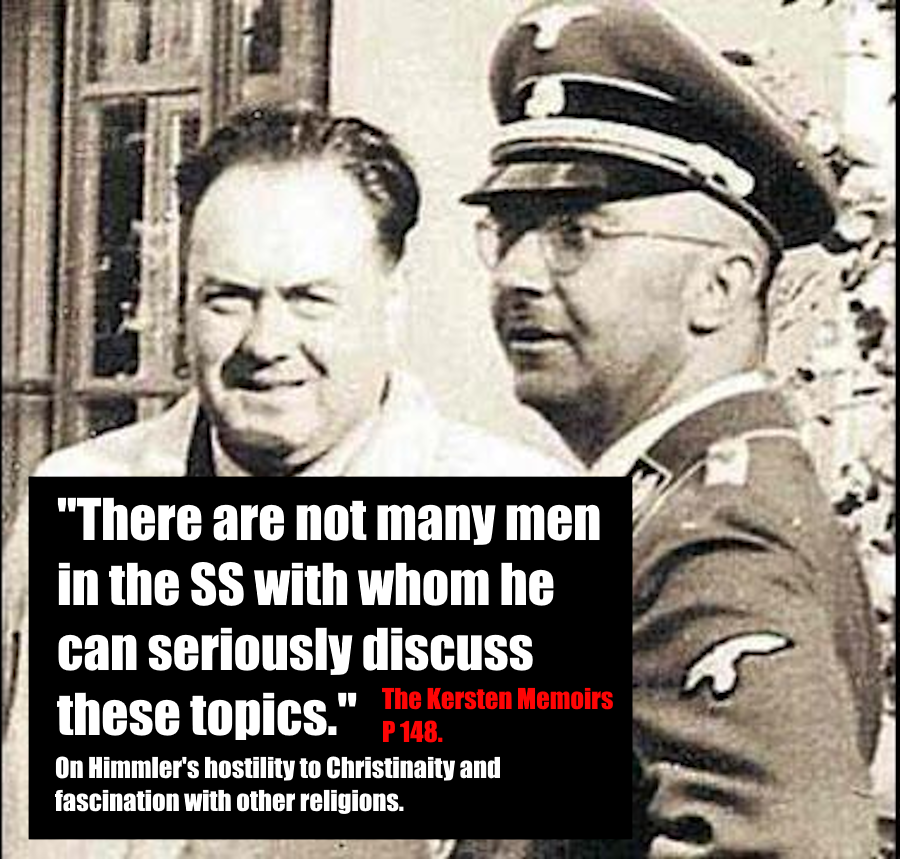
The first meeting was scheduled. The initial contact is arranged by a prominent Swedish businessman who is a friend of Hewitt and connected to Wallenberg networks. In a professional setting, Kersten meets Hewitt by giving him "back therapy". Over several sessions, conversations take place in German.
According to Kersten, Himmler is "anxious to arrive at an arrangement" with the United States and the United Kingdom, acknowledges that the war is lost, and is "quite prepared to bring about [Hitler's] overthrow"
under specific conditions, which mostly hinged on securing power for Himmler himself, Kersten emphasizes the need for Hewitt to go to Germany for face-to-face discussions with Himmler after Stalingrad. Kersten offers to send an advisor (SS-Brigadefuhrer Walter Schellenberg) to Stockholm for confirmation after mentioning Himmler setting up a "shadow government" within the SS.
> Below is a picture of Kersten and Himmler with a quote that confirms that Himmler's esoteric pagan musings were largely isolated and unpopular inside the SS.
5
🔻Early October 1943: Werther is hidden.
On October 9th, 1943: Swiss police began to arrest Rote Drei radio operators Edmond Hamel and Margarete Bolli in Lausanne, revealing 129 encrypted messages including Werther-sourced intelligence on OKW (German Military High Command) plans. This confirms the spy ring's existence to Schellenberg, who learns of the existence of the leak but does not sound a general alarm.
Himmler is notified, but never reveals this information to Hitler or the Military, effectively dooming hundreds of thousands of German men to d*ath on the front lines to a soviet enemy that knew their every move before it happened.
The Werther leak is one of the main reasons Operation Citadel, the largest tank battle in history, failed to recapture the initiative for the Germans. Soviets were aware of Tank movements, troop movements, and weakness in real time.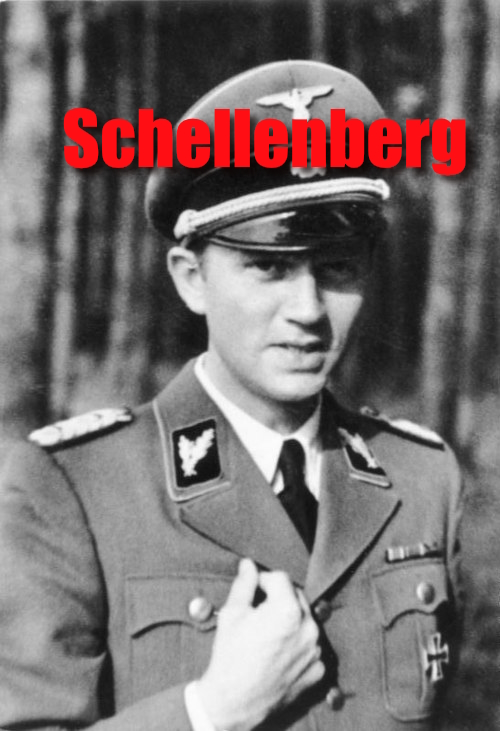
On October 9th, 1943: Swiss police began to arrest Rote Drei radio operators Edmond Hamel and Margarete Bolli in Lausanne, revealing 129 encrypted messages including Werther-sourced intelligence on OKW (German Military High Command) plans. This confirms the spy ring's existence to Schellenberg, who learns of the existence of the leak but does not sound a general alarm.
Himmler is notified, but never reveals this information to Hitler or the Military, effectively dooming hundreds of thousands of German men to d*ath on the front lines to a soviet enemy that knew their every move before it happened.
The Werther leak is one of the main reasons Operation Citadel, the largest tank battle in history, failed to recapture the initiative for the Germans. Soviets were aware of Tank movements, troop movements, and weakness in real time.
6
🔻Mid-to-late October 1943:
Kersten informs Hewitt that Walter Schellenberg (Himmler's RSHA/SD intelligence chief) has arrived in Stockholm and wishes to meet. Arrangements are made to meet in Hewitt's hotel, and another meeting in a colleague's apartment. Technical logistics were discussed for a potential future contact in Lisbon if Hewitt agreed to go to Germany. Kersten writes to Himmler from Stockholm in late October, recounting the talks and an informally agreed-upon seven-point proposal for an "honorable peace", though the details are sketchy.
While the exact seven points are not documented in full, the surrounding context suggests they revolved around:
1. Overthrow of Hitler (Himmler as alternative leader).
2. Immediate separate peace with the Western Allies (U.S./UK).
3. Continuation of war against the Soviet Union. (Even though Himmler felt the war was lost).
4. Preservation of "something of Germany" (territory, economy, or Nazi structures).
5. Possible use of SS/police to maintain order during transition.
6. Humanitarian gestures (e.g., prisoner releases AKA releasing J-ws) as a goodwill gesture.
7. Logistics for direct talks (e.g., meeting in Germany or via Lisbon).
There were several Schellenberg meetings discussing Himmler's stances, internal conflicts, and German morale. Hewitt observed and documented the divisions in Nazi leadership.
Kersten informs Hewitt that Walter Schellenberg (Himmler's RSHA/SD intelligence chief) has arrived in Stockholm and wishes to meet. Arrangements are made to meet in Hewitt's hotel, and another meeting in a colleague's apartment. Technical logistics were discussed for a potential future contact in Lisbon if Hewitt agreed to go to Germany. Kersten writes to Himmler from Stockholm in late October, recounting the talks and an informally agreed-upon seven-point proposal for an "honorable peace", though the details are sketchy.
While the exact seven points are not documented in full, the surrounding context suggests they revolved around:
1. Overthrow of Hitler (Himmler as alternative leader).
2. Immediate separate peace with the Western Allies (U.S./UK).
3. Continuation of war against the Soviet Union. (Even though Himmler felt the war was lost).
4. Preservation of "something of Germany" (territory, economy, or Nazi structures).
5. Possible use of SS/police to maintain order during transition.
6. Humanitarian gestures (e.g., prisoner releases AKA releasing J-ws) as a goodwill gesture.
7. Logistics for direct talks (e.g., meeting in Germany or via Lisbon).
There were several Schellenberg meetings discussing Himmler's stances, internal conflicts, and German morale. Hewitt observed and documented the divisions in Nazi leadership.
7
🔻December 20, 1943: High Treason
After Kersten returned to Berlin in December of 1943, Hewitt submits his handwritten report summarizing the contacts, including Kersten's statements on Himmler's readiness to overthrow Hitler. Donovan forwards it to Roosevelt with a note advising against any follow-up.
The Allies had a policy of no compromise at this point, so Himmler essentially sold his soul for nothing.
_____
Conclusion:
If Himmler was able to get away with such high treason behind Hitler's back, suggesting that his occult/esoteric dabblings, or some random written documents at the end of the war were somehow sanctioned by Hitler, is completely delusional and asinine.
Himmler was guilty of the following:
1. Directly threatening Hitler's Leadership.
2. Unauthorized contact with the Enemy (The OSS via Hewitt and Hopper).
3. High treason (Hochverrat) under Nazi law, which punished attempts to overthrow the Führer with d*ath.
4. Schellenberg had uncovered a high command leaked code-named "Werther" around July of 1943. Himmler never revealed this leak to the German High Command, or HitIer, and sacrificed hundreds of thousands of Germans in the process.
> Insert image: Himmler arrested Cajus Fabricius for uncovering parts of his schemes. Revisionists today try to claim this is proof the Regime was anti-Christian, but the opposite is true. Himmler was arresting and releasing people without Hitler's knowledge for years.
After Kersten returned to Berlin in December of 1943, Hewitt submits his handwritten report summarizing the contacts, including Kersten's statements on Himmler's readiness to overthrow Hitler. Donovan forwards it to Roosevelt with a note advising against any follow-up.
The Allies had a policy of no compromise at this point, so Himmler essentially sold his soul for nothing.
_____
Conclusion:
If Himmler was able to get away with such high treason behind Hitler's back, suggesting that his occult/esoteric dabblings, or some random written documents at the end of the war were somehow sanctioned by Hitler, is completely delusional and asinine.
Himmler was guilty of the following:
1. Directly threatening Hitler's Leadership.
2. Unauthorized contact with the Enemy (The OSS via Hewitt and Hopper).
3. High treason (Hochverrat) under Nazi law, which punished attempts to overthrow the Führer with d*ath.
4. Schellenberg had uncovered a high command leaked code-named "Werther" around July of 1943. Himmler never revealed this leak to the German High Command, or HitIer, and sacrificed hundreds of thousands of Germans in the process.
> Insert image: Himmler arrested Cajus Fabricius for uncovering parts of his schemes. Revisionists today try to claim this is proof the Regime was anti-Christian, but the opposite is true. Himmler was arresting and releasing people without Hitler's knowledge for years.
8
🔻Other key historical facts of note to frame this issue properly in terms of severity.
1. Rudolf Hess was declared a traitor (And insane) by Hitler in May 1941 for flying to Britain without his permission. This led to a crackdown on pagan and esoteric groups. Hess was one of HitIer's best friends.
2. Himmler had suggested Rohm was planning a "Second revolution" in 1934 against the Conservative military establishment that led to Rhom's ex*cution without trial. Gregor Strasser was also liquidated in the Night of the Long Knives.
3. After The July 20, 1944 bomb plot by Stauffenberg, Hitler ordered mass arrests, ex*cutions, and purges of anyone remotely suspected. Even distant connections led to d*ath. This was something Himmler should have been focused on instead of his own treachery.
Thus, Himmler was one of HitIer's biggest mistakes and one of Germany's biggest traitors. As Hitler himself said two years too late, Himmler's betrayal was one of "the most shameful betrayal in history".
Remember that the next time you read some slop from a random SS document in the later years of the war.
1. Rudolf Hess was declared a traitor (And insane) by Hitler in May 1941 for flying to Britain without his permission. This led to a crackdown on pagan and esoteric groups. Hess was one of HitIer's best friends.
2. Himmler had suggested Rohm was planning a "Second revolution" in 1934 against the Conservative military establishment that led to Rhom's ex*cution without trial. Gregor Strasser was also liquidated in the Night of the Long Knives.
3. After The July 20, 1944 bomb plot by Stauffenberg, Hitler ordered mass arrests, ex*cutions, and purges of anyone remotely suspected. Even distant connections led to d*ath. This was something Himmler should have been focused on instead of his own treachery.
Thus, Himmler was one of HitIer's biggest mistakes and one of Germany's biggest traitors. As Hitler himself said two years too late, Himmler's betrayal was one of "the most shameful betrayal in history".
Remember that the next time you read some slop from a random SS document in the later years of the war.
9
I'll end this thread with some accounts of Hitler's reaction to finding out that Himmler was a traitor, two years too late.
"For Hitler, this was the last straw. That his ‘loyal Heinrich’, whose SS had as its motto ‘my honour is loyalty’, should now stab him in the back: this was the end. It was the betrayal of all betrayals. The bunker reverberated to a final elemental explosion of fury. All his stored-up venom was now poured out on Himmler in a last paroxysm of seething rage. It was, he screamed, ‘the most shameful betrayal in human history.’" 116
Chapter 17 - Extinction
Hitler 1936-1945: Nemesis
116. Boldt, 170; see also IfZ, ED 100, Irving-Sammlung, Traudl Junge Memoirs, Fols.152–3; Galante, 11 (Junge); Trevor-Roper, 202.
*Hitler would then execute SS Group Leader and Lieutenant General of the Waffen-SS Hermann Fegelein for deserting his post and his suspected connection to Himmler's betrayal.
---
On Hitler ordering Himmler's execution:
"Shortly after midnight, Hitler came into Greim’s room to convey to him his last orders. His face was white, and sitting on the edge of the bed he explained to Greim the twofold nature of his mission. Firstly, he was to mount an attack by the Luftwaffe against those Russian positions from which the assault on the Chancellery would be made. With the help of the Luftwaffe, Wenck might yet force his way to Berlin. Secondly, he must order the arrest of the treacherous Himmler. As he mentioned that name, Hitler’s voice became more unsteady, and his lips and hands trembled. “A traitor must never succeed me as Fuehrer,” he shouted; “you must go out to ensure that he does not!”
Both Greim and Reitsch protested; they wished to stay; the attempt, they said, would be futile; they would never reach Rechlin. . . . But Hitler insisted that they must go. It was the only chance of success. To this Greim yielded.
Page 171
Last days of Hitler
Hugh Trevor-Roper
---
"Himmler was probably trying to wriggle out of this when confronted. Then the BBC sent a Reuters report confirming all the rumours. The chief of the news bureau, Heinz Lorenz, took the report to Hitler personally. For a moment Hitler lost his self-control. It was loud —I could hear his voice above the telephone calls I was dealing with: ‘Himmler of all people, Himmler of all people!’ Snatches of his words could be heard throughout the Fuhrerbunker area. The whole thing reminded me of his reaction to Hess's defection to Britain in 1941."
P164
Hitler's Last Witness
The Memoirs of Hitler's Bodyguard
Rochus Misch
"For Hitler, this was the last straw. That his ‘loyal Heinrich’, whose SS had as its motto ‘my honour is loyalty’, should now stab him in the back: this was the end. It was the betrayal of all betrayals. The bunker reverberated to a final elemental explosion of fury. All his stored-up venom was now poured out on Himmler in a last paroxysm of seething rage. It was, he screamed, ‘the most shameful betrayal in human history.’" 116
Chapter 17 - Extinction
Hitler 1936-1945: Nemesis
116. Boldt, 170; see also IfZ, ED 100, Irving-Sammlung, Traudl Junge Memoirs, Fols.152–3; Galante, 11 (Junge); Trevor-Roper, 202.
*Hitler would then execute SS Group Leader and Lieutenant General of the Waffen-SS Hermann Fegelein for deserting his post and his suspected connection to Himmler's betrayal.
---
On Hitler ordering Himmler's execution:
"Shortly after midnight, Hitler came into Greim’s room to convey to him his last orders. His face was white, and sitting on the edge of the bed he explained to Greim the twofold nature of his mission. Firstly, he was to mount an attack by the Luftwaffe against those Russian positions from which the assault on the Chancellery would be made. With the help of the Luftwaffe, Wenck might yet force his way to Berlin. Secondly, he must order the arrest of the treacherous Himmler. As he mentioned that name, Hitler’s voice became more unsteady, and his lips and hands trembled. “A traitor must never succeed me as Fuehrer,” he shouted; “you must go out to ensure that he does not!”
Both Greim and Reitsch protested; they wished to stay; the attempt, they said, would be futile; they would never reach Rechlin. . . . But Hitler insisted that they must go. It was the only chance of success. To this Greim yielded.
Page 171
Last days of Hitler
Hugh Trevor-Roper
---
"Himmler was probably trying to wriggle out of this when confronted. Then the BBC sent a Reuters report confirming all the rumours. The chief of the news bureau, Heinz Lorenz, took the report to Hitler personally. For a moment Hitler lost his self-control. It was loud —I could hear his voice above the telephone calls I was dealing with: ‘Himmler of all people, Himmler of all people!’ Snatches of his words could be heard throughout the Fuhrerbunker area. The whole thing reminded me of his reaction to Hess's defection to Britain in 1941."
P164
Hitler's Last Witness
The Memoirs of Hitler's Bodyguard
Rochus Misch
10
Sources:
🔻Hewitt's December 20, 1943 report (declassified via CIA/FRUS)
Kersten urged Hewitt to go to Germany: "The doctor [Kersten] urged me to come to Germany to discuss Himmler's position with him, and to see whether a settlement might be possible. He indicated clearly that, on certain conditions, Himmler was prepared to overthrow Hitler and that he was the only man who had the power to do so in Germany."
🔻John H. Waller's CIA Studies in Intelligence article (2002)
🔻Richard Breitman (1995); FRUS 1944 Vol. 1.
🔻U.S. State Department Transmission (January 10, 1944)
This is a diplomatic cable from the U.S. Legation in Stockholm summarizing Hewitt's memo for the State Department. It includes details like Kersten's professional background, the invitation to Germany, and mentions of a rumored Soviet peace proposal to Hitler (which Kersten said Himmler opposed).
🔻John H. Waller, "Reichsführer-SS Himmler Pitches Washington: Dispatch from Wartime Sweden" (Studies in Intelligence, Vol. 46, No. 1, 2002;.
C/A published article is the most detailed and reliable secondary source, quoting extensively from Hewitt's December 20 report (including the "quite prepared to bring about his overthrow" line). Waller had access to declassified OSS files and provides context on the post-Stalingrad urgency.
🔻Richard Breitman, "A Deal with the Nazi Dictatorship?: Himmler's Alleged Peace Emissaries in Autumn 1943" (Journal of Contemporary History, Vol. 30, No. 3, July 1995).
Cites Hewitt's report (NA RG 84, Box 1, Folder 6) and Schellenberg's postwar interrogations, confirming the invitation and overthrow discussion as part of exploratory probe.
🔻The Kersten Memoirs, 1940–1945 by Felix Kersten (1956 edition, with introduction by Hugh Trevor-Roper)
🔻 The Devil's Doctor: Felix Kersten and the Secret Plot to Turn Himmler Against Hitler (February 1, 2002)
🔻Hewitt's December 20, 1943 report (declassified via CIA/FRUS)
Kersten urged Hewitt to go to Germany: "The doctor [Kersten] urged me to come to Germany to discuss Himmler's position with him, and to see whether a settlement might be possible. He indicated clearly that, on certain conditions, Himmler was prepared to overthrow Hitler and that he was the only man who had the power to do so in Germany."
🔻John H. Waller's CIA Studies in Intelligence article (2002)
🔻Richard Breitman (1995); FRUS 1944 Vol. 1.
🔻U.S. State Department Transmission (January 10, 1944)
This is a diplomatic cable from the U.S. Legation in Stockholm summarizing Hewitt's memo for the State Department. It includes details like Kersten's professional background, the invitation to Germany, and mentions of a rumored Soviet peace proposal to Hitler (which Kersten said Himmler opposed).
🔻John H. Waller, "Reichsführer-SS Himmler Pitches Washington: Dispatch from Wartime Sweden" (Studies in Intelligence, Vol. 46, No. 1, 2002;.
C/A published article is the most detailed and reliable secondary source, quoting extensively from Hewitt's December 20 report (including the "quite prepared to bring about his overthrow" line). Waller had access to declassified OSS files and provides context on the post-Stalingrad urgency.
🔻Richard Breitman, "A Deal with the Nazi Dictatorship?: Himmler's Alleged Peace Emissaries in Autumn 1943" (Journal of Contemporary History, Vol. 30, No. 3, July 1995).
Cites Hewitt's report (NA RG 84, Box 1, Folder 6) and Schellenberg's postwar interrogations, confirming the invitation and overthrow discussion as part of exploratory probe.
🔻The Kersten Memoirs, 1940–1945 by Felix Kersten (1956 edition, with introduction by Hugh Trevor-Roper)
🔻 The Devil's Doctor: Felix Kersten and the Secret Plot to Turn Himmler Against Hitler (February 1, 2002)