One mindset shift that significantly decreases drama in your life:...

Pep@peptalksblog
53 views
Sep 24, 2025
~4 min read
Advertisement
1
One mindset shift that significantly decreases drama in your life:
Owning your experience.
This is often dismissed as therapy speak.
But in reality, it’s more about changing how you relate to things than how you phrase them:🧵
Owning your experience.
This is often dismissed as therapy speak.
But in reality, it’s more about changing how you relate to things than how you phrase them:🧵
2
I once had a roommate who was always in some sort of drama.
Noticing we never had drama at home, they observed what we did differently.
Turns out, we were all "owning our experience".
One of the core practices of Authentic Relating, as taught by ART international:
Noticing we never had drama at home, they observed what we did differently.
Turns out, we were all "owning our experience".
One of the core practices of Authentic Relating, as taught by ART international:
3
In an interaction, there are multiple points of view.
The fact that others can see different aspects of the same thing proves our experience is our own & not necessarily universal.
It's a real experience but not the Whole Truth. When we think it is, conflict often escalates↓↓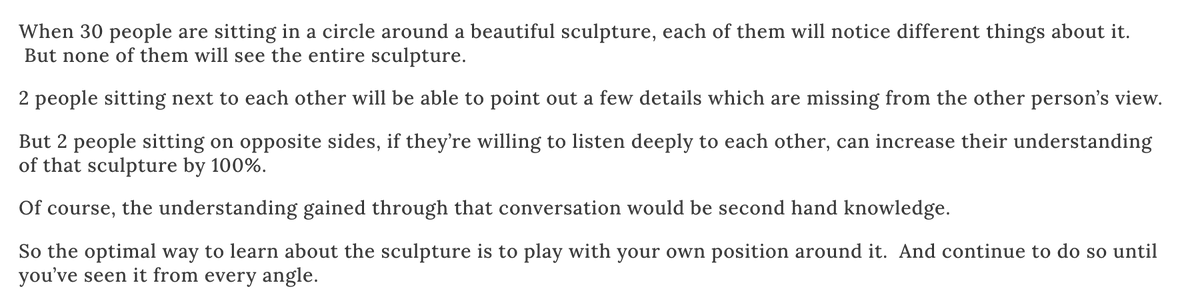
The fact that others can see different aspects of the same thing proves our experience is our own & not necessarily universal.
It's a real experience but not the Whole Truth. When we think it is, conflict often escalates↓↓
4
While owning your experience is more about inner attitude than outward speech, owned language is a useful entry point to understand it:
“I feel __”
“I think ___”
“I imagine ___”
Thoughts in "I statements" are the 1st step to recognizing an experience as ours.↓↓
“I feel __”
“I think ___”
“I imagine ___”
Thoughts in "I statements" are the 1st step to recognizing an experience as ours.↓↓
Pep@peptalksblog
@whatisthisrabia Disowned language: "You made me feel this way."
Owned language: "I felt this way when you did/said that thing."
Owned language is recognizing our experience as ours, without denying anything that factually happened.
Owned language: "I felt this way when you did/said that thing."
Owned language is recognizing our experience as ours, without denying anything that factually happened.
5
Compare the impact of these phrases during conflict:
A) You don’t care about me & your behavior proves it.
B)When I see that you didn’t ____, my first thought is that you don't care about me.
Option B = less likely to escalate...but what if the other person's in the wrong?
A) You don’t care about me & your behavior proves it.
B)When I see that you didn’t ____, my first thought is that you don't care about me.
Option B = less likely to escalate...but what if the other person's in the wrong?
6
A common fear about owning your experience is that it opens the door for gaslighting.
Not entirely unfounded (see QT). But when done properly, owning your experience actually makes you less vulnerable to internalizing other people’s narratives.
Here’s how:
Not entirely unfounded (see QT). But when done properly, owning your experience actually makes you less vulnerable to internalizing other people’s narratives.
Here’s how:
7
Owning that your experience is yours, not the Whole Truth, doesn’t make it false or invalid.
It just admits that your map of reality, like everyone's, has mistakes & blind spots.
(E.g. You can be paranoid & still correct in your suspicions, too.)
This is empowering because:
It just admits that your map of reality, like everyone's, has mistakes & blind spots.
(E.g. You can be paranoid & still correct in your suspicions, too.)
This is empowering because:
8
Owning our experience is a practice that brings us closer to inarguable truths.
So by practicing it, we get closer to reality.
E.g.
It may not be an objective truth that Bob is a blockhead. But it’s inarguably true that I judge him to be one.
This is where nuance comes in:
So by practicing it, we get closer to reality.
E.g.
It may not be an objective truth that Bob is a blockhead. But it’s inarguably true that I judge him to be one.
This is where nuance comes in:
Pep@peptalksblog
How to speak the undeniable, inarguable truth:
- From where I'm standing, ...
- From my perspective, ...
- I have a story that...
- In my experience, ...
- The way I see it, ...
- It seems to me...
- I imagine that...
- I believe that...
- I think that...
- From where I'm standing, ...
- From my perspective, ...
- I have a story that...
- In my experience, ...
- The way I see it, ...
- It seems to me...
- I imagine that...
- I believe that...
- I think that...
9
Owning your experience as a practice of intimacy with reality is what differentiates it from just owned language.
E.g.
“My thoughts keep calling you Nazi” is using owned language as a free pass for an insult.
Is that the experience? Or a disowned thought ABOUT the experience?↓
E.g.
“My thoughts keep calling you Nazi” is using owned language as a free pass for an insult.
Is that the experience? Or a disowned thought ABOUT the experience?↓
10
Owning your experience isn’t “language policing” either.
Yes, it honors the other person by not holding them accountable for our experience of an event.
But it also empowers you because it shifts the locus of responsibility back to you, the experiencer. ↓↓
Yes, it honors the other person by not holding them accountable for our experience of an event.
But it also empowers you because it shifts the locus of responsibility back to you, the experiencer. ↓↓
Pep@peptalksblog
Owned language (“I” statements, acknowledging your experience as yours) isn’t just about communicating non-violently.
It also gives you the opportunity to own things to yourself.
E.g.
“Instagram makes you insecure” is less empowering than “I feel insecure while using it.”
It also gives you the opportunity to own things to yourself.
E.g.
“Instagram makes you insecure” is less empowering than “I feel insecure while using it.”
11
The process underneath owning our experience gradually improving at separating facts from stories:
We go from “that’s an ugly painting” to “I feel aversion towards that painting”.
Clunky as it sounds, the increase in agency can be huge.↓↓
We go from “that’s an ugly painting” to “I feel aversion towards that painting”.
Clunky as it sounds, the increase in agency can be huge.↓↓
Pep@peptalksblog
A major cause of conflict and frustration is failing to separate facts from stories.
It baffles me that this isn’t taught in schools.
A thread on the basics, and how this awareness can save you from unnecessary drama or inner tension: 🧵
It baffles me that this isn’t taught in schools.
A thread on the basics, and how this awareness can save you from unnecessary drama or inner tension: 🧵
12
Our perception of an event gets created after we relate to it, not before.
Event & response can be tough to separate:
"Isn't death objectively sad?"
No, there is no sadness in death. The sadness is response.
A healthy one, but collapsing the 2 together disowns our feelings.↓
Event & response can be tough to separate:
"Isn't death objectively sad?"
No, there is no sadness in death. The sadness is response.
A healthy one, but collapsing the 2 together disowns our feelings.↓
Pep@peptalksblog
Our perception of reality is constructed in 5 steps:
1) Senses receive input (not "perceive")
2) Sensory signals are sent to the brain
3) Brain interprets and matches the signals to context, associations, past experiences, expectations, etc. (our "map")
4) Brain determines what the signals mean
5) We perceive based on this interpretation
1) Senses receive input (not "perceive")
2) Sensory signals are sent to the brain
3) Brain interprets and matches the signals to context, associations, past experiences, expectations, etc. (our "map")
4) Brain determines what the signals mean
5) We perceive based on this interpretation
13
Ever feel taken for granted?
Ever feel the whole world's going crazy?
Ever feel like your phone is listening to you in secret?
Those aren’t feelings. They are interpretations of events.
Separating fact, story & feeling brings you to reality—where you can respond to each↓↓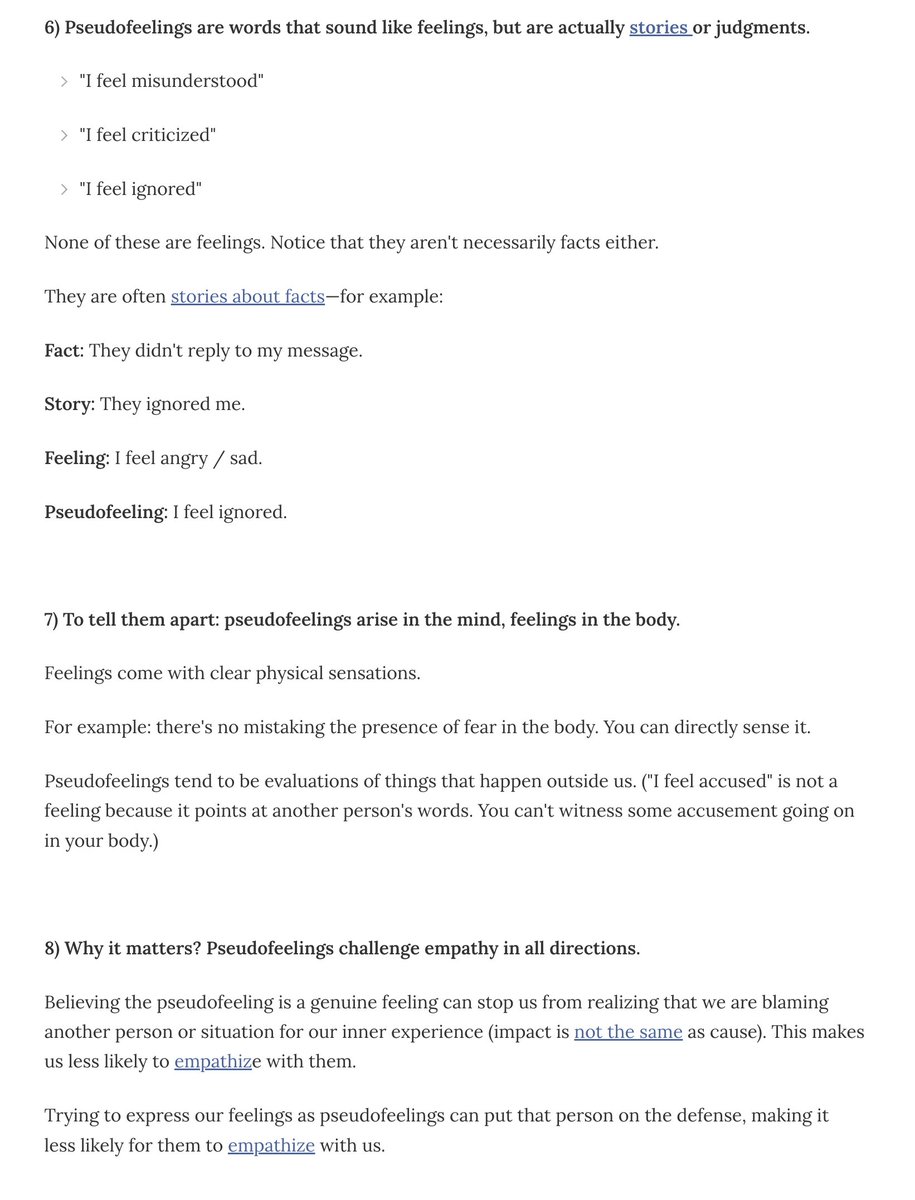
Ever feel the whole world's going crazy?
Ever feel like your phone is listening to you in secret?
Those aren’t feelings. They are interpretations of events.
Separating fact, story & feeling brings you to reality—where you can respond to each↓↓
14
Another way we disown our experience is using words that refer to imaginary constructs:
For example: deserving.
It’s impossible to point out its presence or absence as a phenomenon.
The reality is: “I desire this & it was agreed upon (or I believe it would be appropriate)"↓↓
For example: deserving.
It’s impossible to point out its presence or absence as a phenomenon.
The reality is: “I desire this & it was agreed upon (or I believe it would be appropriate)"↓↓
15
Owning your experience, perhaps because it’s built on concepts from a framework called “Non-Violent Communication” is often inaccurately viewed as weak or submissive.
But it’s actually the basis for clear, assertive communication too. ↓↓
But it’s actually the basis for clear, assertive communication too. ↓↓
16
Yes, owning your experience is taking a stance of radical humility.
But it’s also the way out of a victim-mindset, because it’s taking your power back:
But it’s also the way out of a victim-mindset, because it’s taking your power back:
17
Owning your experience is separating responsibility from blame.
Yes, external and people things behave in ways that impact you.
Their responsibility ends with their behavior. Yours starts with how you receive the impact and respond to it. ↓↓
Yes, external and people things behave in ways that impact you.
Their responsibility ends with their behavior. Yours starts with how you receive the impact and respond to it. ↓↓
Pep@peptalksblog
Responsibility and blame are different things.
When you confuse them, you will continuously disempower yourself.
When you confuse them, you will continuously disempower yourself.
18
The more you learn to own your experience, the more you become aware when others are not owning theirs.
I don’t recommend demanding they own it (that’s their business,).
But this is why I believe the practice makes us less prone to gaslighting and frame control, not more.↓↓
I don’t recommend demanding they own it (that’s their business,).
But this is why I believe the practice makes us less prone to gaslighting and frame control, not more.↓↓
19
How can I then tell people that what they did was problematic while owning my experience?
More truthful answer: Anyway you want to, just own it energetically.
More helpful answer: Read this thread about feedback.
More truthful answer: Anyway you want to, just own it energetically.
More helpful answer: Read this thread about feedback.
Pep@peptalksblog
Did you know that the most widely taught feedback method actually makes your feedback less effective?
A thread on what to do instead🧵
A thread on what to do instead🧵
20
If you want to practice owning your experience with other people, I’m hosting a 12-week group program on Zoom, starting in 2 weeks.
You can claim your spot here:
peptalksblog.com/connection-coh…
You can claim your spot here:
peptalksblog.com/connection-coh…
21
Follow me @peptalksblog for more explorations on connecting with ourselves, each other and reality.
If you think others could benefit from this thread, I'd deeply appreciate you sharing the first post:
If you think others could benefit from this thread, I'd deeply appreciate you sharing the first post:
22

maja 🔭🍒@majamediaco
our subjective experiences are our own private research projects too
every feeling, memory, dream a secret about the world only you can hold
your perception itself is a discovery
every feeling, memory, dream a secret about the world only you can hold
your perception itself is a discovery
