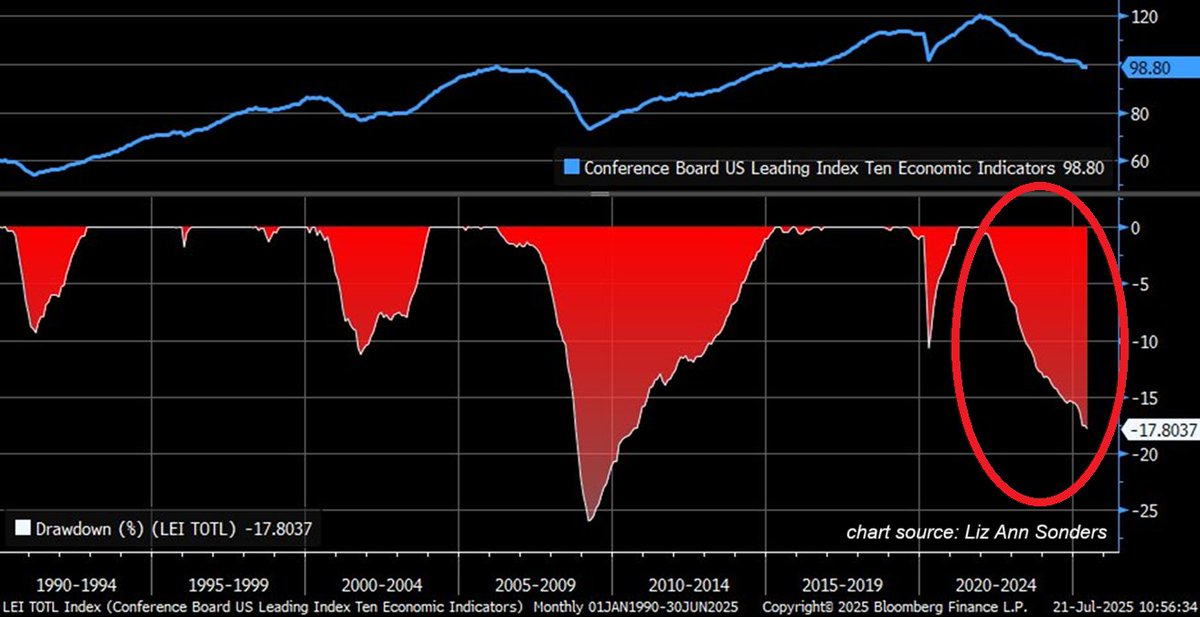
The Conference Board’s Leading Economic Index (LEI) is down 17.8%,...

EndGame Macro@onechancefreedm
10 views
Jul 24, 2025
~1 min read
Advertisement
1
The Conference Board’s Leading Economic Index (LEI) is down 17.8%, the steepest decline since the 2008 financial crisis. Historically, drawdowns of this magnitude have been tightly correlated with recessions. In fact, every major LEI plunge of this scale has preceded or coincided with significant economic contraction, even if with a lag.
The LEI captures forward looking components like manufacturing new orders, building permits, credit conditions, and consumer expectations, key inputs that often deteriorate well before headline GDP figures roll over. The fact that we’re now seeing the third consecutive month of contraction, and a year over year drop of 4.0%, implies the U.S. is already in a rolling recession beneath the surface, masked only by pockets of fiscal stimulus, labor market lag effects, and residual excess savings in some segments.
This kind of collapse typically signals a sharp tightening in private credit creation, a breakdown in business confidence, and a coming inflection in employment. If the Fed waits for coincident indicators to confirm the slowdown, they may once again be too late, especially in a highly financialized economy where asset prices are the de facto collateral base.
The U.S. economy is structurally far more fragile than headline numbers suggest. A breakdown in the LEI at this scale doesn’t just signal deceleration, it implies something deeper is unraveling beneath the statistical surface, particularly as the Treasury faces a $7 trillion debt rollover window, the Fed remains cautious on cuts, and private balance sheets are quietly deteriorating.

The LEI captures forward looking components like manufacturing new orders, building permits, credit conditions, and consumer expectations, key inputs that often deteriorate well before headline GDP figures roll over. The fact that we’re now seeing the third consecutive month of contraction, and a year over year drop of 4.0%, implies the U.S. is already in a rolling recession beneath the surface, masked only by pockets of fiscal stimulus, labor market lag effects, and residual excess savings in some segments.
This kind of collapse typically signals a sharp tightening in private credit creation, a breakdown in business confidence, and a coming inflection in employment. If the Fed waits for coincident indicators to confirm the slowdown, they may once again be too late, especially in a highly financialized economy where asset prices are the de facto collateral base.
The U.S. economy is structurally far more fragile than headline numbers suggest. A breakdown in the LEI at this scale doesn’t just signal deceleration, it implies something deeper is unraveling beneath the statistical surface, particularly as the Treasury faces a $7 trillion debt rollover window, the Fed remains cautious on cuts, and private balance sheets are quietly deteriorating.
Global Markets Investor@GlobalMktObserv
🚨US recession alert:
The Conference Board Leading Economic Index (LEI) drawdown is now 17.8%, the biggest since the Financial Crisis.
The LEI fell 4.0% Y/Y in June, to the lowest in 11 YEARS, and posted the 3rd straight month in which it has triggered a recession signal.
The Conference Board Leading Economic Index (LEI) drawdown is now 17.8%, the biggest since the Financial Crisis.
The LEI fell 4.0% Y/Y in June, to the lowest in 11 YEARS, and posted the 3rd straight month in which it has triggered a recession signal.