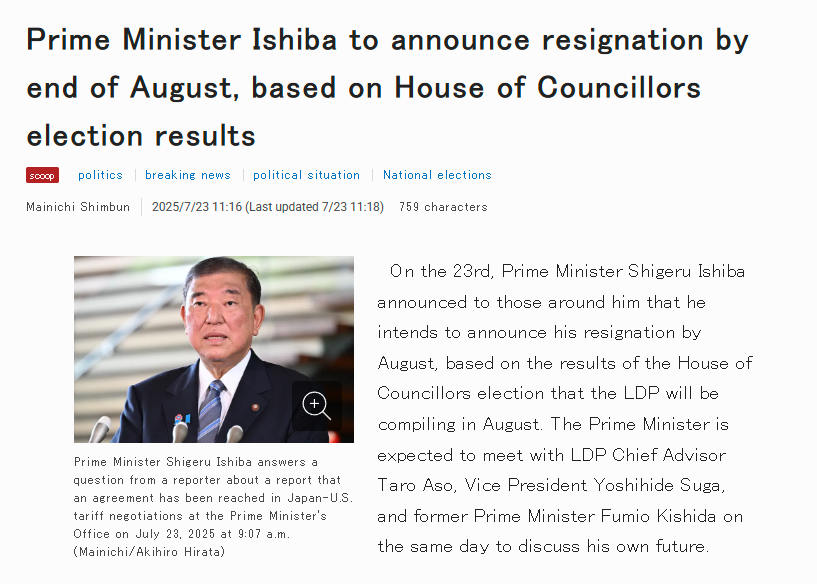
Ishiba isn’t resigning because of bad poll numbers or party drama....

EndGame Macro@onechancefreedm
20 views
Jul 24, 2025
~3 min read
Advertisement
1
Ishiba isn’t resigning because of bad poll numbers or party drama. He is resigning because he became the fall guy in a much bigger game, one where Japan’s entire economic strategy hit a wall, and the United States finally called its bluff. For years, Japan survived on a mix of financial repression, currency suppression, and quiet support from the U.S.-led global order. But that structure is breaking. The U.S. is no longer willing to let allies export deflation, run cheap currencies, or manipulate bond markets while America absorbs the inflation and finances global security. Ishiba found himself caught in the crosshairs of that shift.
When Scott Bessent, the U.S. Treasury Secretary visited Japan earlier this month, it wasn’t just to attend a ceremonial event. He came to deliver a message. Behind closed doors, he likely told Japan’s leadership to stop weakening the yen, scale back the BOJ’s yield curve control, and agree to a new trade framework or face 25% auto tariffs, possible capital flight, and reduced access to dollar support mechanisms. That wasn’t a warning. It was a line in the sand.
Ishiba was already under pressure. Japan’s economy contracted in Q1, real wages are still falling, and his party took a beating in the upper house elections just days before. When Trump announced the U.S.–Japan trade deal on yesterday, including a 15% tariff instead of 25%, and a $550 billion Japanese investment pledge into the U.S., it was billed as a win. But everyone inside Tokyo knew that it meant Japan had conceded. The U.S. didn’t just get a better trade deal, it forced Japan to fall in line with its broader economic and strategic agenda.
So why would Ishiba resign after striking that deal? Because in the eyes of his own political class, he gave up too much. The deal might have prevented harsher tariffs, but it exposed how weak Japan’s position had become. Ishiba looked like a leader who couldn’t protect Japan’s autonomy or economy. And once the agreement was signed, there was no more political reason to keep him in place. His job was done. He’d absorbed the blame and cleared the path for someone else to carry out the post deal restructuring.
At the core of all this is something deeper: Japan’s old playbook no longer works. The three things that held the country together, cheap borrowing via BOJ control, demographic stability to absorb shocks, and quiet U.S. support, have all failed. The bond market’s starting to push back, inflation is squeezing households, and Washington is no longer willing to tolerate Japan’s monetary games. In that environment, Ishiba didn’t have room to lead. He had no tools left. He didn’t step down just because he lost support. He stepped down because the entire system he was trying to manage stopped working.
Now Japan enters a new era. It’s no longer the quietly independent industrial power navigating a middle path between great powers. It’s becoming a tightly bound ally in a U.S. centric order, on trade, on monetary policy, on defense. The resignation wasn’t just about Ishiba. It was about a shift in the global structure. His fall was the signal that Japan’s strategic ambiguity is over and the era of quiet balancing has been replaced by open alignment.
When Scott Bessent, the U.S. Treasury Secretary visited Japan earlier this month, it wasn’t just to attend a ceremonial event. He came to deliver a message. Behind closed doors, he likely told Japan’s leadership to stop weakening the yen, scale back the BOJ’s yield curve control, and agree to a new trade framework or face 25% auto tariffs, possible capital flight, and reduced access to dollar support mechanisms. That wasn’t a warning. It was a line in the sand.
Ishiba was already under pressure. Japan’s economy contracted in Q1, real wages are still falling, and his party took a beating in the upper house elections just days before. When Trump announced the U.S.–Japan trade deal on yesterday, including a 15% tariff instead of 25%, and a $550 billion Japanese investment pledge into the U.S., it was billed as a win. But everyone inside Tokyo knew that it meant Japan had conceded. The U.S. didn’t just get a better trade deal, it forced Japan to fall in line with its broader economic and strategic agenda.
So why would Ishiba resign after striking that deal? Because in the eyes of his own political class, he gave up too much. The deal might have prevented harsher tariffs, but it exposed how weak Japan’s position had become. Ishiba looked like a leader who couldn’t protect Japan’s autonomy or economy. And once the agreement was signed, there was no more political reason to keep him in place. His job was done. He’d absorbed the blame and cleared the path for someone else to carry out the post deal restructuring.
At the core of all this is something deeper: Japan’s old playbook no longer works. The three things that held the country together, cheap borrowing via BOJ control, demographic stability to absorb shocks, and quiet U.S. support, have all failed. The bond market’s starting to push back, inflation is squeezing households, and Washington is no longer willing to tolerate Japan’s monetary games. In that environment, Ishiba didn’t have room to lead. He had no tools left. He didn’t step down just because he lost support. He stepped down because the entire system he was trying to manage stopped working.
Now Japan enters a new era. It’s no longer the quietly independent industrial power navigating a middle path between great powers. It’s becoming a tightly bound ally in a U.S. centric order, on trade, on monetary policy, on defense. The resignation wasn’t just about Ishiba. It was about a shift in the global structure. His fall was the signal that Japan’s strategic ambiguity is over and the era of quiet balancing has been replaced by open alignment.