How to become a memecoin insider in 7 days [how to catch 1000x plays early]

The biggest mistake small accounts make is thinking they need more capital.
They don’t.
They need to stop finding trades after everyone else does.
I see the same posts every day:
“I only have $100.”
“I only have $500.”
“I only have $1K.”
“How do I turn this into 50-100x without always buying after the pump?”
I had the same problem.
For months, I tracked wallets with insane PnL and assumed I was following smart money.
By the time I found them, thousands of other people had already found them too.
Their edge was already public.
And I was buying after the part of the trade that actually mattered.
The shift was learning to look one step earlier.
Not:
“What’s pumping right now?”
But:
“Who was already positioned before anyone else?”
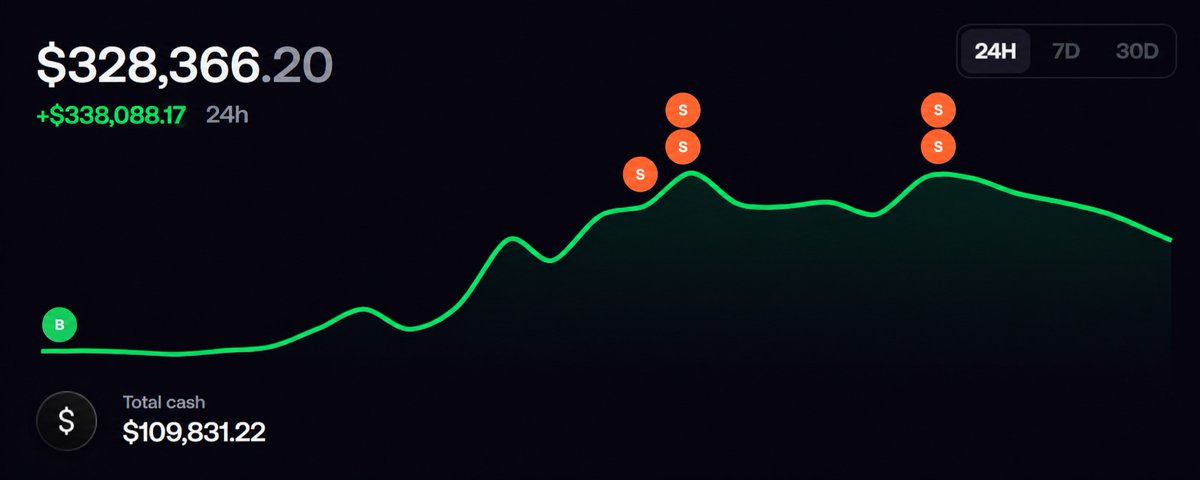
That process has made me $338,088.17.
If I had to build the entire system again from zero, this is exactly how I’d do it in 7 days 👇
1. Why you’re always 5th in line
Picture a fresh memecoin launch.
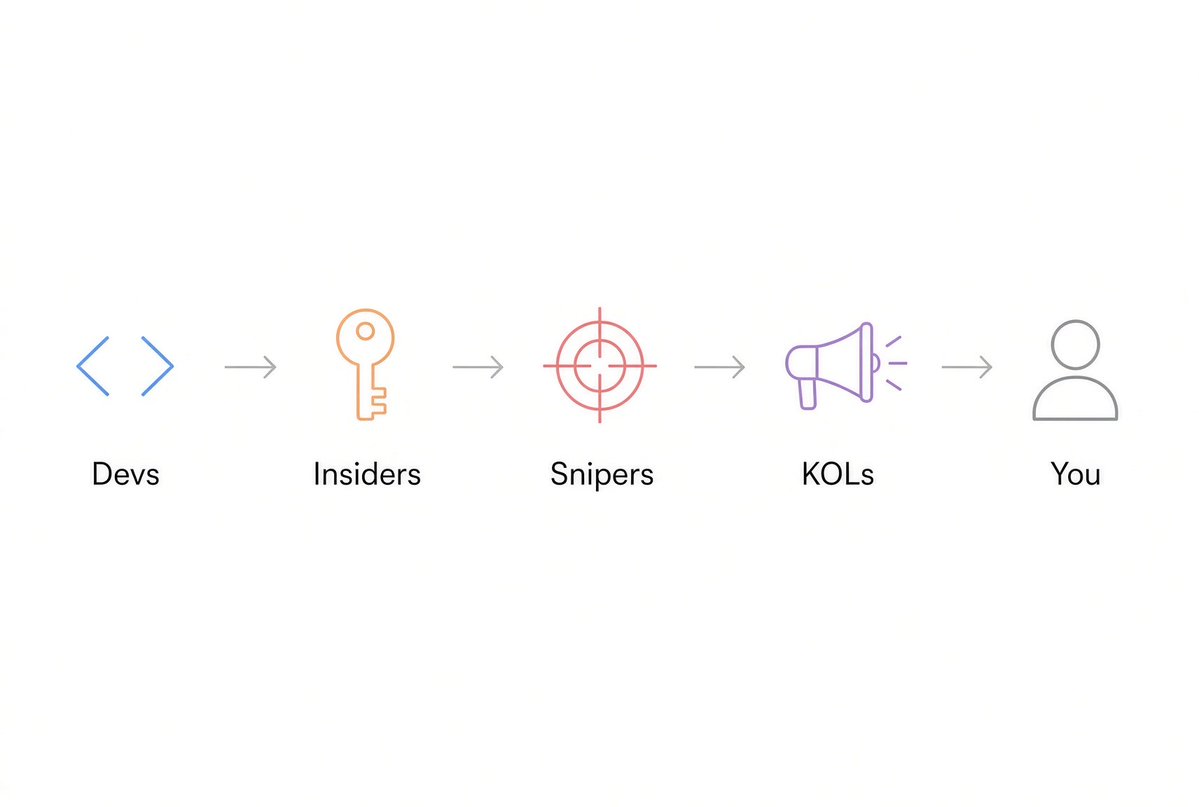
Before you even see it on your timeline, 4 groups of ppl have already had a chance to make money:
1. Devs
They control the supply before the trading pair even exists.
2. Insiders
They’re positioned before the ticker starts spreading on socials.
3. Snipers and bots
They’re buying in the first blocks, long before you can react manually.
4. Public traders / KOLs
They enter, people start copying them, and suddenly their exit has a crowd of buyers waiting underneath.
Then you show up.
You’re #5.
And #5 usually pays everyone above.
That’s why one of my hardest rules is:
I don’t hunt insider trades on coins younger than 14 days.
Not because young coins can’t pump.
They obviously can.
It’s because during those first days, you’re playing against people with an info and edge you simply don’t have.
Trying to beat all four is a terrible game.
Waiting until the coin survives the first wave changes the whole approach.
And now wallet tracking actually starts becoming useful.
The 14-day rule isn’t about being conservative.
It’s about refusing to sit at a table where you’re structurally last.
2. A profitable wallet is NOT automatically an insider
This is where I wasted the most time.
You open a leaderboard.
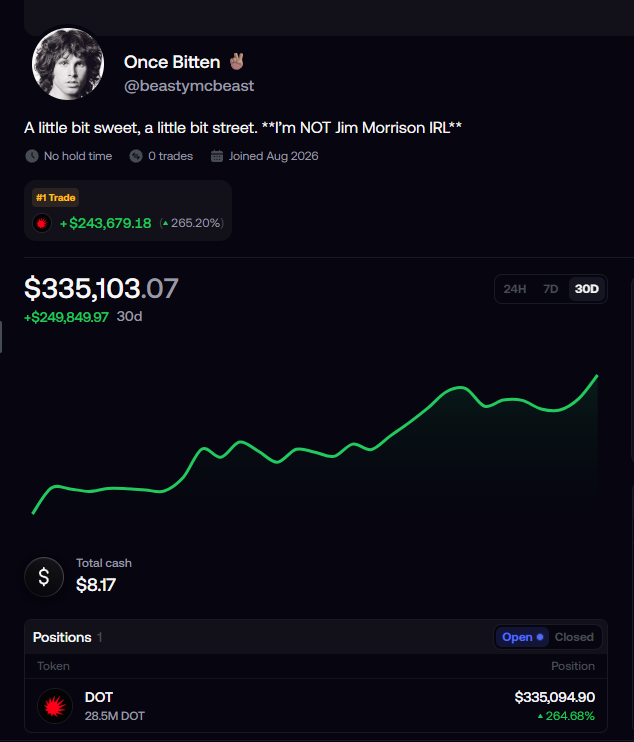
See a wallet with $500K, $1M, $5M in PnL.
And instantly think:
“This guy knows something.”
Maybe.
But a fat wallet can be anything:
None of that automatically gives you something you can trade.
What I actually want is very different:
A wallet that was early before the memecoin went 10-50-100x.
And more importantly:
It did it more than once.
One early 100x can be luck.
Early on one winner, then early again on another completely different coin?
Now I'm starting to care.
That’s when a wallet starts moving from:
“nice PnL” to “possible edge.”
And there’s another trap:
The more public a wallet becomes, the less useful its next buy can be.
The real position may already be built through earlier wallets, while the public address is the one everyone ends up tracking.
The edge usually sits one or two wallets before the one everyone is watching.
This changed how I research wallets completely.
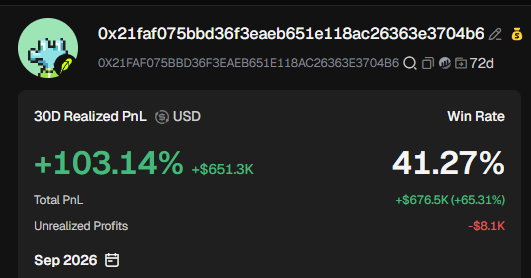
I stopped asking:
“How much did this wallet make?”
And started asking:
That’s the difference between tracking a result and tracking the actual trade.
And it leads to one of the most important rules in this whole guide:
Don’t follow the wallet. Follow the framework.
Funding → buy → split → rotate → exit
We’ll get into exactly how to trace that later.
For now, remember this:
Big PnL gets a wallet on my radar.
Repeatable early positioning is what keeps it there.
3. Build the system before you buy anything
You don’t need 20 tools.
You need 5 things:
Arkham - intel.arkm.com
For funding paths, wallet clusters and connected addresses.
Nansen - nansen.ai
For checking if the behavior is repeatable or just one lucky trade.
GMGN / Cielo - gmgn.ai / cielo.finance
For monitoring wallets and catching buys and sells in real time.
Bubblemaps - bubblemaps.io
For checking holder distribution and hidden wallet connections before buying.
FOMO - fomo.family/r/rektfencer
For the actual action layer: following traders, watching their entries and exits, and trenching from one feed.
That’s enough for the whole research stack.
Free tiers are fine at the start.
Don’t pay for alerts until you actually have wallets worth alerting.

For execution and live tracking, I use FOMO.
It puts the things I care about in one place:
Last cycle, this setup was spread across multiple tools.
Now most of it fits on one screen.
Build the first list.
Start with 10-30 wallets, not 200.
More alerts ≠ more edge.
I want wallets with:
A wallet that bought $10 at a $10K market cap and still holds at $20M looks amazing on a leaderboard.
But there’s nothing there you can actually copy.
And if the avg hold time is 3 mins, the alert is probably already too late.
Then comes the important part:
Buy nothing for 7 days.
Just watch.
Especially the sells.
By the end of the week, you’ll already know which wallets actually take profit and which ones just look good on screenshots.
4. What actually makes the list
Most people add wallets because the PnL looks good.
I care more about how that PnL was made.
There are only 3 types I actually want to keep watching:
Early on one winner.
Then early again on another.
Similar size. Similar behavior.
That second hit is what matters.
One lucky trade gets the wallet on the radar.
Two early winners get the wallet on the list.
A new wallet suddenly starts deploying real size.
Could be a dev.
Could be an insider rotating into a fresh address.
I don’t copy it immediately.
I watch where the money came from and what it does next.
These are some of the most useful wallets.
They were early in one narrative, then suddenly start buying something completely different.
That’s often how you spot a meta shift before CT catches up.

And some wallets get deleted the same day:
That last one matters.
I follow wallets to see how they exit.
Everyone has entries.
The real edge is seeing who actually knows when to sell.
5. How to find your first real insider wallet
Don’t start with a coin you think will pump.
Start with one that already did.
Take a strong runner from the last 1-2 weeks.
Ideally, one where price started moving before the narrative fully hit CT.
Then open the 1-minute chart.
Ignore the giant pump candle.
The interesting part is usually the 3-10 minutes before it.
That’s where I start pulling buyers.
I’m looking for wallets that entered with meaningful size before the move became obvious.
Then I go through them one by one:
One lucky hit means nothing.
Repeatable early entries are what matter.
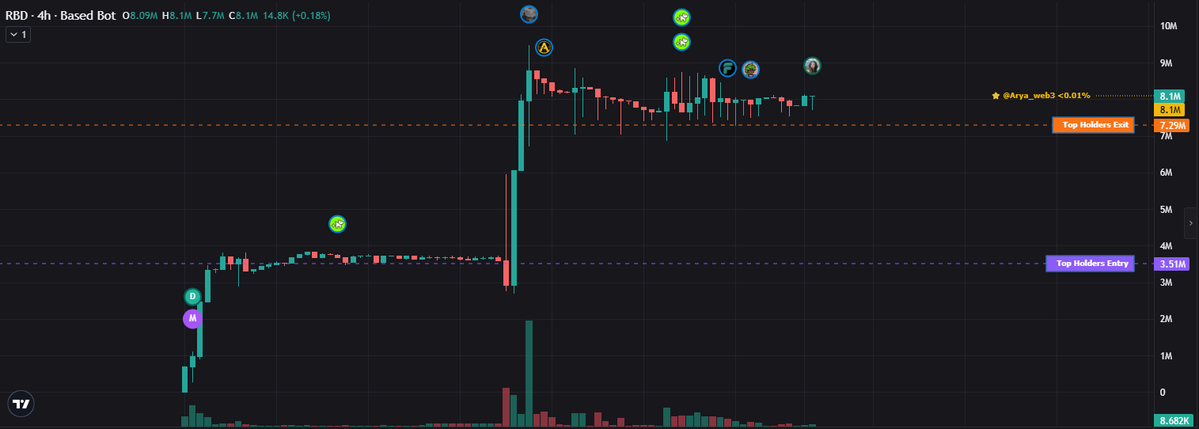
Then I go one level deeper.
This is where wallet tracking becomes much more powerful.
Because smart money is rarely one address.
It’s usually a path:
Funding → buyer → split → rotate → exit
The wallet with the huge PnL is often only the last visible part of that path.
The real edge can sit several txs earlier.
And this is the signal I'm looking at the most:
2-3 wallets from my list start building the same position before CT notices.
Especially if the coin is already 7+ days old and holders are still growing.
One wallet buying 10 coins a day is noise.
Several good wallets quietly stacking the same one?
Now I pay attention.
6. A good wallet is NOT a reason to go all in
Finding the right wallet is only half the edge.
The other half is making sure one bad read doesn’t wipe out everything you built.
I keep the account split roughly like this:
60% Core
Older names that already survived the chaos, have cleaner distribution and enough liquidity to hold through volatility.
25% Rotation
Capital I can move between setups I already understand when one gets stretched and another resets.
15% Shots
This is where the insider-wallet setups go.
And this part stays small on purpose.
A shot needs to be 14+ days old, survive the first major dump, keep growing holders, and have at least 2 tracked wallets entering around the same time.
I can take 5 equal shots and be wrong on most of them without destroying the account.
That’s the point.
Wallet tracking tells me where the opportunity is.
Position sizing decides whether I’m still around when the real one hits.
7. The real edge is knowing when NOT to trade
After all of this, the biggest mistake would be turning wallet tracking into another excuse to trade more.
That’s not the point.
The point is to make the feed smaller.
Fewer wallets.
Fewer alerts.
Fewer trades.
But when something finally lines up, you actually know why you’re buying it.
You don’t need to catch every 100x.
You need a few clean setups where you enter early enough, size correctly, and take profit.
One real 5-10x that you don’t roundtrip will do more for your account than 100 random launches.

The feed will always make it feel like you’re missing something.
You’re not.
Most of the time, doing nothing is part of the system.
Stop rushing. The feed is literally built to make rushing feel productive.
If you made it this far, thank you.
This took me a few days to put together, but most of the lessons took much longer and a lot more money to learn.
I’m not expecting you to copy every rule 1:1.
Take the framework.
Test the wallets yourself.
Change what doesn’t fit you.
And most importantly, don’t blindly trust anyone just because they have a big PNL screenshot.
The easiest way to actually use everything above is to build a small list and watch it live for a week.
That’s what I use FOMO for:
Bookmark this because you definitely won’t remember it all.
And if it helped, follow, like, and RT genuinely means a lot.
And always remember:
You don’t need to be first.
You just need to stop being last.