Make programming easier with these evidence based templates for...

Eamonn Flanagan@EamonnFlanagan
39 views
Jun 23, 2025
~1 min read
Advertisement
1
Make programming easier with these evidence based templates for training program design
VBT
Plyometrics
Complex training
Cluster training
Medicine ball training
Strength & Power Tapering
Blood Flow Restriction Training
👇
VBT
Plyometrics
Complex training
Cluster training
Medicine ball training
Strength & Power Tapering
Blood Flow Restriction Training
👇
2
Velocity Based Training:
- Drive Intent
- Augmented feedback
- Fatigue management
- L:V Profiling
x.com/EamonnFlanagan…
- Drive Intent
- Augmented feedback
- Fatigue management
- L:V Profiling
x.com/EamonnFlanagan…
3
Complex Training pairs high-intensity strength exercises with biomechanically similar high-power or high-velocity exercises.
Here is the "how to" 👇
x.com/EamonnFlanagan…
Here is the "how to" 👇
x.com/EamonnFlanagan…
4
Medicine Ball Training
Improve programming and adaptation to training by following these principles and following the 4-category training model
x.com/EamonnFlanagan…
Improve programming and adaptation to training by following these principles and following the 4-category training model
x.com/EamonnFlanagan…
5
6
7
Strength and Power tapering
Eamonn Flanagan@EamonnFlanagan
💥 Strength & Power tapering made easy 💥
A cheat sheet to minimise fatigue & maximise competition performance
Effective tapering can:
🔸 Optimise btw "expressable" fitness & fatigue
🔸 ↑ strength and power by up to 20%
🔸 ↑ competition performance by up to 5%
🔸 ↓ post-session muscle damage
🔸 ↑ serum testosterone & ↓ stress markers
🔸 Enhance mood state & ↓ sleep disturbances
Tapering approach should primarily consider:
✔️ Athlete experience & training age
Experienced = longer taper phases
Novice = shorter taper phases
✔️ Duration of most recent training block & accumulated fatigue
- short / minimal fatigue
- medium / moderate
- long / over-reaching
Broad guidelines:
Duration: 7-20 days (short/medium) or 14-28 days (over-reached)
Volume: 50-75% reduction over the taper duration
Intensity: Maintain or slightly decrease intensity (-10 to -15%)
Frequency: Maintain normal training routine & frequency
Decay: If utilising longer taper, utilise slower decay of volume/intensity
Practical wisdom (Vern Gambetta):
"In this period you should not do more or something you have never done before. Trust the preparation and fine tune. "One more" of anything is risky. The most important thing is what you are not doing rather than what you are doing".
A cheat sheet to minimise fatigue & maximise competition performance
Effective tapering can:
🔸 Optimise btw "expressable" fitness & fatigue
🔸 ↑ strength and power by up to 20%
🔸 ↑ competition performance by up to 5%
🔸 ↓ post-session muscle damage
🔸 ↑ serum testosterone & ↓ stress markers
🔸 Enhance mood state & ↓ sleep disturbances
Tapering approach should primarily consider:
✔️ Athlete experience & training age
Experienced = longer taper phases
Novice = shorter taper phases
✔️ Duration of most recent training block & accumulated fatigue
- short / minimal fatigue
- medium / moderate
- long / over-reaching
Broad guidelines:
Duration: 7-20 days (short/medium) or 14-28 days (over-reached)
Volume: 50-75% reduction over the taper duration
Intensity: Maintain or slightly decrease intensity (-10 to -15%)
Frequency: Maintain normal training routine & frequency
Decay: If utilising longer taper, utilise slower decay of volume/intensity
Practical wisdom (Vern Gambetta):
"In this period you should not do more or something you have never done before. Trust the preparation and fine tune. "One more" of anything is risky. The most important thing is what you are not doing rather than what you are doing".
8
Cluster training
Eamonn Flanagan@EamonnFlanagan
Cluster Training is the quickest & most practical way to introduce a novel stimulus in existing strength & power programs.
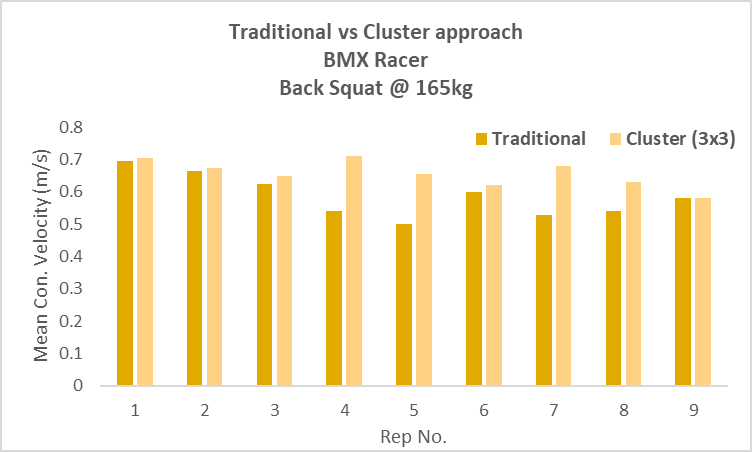
Komi demonstrated that sig ↓ max. force expression can happen in as few as 5️⃣ reps. Cluster sets utilise ↑ btw-rep recovery to reduce within-set fatigue.
This approach can increase quality of performance from rep to rep and ↑ power output & ↑ barbell velocity across sets compared to traditional approaches.
Between repetitions, load can be ascended or undulated in "pyramid" fashion (build-up ↔️ build-down). Haff suggests pyramid approach may leverage some PAPE effects on latter reps.
Research highlights:
📑 Haff (2003): ↑ peak velocity on clean pull by 8% (within session/set) vs. traditional set structures
📑 Rial-Vázquez (2020): Cluster training can improve velocity end of load/velocity profiles to a greater extent than traditional strength training
📑 García-Ramos (2020) & Martínez Guardado (2021): Cluster training is effective at reducing the mechanical (velocity loss) & metabolic (blood lactate) measures of fatigue
📑 Arazi (2021): Cluster training improved high impulse activities (medicine ball throw, CMJ) in well-trained powerlifters to a greater extent than traditional (near failure) methods
Practical applications:
💥 Cluster set loading methods likely best for explosive strength development (vs. traditional heavy maximal strength development)
💥 Cluster training likely ↑ neural load (neural adaptations) due to ↑ in average load across reps/sets.
💥 Cluster training best suited for well trained individuals with existing high levels of maximal strength.
💥 Cluster training is an easy transition from maximal dynamic strength when training variance is required or when entering tapering phases
💥 Cluster training may be best suited to ballistic movements or technical weightlifting movements
💥 Traditional set structures may be better suited for development of maximal strength and hypertrophy due to their likelihood of ↑ activation of high threshold motor units & production of metabolic induced muscular adaptations.
Komi demonstrated that sig ↓ max. force expression can happen in as few as 5️⃣ reps. Cluster sets utilise ↑ btw-rep recovery to reduce within-set fatigue.
This approach can increase quality of performance from rep to rep and ↑ power output & ↑ barbell velocity across sets compared to traditional approaches.
Between repetitions, load can be ascended or undulated in "pyramid" fashion (build-up ↔️ build-down). Haff suggests pyramid approach may leverage some PAPE effects on latter reps.
Research highlights:
📑 Haff (2003): ↑ peak velocity on clean pull by 8% (within session/set) vs. traditional set structures
📑 Rial-Vázquez (2020): Cluster training can improve velocity end of load/velocity profiles to a greater extent than traditional strength training
📑 García-Ramos (2020) & Martínez Guardado (2021): Cluster training is effective at reducing the mechanical (velocity loss) & metabolic (blood lactate) measures of fatigue
📑 Arazi (2021): Cluster training improved high impulse activities (medicine ball throw, CMJ) in well-trained powerlifters to a greater extent than traditional (near failure) methods
Practical applications:
💥 Cluster set loading methods likely best for explosive strength development (vs. traditional heavy maximal strength development)
💥 Cluster training likely ↑ neural load (neural adaptations) due to ↑ in average load across reps/sets.
💥 Cluster training best suited for well trained individuals with existing high levels of maximal strength.
💥 Cluster training is an easy transition from maximal dynamic strength when training variance is required or when entering tapering phases
💥 Cluster training may be best suited to ballistic movements or technical weightlifting movements
💥 Traditional set structures may be better suited for development of maximal strength and hypertrophy due to their likelihood of ↑ activation of high threshold motor units & production of metabolic induced muscular adaptations.
