Not all strength is created equal Strength quality classification:...

Eamonn Flanagan@EamonnFlanagan
42 views
Oct 17, 2025
~2 min read
Advertisement
1
Not all strength is created equal
Strength quality classification: implications for training & testing
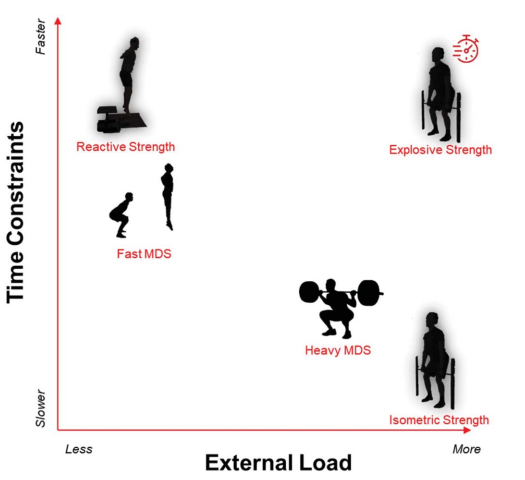
We can consider strength activities as a function of their contraction times & their external load.
Discrete qualities will share <50% common variance
Strength quality classification: implications for training & testing
We can consider strength activities as a function of their contraction times & their external load.
Discrete qualities will share <50% common variance
2
Maximal Isometric Strength
“… ability to express the highest amount of force in isometric conditions"
Isometric strength is non time dependent and not dependent on ability to sustain the effort.
“… ability to express the highest amount of force in isometric conditions"
Isometric strength is non time dependent and not dependent on ability to sustain the effort.
3
Testing:
Iso. mid thigh pull (or squat)
Site specific (eg seated calf)
Metrics:
Fmax (pk force)
Rel. force (Fmax / BM)
Training:
Isometrics (pushing/yielding)
Switches & holds
Pause variations
Beware: can be limited transfer between isometric and dynamic strength qualities
Iso. mid thigh pull (or squat)
Site specific (eg seated calf)
Metrics:
Fmax (pk force)
Rel. force (Fmax / BM)
Training:
Isometrics (pushing/yielding)
Switches & holds
Pause variations
Beware: can be limited transfer between isometric and dynamic strength qualities
4
Heavy maximal dynamic strength.
Typically the domain of the weight room. >85% 1RM lifting in compound movements
Non time dependent. "“… ability to express the highest amount of force in dynamic conditions against very heavy loads”
Typically the domain of the weight room. >85% 1RM lifting in compound movements
Non time dependent. "“… ability to express the highest amount of force in dynamic conditions against very heavy loads”
5
Testing:
1 rep max (1RM)
Load:Velocity profiling
Metrics:
1RM
Velocity @ fixed load
Training:
Strength training @ >80% 1RM with low reps in reserve
1 rep max (1RM)
Load:Velocity profiling
Metrics:
1RM
Velocity @ fixed load
Training:
Strength training @ >80% 1RM with low reps in reserve
6
Fast Dynamic Strength
Typically "jump" or "throw" based ballistic training
"... the ability to express force maximally against low (or zero loads) in short time periods (300-600ms)
Typically "jump" or "throw" based ballistic training
"... the ability to express force maximally against low (or zero loads) in short time periods (300-600ms)
7
Testing:
Squat jump (concentric only)
Countermovement Jump (Slow SSC)
Med Ball throw for distance (upper body)
Metrics:
Jump height (or distance)
FT:Contraction time
Relative peak power (W/kg)
Training:
Jump training
Light load ballistic training
Med ball throws
Squat jump (concentric only)
Countermovement Jump (Slow SSC)
Med Ball throw for distance (upper body)
Metrics:
Jump height (or distance)
FT:Contraction time
Relative peak power (W/kg)
Training:
Jump training
Light load ballistic training
Med ball throws
8
Explosive Strength
"The ability to express force, maximally, in short time periods against high external load"
"... the ability to increase force quickly from a low or resting level"
Often the domain of weightlifting (snatch, clean, jerk) but there are alternatives....
"The ability to express force, maximally, in short time periods against high external load"
"... the ability to increase force quickly from a low or resting level"
Often the domain of weightlifting (snatch, clean, jerk) but there are alternatives....
9
Testing:
IMTP (early phase force)
Loaded Squat jump
Depth jump (high drop heights)
Metrics:
Force @ 200ms (or less)
RFD
Training:
Weightlifting variations (from blocks, pins)
Concentric-only loaded squats, jumps and throws
Depth jumps
IMTP (early phase force)
Loaded Squat jump
Depth jump (high drop heights)
Metrics:
Force @ 200ms (or less)
RFD
Training:
Weightlifting variations (from blocks, pins)
Concentric-only loaded squats, jumps and throws
Depth jumps
10
Reactive Strength
"Plyometric ability"
"... the ability to express force maxiamlly in fast SSC actions during short ground contact impacts (<250ms)..."
Bounces, hops, rebounds.
"Plyometric ability"
"... the ability to express force maxiamlly in fast SSC actions during short ground contact impacts (<250ms)..."
Bounces, hops, rebounds.
11
Testing:
Drop Jump (DJ)
10-5 Rebound Jump Test
Bounds for distance
Metrics:
Jump height
Contact time
Reactive strength index (RSI)
Training:
Plyometrics (general & specific)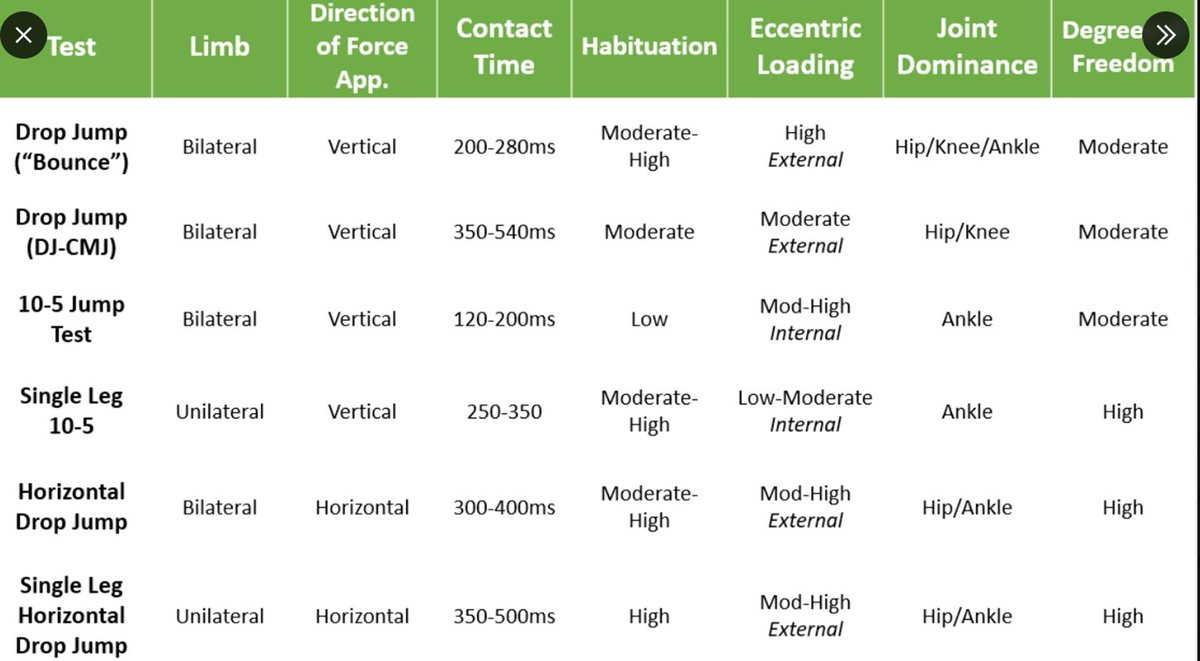
Drop Jump (DJ)
10-5 Rebound Jump Test
Bounds for distance
Metrics:
Jump height
Contact time
Reactive strength index (RSI)
Training:
Plyometrics (general & specific)
12
Key, influential paper from Dr. Lachlan James here

Eamonn Flanagan@EamonnFlanagan
The S&C domain is awash with differing, conflicting and confusing terminology relating to “types” of strength
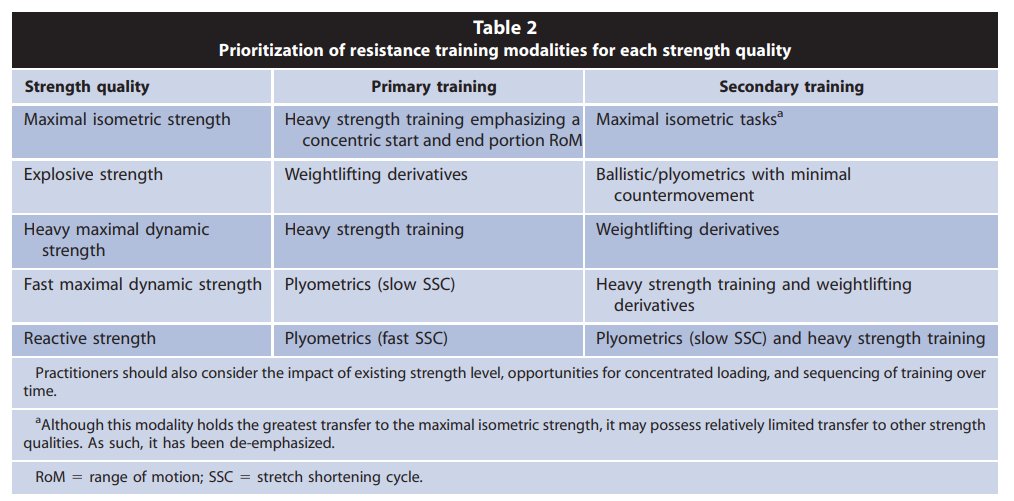
This 2023 paper by Lachlan James and co. (@DocLachJames) does a great job of bringing clarity to strength quality classification
Maximal Isometric Strength = highest force which can be produced against an “unyielding object” in a single, maximal effort irrespective of time. Think IMPT or other short duration, high force isometrics.
Heavy Maximal Dynamic Strength = the ability to express the highest force in dynamic conditions against v. heavy loads. Training with heavy compound lifts and typically assessed via repetition maximum testing. A strength quality that is not typically time-dependent.
Explosive Strength = the ability to produce high levels of force in short time periods against high external loads. Typically trained via weightlifting variations (clean/snatch) and other ballistic strength training exercises.
Fast Maximal Dynamic Strength = the ability to express force maximally against no load, or minimal external load in relatively quick time periods (300ms). Typically training w/ slow SSC jumping actions and assessed via the CMJ.
Reactive Strength = the underlying strength quality which contributes to the fast stretch shortening cycle. Fast SSCs involve high stretch loads, short movement amplitudes, limited joint ranges of motion & v. short contraction or ground contact times – less than 250ms.
This 2023 paper by Lachlan James and co. (@DocLachJames) does a great job of bringing clarity to strength quality classification
Maximal Isometric Strength = highest force which can be produced against an “unyielding object” in a single, maximal effort irrespective of time. Think IMPT or other short duration, high force isometrics.
Heavy Maximal Dynamic Strength = the ability to express the highest force in dynamic conditions against v. heavy loads. Training with heavy compound lifts and typically assessed via repetition maximum testing. A strength quality that is not typically time-dependent.
Explosive Strength = the ability to produce high levels of force in short time periods against high external loads. Typically trained via weightlifting variations (clean/snatch) and other ballistic strength training exercises.
Fast Maximal Dynamic Strength = the ability to express force maximally against no load, or minimal external load in relatively quick time periods (300ms). Typically training w/ slow SSC jumping actions and assessed via the CMJ.
Reactive Strength = the underlying strength quality which contributes to the fast stretch shortening cycle. Fast SSCs involve high stretch loads, short movement amplitudes, limited joint ranges of motion & v. short contraction or ground contact times – less than 250ms.
13
Classic paper from Newton & Dugan (2002)

