1/ $AMD is an asymmetric opportunity everybody sleeps on. Data...

Oguz Erkan@oguzerkan
25 views
Mar 03, 2025
~3 min read
Advertisement
1
1/ $AMD is an asymmetric opportunity everybody sleeps on.
Data center growth is exploding yet the market prices no growth beyond 2026.
Here is my investment thesis: 🧵
Data center growth is exploding yet the market prices no growth beyond 2026.
Here is my investment thesis: 🧵
2
2/ $AMD nearly tripled revenues in the last five years from $9 billion to $25 billion.
Yet, this is just the beginning.
AMD achieved most of this growth by taking market share from Intel in CPUs.
It has just started to capitalize on GPUs..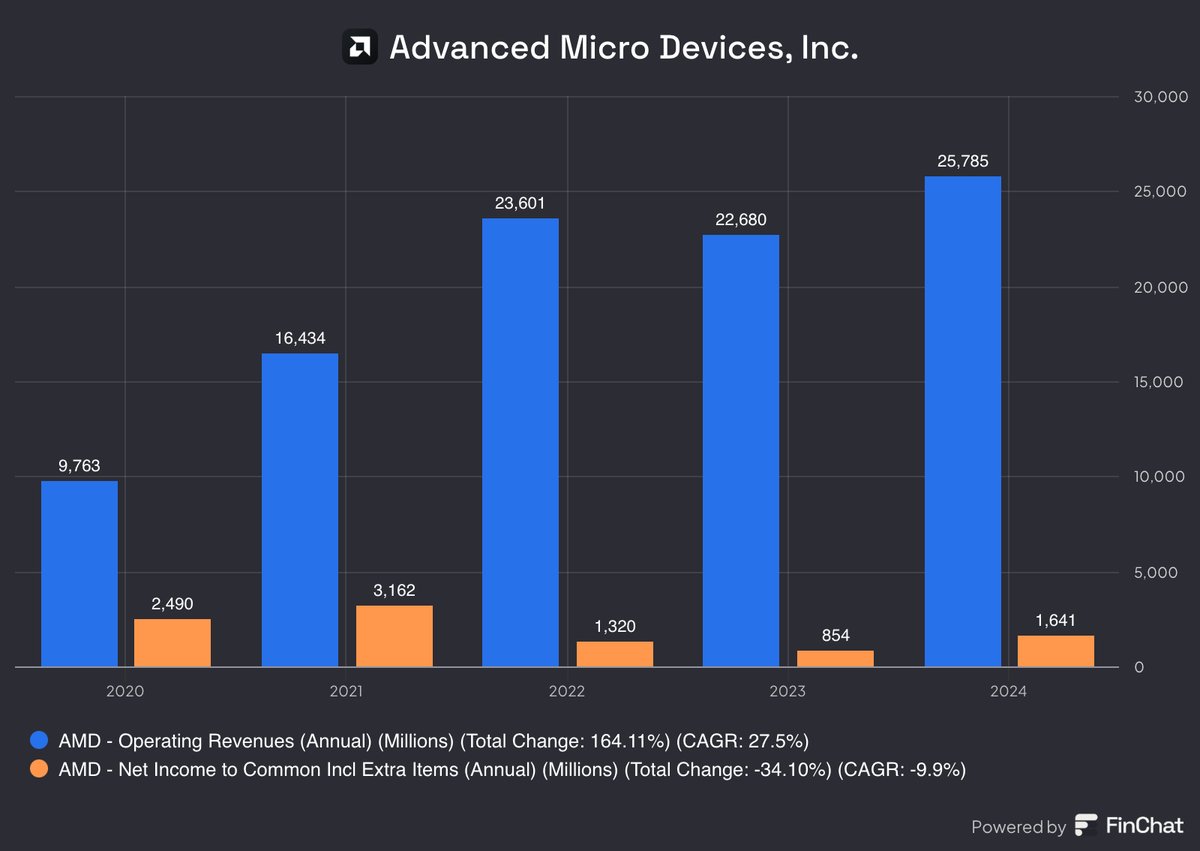
Yet, this is just the beginning.
AMD achieved most of this growth by taking market share from Intel in CPUs.
It has just started to capitalize on GPUs..
3
3/ Its data center segment is exploding.
Segment grew 69% YoY last quarter, primarily driven by the exploding demand for its MI300 GPUs.
Hyperscalers' dependence of Nvidia makes them supply constrained so they are looking for alternatives.
$AMD is the strongest alternative.
Segment grew 69% YoY last quarter, primarily driven by the exploding demand for its MI300 GPUs.
Hyperscalers' dependence of Nvidia makes them supply constrained so they are looking for alternatives.
$AMD is the strongest alternative.
4
4/ $AMD has already started to benefit from hyperscalers' search for alternatives.
$META latest model now runs 100% on $AMD chips for live traffic.
They report significant cost efficiencies and minimal switching costs:
$META latest model now runs 100% on $AMD chips for live traffic.
They report significant cost efficiencies and minimal switching costs:
1:24
5
5/ $AMD is coming after the whole inference market.
Its partnership with $META is just a beginning.
Lisa Su believes that inference will be a much bigger market than training:
Its partnership with $META is just a beginning.
Lisa Su believes that inference will be a much bigger market than training:
1:05
6
6/ But why $AMD has an advantage in inference?
The short answer is the "architecture."
$AMD has excelled in chiplet design for years while $INTC and $NVDA insisted on monolithic designs until recently.
What the hell does this mean?
Let me explain: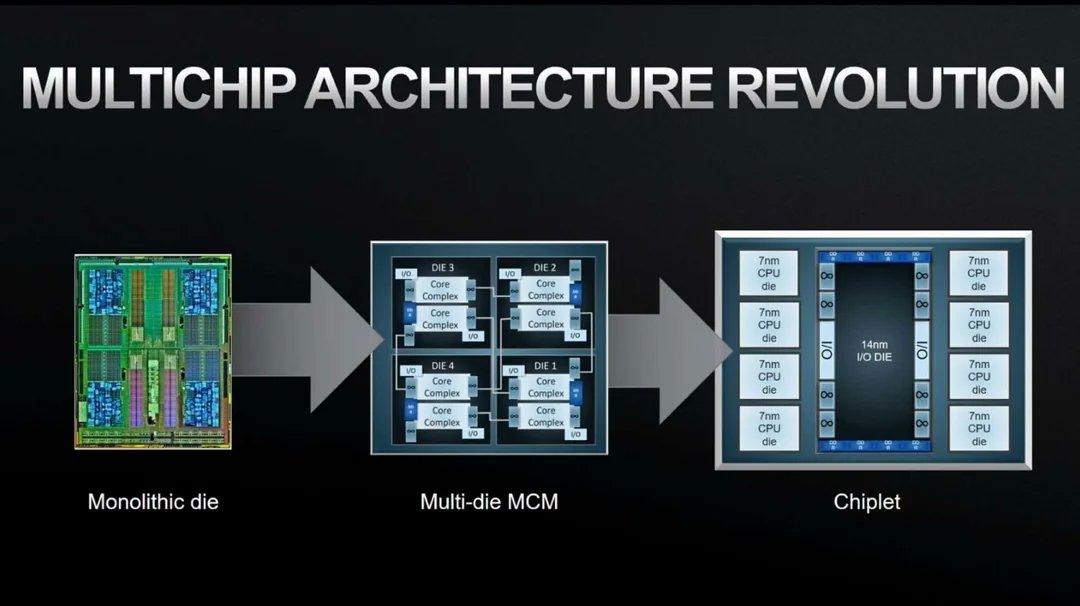
The short answer is the "architecture."
$AMD has excelled in chiplet design for years while $INTC and $NVDA insisted on monolithic designs until recently.
What the hell does this mean?
Let me explain:
7
7/ What's "chiplet" design?
In monolithic design, cores that require advanced manufacturing are put on the same die as I/O interfaces and memory controllers that require less advanced processes.
In chiplet, cores and memory controllers are put on different dies that are then connected with high-speed interconnects.
That allows us to use less advanced processes for I/O interfaces and memory controllers than cores.
Result? Cheaper chips with higher yields.
In monolithic design, cores that require advanced manufacturing are put on the same die as I/O interfaces and memory controllers that require less advanced processes.
In chiplet, cores and memory controllers are put on different dies that are then connected with high-speed interconnects.
That allows us to use less advanced processes for I/O interfaces and memory controllers than cores.
Result? Cheaper chips with higher yields.
8
8/ This allowed $AMD to offer higher memory capacity that is critical for inference workloads.
For instance, AMD MI300X chips come with 192GB H3 memory against 142GB of Nvidia H200 chips.
Higher memory capacity allows cheaper and more efficient inference workloads, positioning $AMD as the top choice for cost sensitive operators.
For instance, AMD MI300X chips come with 192GB H3 memory against 142GB of Nvidia H200 chips.
Higher memory capacity allows cheaper and more efficient inference workloads, positioning $AMD as the top choice for cost sensitive operators.
9
9/ This is just the beginning.
Nvidia's market share in data center GPUs declined from 98% in 2023 to 94% in 2024.
Hyperscalers are looking for alternatives.
Nvidia will likely remain as the leader by a margin in this market but also $AMD doesn't need to fully catch up.
Even if it can expand its market share to 10%, it'll generate more than $30 billion from this segment alone.
Nvidia's market share in data center GPUs declined from 98% in 2023 to 94% in 2024.
Hyperscalers are looking for alternatives.
Nvidia will likely remain as the leader by a margin in this market but also $AMD doesn't need to fully catch up.
Even if it can expand its market share to 10%, it'll generate more than $30 billion from this segment alone.
10
10/ Valuation is amazingly attractive.
Based on the current market developments, analysts expect $4.6 and $6.1 EPS for this year and 2026 respectively.
This means that it's currently trading at 16 times 2026 earnings and the market is pricing zero growth beyond that.
This is a ridiculous valuation.
Even if we assume just 15% annual EPS growth between beyond 2026, we will get $10 EPS in 2030.
Attach a conservative 25 PE and we have $250 stock.
Based on the current market developments, analysts expect $4.6 and $6.1 EPS for this year and 2026 respectively.
This means that it's currently trading at 16 times 2026 earnings and the market is pricing zero growth beyond that.
This is a ridiculous valuation.
Even if we assume just 15% annual EPS growth between beyond 2026, we will get $10 EPS in 2030.
Attach a conservative 25 PE and we have $250 stock.
11
Do you want to become a better investor?
I share all my insights in my weekly newsletter.
Join 12,000+ readers to become a better investor.
You will also get a free e-book when you join 👇
capitalist-letters.com
I share all my insights in my weekly newsletter.
Join 12,000+ readers to become a better investor.
You will also get a free e-book when you join 👇
capitalist-letters.com