Plyometric training, programming and testing Everything you need to...

Eamonn Flanagan@EamonnFlanagan
52 views
Nov 24, 2024
~2 min read
Advertisement
1
Plyometric training, programming and testing
Everything you need to know in 15 tweets
👇
Everything you need to know in 15 tweets
👇
2
Let's get started....
What are true, fast SSC plyometrics?
What are true, fast SSC plyometrics?
Eamonn Flanagan@EamonnFlanagan
How do you define "true plyometrics"?
Is it all about contact time being <0.250s?
Not at all.
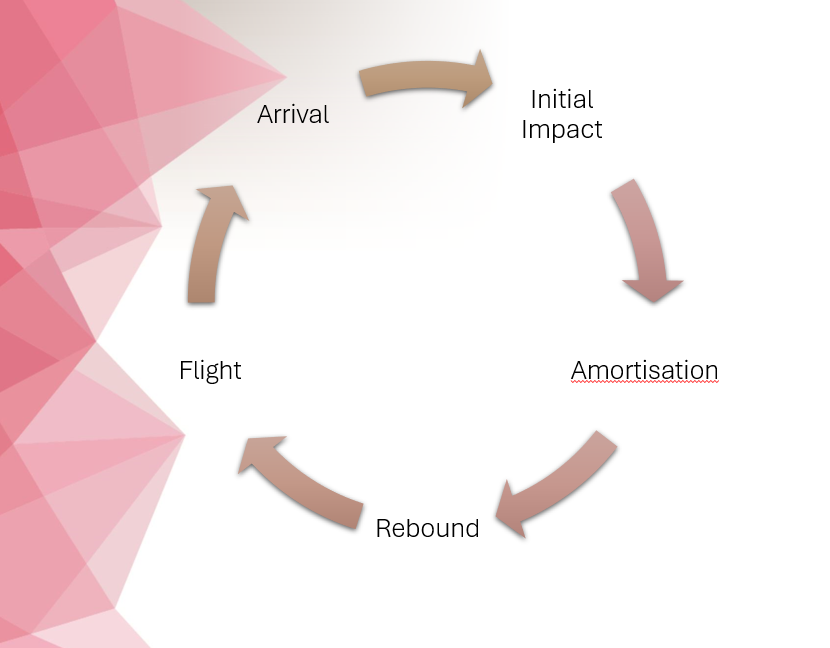
Verkhoshansky describes the CYCLE of TRUE PLYOMETRICS as follows:
Phase 1: “Arrival”
Verkhoshansky terms this the "initial momentum phase". Here the body & limbs are arriving readying for ground contact. While the body is in a relatively relaxed state, it's not a passive action. There is muscular preactivation to ready the body, particularly the lower limbs for forceful ground contact.
Phase 2: "Initial Impact"
Here as the limbs contact the ground, the ground blocks further displacement of the limb & further changes in muscle length. Here, the tendon begins to elongate but muscular contraction hasn't occurred yet.
Phase 3: "Amortisation"
Here, the stretch reflexes kick in, we have eccentric muscle contraction taking place and an fast, very high force isometric contraction is required to transition to the followig concentric contraction.
The coupling time between the eccentric and the subsequent concentric contraction is very short. True plyometrics must have these very short coupling times to harness the full potential of the stretch shortening cycle.
Phase 4: "Rebound"
Here we have the release of the elastic energy & we have contributions from reflexive muscle actions. We also have contribution from concentric muscular contraction… The body is moving back up into the air and it's about to leave the ground.
Phase 5: "Flight"
The athlete has left the ground, they're in the air & they're readying themselves for the next action.
If we are doing “continuous” repeated plyometric activities, then the flight phase naturally transitions into the next arrival phase (or if we're doing single efforts the flight phase naturally evolves into the landing phase to finish the exercise)
This is the underlying cycle of TRUE PLYOMETRICS and we see the maximum benefit of fast stretch shortening cycle utilization when the rates of eccentric loading are high, the coupling time is short and the joint displacements are small.
.
Is it all about contact time being <0.250s?
Not at all.
Verkhoshansky describes the CYCLE of TRUE PLYOMETRICS as follows:
Phase 1: “Arrival”
Verkhoshansky terms this the "initial momentum phase". Here the body & limbs are arriving readying for ground contact. While the body is in a relatively relaxed state, it's not a passive action. There is muscular preactivation to ready the body, particularly the lower limbs for forceful ground contact.
Phase 2: "Initial Impact"
Here as the limbs contact the ground, the ground blocks further displacement of the limb & further changes in muscle length. Here, the tendon begins to elongate but muscular contraction hasn't occurred yet.
Phase 3: "Amortisation"
Here, the stretch reflexes kick in, we have eccentric muscle contraction taking place and an fast, very high force isometric contraction is required to transition to the followig concentric contraction.
The coupling time between the eccentric and the subsequent concentric contraction is very short. True plyometrics must have these very short coupling times to harness the full potential of the stretch shortening cycle.
Phase 4: "Rebound"
Here we have the release of the elastic energy & we have contributions from reflexive muscle actions. We also have contribution from concentric muscular contraction… The body is moving back up into the air and it's about to leave the ground.
Phase 5: "Flight"
The athlete has left the ground, they're in the air & they're readying themselves for the next action.
If we are doing “continuous” repeated plyometric activities, then the flight phase naturally transitions into the next arrival phase (or if we're doing single efforts the flight phase naturally evolves into the landing phase to finish the exercise)
This is the underlying cycle of TRUE PLYOMETRICS and we see the maximum benefit of fast stretch shortening cycle utilization when the rates of eccentric loading are high, the coupling time is short and the joint displacements are small.
.
3
Here are my 4️⃣ key programming principles for plyometric training
Eamonn Flanagan@EamonnFlanagan
Plyometrics are an immensely powerful training tool
But their purpose can vary widely from rehab, to tissue tolerance to maximising power output. This can create ambiguity & confusion around implementation
Here's 4 quick principles that can help guide plyometric programming 👇
But their purpose can vary widely from rehab, to tissue tolerance to maximising power output. This can create ambiguity & confusion around implementation
Here's 4 quick principles that can help guide plyometric programming 👇
4
To program effectively, we must understand the intensity of our available exercises
So.... how do we define PLYOMETRIC INTENSITY?
How should we tier our exercise selection for optimal and safe progression?

So.... how do we define PLYOMETRIC INTENSITY?
How should we tier our exercise selection for optimal and safe progression?
Eamonn Flanagan@EamonnFlanagan
Defining Plyometric Intensity
You can't program safely & effectively unless you understand the intensity of training exercises
Plyometric intensity = stress exercise puts on muscle, connective tissue & joints
Thread & videos below on determining factors of plyo intensity 👇
You can't program safely & effectively unless you understand the intensity of training exercises
Plyometric intensity = stress exercise puts on muscle, connective tissue & joints
Thread & videos below on determining factors of plyo intensity 👇
5
Some more heuristics to guide your understanding of plyometric intensity
Eamonn Flanagan@EamonnFlanagan
Defining Plyometric Intensity
There's no gold standard study comparing the vast array of plyometric exercises to each other on an intensity basis.
But... there are some general heuristics which can help infer relative intensity of one plyo exercise to another.
But first... how do we define plyometric intensity?
Verkhoshanksy states that the momentum of the body, just before impact is most appropriate measure of plyometric intensity.
In a practical sense, plyometric intensity can be considered the amount of stress the plyometric exercise places on the muscle, connective tissue and joints involved.
.......
The first, two key factors to consider in plyometric intensity classification are intent and surface.
All other things being equal, an exercise performed with a higher intent of effort by the athlete will be of higher intensity. Similarly, the same exercise performed on stiffer, harder surfaces will likely be of a higher intensity.
From there, these heuristics that can help us better understand plyometric intensity:
💥 The height that athletes jump up to, or down from, in the “arrival” phase is the most potent predictor of plyometric intensity. A athlete who performs pogo jumps to 50cm will experience greater ground reaction forces on rebounding, than an athlete jumping 30cm.
💥 Using boxes to create dropping heights beyond the jumping ability of the athlete further increases impact intensity. Jumping up to boxes or steps reduces intensity as impact momentum is greatly reduced.
💥 Fast SSC exercises will typically result in greater intensities than slow SSC exercises due to shorter time period of force application resulting in greater loading rates.
💥 Any single leg exercise is more intense than the same exercise performed bilaterally. A single leg drop hop from 30cm drop height will result in greater joint reaction forces than a bilateral jump from the same height.
💥 Exercises with exaggerated, forceful extension of the legs, prior to landing , such as repeat tuck jumps or repeat hurdle jumps are likely to have higher knee joint reaction forces than exercises without such forceful leg excursions.
💥 Exercises with a significant horizontal component (bounds, power skips, hopping for distance), likely have higher knee joint reaction forces than when performed with a more vertical bias.
When creating plyometric training menus, these heuristics can be used to arrange training options into a hierarchy of intensity.
There's no gold standard study comparing the vast array of plyometric exercises to each other on an intensity basis.
But... there are some general heuristics which can help infer relative intensity of one plyo exercise to another.
But first... how do we define plyometric intensity?
Verkhoshanksy states that the momentum of the body, just before impact is most appropriate measure of plyometric intensity.
In a practical sense, plyometric intensity can be considered the amount of stress the plyometric exercise places on the muscle, connective tissue and joints involved.
.......
The first, two key factors to consider in plyometric intensity classification are intent and surface.
All other things being equal, an exercise performed with a higher intent of effort by the athlete will be of higher intensity. Similarly, the same exercise performed on stiffer, harder surfaces will likely be of a higher intensity.
From there, these heuristics that can help us better understand plyometric intensity:
💥 The height that athletes jump up to, or down from, in the “arrival” phase is the most potent predictor of plyometric intensity. A athlete who performs pogo jumps to 50cm will experience greater ground reaction forces on rebounding, than an athlete jumping 30cm.
💥 Using boxes to create dropping heights beyond the jumping ability of the athlete further increases impact intensity. Jumping up to boxes or steps reduces intensity as impact momentum is greatly reduced.
💥 Fast SSC exercises will typically result in greater intensities than slow SSC exercises due to shorter time period of force application resulting in greater loading rates.
💥 Any single leg exercise is more intense than the same exercise performed bilaterally. A single leg drop hop from 30cm drop height will result in greater joint reaction forces than a bilateral jump from the same height.
💥 Exercises with exaggerated, forceful extension of the legs, prior to landing , such as repeat tuck jumps or repeat hurdle jumps are likely to have higher knee joint reaction forces than exercises without such forceful leg excursions.
💥 Exercises with a significant horizontal component (bounds, power skips, hopping for distance), likely have higher knee joint reaction forces than when performed with a more vertical bias.
When creating plyometric training menus, these heuristics can be used to arrange training options into a hierarchy of intensity.
6
If you like this content and want to dig deeper, please check out the Sportsmith course:
Plyometrics: The science & practice of reactive strength development
sportsmith.co/courses/plyome…
Plyometrics: The science & practice of reactive strength development
sportsmith.co/courses/plyome…
7
How should we progress and periodise plyometrics?
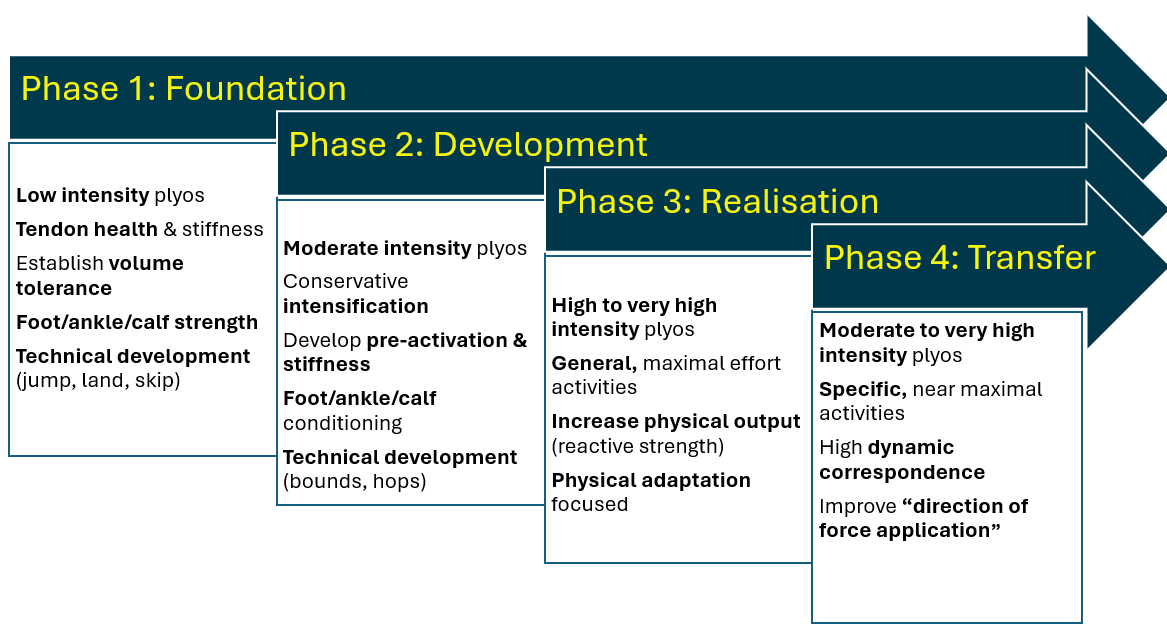
The 4-phase approach offers a granular approach to exercise progression and overall periodisation.

The 4-phase approach offers a granular approach to exercise progression and overall periodisation.
Eamonn Flanagan@EamonnFlanagan
A 4-phase approach to plyometric training.
While the broad differentiation between extensive & intensive methods can be useful, a more granular approach is often needed
Here's the 4-phase approach for plyometric training I use 🧵
While the broad differentiation between extensive & intensive methods can be useful, a more granular approach is often needed
Here's the 4-phase approach for plyometric training I use 🧵
8
What are the differences between EXTENSIVE and INTENSIVE plyometric training phases?
The table below breaks it down
x.com/EamonnFlanagan…
The table below breaks it down
x.com/EamonnFlanagan…
9
More on thoughts periodisation below.
From the @SportsmithHQ course:
PLYOMETRICS: The science & practice of reactive strength development
sportsmith.co/courses/plyome…

From the @SportsmithHQ course:
PLYOMETRICS: The science & practice of reactive strength development
sportsmith.co/courses/plyome…
Sportsmith@SportsmithHQ
Periodisation of plyometric training
Join world leading authority @EamonnFlanagan and discover why the four phases of plyometric training don't necessarily progress in a linear fashion.
sportsmith.co/courses/
Join world leading authority @EamonnFlanagan and discover why the four phases of plyometric training don't necessarily progress in a linear fashion.
sportsmith.co/courses/
10
Plyometric Training Volumes
Identify the training goal or training phase
Select exercises accordingly
Follow the volume guidelines
Click below for the cheatsheet

Identify the training goal or training phase
Select exercises accordingly
Follow the volume guidelines
Click below for the cheatsheet
Eamonn Flanagan@EamonnFlanagan
Plyometric Training Volume Cheat Sheet
There's four primary factors when establishing plyo training volume:
🔹 exercise intensity (or training phase)
🔹 surface type
🔹 exercise variety
🔹 the athlete level
Here's how they influence plyometric training volumes 👇
There's four primary factors when establishing plyo training volume:
🔹 exercise intensity (or training phase)
🔹 surface type
🔹 exercise variety
🔹 the athlete level
Here's how they influence plyometric training volumes 👇
11
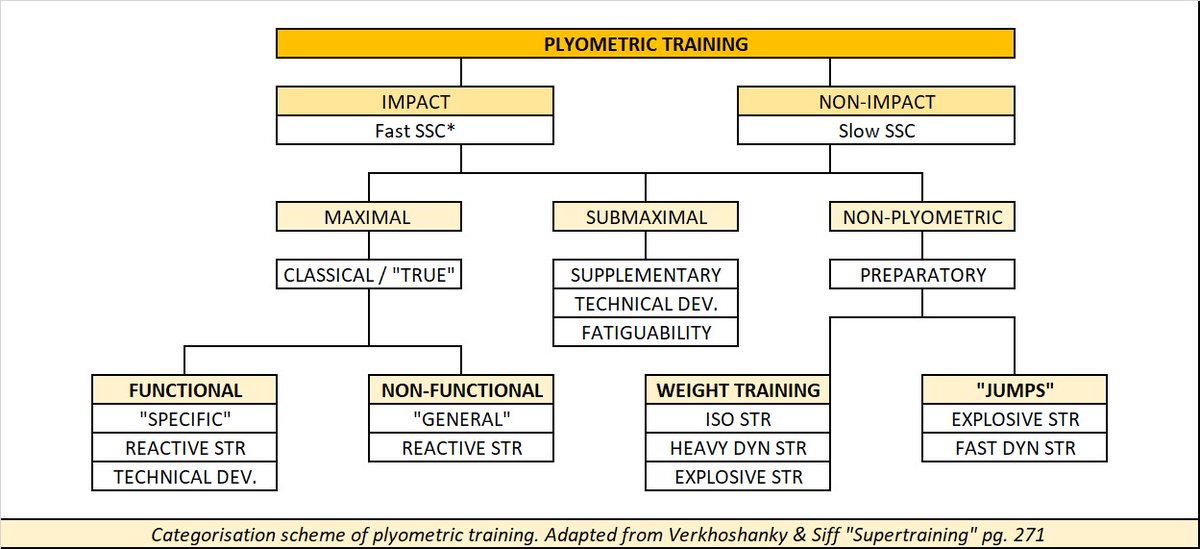
A key schematic from Verkhoshansky to understand the context and placement of your plyometric training
Eamonn Flanagan@EamonnFlanagan
A key schematic from Verkhoshansky to understand the context and placement of your plyometric training
This helps understand the categories of plyometrics or "jump" training.
(figure is slightly adapted from original)
This helps understand the categories of plyometrics or "jump" training.
(figure is slightly adapted from original)
12
,What's the difference between DROP JUMPS and DEPTH JUMPS?
💥
💥
Eamonn Flanagan@EamonnFlanagan
Depth Jumps Vs Drop Jumps
Often confused.
Different jumps for different circumstances, with different origins
Often confused.
Different jumps for different circumstances, with different origins
13
14
The Drop Jump and the 10-5 Rebound Jump Test are the most common RSI assessments.
What's the difference?
x.com/EamonnFlanagan…
What's the difference?
x.com/EamonnFlanagan…
15
Normative data for MALE athletes for the reactive strength index via the 10-5 Rebound Jump Test
x.com/EamonnFlanagan…
x.com/EamonnFlanagan…
16
Normative data for FEMALE athletes for the reactive strength index via the 10-5 Rebound Jump Test
x.com/EamonnFlanagan…
x.com/EamonnFlanagan…
17
What can we learn from some of the best practitioners of plyometric training?
Dive in ⬇️

Dive in ⬇️
Eamonn Flanagan@EamonnFlanagan
Plyometrics: What can we learn from masters of the craft?
Here's what I've learned from the themes & commonalities between the world's experts on high plyometric training.
Plyometric experts all have strong clarity and give deep thought to the following:
🔹 Their plyometric philosophy
🔹Quantifying plyometric intensity
🔹The specificity/intensity tradeoff
🔹The balance w/ sport specific training
The Plyometric Purpose
Each expert has a clear definition of plyometric training:
↪️What it is.
↪️And what it isn't.
↪️When to use it.
↪️And when to avoid.
They all have a clear "why". They don't all agree... but they each have a specific & clear purpose for using plyometrics.
Quality > Quantity
All clearly consider plyos to be a high powered, quality-dependent training stimulus.
All are thoughtful & methodical in quantifying intensity of exercises used.
Intensity factors are established in a number of ways across the expert group but most are a combination of one or more of the following:
🔸Published research
🔸Contraction types & contact times 📷 🔸Experiential knowledge
Quantification ↔️ Classification
Once intensity is quantified exercises can be classified.
The experts all have clear categories of exercises from which they build clear training menus and progression plans. Example:
All consider the individual athlete
The training process is strongly guided by:
🔸Training purpose
🔸Time of year
🔸The athlete "type"
🔸The athlete training history
Intensity ↔️ Specificity
There is a tradeoff between plyometric specificity & intensity.
When we ⬆️ specificity we can infringe on sport technique & inadvertently ⬇️ the magnitude of physical quality overload.
"General" plyometrics overload physical qualities. Established sport specific drills are likely best way to balance both.
All of this info has come from
@SportsmithHQ
podcasts from:
@sprintcoachSWE
(ep. 272)
@SheppardCoach
(28 & 103)
@MMJPerformance (38)
@BooSchex (212)
@dkhammy (42)
And other resources from:
@wildy_jj
@benthebounce
@DerekMHansen
Here's what I've learned from the themes & commonalities between the world's experts on high plyometric training.
Plyometric experts all have strong clarity and give deep thought to the following:
🔹 Their plyometric philosophy
🔹Quantifying plyometric intensity
🔹The specificity/intensity tradeoff
🔹The balance w/ sport specific training
The Plyometric Purpose
Each expert has a clear definition of plyometric training:
↪️What it is.
↪️And what it isn't.
↪️When to use it.
↪️And when to avoid.
They all have a clear "why". They don't all agree... but they each have a specific & clear purpose for using plyometrics.
Quality > Quantity
All clearly consider plyos to be a high powered, quality-dependent training stimulus.
All are thoughtful & methodical in quantifying intensity of exercises used.
Intensity factors are established in a number of ways across the expert group but most are a combination of one or more of the following:
🔸Published research
🔸Contraction types & contact times 📷 🔸Experiential knowledge
Quantification ↔️ Classification
Once intensity is quantified exercises can be classified.
The experts all have clear categories of exercises from which they build clear training menus and progression plans. Example:
All consider the individual athlete
The training process is strongly guided by:
🔸Training purpose
🔸Time of year
🔸The athlete "type"
🔸The athlete training history
Intensity ↔️ Specificity
There is a tradeoff between plyometric specificity & intensity.
When we ⬆️ specificity we can infringe on sport technique & inadvertently ⬇️ the magnitude of physical quality overload.
"General" plyometrics overload physical qualities. Established sport specific drills are likely best way to balance both.
All of this info has come from
@SportsmithHQ
podcasts from:
@sprintcoachSWE
(ep. 272)
@SheppardCoach
(28 & 103)
@MMJPerformance (38)
@BooSchex (212)
@dkhammy (42)
And other resources from:
@wildy_jj
@benthebounce
@DerekMHansen
18
19
The Sportsmith courst has close to 3 hours of lectures and demos. Notes and countless cheatsheets and resources are includes.
Check it out here:
sportsmith.co/courses/plyome…
Check it out here:
sportsmith.co/courses/plyome…
