-$6 Trillion In 45 Days: Is This A "Bubble" Or An Opportunity?

Our most common question right now: Is there an "AI bubble" and did it pop? US stocks have now lost an average of -$225 billion per day, for 31-straight trading days. Below, we provide a comprehensive breakdown of how we got here, what is happening, and what we see next.

Since November 2022, we have been highly bullish on AI, calling it the biggest technological revolution in history. Our view of "own assets or be left behind" was built on the combination of innovation-driven returns and compounding inflation.
Over the last 6 weeks, the AI trade has faced one of its biggest tests since inception, among the likes of April 2025 amid the trade war. Bookmark this Article and refer to it over the coming weeks.
The reality is that AI is disrupting the status quo of the global market, economy, and civilization. Disruption yields polarity in sentiment, and swings in asset prices only exacerbate that polarity.
That is exactly what we are seeing right now.
The Last 45 Days Have Been Chaotic:
Before we begin, it is important to understand just how much has happened since October 6th, the last time the S&P 500 hit a record high.

Over the last 45 days, the market has seen countless Iran War headlines, Q3 2026 earnings season, concerns around AI CapEx and Free Cash Flow, the October Fed meeting, US Midterm Elections, the Nvidia, $NVDA, controversy, and ultimately a loss of -$6 trillion in market cap.
On top of this, Anthropic's IPO just raised over $100 billion in the biggest IPO in history, which has been a clear strain on market liquidity over the last few sessions.
As an investor in times like these, it is important to step back and ask yourself one key question: What has changed and what is priced in?
A Lot Is Priced-In: CapEx and FCF Concerns:
The selloff began primarily over concerns about Capital Expenditures on AI by large cap technology companies in the US and the implications on Free Cash Flow and profitability looking into 2027 and 2028.
These are real concerns.
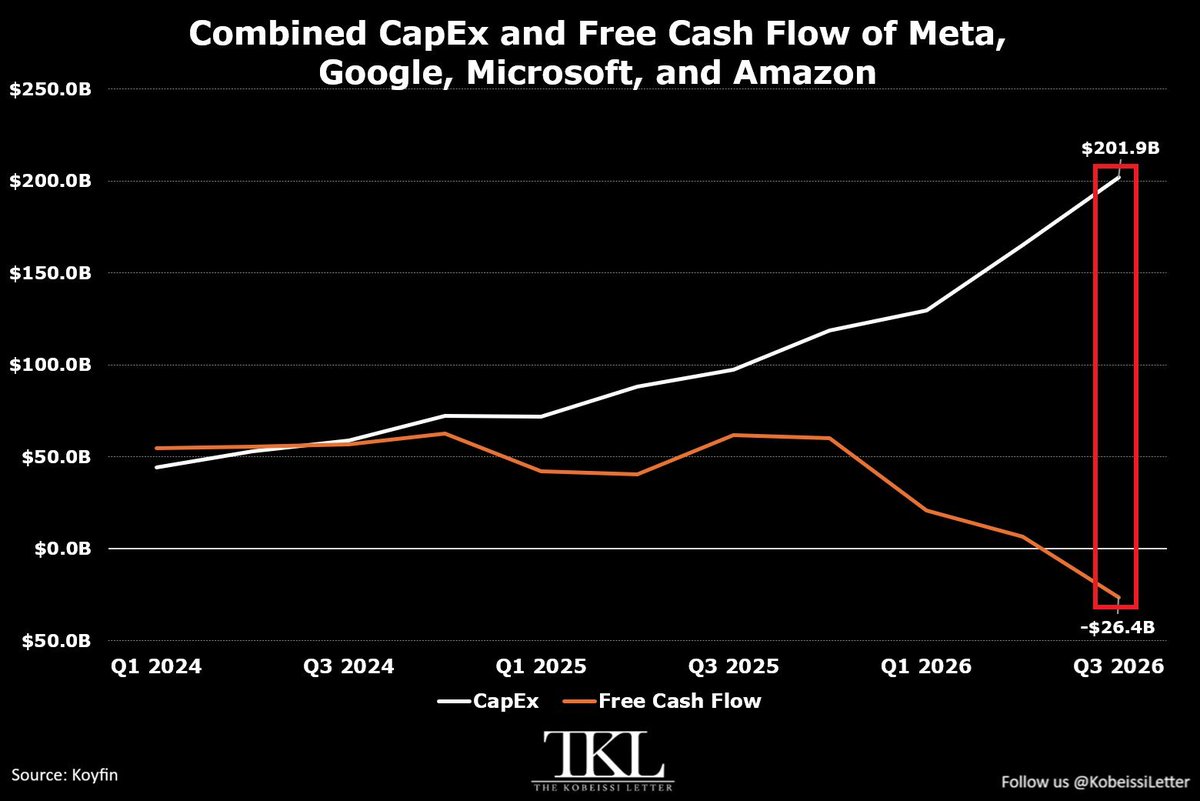
The combined CapEx of Amazon, $AMZN, Alphabet, $GOOGL, Meta, $META, and Microsoft, $MSFT, rose +$36.9 billion in Q3 2026, to a record $201.9 billion.
This figure has more than doubled over the last 12 months and is up +356% since Q1 2024. Big Tech has now spent $1.6 trillion on CapEx over the last 3 years.
However, it is also important to acknowledge that record infrastructure spending is a necessary condition for the biggest technological revolution in history. A brief period of negative free cash flow is the short-term cost of a long-term buildout.
A lot of these fears are already priced-in, but they will persist until more clarity on the ROI of this CapEx is obtained - likely into Q1/Q2 2027.

There has never been a market with so much fear yet so much growth. S&P 500 companies have reported +31.9% YoY EPS growth so far in Q3 2026, the strongest YoY growth rate in at least 4 years.
Actual earnings have beaten estimates for 13 consecutive quarters, the AI buildout is stronger than most people realize.
Democrats "Sweep" US Midterms - The "Trump Put" Ends:
Next, we believe the catalyst behind a major portion of the recent drawdown in technology stocks is related to the outcome of the US Midterm Elections which effectively ended what we are calling the "Trump Put."
As seen in President Trump's first term from 2016 through 2020 as well as Trump's second term to date, markets objectively find comfort in times of volatility when President Trump has the ability to sway them. The "Trump Put" is a hedge, a notion that if the market gets ugly, President Trump will intervene because stable markets have been a top priority for him.
With the Democrats' "sweep" of the Midterm Elections, we believe the "Trump Put" has effectively come to an end. Further catalyzing the end of this backstop was the below post on November 4th:
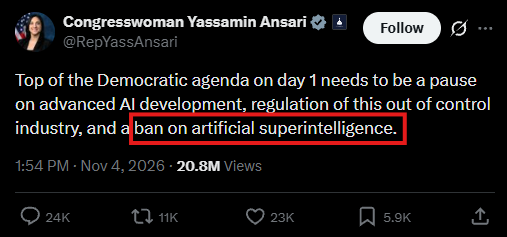
President Trump's ability to intervene in markets has been partially eroded by the change in control of the US Senate and US House. Calls for an AI ban have gained traction and markets have priced in aggressive regulation and potential bans on AI when Democrats take control in January 2027.
While the end of the "Trump Put" will not be reversed and will spur sharper drawdowns in US equities, we believe regulation concerns are overdone.
The US banning AI will not happen. Such a ban, if even possible to enforce, would effectively mean the US surrendering its position in the global AI race to China.
There will be more regulation and likely new taxes, but the market is assuming a more extreme case than what we believe will come to fruition.
Ultimately, the US should want to win, regardless of who is in power.
The Fed Is Hiking Into An Anxious Market:
On top of the concerns surrounding AI investment and the shift in the political landscape, the Fed is hiking interest rates aggressively.
As the Iran War nears its 300th day and US inflation has been above the Fed's 2% target for 67-straight months, Fed Chair Warsh has made it clear that his top priority is to lower inflation to 2% with no exceptions.
This means the already expensive burden of building AI is getting even more expensive. Not to mention, the US Federal debt situation is even worse.

As shown above, US investment-grade corporate bond sales are expected to rise +$37 billion YoY in November, or +27%, to $175 billion, the highest for any November on record. We believe the Fed's rate hikes into this backdrop have further contributed to the recent instability. Can this change?

The shift in political power and the recent market downturn has led to a ~22% drop in oil prices this month. Couple this with the market's instability and the Fed's outlook into 2027 will likely change, especially if it is clear that the Iran War is closer to its end.
On November 2nd, we published the below analysis on US oil prices heading into the US Midterms, calling for a drop below $93.00. Since then, prices have hit their lowest since August 2026. On Sunday, we will publish the latest edition of The Kobeissi Letter, consider subscribing to gain access here.
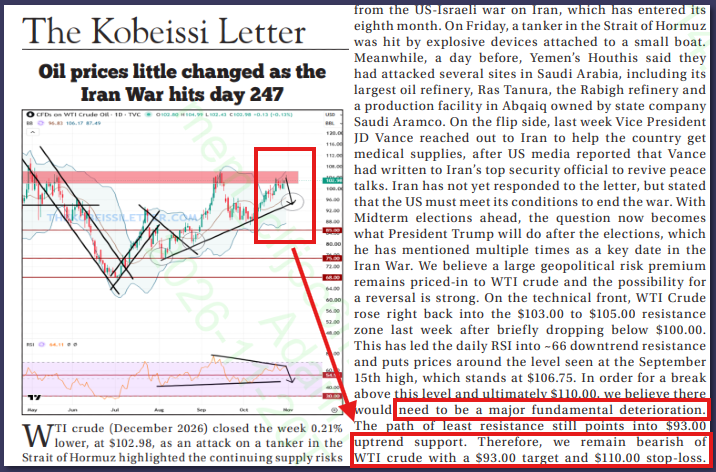
Even with the drop in oil prices, "higher for longer" will remain for now, but we believe the possibility of less restrictive Fed policy into mid-2027 is growing.
Nvidia, AMD, And The China-Chip Situation:
Over the last two weeks, Nvidia has lost Jensen Huang, the leader of the AI Revolution, its stock is down -40% in a matter of weeks, AMD is now being accused of smuggling chips into China, and markets have priced in major concerns around the implications.
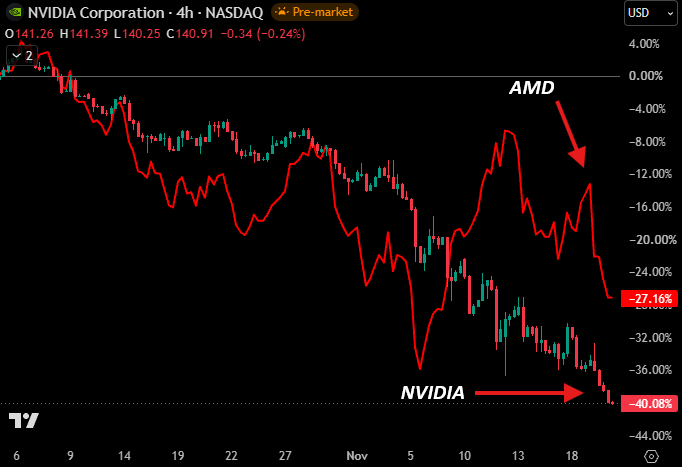
As you have all likely seen, we have been very vocal on the Nvidia situation, taking an early stance that Jensen Huang is innocent until proven guilty. We called for the board to leave the door open for Jensen until a definitive independent investigation establishes the facts.
We took this view because of how innovative and impactful Jensen Huang has been for the AI Revolution and for the success of the United States. Nvidia's stock price now reflects a near-certainty that Jensen Huang will not return and has effectively written off the company's forward guidance entirely.
The same is happening with AMD after a short seller report on November 19th accused the company of smuggling chips into China, a claim that has been far from substantiated.
As a result of these events, the Forward P/E of the tech sector has collapsed to its lowest since March 2020.
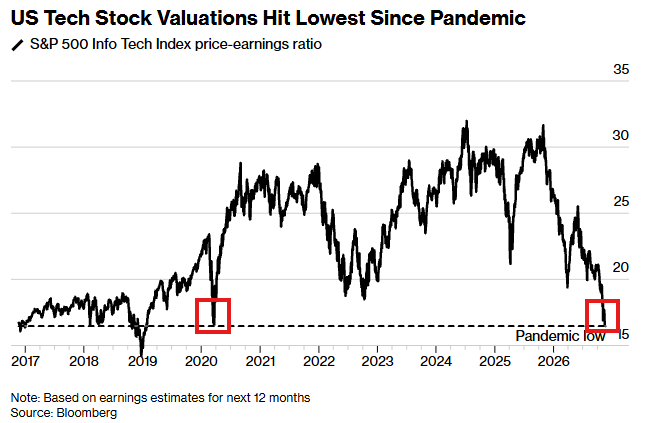
Nvidia's Forward P/E is down to 9x, making it one of the cheapest stocks in the S&P 500, and by far the cheapest relative to the growth in earnings that the company is seeing.
What does this mean? The market does not believe the "E" portion of the Forward P/E. Despite Nvidia guiding ~$750 billion in revenue for FY2028, even without Jensen Huang, the market refuses to believe it.
There is a ton of room for surprise baked into this market right now.
Sentiment Is At Crisis Levels Right Now:
On October 15th, we published our analysis titled the "Stealth Bear Market" which identified a bear market underneath the surface of the S&P 500, particularly in technology stocks. This marked the beginning of the shift in sentiment. It did not begin with the Midterm Elections or the Nvidia situation.
As shown below, those events only accelerated the shift in sentiment.

The Volatility Index, $VIX, is now up over +100% from its October low and posted its biggest daily gain since February 2018 on November 5th. Now, couple this sudden surge in fear with the Anthropic, $ANT, IPO which significantly reduced liquidity in the market.
Institutional demand for the IPO hit $400 billion, with retail orders at $100 billion after the books closed Tuesday, nearly 8x the initial $64.4 billion raise at the $78 share price expected at the time.

The combination of a sudden shift in sentiment and a large drawdown in liquidity led to the price action we saw this week, with everything trading lower from stocks, to gold, to crypto, and more.
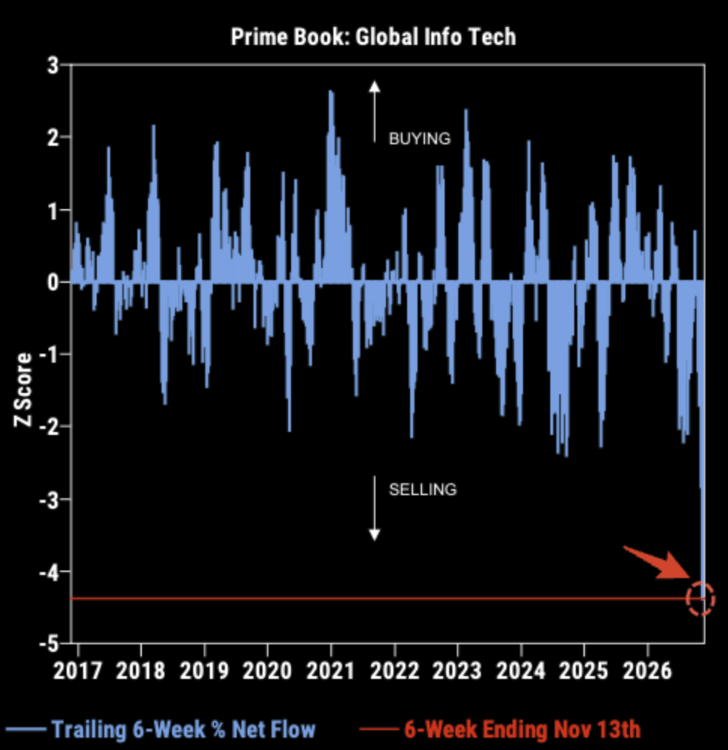
Hedge funds posted their largest trailing 6-week net outflow in over a decade this month. It was simply a dash for the exit.
Once liquidity returns, we believe the market will stabilize.
In Conclusion: What Comes Next?
This brings us back to our original question: Is there an "AI bubble" and did it pop?
Our answer is no.
There is no question that the AI Revolution is facing one of its most significant tests to date. However, we believe the market has begun pricing in a far more pessimistic outcome than what the underlying fundamentals currently suggest.
We believe the market is in the midst of a normal correction. Even if the S&P 500 fell an additional 10% from current levels, we would still be within the range of a healthy correction.
To call for a prolonged bear market well into 2027 is betting that the above factors will not only play out, but worsen. There is a lot of negative sentiment already accounted for in current asset valuations, we would be cautious about calls for a 30%+ drop in the S&P 500 which are quickly spreading.
The reality is that sentiment has become extremely polarized and we believe this polarization will create an opportunity, as it always does.
At current levels, the market is pricing in a combination of sustained higher interest rates, aggressive AI regulation, disappointing returns on AI infrastructure investment, and prolonged uncertainty around some of the most important companies in the technology sector. There is a lot of room for positive surprise heading into 2027.
We are not suggesting that the market has necessarily reached its bottom. Volatility will remain elevated, liquidity remains constrained, and further downside is entirely possible as uncertainty persists.
However, the risk-reward setup is becoming increasingly attractive, particularly in high-quality technology companies with strong balance sheets, accelerating earnings growth, and durable competitive advantages.
We believe a significant amount of bearishness is already priced in, while the market is overlooking the potential for positive surprises. Once the dust settles, we expect dip buyers to rotate back into high-quality technology stocks quickly, similar to April 2025.
Asset owners will continue to win in the long run.
More about our strategy: Remain objective and following a process during times of disruption are key to being a successful investor.
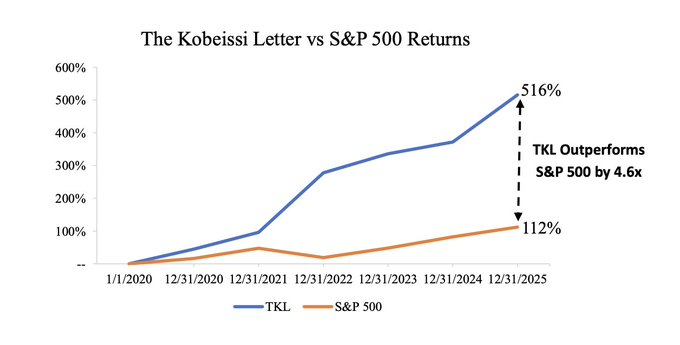
An objective and systematic approach is what has led to our outperformance of market benchmarks.
As shown below, our investment strategy has returned nearly five times the S&P 500 since 2020.
If you are interested in receiving our premium daily analysis, you may do so by joining our service here.
Follow us @KobeissiLetter for real time analysis as this develops.