#THECORRUPTED #QURAN - AND IT'S ENABLERS Muslim popular apologetics...

Jay49er@Jay_49erTikTok
82 views
Jul 30, 2026
~5 min read
Advertisement
1
#THECORRUPTED #QURAN - AND IT'S ENABLERS
Muslim popular apologetics often presents the qiraat as a simple preservation miracle: Muhammad recited several authorized forms, the Companions memorized them exactly, Uthman preserved them in a stable written text, and the canonical readings came down by overwhelming mass transmission. The historical record is far less tidy.
Muslim popular apologetics often presents the qiraat as a simple preservation miracle: Muhammad recited several authorized forms, the Companions memorized them exactly, Uthman preserved them in a stable written text, and the canonical readings came down by overwhelming mass transmission. The historical record is far less tidy.
2
“The story begins before the Seven, before the Ten, and before the familiar names Hafs and Warsh. It begins with a consonantal text that could limit readings but could not always specify them completely.”
1. The Popular Story and the Historical Question
👉The popular story starts at the end. It takes the modern printed mushaf, with its dots, vowels, pause marks, and standardized recitation, and mentally projects that finished form backward into the seventh century. That is precisely what a historical investigation cannot do.
❗️The earliest recoverable layer is the Quranic consonantal text, commonly called the rasm. It is not an empty scribble and it is not devoid of consonants. But it lacks the complete system of consonantal dots and short-vowel signs familiar from modern Arabic printing.
A skeletal spelling could therefore support more than one vocalization or grammatical analysis. Oral teaching could resolve many ambiguities, but the historical question is whether one complete oral solution controlled every point from the beginning or whether readers also interpreted and regularized the written outline.
1. The Popular Story and the Historical Question
👉The popular story starts at the end. It takes the modern printed mushaf, with its dots, vowels, pause marks, and standardized recitation, and mentally projects that finished form backward into the seventh century. That is precisely what a historical investigation cannot do.
❗️The earliest recoverable layer is the Quranic consonantal text, commonly called the rasm. It is not an empty scribble and it is not devoid of consonants. But it lacks the complete system of consonantal dots and short-vowel signs familiar from modern Arabic printing.
A skeletal spelling could therefore support more than one vocalization or grammatical analysis. Oral teaching could resolve many ambiguities, but the historical question is whether one complete oral solution controlled every point from the beginning or whether readers also interpreted and regularized the written outline.
3
✋The question that controls the entire handbook
“Did a perfectly fixed oral Quran control the written skeleton, or did the ambiguous written skeleton help generate, preserve, and filter later readings?”
The evidence does not permit a simplistic answer in which writing is irrelevant.
✅Francois Deroche emphasizes that written and oral transmission were intertwined and that the initial writing system was inadequate to prevent variants. He also notes that the Uthmanic rasm became the basis for the canonical readings later established by Ibn Mujahid. That is already far removed from the apologetic image of an independent oral recording merely copied onto paper.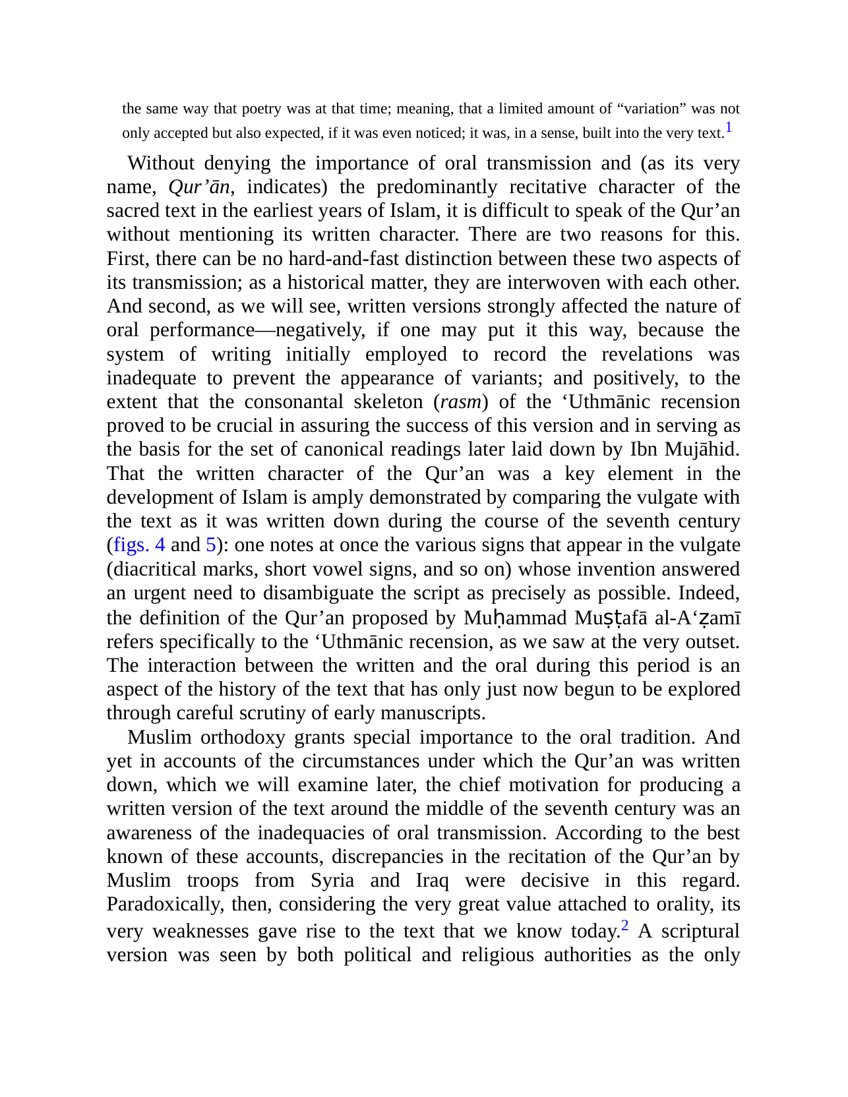
“Did a perfectly fixed oral Quran control the written skeleton, or did the ambiguous written skeleton help generate, preserve, and filter later readings?”
The evidence does not permit a simplistic answer in which writing is irrelevant.
✅Francois Deroche emphasizes that written and oral transmission were intertwined and that the initial writing system was inadequate to prevent variants. He also notes that the Uthmanic rasm became the basis for the canonical readings later established by Ibn Mujahid. That is already far removed from the apologetic image of an independent oral recording merely copied onto paper.
4
👉From Written Skeleton to Competing Reading Traditions
“Once the rasm became the boundary, the next question was how to read it. The answer did not arrive as one universally documented recitation. It arrived through regional readers, teachers, transmitters, grammar, analogy, preference, and competing scholarly collections.”
👉Did Oral Tradition Control the Rasm, or Did the Rasm Shape the Readings?
The standard apologetic answer is that oral transmission controlled the rasm. The written text was merely a reminder for people who already knew the Quran.
That claim may explain some variation, but it cannot simply be assumed for every disputed word. The later validity test itself reveals the tension. A reading had to agree with Arabic grammar, agree with at least one Uthmanic codex, and possess a sound chain.
🤌If the oral transmission were independently certain in every detail, why would grammar or conformity to a later written codex be allowed to reject it?
The three-filter system makes sense only when scholars are judging claims, not merely receiving an unquestionable mass tradition.
The rasm could also invite more than one reading. A consonantal outline without full dotting or vowels may fit different forms. Some readings may preserve genuine early recitations; others may reflect regional language, analogical reasoning, grammatical correction, or attempts to bring the text into conformity with later ideals of proper Arabic.
🤟KEY DISTINCTION
Compatibility is not identity. A later reading may fit the Uthmanic rasm without being uniquely demanded by it. “The rasm permits this reading” is not the same as “the rasm proves Muhammad recited this reading.”
“Once the rasm became the boundary, the next question was how to read it. The answer did not arrive as one universally documented recitation. It arrived through regional readers, teachers, transmitters, grammar, analogy, preference, and competing scholarly collections.”
👉Did Oral Tradition Control the Rasm, or Did the Rasm Shape the Readings?
The standard apologetic answer is that oral transmission controlled the rasm. The written text was merely a reminder for people who already knew the Quran.
That claim may explain some variation, but it cannot simply be assumed for every disputed word. The later validity test itself reveals the tension. A reading had to agree with Arabic grammar, agree with at least one Uthmanic codex, and possess a sound chain.
🤌If the oral transmission were independently certain in every detail, why would grammar or conformity to a later written codex be allowed to reject it?
The three-filter system makes sense only when scholars are judging claims, not merely receiving an unquestionable mass tradition.
The rasm could also invite more than one reading. A consonantal outline without full dotting or vowels may fit different forms. Some readings may preserve genuine early recitations; others may reflect regional language, analogical reasoning, grammatical correction, or attempts to bring the text into conformity with later ideals of proper Arabic.
🤟KEY DISTINCTION
Compatibility is not identity. A later reading may fit the Uthmanic rasm without being uniquely demanded by it. “The rasm permits this reading” is not the same as “the rasm proves Muhammad recited this reading.”
5
🚨Al-Razi’s Internal Muslim Warning About Delayed Oral Recall
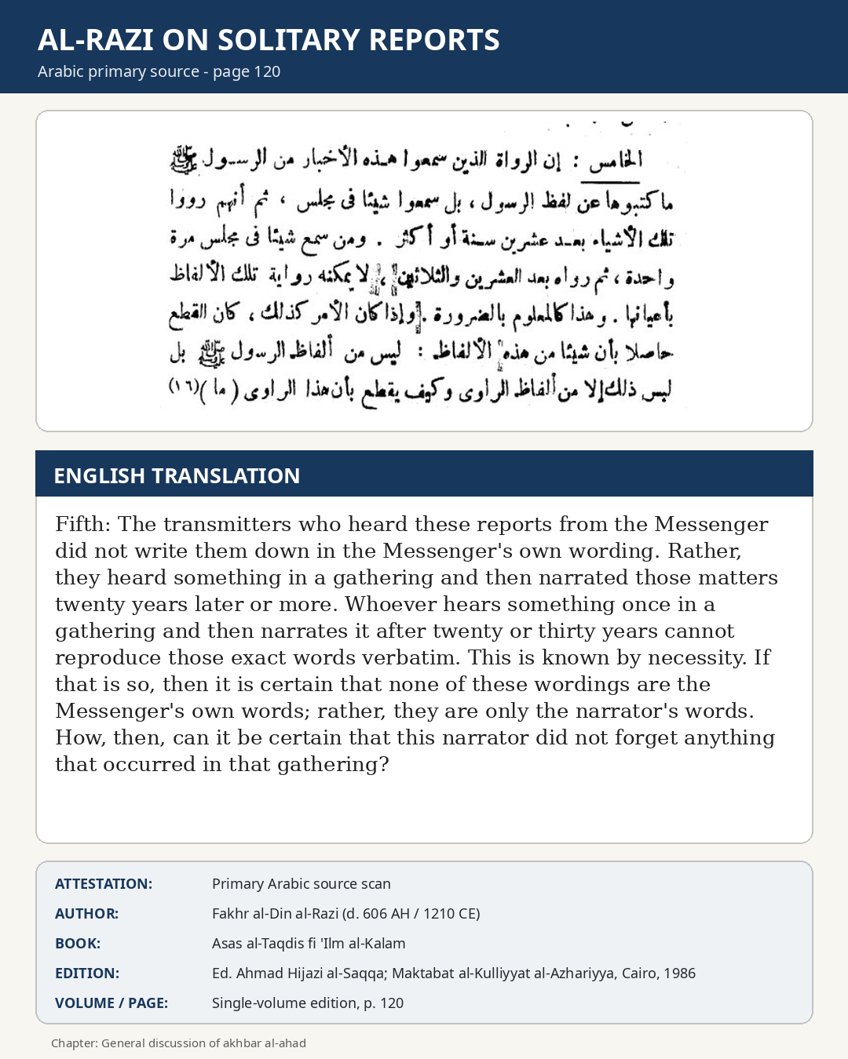
Fakhr al-Din al-Razi was discussing solitary reports used in theology, not the qiraat directly. His logic is nevertheless relevant as an internal Muslim warning about oral exactness.
❌He argues that narrators who heard speech in a gathering, did not write it down, and related it twenty or thirty years later could not guarantee the exact wording. Wording, order, and composition could be forgotten or confused.
The proper use of al-Razi is supporting, not decisive. Qiraat defenders will say that Quranic recitation was repetitive and communal, unlike a hadith heard once. That response has force.
The cross-examination then becomes specific: where is the evidence that every disputed canonical variant was repeatedly and independently recited by large communities before the written and canonical system stabilized it?
📷
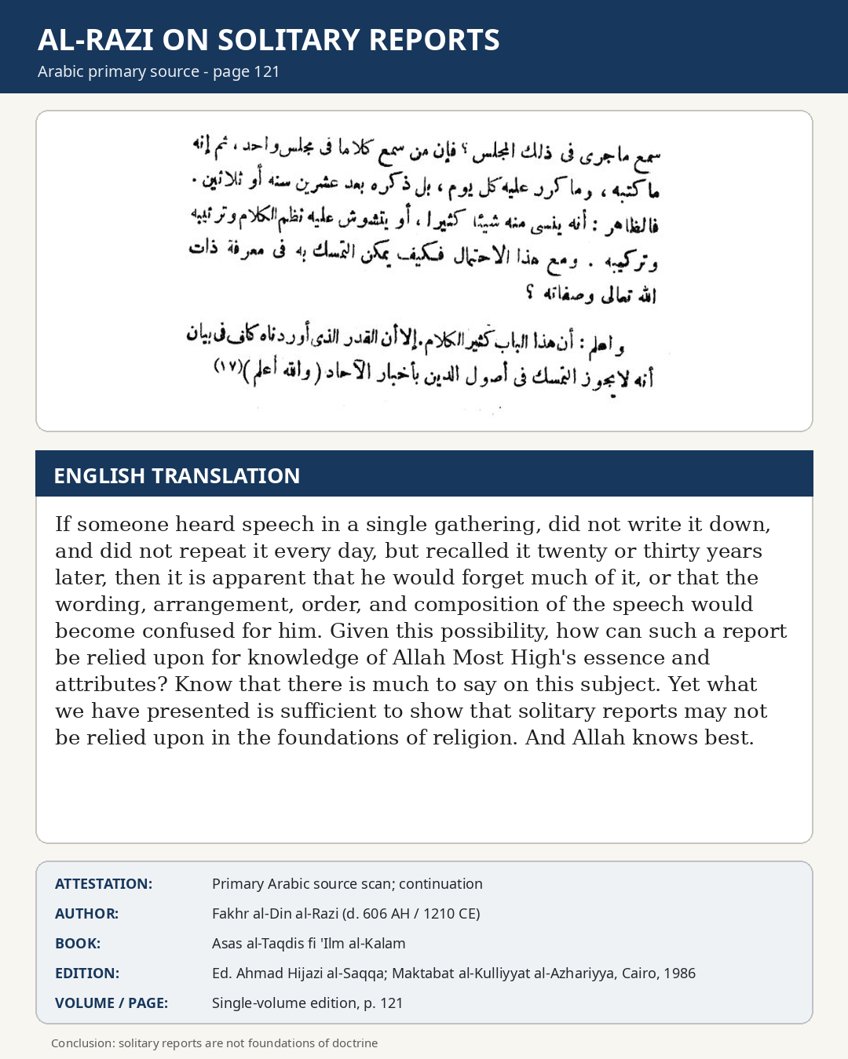
Fakhr al-Din al-Razi was discussing solitary reports used in theology, not the qiraat directly. His logic is nevertheless relevant as an internal Muslim warning about oral exactness.
❌He argues that narrators who heard speech in a gathering, did not write it down, and related it twenty or thirty years later could not guarantee the exact wording. Wording, order, and composition could be forgotten or confused.
The proper use of al-Razi is supporting, not decisive. Qiraat defenders will say that Quranic recitation was repetitive and communal, unlike a hadith heard once. That response has force.
The cross-examination then becomes specific: where is the evidence that every disputed canonical variant was repeatedly and independently recited by large communities before the written and canonical system stabilized it?
📷
6
😲Early Scholars Did Not Treat Every Variant as Divine Revelation😲
✅One of Shady Nasser’s most important conclusions is that early Muslim scholars did not necessarily regard every variant reading as divine revelation.
They attributed variants to reader choice, interpretation of the consonantal outline, linguistic reasoning, and transmission mistakes. Al-Tabari could call one accepted reading preferable, reject another, or classify a reading as irregular based on grammar, circulation, the current rasm, and consensus.
🤟Nasser gives a striking example: al-Tabari rejected a reading as irregular that was later canonized through Yacqub and acquired mutawatir, divinely revealed status. The reading did not change. Its canonical classification changed.
Later scholarship increasingly sacralized the canonical package. Once every canonical variant was declared revealed by God, earlier criticism became embarrassing. Human mistakes could no longer be attributed to the eponymous readers, even though earlier sources openly discussed them.
“The doctrine became stronger over time: first scholars judged readings; later orthodoxy treated the winners of that judgment as revelation.”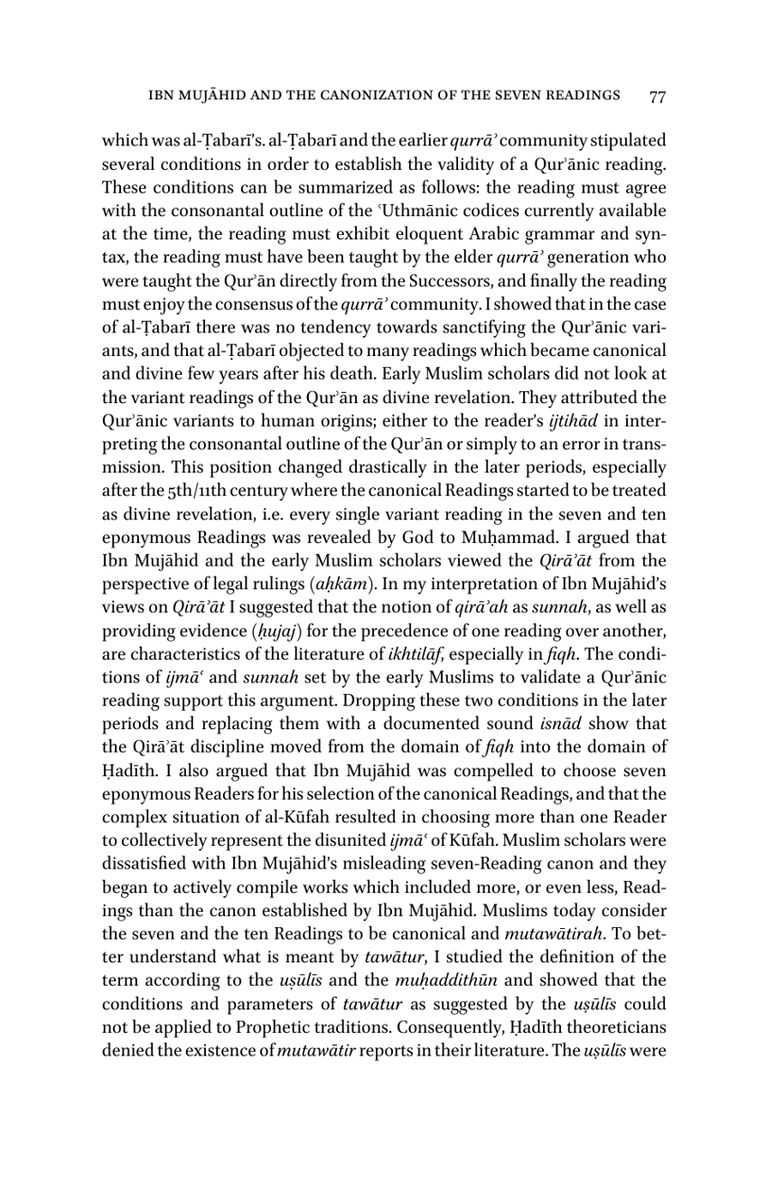
✅One of Shady Nasser’s most important conclusions is that early Muslim scholars did not necessarily regard every variant reading as divine revelation.
They attributed variants to reader choice, interpretation of the consonantal outline, linguistic reasoning, and transmission mistakes. Al-Tabari could call one accepted reading preferable, reject another, or classify a reading as irregular based on grammar, circulation, the current rasm, and consensus.
🤟Nasser gives a striking example: al-Tabari rejected a reading as irregular that was later canonized through Yacqub and acquired mutawatir, divinely revealed status. The reading did not change. Its canonical classification changed.
Later scholarship increasingly sacralized the canonical package. Once every canonical variant was declared revealed by God, earlier criticism became embarrassing. Human mistakes could no longer be attributed to the eponymous readers, even though earlier sources openly discussed them.
“The doctrine became stronger over time: first scholars judged readings; later orthodoxy treated the winners of that judgment as revelation.”
7
🚨Memorizing a Written Text Is Not Pure Oral Transmission🚨
Muslim defenders often answer historical criticism by pointing to modern scholars who memorize enormous books. The comparison fails if those scholars memorize from stable written editions.
🤟Van Putten’s Reddit comment identifies the crucial difference: modern savants have access to written texts, while the earliest generations did not possess the same fully vocalized, standardized documentary control.
He argues that cross-cultural studies of oral transmission do not support perfect verbatim transmission over long periods and that textual transmission becomes more reliable when the oral phase transitions into a written phase. His compact summary is exact: memorizing a written text is not oral transmission.
📷
Muslim defenders often answer historical criticism by pointing to modern scholars who memorize enormous books. The comparison fails if those scholars memorize from stable written editions.
🤟Van Putten’s Reddit comment identifies the crucial difference: modern savants have access to written texts, while the earliest generations did not possess the same fully vocalized, standardized documentary control.
He argues that cross-cultural studies of oral transmission do not support perfect verbatim transmission over long periods and that textual transmission becomes more reliable when the oral phase transitions into a written phase. His compact summary is exact: memorizing a written text is not oral transmission.
📷