Our study on virus-specific T cell activation in Long COVID (LC) is...

Mark Painter@markmpainter
6 views
Oct 17, 2026
~5 min read
Advertisement
1
Our study on virus-specific T cell activation in Long COVID (LC) is up on bioRxiv! We identify a subset of people with LC with persistently elevated activation of CD8 T cells targeting spike and/or EBV lytic antigens, consistent with viral persistence.
biorxiv.org/content/10.648…
biorxiv.org/content/10.648…
2
The mechanisms driving LC remain unclear, slowing the development of new therapies. Different mechanisms may be at play in different people. 2 leading hypotheses, persistence of SARS-CoV-2 and herpesvirus reactivation, could explain symptoms but are difficult to measure directly.
3
We harnessed the unique properties of T cells to see if viral antigens are persistently stimulating the immune system in LC. T cells survey most tissues in the body, where they can be activated by trace amounts of viral peptide and return to the blood bearing signs of activation.
4
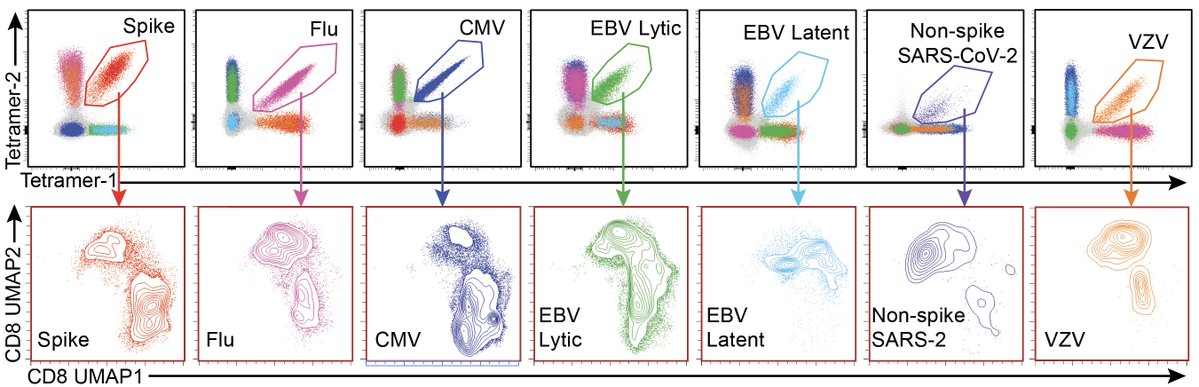
With multiplexed peptide/HLA tetramers, we could identify CD8 and CD4 T cells recognizing a range of viral antigens and see if they express markers that indicate recent activation, using these cells as in vivo biosensors of viral antigens.
5
Thanks to collaborations with @MichaelPelusoMD, @PutrinoLab, @VirusesImmunity, @nualameyer and the help of @polybioRF @microbeminded2, we were able to perform these analyses on over 500 samples from hundreds of people with LC, recovered controls, and acute SARS-CoV-2 infection.

6
First, we see minimal differences in the overall circulating T cell landscape in people with LC compared to recovered controls, suggesting that LC is not associated with broad deficiencies or alterations to T cell immunity.

7
Virus-specific CD8 T cells, however, tell a different story. When we focus on SARS-CoV-2 spike-specific CD8 T cells, we see that a subset of people with LC maintain elevated activation of these cells compared to recovered controls. Flu-specific T cells were not activated in LC.

8
Spike-specific CD8 T cell activation was maintained over time, with distinct groups of LC patients maintaining consistently low or consistently high activation in longitudinal samples.

9
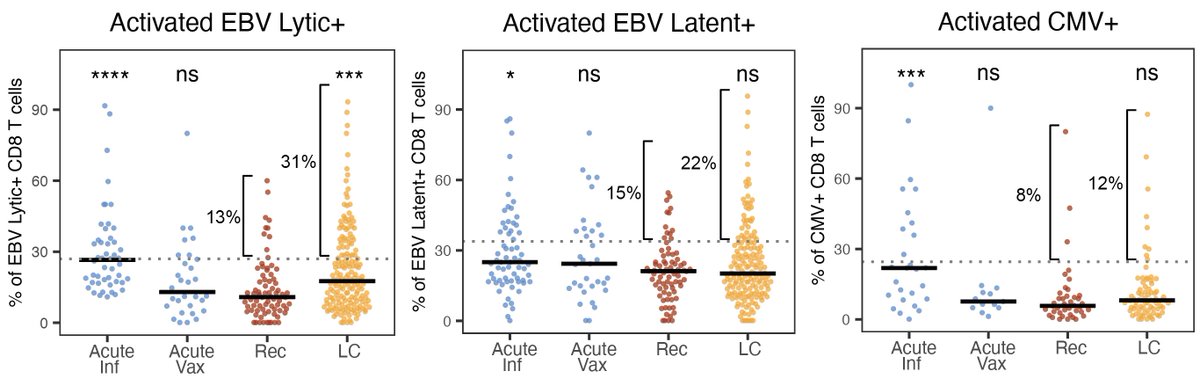
Activation of CD8 T cells targeting EBV lytic antigens was also elevated in a subset of LC patients, whereas activation of cells specific for latent EBV antigens or CMV was comparable to recovered controls. Thus, ongoing EBV replication may be linked to LC in some individuals.
10
To test whether the spike-specific CD8 T cells from people with LC who maintained elevated activation truly showed evidence of persistent antigen stimulation, we did a deep dive using scRNA and TCR sequencing with barcoded peptide/HLA tetramers to track virus-specific T cells.

11
In contrast to Flu-specific CD8 T cells, which had similar gene expression profiles in recovered controls and people with LC, spike-specific CD8 T cells from people with LC resembled spike-specific cells from acute SARS-CoV-2 infection samples.

12
At the clonal level, a large majority of spike-specific CD8 T cell clones from these people with LC (selected from the subset with high activation) were enriched in activated gene expression clusters compared to clones from recovered controls.

13
Spike-specific CD8 T cells from these people with LC shared gene expression profiles with spike-specific cells from acute SARS-CoV-2 infection, including enrichment of gene expression modules associated with recent TCR stimulation but not bystander activation.

14
T cell exhaustion is a distinct differentiation fate driven by chronic antigen stimulation. We observed strong enrichment for T cell exhaustion gene sets in spike-specific CD8 T cells from the activated subset of people with LC, consistent with persistent TCR-driven activation.

15
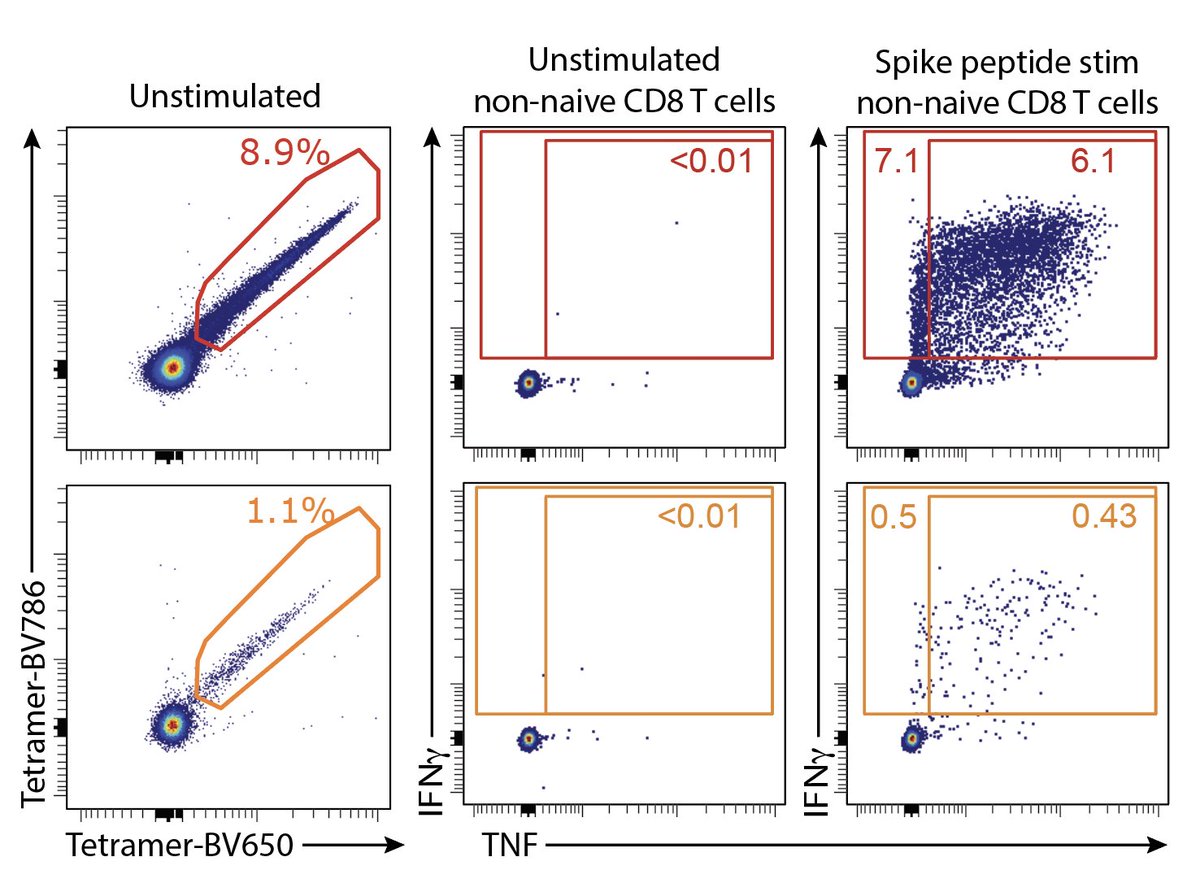
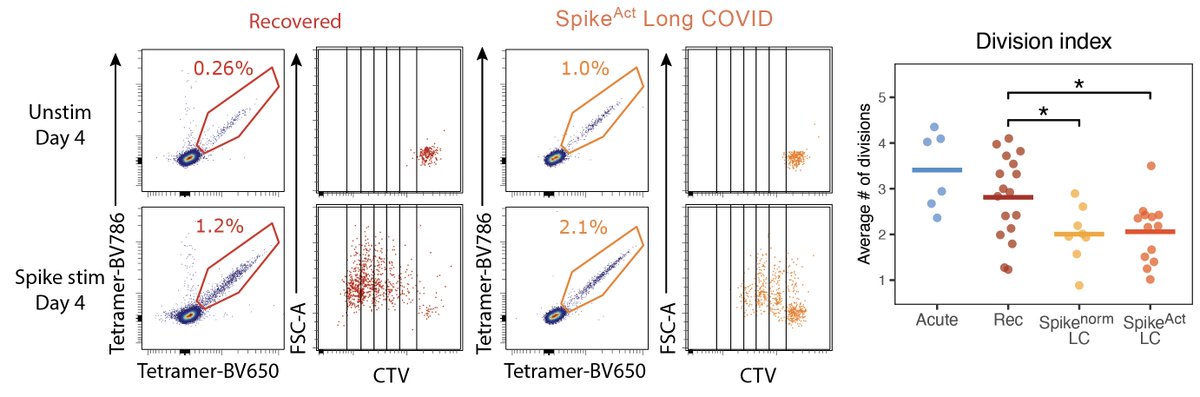
To more directly test whether these cells showed evidence of T cell exhaustion, we stimulated cells ex vivo with spike peptides and assessed the ability of spike-specific CD8 T cells to produce cytokines, proliferate, and expand in culture.
16
Spike-specific CD8 T cells from the subset of people with LC with persistent activation and evidence of exhaustion (e.g. expression of TOX and 2B4) produced fewer cytokines and were less proliferative compared to recovered controls, indicating some degree of T cell exhaustion.
17
Taken together, our data are consistent with chronic stimulation of spike-specific CD8 T cells by a persistent reservoir of SARS-CoV-2 in a subset of people with LC. These findings have several implications for ongoing efforts to develop successful therapies for LC.
18
First, not all people with LC show evidence of persistent T cell activation. This is consistent with a model in which multiple mechanisms contribute to LC, and SARS-CoV-2 persistence drives disease in only a fraction of patients.
19
Alternatively, it is possible that some people harbor viral reservoirs that are not accessible to circulating T cells. Further efforts will be needed to determine which tissues harbor persistent SARS-CoV-2 in LC and to directly link these viral reservoirs to T cell activation.
20
CD8 T cells specific for EBV lytic antigens were also activated in LC, largely in the same participants who had elevated spike-specific CD8 T cell activation. These data nonetheless support an association between EBV activity and the development of LC.
21
Clinical trials for LC often enroll and assess response without objective measures of the targeted mechanism. Activation of virus-specific T cells could therefore be used to identify patients likely to benefit from drugs targeting SARS-CoV-2 persistence or EBV reactivation.
22
Virus-specific T cells could also be used as a readout of intervention efficacy through changes in activation or exhaustion. Moreover, existing therapies could be used to modulate activated T cell responses in multiple ways as a potential therapy for LC.
23
In summary, we describe a subset of people with LC with evidence of chronic antigen-driven T cell activation. This provides key mechanistic insights and identifies a biomarker for stratifying patients, assessing response to treatment, and guiding the development of new therapies.
24
I want to thank everyone who worked on this study, especially David Reeg and @EJohnWherry, and all the study participants who made this possible, especially the LC patient community. Check out the paper for everything that didn't fit in this thread! biorxiv.org/content/10.648…