10x1 Method - Implementing Death-Ground Squats I did these...

Coach Wayland | Performance Expert | Craftsman@WSWayland
27 views
Feb 18, 2026
~2 min read
Advertisement
1
10x1 Method - Implementing Death-Ground Squats
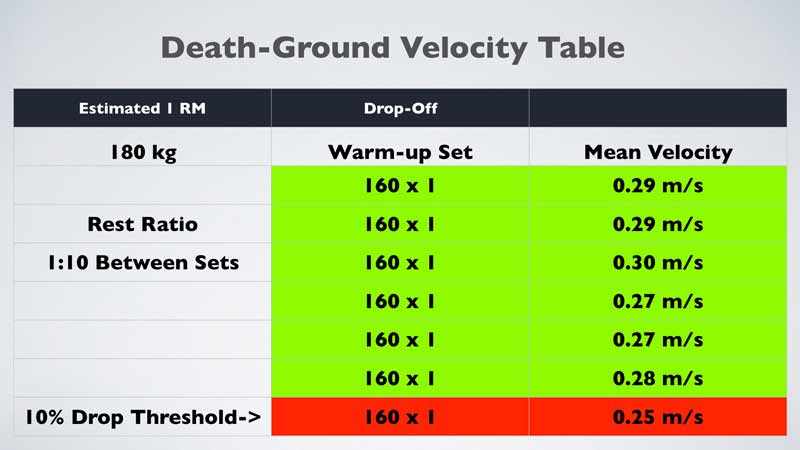
I did these yesterday as part of my HIGH day. Heres the method slightly modified from Simplifaster article excerpt.
"Effectively a cluster variant a 10 sets of 1 (More or less) what I call death ground, our death-ground squat parameters are:
Squat at 90%+ load every minute on the minute (EMOM or minute rest between reps, not counting the time we squat) until we see a degradation in rep speed and movement quality.
Across an array of athletes, most can achieve 5-8 reps with 1:00-1:15 rest between reps.
Why perform repeated singles? With high reps and high loads, the neuromuscular system fatigues to the point where a second set will not resemble the first.
Why rest 1:00+? It’s enough time for the CP system to recover while keeping the nervous system in an excited state without the energetic cost of multiple reps with only limited rest between clusters. It’s a very time-efficient way to develop skill and capacity. You have about six seconds of quality, very high-intensity work available. Go beyond that, and we start using energy pathways we should avoid and see a speed and nervous system degradation.
Low reps are great for athletes, but we must manage them carefully as they are exhausting to the nervous system. Avoiding intensive training will only dig an athlete’s grave later in the year; sufficient maximal strength drives the lower body’s power.
By hitting regular singles much like the cluster sets, we can achieve a higher volume of high-quality work at a high intensity. I find that attempting 85%-90+ lifts using 3 x 3 leads to an awful looking third set, despite Zatsiorsky suggesting this is the best place to acquire strength in the classic Science and Practice of Strength Training. While this might be fine for Soviet-era weightlifters practically, applying it to sports athletes is a tricky proposition. I’m sure any strength coach would rather have nine high-quality reps than three good ones followed by six ugly ones.
To dictate the amount of volume achieved, we use a timed drop-off, a velocity measurement, or a coach-determined drop in rep speed. There are plenty of inexpensive velocity measurement tools, some of which offer percentage drop-off alarms. We usually look for a 10% drop-off in speed or power.
We often find that the first rep is slow and subsequent sets are faster until, on average, reps 6-8 unless the athlete is having a really bad day and achieves only 3-4 reps. Load and the athlete’s activation/arousal matter."
I did these yesterday as part of my HIGH day. Heres the method slightly modified from Simplifaster article excerpt.
"Effectively a cluster variant a 10 sets of 1 (More or less) what I call death ground, our death-ground squat parameters are:
Squat at 90%+ load every minute on the minute (EMOM or minute rest between reps, not counting the time we squat) until we see a degradation in rep speed and movement quality.
Across an array of athletes, most can achieve 5-8 reps with 1:00-1:15 rest between reps.
Why perform repeated singles? With high reps and high loads, the neuromuscular system fatigues to the point where a second set will not resemble the first.
Why rest 1:00+? It’s enough time for the CP system to recover while keeping the nervous system in an excited state without the energetic cost of multiple reps with only limited rest between clusters. It’s a very time-efficient way to develop skill and capacity. You have about six seconds of quality, very high-intensity work available. Go beyond that, and we start using energy pathways we should avoid and see a speed and nervous system degradation.
Low reps are great for athletes, but we must manage them carefully as they are exhausting to the nervous system. Avoiding intensive training will only dig an athlete’s grave later in the year; sufficient maximal strength drives the lower body’s power.
By hitting regular singles much like the cluster sets, we can achieve a higher volume of high-quality work at a high intensity. I find that attempting 85%-90+ lifts using 3 x 3 leads to an awful looking third set, despite Zatsiorsky suggesting this is the best place to acquire strength in the classic Science and Practice of Strength Training. While this might be fine for Soviet-era weightlifters practically, applying it to sports athletes is a tricky proposition. I’m sure any strength coach would rather have nine high-quality reps than three good ones followed by six ugly ones.
To dictate the amount of volume achieved, we use a timed drop-off, a velocity measurement, or a coach-determined drop in rep speed. There are plenty of inexpensive velocity measurement tools, some of which offer percentage drop-off alarms. We usually look for a 10% drop-off in speed or power.
We often find that the first rep is slow and subsequent sets are faster until, on average, reps 6-8 unless the athlete is having a really bad day and achieves only 3-4 reps. Load and the athlete’s activation/arousal matter."

