The "Rediscovered" Amino Acid That Could Save Muscles from Aging...

Nick Norwitz MD PhD@nicknorwitz
23 views
Sep 18, 2025
~2 min read
Advertisement
1
The "Rediscovered" Amino Acid That Could Save Muscles from Aging (New Study)🔗 at the end💪
1/5) “Aging isn’t for the weak.” You’ve either heard that before—or lived it—and it’s true. But here’s the truth: that decline is not inevitable.
The fact that humans tend to become metabolically disadvantaged over time is a result of specific physiological changes that occur with aging. By understanding what those changes are—and how to target them—we may be able to slow, block, or even reverse age-related dysfunction.
To that end, let’s look at some brand-new science published in @NatureAging on this exact topic: the loss of muscle mass with age (the medical term for this is “sarcopenia”).
Inside thought: I wonder if @bryan_johnson will add sarcosine to his stack...
2
2/5) The Study: Mapping the Metabolic Fingerprint of Muscle Loss
The researchers set out to identify the metabolic signature of age-related muscle loss. To do this, they performed deep molecular profiling on 1,013 individuals aged 50 to 103.
💪Among the molecules that stood out was sarcosine.
Now, while this research is brand new, the molecule itself is quite old—first discovered in 1847 by a German scientist. Its name comes from the root “sarco-” meaning flesh, presumably because sarcosine was first identified from flesh or muscle tissue.
Sarcosine is an amino acid—but not the kind you’ll find in your whey protein powder or ribeye steak. It’s actually a modified version of glycine and goes by the alternate name N-methylglycine.
3
3/5) Sarcosine Declines with Age — and So Does Muscle
The researchers found that sarcosine levels decline in sarcopenia and with age—across species, from mice to monkeys to men. Sarcosine levels were also correlated with muscle mass.
Of course, correlation doesn’t prove causation.
So, the next logical question: Is this decline in sarcosine just a biomarker of aging, or is it contributing to age-related muscle loss?
To answer that, the researchers turned to animal models.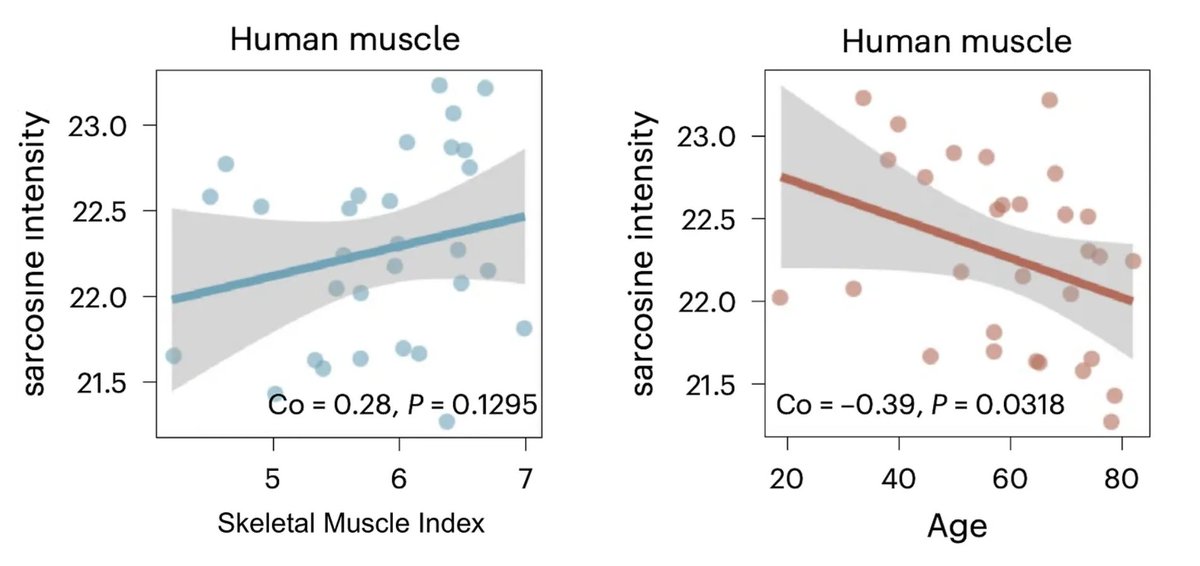
The researchers found that sarcosine levels decline in sarcopenia and with age—across species, from mice to monkeys to men. Sarcosine levels were also correlated with muscle mass.
Of course, correlation doesn’t prove causation.
So, the next logical question: Is this decline in sarcosine just a biomarker of aging, or is it contributing to age-related muscle loss?
To answer that, the researchers turned to animal models.
4
4/5) Sarcosine Supplementation in Mice: Muscle Up, Fat Down
Researchers supplemented aging mice with sarcosine and compared them to controls.
👉 Sarcosine supplementation effectively prevented age-related muscle loss.
👉 And sarcosine didn’t just preserve muscle—it decreased overall fat mass, yielding leaner, more muscular animals.
What’s more sarcosine supplementation also activated fat tissue thermogenesis. That’s the process of producing heat by burning calories, primarily through metabolically active brown and beige fat.
Put simply: in aging animals, sarcosine increased muscle and decreased fat.
5
5/5) Those findings alone should have you jumping for joy (also box jumps are a great exercise) In the rest of this letter:
👉 How Sarcosine Works:
👉 Inflammaging
👉 The Exact Dosage
👉 Other Natural compounds that protect muscles
staycuriousmetabolism.substack.com/p/age-related-…
👉 How Sarcosine Works:
👉 Inflammaging
👉 The Exact Dosage
👉 Other Natural compounds that protect muscles
staycuriousmetabolism.substack.com/p/age-related-…
