1/4) A few months ago, in March 2025, a randomized controlled trial...

Nick Norwitz MD PhD@nicknorwitz
34 views
Jun 06, 2025
~4 min read
Advertisement
1
1/4) A few months ago, in March 2025, a randomized controlled trial was published that claimed to debunk the Carbohydrate Insulin Model (CIM).
In this study, 120 lean young adults (mean BMI 21-22) were assigned to one of three meals that varied in glycemic index (GI). All diets were 60% of calories from carbs, but the glycemic indices were 33, 65, and 73 for the low-, medium-, and high-GI meals, which were composed primarily of pasta or bread.
🍝Baseline: The day before the test meal, subjects were given a standard meal, buffet style, and allowed to eat as much as they wanted.
🍝Intervention: The next morning, they were given the intervention meal—either spaghetti pasta, buckwheat noodles, or steamed bread
🍝Test Meal: 5 hours later, they were given another buffet-style meal and again allowed to eat freely.
The researchers wanted to measure how much energy intake *changed* between the two buffet meals based on which intervention meal the participants received.
The CIM predicts that those who got the lower-GI intervention would have a smaller increase in calorie intake compared to those who ate the higher-GI meals.
To be crystal clear; “The primary, prespecified outcome in the registry (Clinicaltrials.gov: NCT05804942) was a change in energy intake between the baseline and test meals, powered to detect a 63 kcal group difference.”
So, what did they find?
*CC @davidludwigmd @AdrianSotoMota co-authors on letter to the editor
*All links (original paper, LTE, and reply to LTE) can be found in the newsletter version of the thread linked in 4/4
2
2/4) Indeed, the higher-GI diets led to larger increases in calorie intake: The low-GI group only increased by 17 calories; The medium- and high-GI groups increased by over 140 calories—more than double the effect size expected.
🤔So, why the discrepancy in interpretations?
i. First, the original research team feature an altered version of the primary outcome in stating there was “[n]o effect of GI on intake at [the] next meal.” This is a shift away from “change” in energy intake and omits the prespecified baseline, providing a notably less precise effect estimate than the more powerful change score.
ii. Second, they highlight the absence of group difference in subjective hunger ratings.
But subjective hunger is poorly correlated with objective food intake. If you’ve ever opened the fridge “just to look” and ended up eating half a cheesecake, you already know this.
To do our due diligence, we conducted an analysis and found no relationship between hunger ratings and food intake using their publicly available data.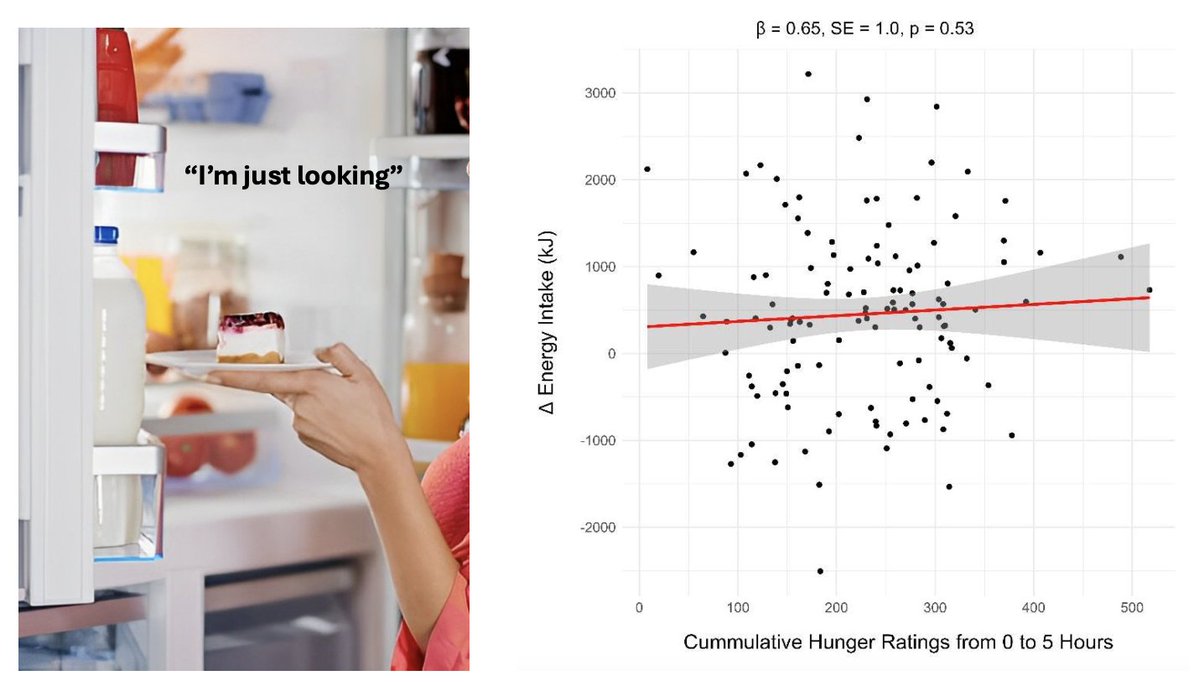
🤔So, why the discrepancy in interpretations?
i. First, the original research team feature an altered version of the primary outcome in stating there was “[n]o effect of GI on intake at [the] next meal.” This is a shift away from “change” in energy intake and omits the prespecified baseline, providing a notably less precise effect estimate than the more powerful change score.
ii. Second, they highlight the absence of group difference in subjective hunger ratings.
But subjective hunger is poorly correlated with objective food intake. If you’ve ever opened the fridge “just to look” and ended up eating half a cheesecake, you already know this.
To do our due diligence, we conducted an analysis and found no relationship between hunger ratings and food intake using their publicly available data.
3
3/4) iii. Third, the investigators emphasize the lack of associations between blood sugar after the meals and change in energy intake, as would be predicted by the CIM. But – and this is a subtle but important point, so take note – they include too much time after the meal. Most of the difference in blood sugar response between groups should occur occurred within the first ~2 hours, but they included 5 hours.
By way of simple analogy, if I force-fed you a Coke followed by Mentos and then insisted it didn’t cause gastrointestinal distress – a claim I suspect you’d contend – would it then be fair for me to counter that, “well, your stomach didn’t hurt at the 5 hour mark after I turned your GI system into an 8th grade science fair volcano.”
iv. Fourth, the original team note the lack of a “dose response,” with no difference in energy intake between the medium- and high-GI groups in post hoc analyses. However, even if the CIM specified a linear relationship between glycemic load and energy intake (it doesn’t), the contrast in GI between the low and moderate meals (33 versus 65) was much larger than between the moderate and high meals (65 versus 73).
This suggests the latter comparison is underpowered.
4
4/4) If you’d like to read for yourself the original study, our letter to the editor, and the original team’s reply to our letter, they are all hyperlinked in the Newsletter version of this thread: staycuriousmetabolism.substack.com/p/the-carb-ins…
But in my opinion, and that of my colleagues, the conclusion that originally reads, “These results were largely inconsistent with the CIM” should read, “These data provide evidence supporting the CIM.”
But I suppose that one interesting element of science, the same data are open to variable interpretations.
What do you think?
