Most relationship advice focuses on the people inside the...

Pep@peptalksblog
57 views
Sep 03, 2025
~3 min read
Advertisement
1
Most relationship advice focuses on the people inside the relationship.
But here's an entirely different, surprisingly powerful perspective I rarely see discussed: 🧵
But here's an entirely different, surprisingly powerful perspective I rarely see discussed: 🧵
2
2 people can both be happy in their relationship, have their needs met, and genuinely enjoy being together.
But that doesn't mean the relationship itself is healthy.
It's not uncommon for couples to feel satisfied while their relationship quietly deteriorates:
Here's why:
But that doesn't mean the relationship itself is healthy.
It's not uncommon for couples to feel satisfied while their relationship quietly deteriorates:
Here's why:
3
The game-changer:
Seeing the relationship itself as a separate entity.
It has its own needs, desires, and boundaries—separate from what you each want individually (though there's often plenty of overlap).
Here are some ways to apply this:
Seeing the relationship itself as a separate entity.
It has its own needs, desires, and boundaries—separate from what you each want individually (though there's often plenty of overlap).
Here are some ways to apply this:
Pep@peptalksblog
Every relationship is a threesome.
There's you, your partner, and the relationship you're in.
Each have their own needs, boundaries and desires (which constantly impact each other's).
It's common sacrifice one (or more) for the others.
The best choices honor all three.
There's you, your partner, and the relationship you're in.
Each have their own needs, boundaries and desires (which constantly impact each other's).
It's common sacrifice one (or more) for the others.
The best choices honor all three.
4
1/
Consult the relationship as a third person in your decisions:
"OK, we're both on board with this. But how will our relationship be impacted? What does it want?"
Consult the relationship as a third person in your decisions:
"OK, we're both on board with this. But how will our relationship be impacted? What does it want?"
5
2/
Play a game where you take turns trying to tune into how your relationship is feeling:
"Right now, our relationship seems to feel ____"
(Horny, bored, grieving, expansive, childlike, playful, stuck...)
Play a game where you take turns trying to tune into how your relationship is feeling:
"Right now, our relationship seems to feel ____"
(Horny, bored, grieving, expansive, childlike, playful, stuck...)
6
3/
Have a conversation where you narrate the phase your relationship is going through.
- Where does our relationship seem to want to go right now?
- What is it not in the mood for lately?
- What does it want us to do more of?
- How is it growing up & developing?
Have a conversation where you narrate the phase your relationship is going through.
- Where does our relationship seem to want to go right now?
- What is it not in the mood for lately?
- What does it want us to do more of?
- How is it growing up & developing?
7
4/
Get to know the preferences of your relationships:
- What activities does our relationship love, even if they're not our personal favorites?
- If our relationship had a love language, what would it be? How does it differ from ours?
- What makes it come alive?
Get to know the preferences of your relationships:
- What activities does our relationship love, even if they're not our personal favorites?
- If our relationship had a love language, what would it be? How does it differ from ours?
- What makes it come alive?
8
Btw, this also gives an entirely different perspective on cheating and affairs.
Sure, maybe your partner doesn't know. But the relationship definitely knows. Its entire nature has changed.
(Relationships can get traumatized too.) ↓↓
Sure, maybe your partner doesn't know. But the relationship definitely knows. Its entire nature has changed.
(Relationships can get traumatized too.) ↓↓
Pep@peptalksblog
We all know lies can hurt others (and some might say “so can the truth”).
And whether lying is moral… well, it depends on your beliefs and values.
But here’s a selfish argument why you better stick to the truth in relationships, no matter what those beliefs or values are.
And whether lying is moral… well, it depends on your beliefs and values.
But here’s a selfish argument why you better stick to the truth in relationships, no matter what those beliefs or values are.
9
Here's where it gets really fun, IMO: This applies to all relationships.
A group of 3 friends? That's actually 7 entities:
3 individual people
3 pair relationships
1 group dynamic
This is group chemistry can be so complex (& electrifying). ↓↓
A group of 3 friends? That's actually 7 entities:
3 individual people
3 pair relationships
1 group dynamic
This is group chemistry can be so complex (& electrifying). ↓↓
10
Each person entering a group adds another ingredient to the vibe soup.
Wild to think about! Adding 1 person to a group of 5 is adding 6 new relational entities into the mix, with their own needs, desires and personalities.
No wonder groups are often instinctively protective against newbies! ↓↓
Wild to think about! Adding 1 person to a group of 5 is adding 6 new relational entities into the mix, with their own needs, desires and personalities.
No wonder groups are often instinctively protective against newbies! ↓↓
11
Hope some of this was helpful to experiment with in your romantic relationship (maybe even your friend groups).
If this perspective shifted something for you, I'd love it if you helped me out by reposting this thread.
Follow me @peptalksblog for more insights on connection🙏
If this perspective shifted something for you, I'd love it if you helped me out by reposting this thread.
Follow me @peptalksblog for more insights on connection🙏
12
P.S. This gets even wilder when you count the egregores in the room.
But voicing their relationships is something I don't recommend exploring without a trained facilitator.
Just wanted to share it for anyone interested in going down a rabbit hole.
But voicing their relationships is something I don't recommend exploring without a trained facilitator.
Just wanted to share it for anyone interested in going down a rabbit hole.
13
Also belongs in this thread:
The relational entities aren't just between you and another person, but between the roles you occupy for each other.
(I'll write a thread about people vs role relationships some other day—huge topic in itself.)
x.com/MattPirkowski/…
The relational entities aren't just between you and another person, but between the roles you occupy for each other.
(I'll write a thread about people vs role relationships some other day—huge topic in itself.)
x.com/MattPirkowski/…
14
Another added layer to this is that this whole thread applies to our intrapersonal relationships (the relational entities that exist between different parts of us) too.
So instead of "me and you" being one interpersonal entity, it's already a collective.

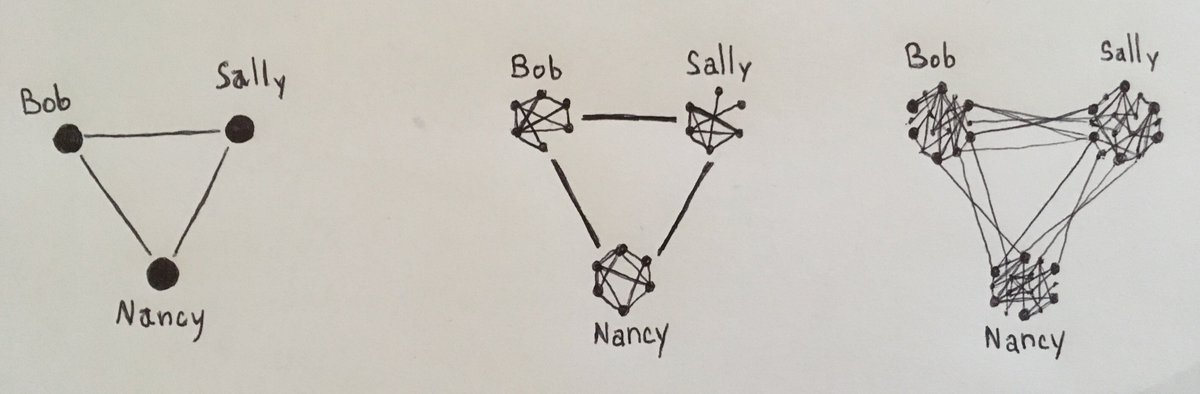
So instead of "me and you" being one interpersonal entity, it's already a collective.
Richard D. Bartlett@RichDecibels
I still remember seeing this diagram in 2018 and having my mind blown permanently
15
What I find beautiful about this is that we experience as the unit from which our awareness arises (e.g. "me") is just one of the possible levels of distinction.
In fact, we shift between these identifications all the time:
In fact, we shift between these identifications all the time:
16
Sometimes you speak as you, the individual.
Sometimes you on behalf of a particular part of yourself.
Sometimes you speak as you, the country, the company, the ethnicity, the twitter subculture, the egregore.
All have different relationships with other relational entities.
Sometimes you on behalf of a particular part of yourself.
Sometimes you speak as you, the country, the company, the ethnicity, the twitter subculture, the egregore.
All have different relationships with other relational entities.
17
There are even points of observation where you are the "part" in someone else's IFS therapy session:
peptalksblog.com/what-if-you-we…
peptalksblog.com/what-if-you-we…
