Others have now raised this topic a few times, so allow me to share...

Glenn@GlennLuk
7 views
Jun 22, 2025
~8 min read
Advertisement
1
Others have now raised this topic a few times, so allow me to share some thoughts on the BYD (and broader) supply chain financing story:
1⃣ BYD's high payables number actually reflects the strength of its underlying business model and market dominance for two key reasons (ability to extract favorable supplier terms; how that number is driven in part by rapid expansion in production capacity)
2⃣ Establishing industry norms that forces larger players like BYD to adhere to standard payment terms (voluntarily or involuntarily) is a positive step forward for the whole industry, leading to more efficient overall financing approach.
3⃣ BYD and other market leaders that also run large negative working capital balances are generally not a risk of insolvency by adhering to new industry norms as they are generally under-leveraged (with traditional debt financing) and will simply plug the financing hole with more traditional debt and equity financing. In BYD's case, I expect all or most of it to be to replaced with debt (long-term bonds).
1⃣ BYD's high payables number actually reflects the strength of its underlying business model and market dominance for two key reasons (ability to extract favorable supplier terms; how that number is driven in part by rapid expansion in production capacity)
2⃣ Establishing industry norms that forces larger players like BYD to adhere to standard payment terms (voluntarily or involuntarily) is a positive step forward for the whole industry, leading to more efficient overall financing approach.
3⃣ BYD and other market leaders that also run large negative working capital balances are generally not a risk of insolvency by adhering to new industry norms as they are generally under-leveraged (with traditional debt financing) and will simply plug the financing hole with more traditional debt and equity financing. In BYD's case, I expect all or most of it to be to replaced with debt (long-term bonds).
2
1⃣ BYD's high payables figure reflects strength of its underlying business model and is in part a reflection of its rapid growth in production capacity
While the high payables figure has been portrayed as a potential weakness (with some even raising the idea that BYD is insolvent), actually it reflects the opposite.
While the high payables figure has been portrayed as a potential weakness (with some even raising the idea that BYD is insolvent), actually it reflects the opposite.
3
BYD uses its scale to extract favorable terms from its suppliers. It trades volume for pricing as well as non-pricing advantages, like extended payment terms. It does this because that's what extremely competitive companies do: they try to exploit every advantage they have over the competition.
As BYD has only gotten bigger and more powerful, it has maintained its ability to sustain structural negative working capital state on its balance sheet.
Companies that can maintain negative working capital are often extremely competitive. This is a very desirable business model to run for rapidly growing companies because as revenue grows, working capital becomes a source of funding.
Amazon's marketplace business was an example of this. Amazon collects payment upfront and then pays out sellers later. This leads to a negative working capital balance, which is effectively a very low-cost form of growth financing for its marketplace business.
Ability to maintain negative working capital is even more rare in a capital-intensive businesses like the car sector. That reflects just how dominant BYD has become.
This doesn't mean it's a good thing for the industry overall (and I'll touch on this in the next point), but it does reflect on the increasing dominance of BYD individually.
As BYD has only gotten bigger and more powerful, it has maintained its ability to sustain structural negative working capital state on its balance sheet.
Companies that can maintain negative working capital are often extremely competitive. This is a very desirable business model to run for rapidly growing companies because as revenue grows, working capital becomes a source of funding.
Amazon's marketplace business was an example of this. Amazon collects payment upfront and then pays out sellers later. This leads to a negative working capital balance, which is effectively a very low-cost form of growth financing for its marketplace business.
Ability to maintain negative working capital is even more rare in a capital-intensive businesses like the car sector. That reflects just how dominant BYD has become.
This doesn't mean it's a good thing for the industry overall (and I'll touch on this in the next point), but it does reflect on the increasing dominance of BYD individually.
4
The second element here is that the high payables number in part reflects rapid expansion of production capacity.
This point is a bit more speculative, as BYD does not break out its payables by supplier. But the key point here is that there are different types of suppliers and associated industry norms on payment standards.
One way to think about this is how supplier payment terms might vary between (i) third-party raw material and component suppliers that show up in Cost of Goods Sold and (ii) suppliers for the long-term buildout of PP&E that go into those massive BYD factories that shows up in CapEx.
Typically raw materials/component suppliers get paid in anywhere from 30-60 days.
But for "suppliers" to the buildout of these massive BYD factories (think general contractors, large equipment suppliers, etc.), the industry norm on payment terms could be much, much longer.
This point is a bit more speculative, as BYD does not break out its payables by supplier. But the key point here is that there are different types of suppliers and associated industry norms on payment standards.
One way to think about this is how supplier payment terms might vary between (i) third-party raw material and component suppliers that show up in Cost of Goods Sold and (ii) suppliers for the long-term buildout of PP&E that go into those massive BYD factories that shows up in CapEx.
Typically raw materials/component suppliers get paid in anywhere from 30-60 days.
But for "suppliers" to the buildout of these massive BYD factories (think general contractors, large equipment suppliers, etc.), the industry norm on payment terms could be much, much longer.
5
And because BYD is so highly vertically integrated (which ties to CapEx intensity) and still growing faster than the industry, it is building a disproportionate share of the PP&E in China's overall car sector (including upstream suppliers).
This means that a larger proportion of its bills are related to CapEx vs. COGS-related.
And if the industry norm on CapEx supplier payment terms is 180-day payment terms vs. 60 days for component suppliers, then BYD's payables will be elevated even if it were adhering to those industry norms.
Now the reality is likely that BYD is doing the above but also extracting the most favorable terms from suppliers, which compounds the problem.
It has since agreed in principle to adhere to industry norms, and next I will explain why this is a good thing overall for the car sector in the long run.
This means that a larger proportion of its bills are related to CapEx vs. COGS-related.
And if the industry norm on CapEx supplier payment terms is 180-day payment terms vs. 60 days for component suppliers, then BYD's payables will be elevated even if it were adhering to those industry norms.
Now the reality is likely that BYD is doing the above but also extracting the most favorable terms from suppliers, which compounds the problem.
It has since agreed in principle to adhere to industry norms, and next I will explain why this is a good thing overall for the car sector in the long run.
6
2⃣ Establishing industry norms on supplier terms is good for overall financing efficiency in the broad car sector (including upstream suppliers).
In undergrad finance classes I remember learning about the efficient capital frontier. While we learned it mainly from a stock portfolio perspective (which I remain skeptical about), I think the framework is actually more useful to apply here at the company/asset level.
Basically larger firms — especially those in market-leading positions — like BYD should have a cost of capital advantage over smaller firms (like all of BYD's suppliers). This makes sense and while I haven't done an exhaustive study, I am highly confident BYD can raise funding at lower cost than the company that supplies it with say components that go into making its in-car refrigerators.
Extended supplier payment terms are a form of extremely low-cost working capital financing. BYD is "borrowing" from its supplier at zero financing cost; either that, or it can negotiate favorable "pay early" terms at very high effective rates of return which indirectly lowers what is probably already a low headline component supply price.
Because the suppliers will have much higher costs of capital vs. BYD, what's happening here is that this is forcing smaller suppliers in the industry to take on a disproportionate share of working capital financing, even though their cost of capital is presumably much higher than a company like BYD.
This is good for BYD (and per above, reflective of its market dominance), but it is inefficient from an industry perspective.
In undergrad finance classes I remember learning about the efficient capital frontier. While we learned it mainly from a stock portfolio perspective (which I remain skeptical about), I think the framework is actually more useful to apply here at the company/asset level.
Basically larger firms — especially those in market-leading positions — like BYD should have a cost of capital advantage over smaller firms (like all of BYD's suppliers). This makes sense and while I haven't done an exhaustive study, I am highly confident BYD can raise funding at lower cost than the company that supplies it with say components that go into making its in-car refrigerators.
Extended supplier payment terms are a form of extremely low-cost working capital financing. BYD is "borrowing" from its supplier at zero financing cost; either that, or it can negotiate favorable "pay early" terms at very high effective rates of return which indirectly lowers what is probably already a low headline component supply price.
Because the suppliers will have much higher costs of capital vs. BYD, what's happening here is that this is forcing smaller suppliers in the industry to take on a disproportionate share of working capital financing, even though their cost of capital is presumably much higher than a company like BYD.
This is good for BYD (and per above, reflective of its market dominance), but it is inefficient from an industry perspective.
7
Further, BYD is using this as a funding advantage against its competitors (hence the loud complaining from smaller competitors like GWM):
Glenn@GlennLuk
@leixing77 GWM chairman's words seem more like indicatio that the company is struggling.
8
But one could argue that unfair financing advantages are not where competitive energy should be directed for the overall health of the industry.
Smaller suppliers strain under these onerous payment terms; smaller automakers will always be at a disadvantage vs. larger / more ruthless ones.
It can be seen as a quasi-"monopoly" advantage that accrues to market leaders to the detriment of smaller players.
Smaller suppliers strain under these onerous payment terms; smaller automakers will always be at a disadvantage vs. larger / more ruthless ones.
It can be seen as a quasi-"monopoly" advantage that accrues to market leaders to the detriment of smaller players.
9
And we all know how seriously Beijing takes its "anti-monopoly" stance (e.g. Alibaba).
That is why it is not at all surprising that BYD recently agreed to adhere to industry norm payment terms:
bloomberg.com/news/articles/…
That is why it is not at all surprising that BYD recently agreed to adhere to industry norm payment terms:
bloomberg.com/news/articles/…
10
This is good for the industry, as it shifts the burden of financing working capital from firms with higher cost of capital to those with lower cost of capital.
This doesn't remove the 内卷 (involution) but instead re-directs this competitive impulse to other efforts where there are greater positive societal spillovers, e.g. more rapid technology development, cost efficiencies and creative designs and market segmentation.
This doesn't remove the 内卷 (involution) but instead re-directs this competitive impulse to other efforts where there are greater positive societal spillovers, e.g. more rapid technology development, cost efficiencies and creative designs and market segmentation.
11
3⃣ It will be fairly trivial to rightsize the balance sheets to adhere to new industry standards on payment terms, especially for BYD
I did some very rough math on BYD and calculated that in a conservative case it would have to raise ~$15B to reduce its COGS payable days to ~30 days (I estimate ~40% of its trade payables are associated with long-term CapEx).
I did some very rough math on BYD and calculated that in a conservative case it would have to raise ~$15B to reduce its COGS payable days to ~30 days (I estimate ~40% of its trade payables are associated with long-term CapEx).
12
BYD's balance sheet is under-leveraged (by traditional debt financing metrics i.e. ignoring the working capital deficit).
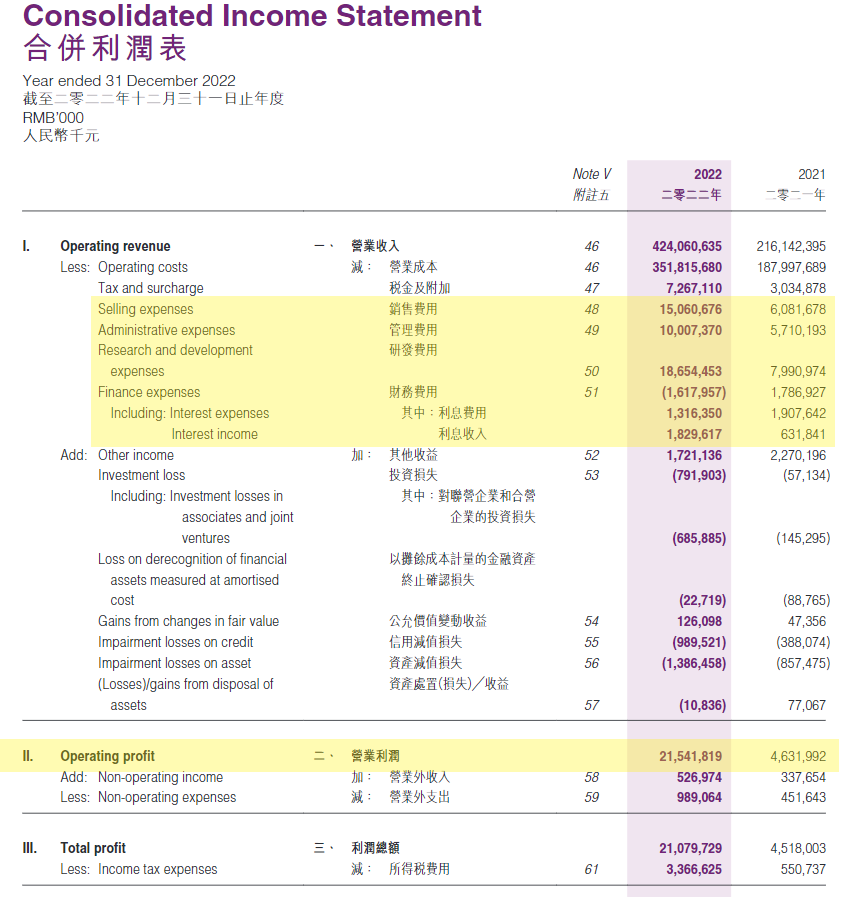
It could easily raise this amount in LT bonds alone. Assuming 5% cost of debt, this adds ~$750M in incremental interest expense.

It could easily raise this amount in LT bonds alone. Assuming 5% cost of debt, this adds ~$750M in incremental interest expense.
Glenn@GlennLuk
For example, in 2022 BYD generated net profit of ¥17.7 billion on average shareholders' equity of ~¥122 billion, for a RoE of 14.5%.
Avg. fixed assets of ¥96 billion put to work + construction assets and modest net working capital requirements. BYD has more cash than debt.
Avg. fixed assets of ¥96 billion put to work + construction assets and modest net working capital requirements. BYD has more cash than debt.
13
To put that in perspective, $750M in incremental interest expense is ~1% of its automotive COGS.
BYD recently announced price cuts upwards of 30% on its retail ASPs.
So this is really trivial impact both on its balance sheet and its income statement. There is zero risk here.
BYD recently announced price cuts upwards of 30% on its retail ASPs.
So this is really trivial impact both on its balance sheet and its income statement. There is zero risk here.
14
Addendum: I put this together just now to analyze the impact of a capital raise (debt + equity) to cover the a one-time reduction in COGS supplier payable days to 60 for BYD, largely in line with assumptions made above and more recent figures (Q1 2025 unaudited report).
▪️ Using 180 days as an assumption for CapEx payables, I estimate COGS payables to be ~109 days.
▪️ Reducing COGS payables to 60 days and CapEx to 120 days has a one-time** impact of ~¥106 billion.
▪️ This could be taken care of with a ~¥125 billion fundraising (incl. amounts to pay off existing b/s borrowings).
▪️ I assumed ~¥100 billion in the form of long-term borrowings (bonds), a modest line of credit facility and ¥10 billion equity issuance.
▪️ The incremental cashflow impact is ¥5 billion in incremental interest expenses
▪️ The dilutive impact of the equity offering is ~1.43% of total shares outstanding
▪️ The resulting balance sheet remains conservatively leveraged by any standard, with inventories and physical PP&E alone of ~¥424 billion covering gross debt of ~¥114 billion by ~4x.
** Most likely, the reduction would happen in a phased approach over a period of time instead of being a "one-time" event, so this is a conservative assumption. If it were phased in over time, incremental operating cashflow could be used to cover these amounts.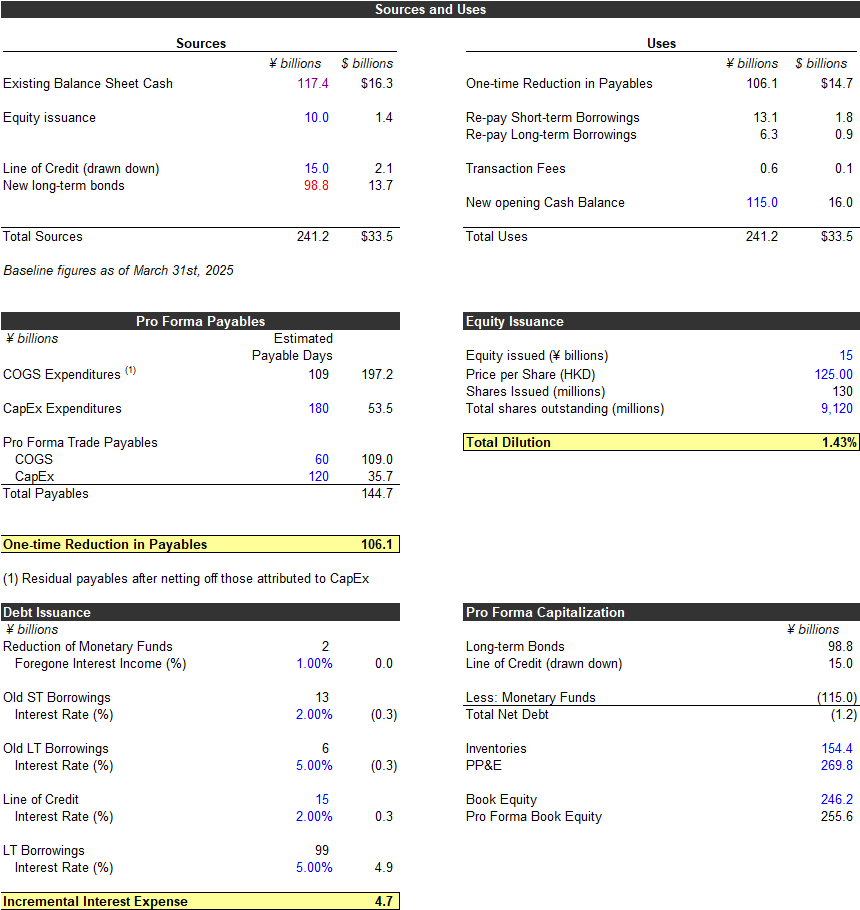
▪️ Using 180 days as an assumption for CapEx payables, I estimate COGS payables to be ~109 days.
▪️ Reducing COGS payables to 60 days and CapEx to 120 days has a one-time** impact of ~¥106 billion.
▪️ This could be taken care of with a ~¥125 billion fundraising (incl. amounts to pay off existing b/s borrowings).
▪️ I assumed ~¥100 billion in the form of long-term borrowings (bonds), a modest line of credit facility and ¥10 billion equity issuance.
▪️ The incremental cashflow impact is ¥5 billion in incremental interest expenses
▪️ The dilutive impact of the equity offering is ~1.43% of total shares outstanding
▪️ The resulting balance sheet remains conservatively leveraged by any standard, with inventories and physical PP&E alone of ~¥424 billion covering gross debt of ~¥114 billion by ~4x.
** Most likely, the reduction would happen in a phased approach over a period of time instead of being a "one-time" event, so this is a conservative assumption. If it were phased in over time, incremental operating cashflow could be used to cover these amounts.
15
Related prior 🧵
Glenn@GlennLuk
So a company BYD is either signing up to pare down its outstanding payable days and will go “Evergrande” or that scenario/comparison was never real to begin with.
I’m thinking the latter.
I’m thinking the latter.