This reflects both (i) an incomplete understanding of how debt is...

Glenn@GlennLuk
13 views
Jul 29, 2025
~4 min read
Advertisement
1
This reflects both (i) an incomplete understanding of how debt is serviced in China and (ii) general financial illiteracy.
It is not about liquidity via asset sales. Asset sales are rare.
It is about how asset-backed means there is an attached revenue stream that is used to service debt …
… in sharp contrast to central government debt issued under the “full faith and credit” of the issuing country that ostensibly relies on tax revenue from a general fund.

It is not about liquidity via asset sales. Asset sales are rare.
It is about how asset-backed means there is an attached revenue stream that is used to service debt …
… in sharp contrast to central government debt issued under the “full faith and credit” of the issuing country that ostensibly relies on tax revenue from a general fund.
Blume Industries CEO Balding 大老板@BaldingsWorld
It is regularly put forward that China's debt isn't bad because it has lots of state assets it could sell. Technically this is correct but leave aside the problem this is effectively telling China to not be communist, there is another problem. Who would buy the assets in ay material amount? Chinese companies are doing not insignificant amount of secondary offerings (in the US the biggest problem is a shrinking share base from all the buybacks). One recent secondary offering from a state grid operator and all the buyers were Chinese SOEs from banks to oil. The only real buyers of Chinese assets are Chinese SOEs. The net debt concept for China accounting for state assets simply isn't a realistic concept
2
Example:
China Railway (a national-level SOE) has ~¥5.3T of debt on its balance through a combination of secured loans and issued bonds.
This represents ~1.2% of China’s ~¥426T in total social financing (“TSF” which is ~97-98% debt or debt-like instruments) as of June 2025. TSF is often used as a proxy for the numerator of China’s debt/GDP metric.
China Railway’s debt is serviced by ~¥1.3T in revenue generated from its freight & passenger rail operations, which is plenty to cover an est. ¥180B of annual interest expense (wtd. avg. interest rate of ~3.4%)👇

China Railway (a national-level SOE) has ~¥5.3T of debt on its balance through a combination of secured loans and issued bonds.
This represents ~1.2% of China’s ~¥426T in total social financing (“TSF” which is ~97-98% debt or debt-like instruments) as of June 2025. TSF is often used as a proxy for the numerator of China’s debt/GDP metric.
China Railway’s debt is serviced by ~¥1.3T in revenue generated from its freight & passenger rail operations, which is plenty to cover an est. ¥180B of annual interest expense (wtd. avg. interest rate of ~3.4%)👇
Glenn@GlennLuk
I've finally had a chance to update China Railway financials through 2023.
I have yet to figure out the discrepancies in the non-transport revenue line; coincides with discrepancies between revenue on IS and the "cash from goods & services" in CF statement.
I have yet to figure out the discrepancies in the non-transport revenue line; coincides with discrepancies between revenue on IS and the "cash from goods & services" in CF statement.
3
In other words, China Railway’s portion of the debt does not need to be serviced out of the central government’s general fund.
Now multiply this across the entire SOE economy — both at the national and provincial level.
Now multiply this across the entire SOE economy — both at the national and provincial level.
4
National SOEs like China Railway (under the supervision of national SASAC) generate plenty of revenue to service their debt.
Managing SOEs’ finances isn’t rocket science. They often operate monopoly sectors (e.g. rail, telecom, power) where they can set prices at a level that meets their financial objectives, which invariably includes servicing balance sheet debt.
Managing SOEs’ finances isn’t rocket science. They often operate monopoly sectors (e.g. rail, telecom, power) where they can set prices at a level that meets their financial objectives, which invariably includes servicing balance sheet debt.
5
It’s at the local level where the financial situations are often far murkier and less consistent (for a lot of reasons we don’t need to get into here, but which I’ve covered elsewhere).
As I discussed a couple years ago in my deep dive on LGFVs, these are the economy’s “bottom of the barrel” assets that ultimately end up requiring central government financial support.

As I discussed a couple years ago in my deep dive on LGFVs, these are the economy’s “bottom of the barrel” assets that ultimately end up requiring central government financial support.
Glenn@GlennLuk
@HongshenZhu The really bad assets at the bottom are shut down and rehabilitated, converted to alternative uses.
I like to use this “barrel” analogy, applies here if we zero in on just local government assets
I like to use this “barrel” analogy, applies here if we zero in on just local government assets
6
But even in the “bottom of the barrel” local government asset category, the assets still generate revenue … just possibly not enough to cover their debt service.
Those are the ones that need support.
And the central government is providing some funds supplemental financial support, but with strings attached that at least attempt to force local governments to restructure or otherwise rehabilitate these assets.
Those are the ones that need support.
And the central government is providing some funds supplemental financial support, but with strings attached that at least attempt to force local governments to restructure or otherwise rehabilitate these assets.
7
This means that a much smaller share of the country’s aggregate debt service burden falls onto the central government.
It also means that there is more direct accountability in the system.
An asset that cannot generate enough revenue to service its debt is a signal that it might be impaired and is worth looking into.
Whereas funding out of a general pool doesn’t provide the same level of discrete accountability.
A prime example is the Interstate Highway system, which is funded out of the federal budget.
You end up with situations like Corridor H in West Virginia which has turned into a quintessential “pork barrel” money pit on the basis of social welfare funding for a relatively poor state with outsize political influence 👇.
It also means that there is more direct accountability in the system.
An asset that cannot generate enough revenue to service its debt is a signal that it might be impaired and is worth looking into.
Whereas funding out of a general pool doesn’t provide the same level of discrete accountability.
A prime example is the Interstate Highway system, which is funded out of the federal budget.
You end up with situations like Corridor H in West Virginia which has turned into a quintessential “pork barrel” money pit on the basis of social welfare funding for a relatively poor state with outsize political influence 👇.
Glenn@GlennLuk
@twittwoods So some of it may be same goal, different financing approach.
Instead of raising federal taxes to subsidize a poor state like West Virginia via projects like Corridor H, China used land finance model to build social projects in places like Guizhou.
en.m.wikipedia.org/wiki/U.S._Rout…
Instead of raising federal taxes to subsidize a poor state like West Virginia via projects like Corridor H, China used land finance model to build social projects in places like Guizhou.
en.m.wikipedia.org/wiki/U.S._Rout…
8
Or compare China Railway with Amtrak, which has been loss-making for decades and thus unable to properly service its debt, requiring tens of billions in financial support from the federal budget through the years.
Glenn@GlennLuk
@Dali_Yang And Amtrak is losing money.
If long-haul passenger rail cannot work in the densest corridor in the US, how is it supposed to work in the rest of the country?
cnbc.com/2020/05/27/amt…
If long-haul passenger rail cannot work in the densest corridor in the US, how is it supposed to work in the rest of the country?
cnbc.com/2020/05/27/amt…
9
With asset-level accountability you can more easily identify and target problem assets.
Aggregating it into the general pool means far less direct accountability.
Debates over line-items in the general budget are resolved in backroom horse trading that predictably results in those “pork barrel” projects, especially for smaller states that can leverage the structural idiosyncrasies of the legislative system where they hold disproportionate influence over votes (2 senate seats for each state).
Aggregating it into the general pool means far less direct accountability.
Debates over line-items in the general budget are resolved in backroom horse trading that predictably results in those “pork barrel” projects, especially for smaller states that can leverage the structural idiosyncrasies of the legislative system where they hold disproportionate influence over votes (2 senate seats for each state).
10
And the political incentives of each administration is biased towards running a large general deficit, one funded by the seemingly unlimited borrowing power of the USG.
This whole budgeting process is fraught with moral hazard and lack of discrete accountability.
This whole budgeting process is fraught with moral hazard and lack of discrete accountability.
11
There is other important context (e.g. different GDP growth rates) when you try to compare China’s debt levels/situation to other countries but the asset-backed nature is one of the least understood ones but highly relevant to the conversation.
12
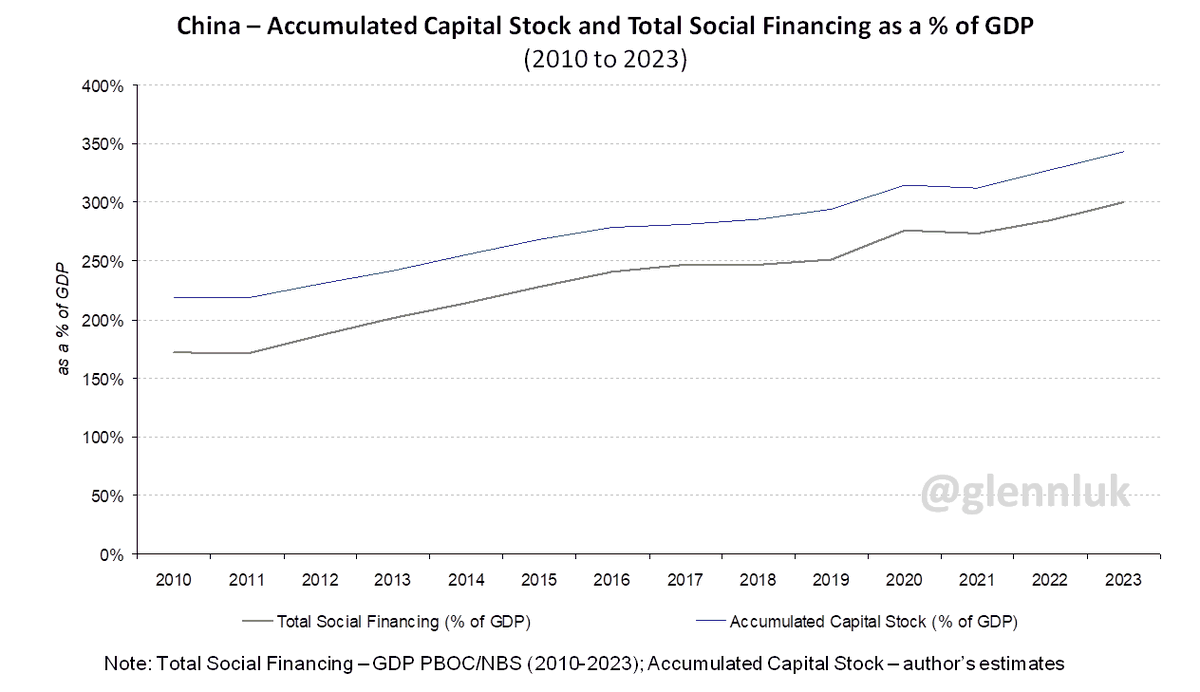
@matthewswspence And how TSF and gross capital formation are highly correlated
Glenn@GlennLuk
This chart lines up accumulated capital stock & TSF.
As you can see, TSF is highly correlated to accumulated capital stock.
Thus debt correlates with accumulated capital stock, and only indirectly with aggregate GDP/NDP.
As you can see, TSF is highly correlated to accumulated capital stock.
Thus debt correlates with accumulated capital stock, and only indirectly with aggregate GDP/NDP.
