Kai Fu Lee estimates annualized run-rate operating cost for...

Glenn@GlennLuk
7 views
Aug 24, 2025
~5 min read
Advertisement
1
Kai Fu Lee estimates annualized run-rate operating cost for DeepSeek of ~$140M per year
(he compares this to being 2% of OpenAI’s opex/spending run rate $7B)

(he compares this to being 2% of OpenAI’s opex/spending run rate $7B)
David Ingles@DavidInglesTV
"Is OpenAI's model even sustainable?"
The China moment that sparked the sudden shift in AI economics and where the value add now lies for investors and innovators
The China moment that sparked the sudden shift in AI economics and where the value add now lies for investors and innovators
2
This is roughly in line with my back-of-the-envelope estimates of what I calculated DeepSeek’s budget could have been based on assumption of being self-funded by estimated GP economics of High Flyer fund.

Glenn@GlennLuk
P.P.P.P.S. This is just a very quick estimate of the lifetime revenue that High Flyer funds would have generated with accompanying assumptions.
~$400 million available for reinvestment into both R&D and CapEx.
~$400 million available for reinvestment into both R&D and CapEx.
3
This also triangulates with DeepSeek’s owned cluster estimate closer to 3-5k “Hoppers” than the “50,000” figure that was widely circulated and amplified.
Increasingly clear that figure was some analyst’s wild guess and off by more than an order of magnitude.

Increasingly clear that figure was some analyst’s wild guess and off by more than an order of magnitude.
Glenn@GlennLuk
This key chart from @SemiAnalysis_ appears to have been the key source for claims of "50,000 Hoppers" and more detailed disclosure on their CapEx buildup analysis ("$1.3B").
But the table has errors/inconsistencies. More significantly, key assumptions don't pass sanity checks.
But the table has errors/inconsistencies. More significantly, key assumptions don't pass sanity checks.
4
As I discussed in the thread, even 5-10k H800s (on top of the 10k A100s purchased earlier for the quant fund) would have been a major commitment for High Flyer to finance on its own — a 70% reinvestment rate back into capex is already “extraordinarily” high.
Glenn@GlennLuk
The 10,000 A100s bet was already an extraordinary bet for Liang / High Flyer, with parallels to Elon Musk investing nearly all his PayPal sale proceeds into Tesla + SpaceX.
It's also inconsistent with Quant Fund CEO's comments in 2020 of redirecting reinvestment efforts at R&D (a.k.a. smart people) instead of CapEx.
It's also inconsistent with Quant Fund CEO's comments in 2020 of redirecting reinvestment efforts at R&D (a.k.a. smart people) instead of CapEx.
5
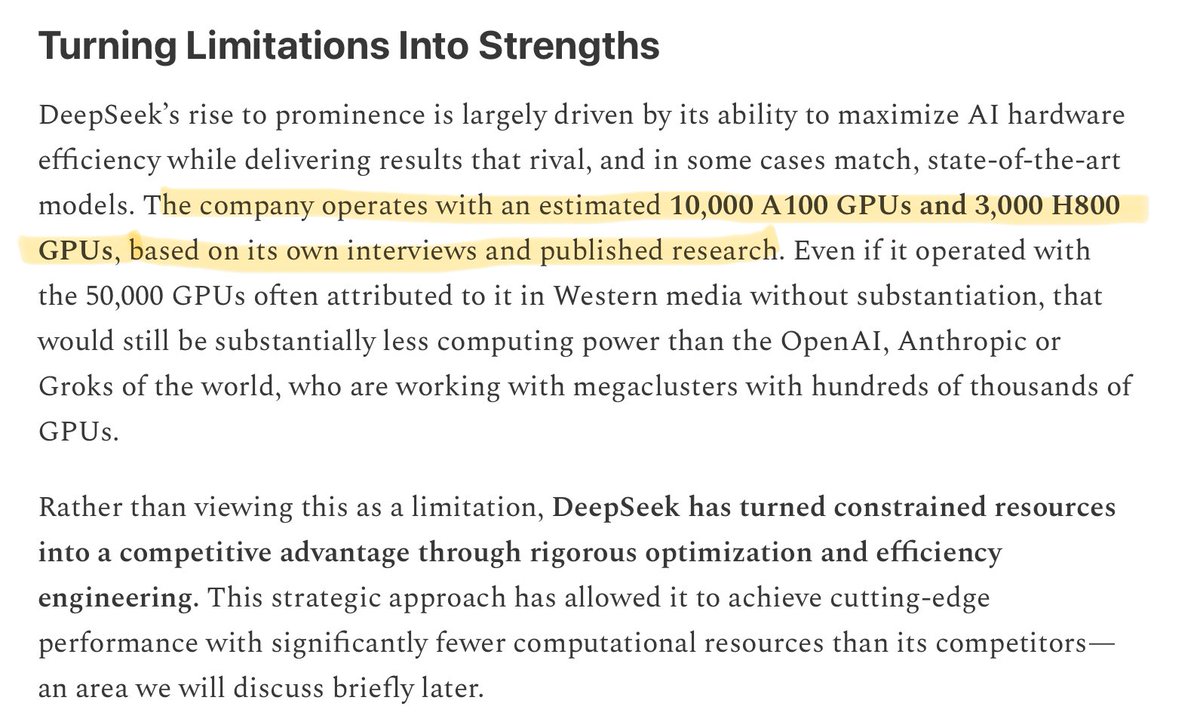
TechBuzzChina estimate of “3,000 H800s” is much more reasonable and also consistent with Kai Fu’s estimate of opex run rate.
6
Other interesting insights from the interview.
Drawing an analogy with the foundational or “pioneer” model to the “kernel” (core services) of an operating system.
Drawing an analogy with the foundational or “pioneer” model to the “kernel” (core services) of an operating system.

7
From that perspective, the foundation model is analogous to other OS kernels like Linux (open), Android (open), Mac (closed), iOS (closed) and Windows (closed).
8
There are several key implications to this:
(1) The winners at the kernel layer will be a duopoly or oligopoly:
Every other platform has featured between 2-3 winners (PC: Windows vs. Mac; Servers: Windows vs. Linux; Mobile: iOS vs. Android - and now Harmony OS)
(1) The winners at the kernel layer will be a duopoly or oligopoly:
Every other platform has featured between 2-3 winners (PC: Windows vs. Mac; Servers: Windows vs. Linux; Mobile: iOS vs. Android - and now Harmony OS)
9
Right now, KFL thinks the three key contenders coming out of China are DeepSeek, Alibaba/Qwen and Bytedance/Doubao.
(DeepSeek coming out of left field to surge into pole position on this was such a seismic event)
(DeepSeek coming out of left field to surge into pole position on this was such a seismic event)
10
(2) Open vs. closed source will determine where value can be captured.
If open source wins (looking that way, especially in China), that doesn't mean that the economics in AI will be bad, only that it will be hard for anyone outside that duo/oligopoly to make money specifically on the foundation model.
If open source wins (looking that way, especially in China), that doesn't mean that the economics in AI will be bad, only that it will be hard for anyone outside that duo/oligopoly to make money specifically on the foundation model.
11
12
The closed model won in PC and also to a certain extent in mobile because the early incumbents (Microsoft, Apple) leveraged their early leads in device market share to push into the application layers.
Also — especially in the case of PCs — tight integration between the OS kernel and the hardware ("Wintel") was a crucial performance differentiator.
Also — especially in the case of PCs — tight integration between the OS kernel and the hardware ("Wintel") was a crucial performance differentiator.
13
Microsoft built an applications business on top of its OS franchise and developed a semi-open Windows-centric developer ecosystem.
This is how it leveraged a closed model approach at the OS kernel level into what eventually became a dominant monopoly.
This is how it leveraged a closed model approach at the OS kernel level into what eventually became a dominant monopoly.
14
OpenAI was clearly trying to take a similar approach, leveraging its early lead in foundation model development to establish a dominant position in the application layer.
ChatGPT was the first "killer app". Deep Research is another example.
ChatGPT was the first "killer app". Deep Research is another example.
15
The problem it is now running into is that open source models have caught up or are close enough to erode any advantages that it might have been able to provide to its proprietary apps like ChatGPT and Deep Research.
That makes it hard to monetize.
That makes it hard to monetize.
16
Foundation model switching costs are extremely low, amounting to switching out a few lines of code in some cases.
e.g. it was relatively painless to switch from OpenAI to Mistral at one of my companies.
e.g. it was relatively painless to switch from OpenAI to Mistral at one of my companies.
17
Other companies that have vast installed bases and have a major advantage over OpenAI in integrating AI features into existing applications.
They can shop around for the best foundation models to plug in on the backend and can build the price into existing monetization models.
They can shop around for the best foundation models to plug in on the backend and can build the price into existing monetization models.
18
The key measure on who is winning the foundation model battle is share of usage by downstream application developers.
Since the v3/r1 release, DeepSeek's model has been integrated into existing models with hundreds of millions of existing user bases like WeChat, car voice assistants etc.
Since the v3/r1 release, DeepSeek's model has been integrated into existing models with hundreds of millions of existing user bases like WeChat, car voice assistants etc.
19
When switching costs are low/minimal, LT sustainable competitive advantage comes with being the low-cost provider.
For commodity services, scale/market share enables fixed development costs to be amortized over a larger base.
Market share (integration by downstream application developers) becomes the critical success factor for AI foundation models.
For commodity services, scale/market share enables fixed development costs to be amortized over a larger base.
Market share (integration by downstream application developers) becomes the critical success factor for AI foundation models.
20
(3) Low cost enables creative new downstream applications and enforces a virtuous cycle with the leading foundation models.
DeepSeek pricing is an OoM lower than proprietary models.
x.com/GlennLuk/statu…
DeepSeek pricing is an OoM lower than proprietary models.
x.com/GlennLuk/statu…
21
By driving API costs down this opens up new product features and business models downstream at the application layer.
It will be very difficult for propietary approaches to compete with an open source model that has also gained early critical mass market share with application developers.
It will be very difficult for propietary approaches to compete with an open source model that has also gained early critical mass market share with application developers.
22
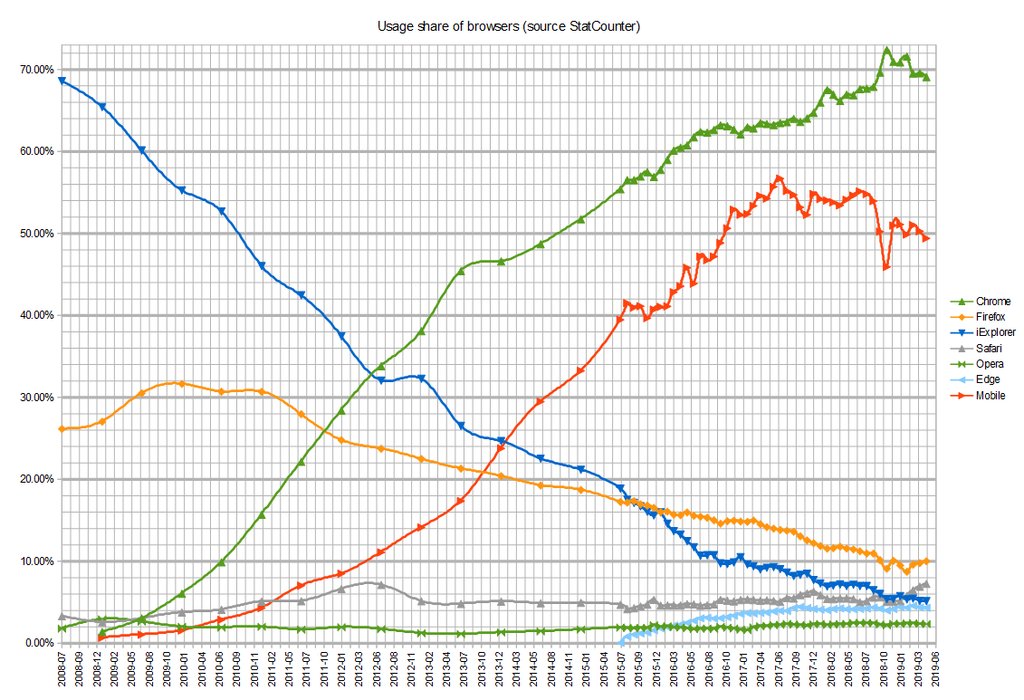
*⃣ Beyond the operating system kernel analogy, I'd also submit another relevant one - the open vs. closed Internet browser wars of the 90s:
x.com/GlennLuk/statu…
x.com/GlennLuk/statu…
23
In early Internet years, it was also unclear how the "Web" would be monetized.
The browser wars in the 90s illustrated the struggle to figure out how to monetize the Internet.
Some thought paying for browser software was the way to go. But we saw how Microsoft eventually simply leveraged their monopoly with PCs to include Internet Explorer for free, which made it hard for standalone browster companies like Netscape to monetize the browser they had developed.
The browser wars in the 90s illustrated the struggle to figure out how to monetize the Internet.
Some thought paying for browser software was the way to go. But we saw how Microsoft eventually simply leveraged their monopoly with PCs to include Internet Explorer for free, which made it hard for standalone browster companies like Netscape to monetize the browser they had developed.
24
But in the long run Google Chrome ended up defeating Internet Explorer because it figured out a completely novel way of monetization that was superior to Microsoft's - through the search engine via advertising.
25
Apple was also a huge winner, because its control of iOS ecosystem meant that it could extract a massive annual toll from Google to pay to be the default search engine for iOS devices.
That toll is funded by the superior underlying business model.
bloomberg.com/news/articles/…
That toll is funded by the superior underlying business model.
bloomberg.com/news/articles/…
26
I expect AI to follow a similar long path.
Companies and entrepreneurs are still not yet quite sure how best to monetize this paradigm-shifting technology enabled in part by those foundation models.
As we saw with the browser wars and Google's eventual emergence, it will likely take years if not decades to really figure out the winning formulas.
Companies and entrepreneurs are still not yet quite sure how best to monetize this paradigm-shifting technology enabled in part by those foundation models.
As we saw with the browser wars and Google's eventual emergence, it will likely take years if not decades to really figure out the winning formulas.
27
Whether this favors tech incumbents or new entrants is still unclear: the pendulum keeps shifting back and forth.
(IMO open source foundation models shifts the pendulum to incumbents like Google, Microsoft, Alibaba, Tencent, Xiaomi, Bytedance ...)
But that's one reason why it is so interesting to follow developments in this space.
(IMO open source foundation models shifts the pendulum to incumbents like Google, Microsoft, Alibaba, Tencent, Xiaomi, Bytedance ...)
But that's one reason why it is so interesting to follow developments in this space.