An EEG study reveals that individuals with ADHD exhibit increased...

Psychiatry Excellence@psycheureka
10 views
Jun 17, 2025
~2 min read
Advertisement
1
An EEG study reveals that individuals with ADHD exhibit increased theta and alpha power, coupled with decreased beta power, indicating impaired attention regulation and executive control (Michelini, 2022).
These patterns reflect the same brain dynamics underlying overthinking: intrusive, uncontrolled, and cognitively taxing thought loops.
1/11🧵
These patterns reflect the same brain dynamics underlying overthinking: intrusive, uncontrolled, and cognitively taxing thought loops.
1/11🧵
2
Overthinking is not a diagnosis, but a symptom that crosses diagnostic boundaries.
In ADHD, anxiety, depression, PTSD, and bipolar disorder, it can signal cognitive dysregulation within core brain networks.
2/11 🧵
In ADHD, anxiety, depression, PTSD, and bipolar disorder, it can signal cognitive dysregulation within core brain networks.
2/11 🧵
3
At its core, overthinking reflects a breakdown in executive function.
This includes impaired set-shifting, poor attention control, and inability to suppress intrusive thoughts, hallmarks of prefrontal–striatal–limbic dysfunction.
3/11 🧵
This includes impaired set-shifting, poor attention control, and inability to suppress intrusive thoughts, hallmarks of prefrontal–striatal–limbic dysfunction.
3/11 🧵
4
These cognitive disruptions map onto the brain’s triple-network model:
● Salience Network (detects internal + external significance)
● Default Mode Network (DMN) (self-referential thought, rumination)
● Executive Control Network (ECN) (focus, decision-making, regulation)
4/11 🧵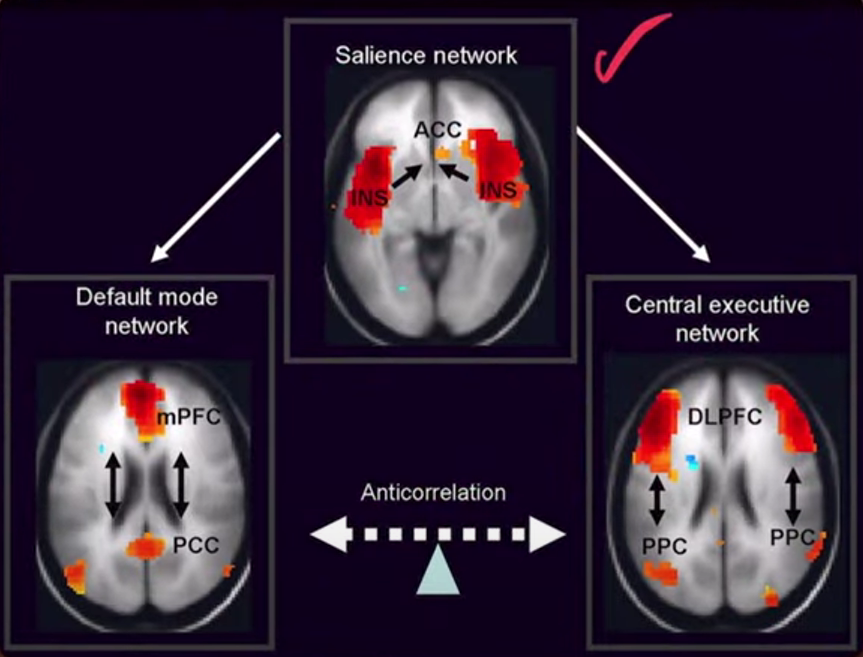
● Salience Network (detects internal + external significance)
● Default Mode Network (DMN) (self-referential thought, rumination)
● Executive Control Network (ECN) (focus, decision-making, regulation)
4/11 🧵
5
Under healthy conditions, these networks balance each other.
When attention is required, the ECN suppresses the DMN.
But in overthinking, this anti-correlation weakens, and intrusive thoughts break through.
5/11 🧵
When attention is required, the ECN suppresses the DMN.
But in overthinking, this anti-correlation weakens, and intrusive thoughts break through.
5/11 🧵
6
Overthinking spans a spectrum of thought pathologies:
– Preoccupations
– Obsessions
– Ruminations
– Delusions
Each reflects deeper network disruptions, especially in the salience and executive circuits.
The diagram below visualises how higher rumination scores correlate with altered amygdala–PFC connectivity across diagnoses like MDD, PTSD, and GAD.
6/11 🧵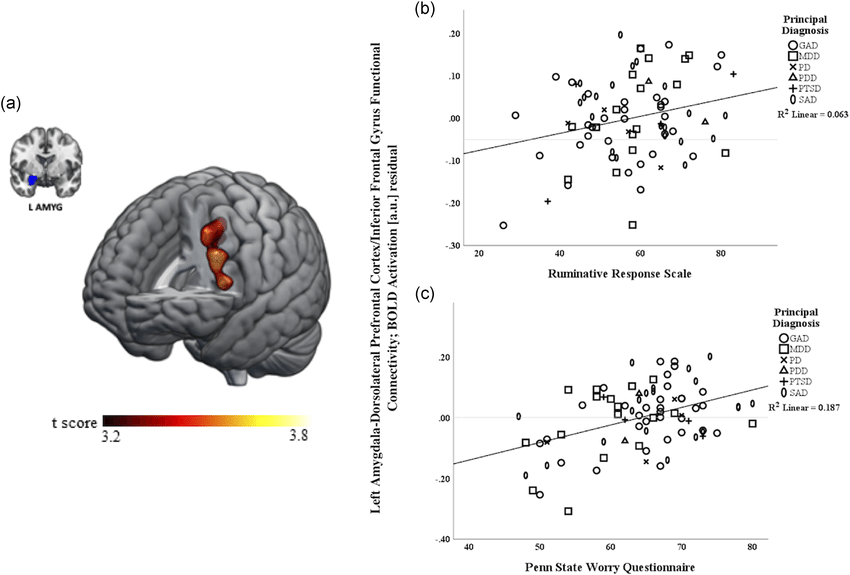
– Preoccupations
– Obsessions
– Ruminations
– Delusions
Each reflects deeper network disruptions, especially in the salience and executive circuits.
The diagram below visualises how higher rumination scores correlate with altered amygdala–PFC connectivity across diagnoses like MDD, PTSD, and GAD.
6/11 🧵
7
What triggers this shift?
Emotional arousal.
Overactivation of the amygdala (a key salience hub) weakens prefrontal function, resulting in cognitive inflexibility, racing thoughts, and poor inhibition.
7/11 🧵
Emotional arousal.
Overactivation of the amygdala (a key salience hub) weakens prefrontal function, resulting in cognitive inflexibility, racing thoughts, and poor inhibition.
7/11 🧵
8
Overthinking may present as:
● Racing thoughts: rapid, uncontrollable, often linked to hypomania
● Crowded thoughts: overwhelming internal chatter with poor inhibition (seen in mixed states)
8/11 🧵
● Racing thoughts: rapid, uncontrollable, often linked to hypomania
● Crowded thoughts: overwhelming internal chatter with poor inhibition (seen in mixed states)
8/11 🧵
9
Overthinking impairs decision-making (analysis paralysis), leads to avoidance, and worsens mood symptoms, especially when chronic.
Stress, sleep deprivation, and inflammation heighten arousal, weaken the prefrontal cortex, and perpetuate cognitive loops.
9/11 🧵
Stress, sleep deprivation, and inflammation heighten arousal, weaken the prefrontal cortex, and perpetuate cognitive loops.
9/11 🧵
10
Treatment starts with mapping the thought type.
Is it worry, obsession, rumination, or racing thoughts?
Next: address sleep, arousal, and comorbidities—then apply targeted pharmacological and psychotherapeutic strategies.
10/11 🧵
Is it worry, obsession, rumination, or racing thoughts?
Next: address sleep, arousal, and comorbidities—then apply targeted pharmacological and psychotherapeutic strategies.
10/11 🧵
11
Want evidence-based updates on cognitive neuroscience, clinical reasoning, and prescribing frameworks?
Join 23,000+ clinicians subscribed to the Psych Scene newsletter for expert commentary, transdiagnostic insights, and practical strategies you can apply in practice.
psychscene.co/42kdxsP
11/11🧵
Join 23,000+ clinicians subscribed to the Psych Scene newsletter for expert commentary, transdiagnostic insights, and practical strategies you can apply in practice.
psychscene.co/42kdxsP
11/11🧵