1/12 Is the consumer paying higher prices due to tariffs? We don't...

Jim Bianco@biancoresearch
43 views
May 25, 2025
~3 min read
Advertisement
1
1/12
Is the consumer paying higher prices due to tariffs?
We don't know for sure, and will not for months, but some numbers suggest they are.
This will surge inflation and keep the Fed on hold for a long while.
Wall Street does not get this.
🧵
Is the consumer paying higher prices due to tariffs?
We don't know for sure, and will not for months, but some numbers suggest they are.
This will surge inflation and keep the Fed on hold for a long while.
Wall Street does not get this.
🧵
2
2/12
Customs collects tariffs daily and sends most to the Treasury around the 22nd.
On Thursday (May 22), $16B flowed into the Treasury's account.
Tariff collections are now ~$29B ahead of last year's. On Liberation Day, they were ~$5B ahead of last year.
+$24B in 7 weeks.
Customs collects tariffs daily and sends most to the Treasury around the 22nd.
On Thursday (May 22), $16B flowed into the Treasury's account.
Tariff collections are now ~$29B ahead of last year's. On Liberation Day, they were ~$5B ahead of last year.
+$24B in 7 weeks.
3
3/12
The US has been importing about $325B to $340B of goods monthly.
According to the latest data, imports have surged in the last few months (through March) as importers rushed goods ahead of Liberation Day.
The US has been importing about $325B to $340B of goods monthly.
According to the latest data, imports have surged in the last few months (through March) as importers rushed goods ahead of Liberation Day.
4
4/12
Back of the envelope:
Assume the US imported $650B of goods in April/May (data not out yet). The chart above (2/12) shows that the US collected ~$24B more in tariffs in the last 7 weeks.
This means imported items are 3.6% more expensive than on Liberation Day.
Back of the envelope:
Assume the US imported $650B of goods in April/May (data not out yet). The chart above (2/12) shows that the US collected ~$24B more in tariffs in the last 7 weeks.
This means imported items are 3.6% more expensive than on Liberation Day.
5
5/12
About 15% of all US consumer purchases are imported goods (remember the majority of consumer purchases are services, which are almost all domestically produced ... we do not use Chinese plumbers or doctors).
If these goods are 3.6% more expensive ...
About 15% of all US consumer purchases are imported goods (remember the majority of consumer purchases are services, which are almost all domestically produced ... we do not use Chinese plumbers or doctors).
If these goods are 3.6% more expensive ...
6
6/12
Imported goods are 3.6% more expensive X 15% of all goods are imported = 0.54% increase in consumer inflation (CPI).
We will not know if this is the case for a few months, but a stat suggests prices have surged roughly this amount (0.54%) in the last month.
Imported goods are 3.6% more expensive X 15% of all goods are imported = 0.54% increase in consumer inflation (CPI).
We will not know if this is the case for a few months, but a stat suggests prices have surged roughly this amount (0.54%) in the last month.
7
7/12
@truflation
See the red box; prices have surged 0.64% in the last month ... almost the same as the 0.54% above.
The math does work out. It suggests that the consumer is "eating" most of these tariffs.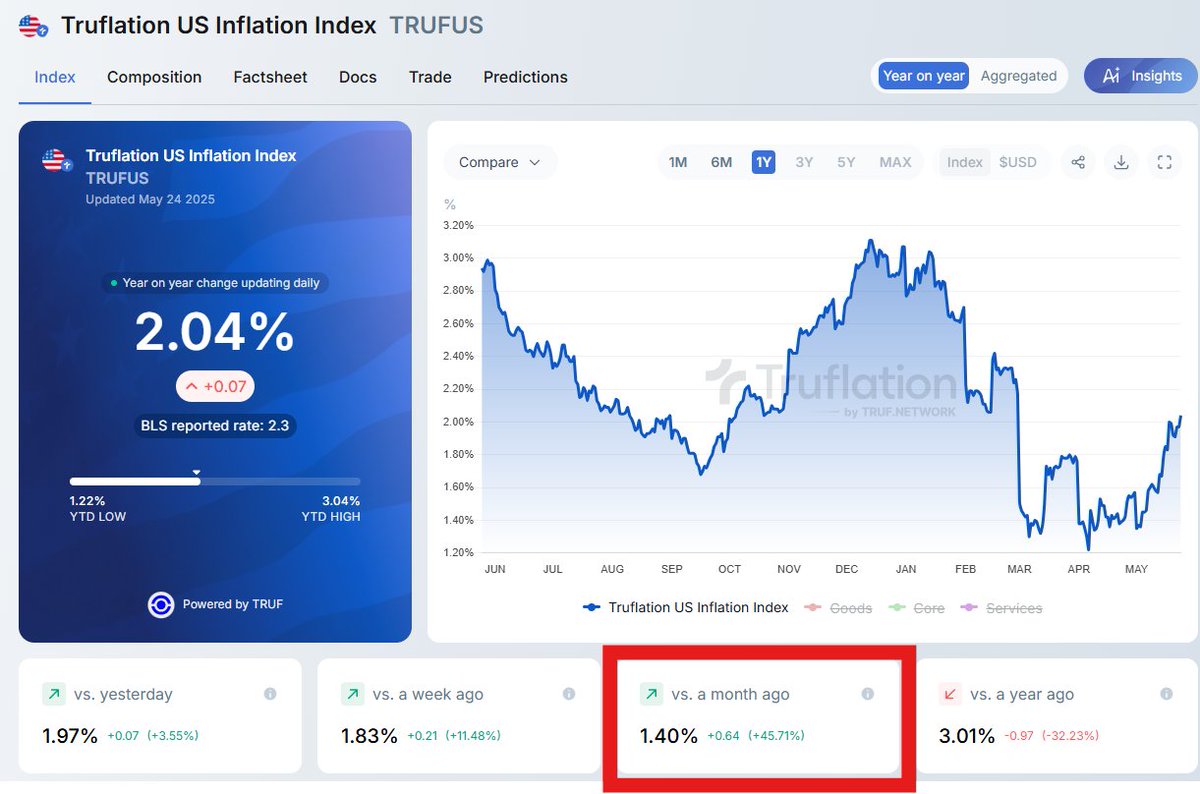
@truflation
See the red box; prices have surged 0.64% in the last month ... almost the same as the 0.54% above.
The math does work out. It suggests that the consumer is "eating" most of these tariffs.
8
8/12
MAYBE the market is picking up on a coming surge in inflation?
The 30-year is above 5%, and for the first time this year, the probability of a rate cut is below 50% for June 18 (red), July 30 (green), and September 17 (blue).
No rate cut until Halloween... if then.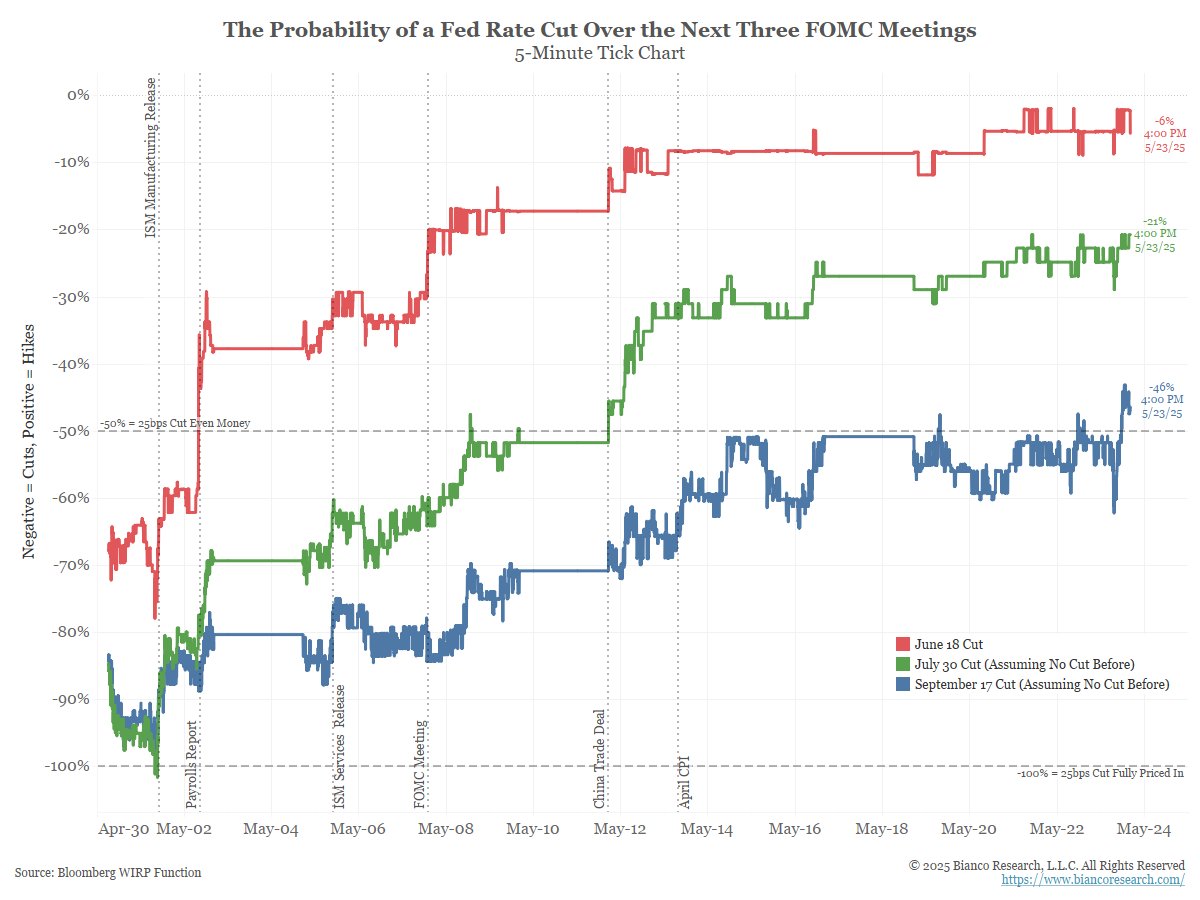
MAYBE the market is picking up on a coming surge in inflation?
The 30-year is above 5%, and for the first time this year, the probability of a rate cut is below 50% for June 18 (red), July 30 (green), and September 17 (blue).
No rate cut until Halloween... if then.
9
9/12
Why do we have to go out on Halloween (October 29 FOMC meeting to be exact) to find a Fed meeting with a better than 50% probability of a hike?
Because PRICES MATTER MOST, the fear is that tariffs will push them (inflation) higher.
Why do we have to go out on Halloween (October 29 FOMC meeting to be exact) to find a Fed meeting with a better than 50% probability of a hike?
Because PRICES MATTER MOST, the fear is that tariffs will push them (inflation) higher.
10
10/12
So, talk of recession and surging unemployment is LESS IMPORTANT than the potential for surging prices.
The Fed is on hold, and yields are rising under this threat.
So, talk of recession and surging unemployment is LESS IMPORTANT than the potential for surging prices.
The Fed is on hold, and yields are rising under this threat.
11
11/12
Wall Street does not get this.
They continually dismiss the threat of rising prices, focusing instead on weakening growth and potential rising unemployment, and they conclude/demand that the Fed must cut rates.
This is the point I made on BBTV yesterday.
Wall Street does not get this.
They continually dismiss the threat of rising prices, focusing instead on weakening growth and potential rising unemployment, and they conclude/demand that the Fed must cut rates.
This is the point I made on BBTV yesterday.
9:20
12
12/12
Wall Street wants to blame rising yields on anything but "sticky" inflation. Now, the focus is on deficits. While that is pushing yields higher (more borrowing), inflation seems poised to surge again thanks to tariffs, and this matters more.
Wall Street wants to blame rising yields on anything but "sticky" inflation. Now, the focus is on deficits. While that is pushing yields higher (more borrowing), inflation seems poised to surge again thanks to tariffs, and this matters more.
13
Footnote
Truflation measures millions of online prices and estimates CPI.
They overweight goods vs. services, leading to a lower overall CPI reading (services inflation is higher than goods inflation).
The rate of change is more important than the level. It is now firmly up.
Truflation measures millions of online prices and estimates CPI.
They overweight goods vs. services, leading to a lower overall CPI reading (services inflation is higher than goods inflation).
The rate of change is more important than the level. It is now firmly up.


