Why Your “Improvements” Lead to Capital Decline🧵 This thread...

Yumi🌸@samuraipips358
41 views
May 24, 2025
~4 min read
Advertisement
1
Why Your “Improvements” Lead to Capital Decline🧵
This thread explains how losing consistency causes your capital to decrease.
🧵1/5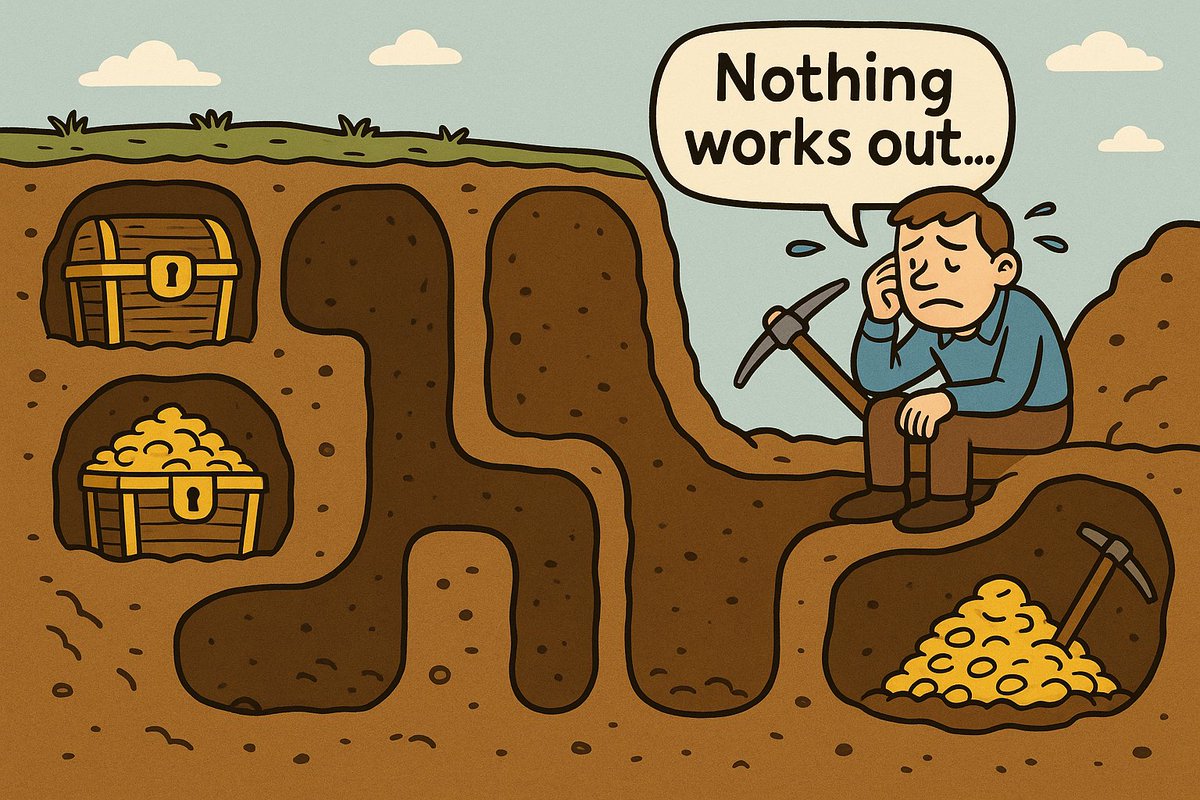
This thread explains how losing consistency causes your capital to decrease.
🧵1/5
2
2/5
An edge is drawn out through the law of large numbers, and what’s needed for that is consistency.
No strategy can escape the randomness of short-term results, and even great strategies cannot avoid losing streaks.
If a strategy has an edge, you must continue following the rules consistently even during losing streaks, build a large sample size, and eventually the profits will exceed the losses.
However, when people experience a series of losses or a period of poor performance, they start thinking “Maybe this strategy is no good,” “The market has changed,” or “I need to change something,” and they lose consistency.
Anyone can follow the rules easily while winning.
The time when people fail to follow the rules is always during losing streaks or drawdowns.
In other words, the moment you abandon or tweak your rules or strategy is “always when your capital is decreasing.”
And because of that, strategies are always abandoned before the edge can play out, which is why your capital keeps going down.
An edge is drawn out through the law of large numbers, and what’s needed for that is consistency.
No strategy can escape the randomness of short-term results, and even great strategies cannot avoid losing streaks.
If a strategy has an edge, you must continue following the rules consistently even during losing streaks, build a large sample size, and eventually the profits will exceed the losses.
However, when people experience a series of losses or a period of poor performance, they start thinking “Maybe this strategy is no good,” “The market has changed,” or “I need to change something,” and they lose consistency.
Anyone can follow the rules easily while winning.
The time when people fail to follow the rules is always during losing streaks or drawdowns.
In other words, the moment you abandon or tweak your rules or strategy is “always when your capital is decreasing.”
And because of that, strategies are always abandoned before the edge can play out, which is why your capital keeps going down.
3
3/5
Let’s take a simple example: a strategy with a 60% win rate and a 1:1 risk-reward ratio.
Imagine a trader using this strategy who hits a losing streak and starts doubting it, eventually stopping its use.
Over 10 trades, the win rate was just 20%.
Meanwhile, another trader trusts the same strategy, stays disciplined, and keeps trading.
This trader also saw a 20% win rate in the first 10 trades.
But he kept going—70% in the next 10 trades, 40% in the 10 after that...
Short-term win rates varied, but as the number of trades increased, the overall win rate began to converge toward the strategy’s original 60%, and he was able to earn long-term profits.
The first trader gave up before the edge could emerge, ending with losses.
For that trader, it’s the same as using a 20% win rate strategy.
But the second trader saw probability begin to work and gained long-term profits.
This shows that while probability is influenced by randomness in the short term, the more trades you make, the more it converges to the true performance.
This is called the law of large numbers.
This is why traders who rely on probability must value large sample sizes and consistency.
Of course, in reality, profitability isn’t determined by win rate alone—risk-reward ratio also matters.
But here, we’re focusing on probability for simplicity.
Let’s take a simple example: a strategy with a 60% win rate and a 1:1 risk-reward ratio.
Imagine a trader using this strategy who hits a losing streak and starts doubting it, eventually stopping its use.
Over 10 trades, the win rate was just 20%.
Meanwhile, another trader trusts the same strategy, stays disciplined, and keeps trading.
This trader also saw a 20% win rate in the first 10 trades.
But he kept going—70% in the next 10 trades, 40% in the 10 after that...
Short-term win rates varied, but as the number of trades increased, the overall win rate began to converge toward the strategy’s original 60%, and he was able to earn long-term profits.
The first trader gave up before the edge could emerge, ending with losses.
For that trader, it’s the same as using a 20% win rate strategy.
But the second trader saw probability begin to work and gained long-term profits.
This shows that while probability is influenced by randomness in the short term, the more trades you make, the more it converges to the true performance.
This is called the law of large numbers.
This is why traders who rely on probability must value large sample sizes and consistency.
Of course, in reality, profitability isn’t determined by win rate alone—risk-reward ratio also matters.
But here, we’re focusing on probability for simplicity.
4
4/5
Many traders fall into the same loop as the first trader mentioned earlier.
They lose capital during losing streaks, lose trust, and abandon their strategy at the worst possible time.
Even if they start using a new strategy, once the capital starts to decrease, they soon stop using it and search for the next one.
If this cycle continues, they never draw out the edge, and their capital just keeps declining.
That’s because losing streaks and drawdowns are inevitable in any strategy and will “never” disappear.
To gain consistency, you must understand probability, think long-term about your own strategy, and examine how much you trust those long-term results and whether you’ve done the preparation needed to trust them.
As long as you place value on each individual win or loss in front of you, maintaining consistency will be extremely difficult.
That’s because this mistaken belief strongly urges you—through emotion—to “reflect on every loss” and think “something needs to change.”
You’ll easily abandon consistency, but because you mistakenly believe “I’ve improved” or “I’ve taken a step forward,” you’ll never achieve true consistency.
Many traders fall into the same loop as the first trader mentioned earlier.
They lose capital during losing streaks, lose trust, and abandon their strategy at the worst possible time.
Even if they start using a new strategy, once the capital starts to decrease, they soon stop using it and search for the next one.
If this cycle continues, they never draw out the edge, and their capital just keeps declining.
That’s because losing streaks and drawdowns are inevitable in any strategy and will “never” disappear.
To gain consistency, you must understand probability, think long-term about your own strategy, and examine how much you trust those long-term results and whether you’ve done the preparation needed to trust them.
As long as you place value on each individual win or loss in front of you, maintaining consistency will be extremely difficult.
That’s because this mistaken belief strongly urges you—through emotion—to “reflect on every loss” and think “something needs to change.”
You’ll easily abandon consistency, but because you mistakenly believe “I’ve improved” or “I’ve taken a step forward,” you’ll never achieve true consistency.
5
5/5
Of course, if your strategy has no edge to begin with, continuing it will lead to capital decline.
However, the real problem is that “even if the strategy has an edge,” many people still fail to grow their capital.
The reason is that everyone focuses too much on short-term results and fails to remain consistent.
They always start to doubt during losing periods and abandon their strategy at the worst timing.
What truly matters is whether you’ve shifted your perspective to the long term—and whether you’ve done the proper preparation to support that shift.
Thanks for reading!
If you enjoyed this thread, check out my books on trading.
E-book
payhip.com/YumiSakura
Paperback
【THE PATH TO SUCCESS IN TRADING】
a.co/d/fXmRhIa
【Trading Psychology】
a.co/d/d0QJMxK
Hope these insights help your trading journey😊
Of course, if your strategy has no edge to begin with, continuing it will lead to capital decline.
However, the real problem is that “even if the strategy has an edge,” many people still fail to grow their capital.
The reason is that everyone focuses too much on short-term results and fails to remain consistent.
They always start to doubt during losing periods and abandon their strategy at the worst timing.
What truly matters is whether you’ve shifted your perspective to the long term—and whether you’ve done the proper preparation to support that shift.
Thanks for reading!
If you enjoyed this thread, check out my books on trading.
E-book
payhip.com/YumiSakura
Paperback
【THE PATH TO SUCCESS IN TRADING】
a.co/d/fXmRhIa
【Trading Psychology】
a.co/d/d0QJMxK
Hope these insights help your trading journey😊