Is it good behavior to immediately move your stop loss to...

Yumi🌸@samuraipips358
57 views
May 11, 2025
~2 min read
Advertisement
1
Is it good behavior to immediately move your stop loss to breakeven, or cut your losses early before your original stop loss is hit?🧵
I'll answer this frequently asked question.
🧵1/5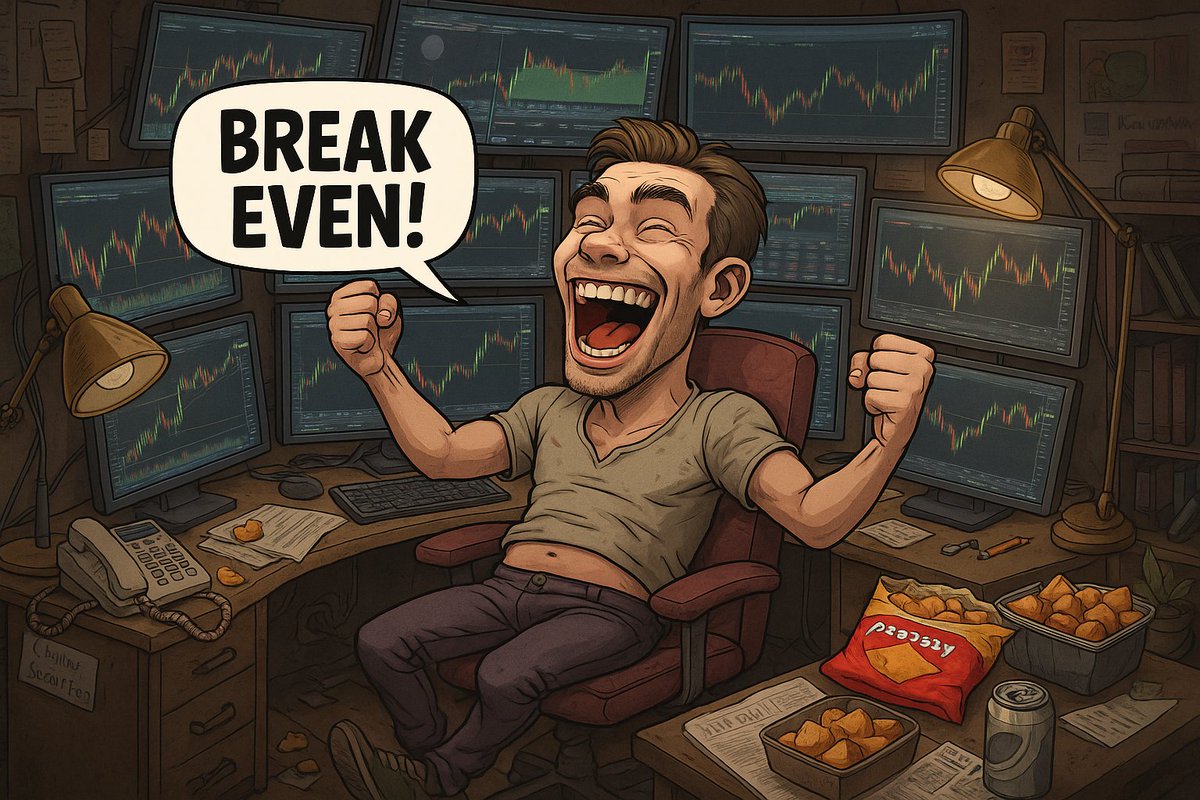
I'll answer this frequently asked question.
🧵1/5
2
2/5
Many traders immediately move their stop loss to breakeven as soon as they have a small unrealized profit, or rush to cut losses before their initially set stop loss point, driven by a desire to absolutely avoid losses.
If you have predefined rules for moving your stop loss and understand in advance that repeatedly taking these actions generates a positive expectancy, there is no problem.
However, if you're acting out of emotional reactions to immediate outcomes, this is not good.
Exit rules are extremely important.
Your win rate and risk-reward are determined by "where you cut losses" and "where you take profits."
If your strategy has a positive expectancy, you must follow those rules.
If you deviate from your rules, the original win rate and risk-reward will change, meaning you are effectively trading a different strategy.
Many traders immediately move their stop loss to breakeven as soon as they have a small unrealized profit, or rush to cut losses before their initially set stop loss point, driven by a desire to absolutely avoid losses.
If you have predefined rules for moving your stop loss and understand in advance that repeatedly taking these actions generates a positive expectancy, there is no problem.
However, if you're acting out of emotional reactions to immediate outcomes, this is not good.
Exit rules are extremely important.
Your win rate and risk-reward are determined by "where you cut losses" and "where you take profits."
If your strategy has a positive expectancy, you must follow those rules.
If you deviate from your rules, the original win rate and risk-reward will change, meaning you are effectively trading a different strategy.
3
3/5
When you quickly move your stop loss to breakeven, it might seem good because you avoid losing.
However, by doing this, trades that could have generated greater profits may instead end at breakeven.
The same applies when cutting losses earlier than your rules specify.
You might think this reduces your loss on that single trade, but by waiting until the original stop loss, that trade might have ended as a significant winner rather than a loss.
In other words, even if your rules are designed to produce a positive expectancy through consistent repetition, your obsession with the immediate result alters the rules themselves, potentially preventing that positive expectancy from materializing.
When you quickly move your stop loss to breakeven, it might seem good because you avoid losing.
However, by doing this, trades that could have generated greater profits may instead end at breakeven.
The same applies when cutting losses earlier than your rules specify.
You might think this reduces your loss on that single trade, but by waiting until the original stop loss, that trade might have ended as a significant winner rather than a loss.
In other words, even if your rules are designed to produce a positive expectancy through consistent repetition, your obsession with the immediate result alters the rules themselves, potentially preventing that positive expectancy from materializing.
4
4/5
It's important not to think "this would be better" or make changes based on the immediate outcomes of individual trades or short-term results.
Such outcomes are based on a small, short-term sample size, strongly influenced by randomness.
A trader's job is to repeat consistent actions, accumulate trades under identical conditions, build a large sample size, and leverage the law of large numbers to extract an edge.
Repeating consistent actions is a prerequisite for extracting an edge.
It's important not to think "this would be better" or make changes based on the immediate outcomes of individual trades or short-term results.
Such outcomes are based on a small, short-term sample size, strongly influenced by randomness.
A trader's job is to repeat consistent actions, accumulate trades under identical conditions, build a large sample size, and leverage the law of large numbers to extract an edge.
Repeating consistent actions is a prerequisite for extracting an edge.
5
5/5
I don't want you to misunderstand; I'm not rejecting discretionary judgment here.
What matters is whether your actions are grounded in a positive expectancy derived from a large sample size.
Many traders act based on immediate individual outcomes, compromising consistency.
If your rules have a positive expectancy, don't try to win, don't try to avoid losing; just follow the rules.
This is extremely important.
Thanks for reading!
If you enjoyed this thread, check out my books on trading.
【THE PATH TO SUCCESS IN TRADING】
E-book:payhip.com/b/H1ZBo
Paperback:a.co/d/fXmRhIa
【Trading Psychology】
E-book:payhip.com/b/SNnJC
Paperback:a.co/d/d0QJMxK
Hope these insights help your trading journey 😊
I don't want you to misunderstand; I'm not rejecting discretionary judgment here.
What matters is whether your actions are grounded in a positive expectancy derived from a large sample size.
Many traders act based on immediate individual outcomes, compromising consistency.
If your rules have a positive expectancy, don't try to win, don't try to avoid losing; just follow the rules.
This is extremely important.
Thanks for reading!
If you enjoyed this thread, check out my books on trading.
【THE PATH TO SUCCESS IN TRADING】
E-book:payhip.com/b/H1ZBo
Paperback:a.co/d/fXmRhIa
【Trading Psychology】
E-book:payhip.com/b/SNnJC
Paperback:a.co/d/d0QJMxK
Hope these insights help your trading journey 😊