Bill Gates predicts 2-day work week as AI set to replace humans for...

Chubby♨️@kimmonismus
61 views
May 08, 2025
~2 min read
Advertisement
1
Bill Gates predicts 2-day work week as AI set to replace humans for most jobs within a decade
A few thoughts on Bill Gates' statement.
The promise that automation could and would shorten our working hours has been around for a long time. John Maynard Keynes predicted in his 1930 essay “Economic Opportunities for Our Grandchildren” that by 2030 we would only need to work 15 hours a week to achieve a good standard of living.
As we know, however, this never happened. On the contrary. Even in 2025, we will have a greater demand for labor and skilled workers in the western industrialized nations than we would have if we reduced working hours. Why? Because productivity growth and the expansion of production are inherent characteristics of capitalism. I mean that as a value-neutral description of the facts.
But: with the advent of AI and the combination of robotics, a qualitatively new characteristic is emerging. As I have often said, the special thing about AI + robotics is that for the first time in human history, humans are not only improved in their work performance (augmented), but can be completely replaced. There is no activity that a robot / AI could not do better, faster and more efficiently than human labor in the future. In this respect, it can be said in retrospect that Keynes' promise can now become reality, due to a technology that does not make people more efficient, but replaceable.
However, this is not a sure-fire success. Many questions remain. If robotics and AI take over the work, how will taxes be raised to finance the good life for all people? Can we continue to live exactly like this in society? And what will people do with all that free time? These are all questions that need to be discussed now.
The basis for a better world is there. The golden age is within our grasp. But we all have to make sure it happens. And, in particular, lead the discussion. Thankfully, @DaveShapi keeps bringing the discussion about the post-labor society into the discourse. This is a very important process.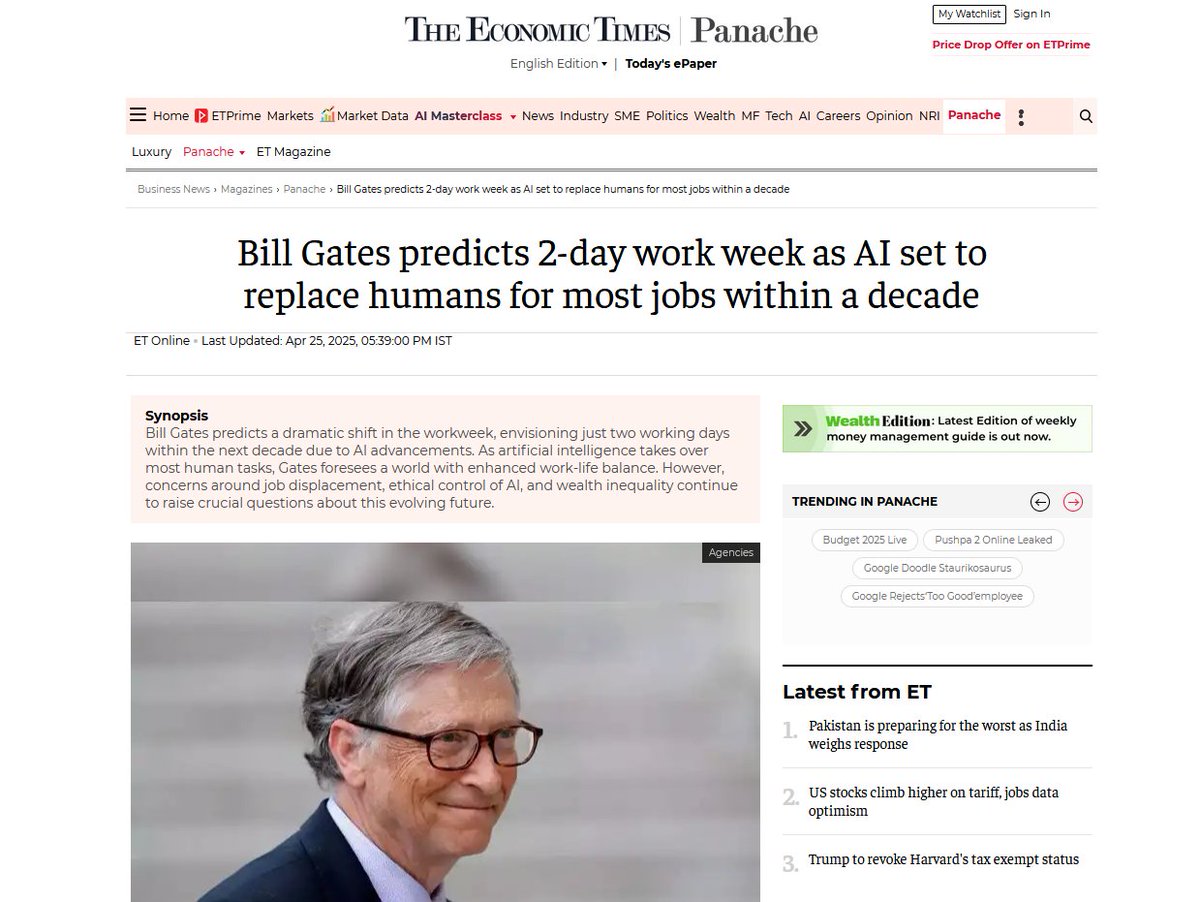
A few thoughts on Bill Gates' statement.
The promise that automation could and would shorten our working hours has been around for a long time. John Maynard Keynes predicted in his 1930 essay “Economic Opportunities for Our Grandchildren” that by 2030 we would only need to work 15 hours a week to achieve a good standard of living.
As we know, however, this never happened. On the contrary. Even in 2025, we will have a greater demand for labor and skilled workers in the western industrialized nations than we would have if we reduced working hours. Why? Because productivity growth and the expansion of production are inherent characteristics of capitalism. I mean that as a value-neutral description of the facts.
But: with the advent of AI and the combination of robotics, a qualitatively new characteristic is emerging. As I have often said, the special thing about AI + robotics is that for the first time in human history, humans are not only improved in their work performance (augmented), but can be completely replaced. There is no activity that a robot / AI could not do better, faster and more efficiently than human labor in the future. In this respect, it can be said in retrospect that Keynes' promise can now become reality, due to a technology that does not make people more efficient, but replaceable.
However, this is not a sure-fire success. Many questions remain. If robotics and AI take over the work, how will taxes be raised to finance the good life for all people? Can we continue to live exactly like this in society? And what will people do with all that free time? These are all questions that need to be discussed now.
The basis for a better world is there. The golden age is within our grasp. But we all have to make sure it happens. And, in particular, lead the discussion. Thankfully, @DaveShapi keeps bringing the discussion about the post-labor society into the discourse. This is a very important process.