SEAL: LLM That Writes Its Own Updates Solves 72.5% of ARC-AGI...

Chubby♨️@kimmonismus
108 views
Jun 14, 2025
~2 min read
Advertisement
1
SEAL: LLM That Writes Its Own Updates Solves 72.5% of ARC-AGI Tasks—Up from 0%
This is a breakthrough that is rarely seen and could open up undreamt-of possibilities. In the following, I will go into more detail and summarize this breakthrough: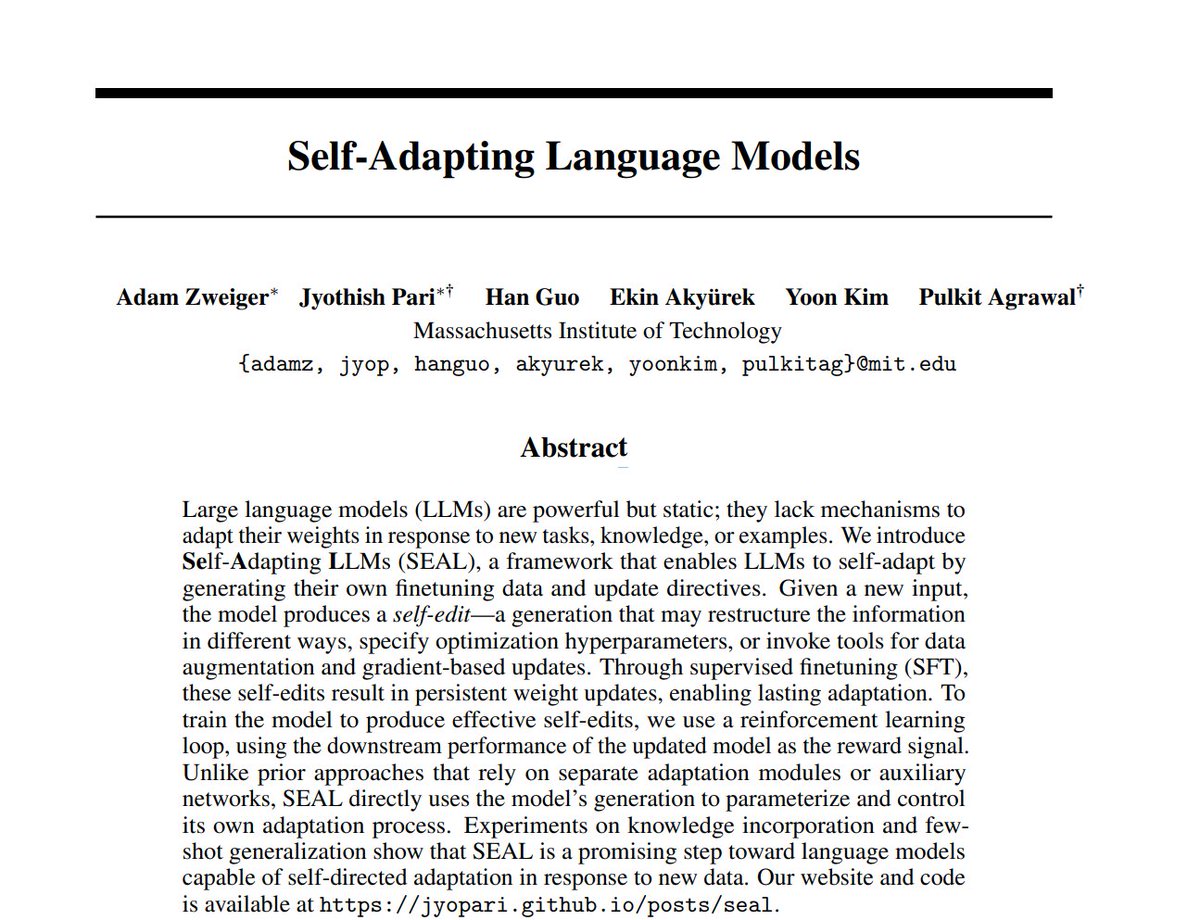
This is a breakthrough that is rarely seen and could open up undreamt-of possibilities. In the following, I will go into more detail and summarize this breakthrough:
2
1. Large language models (LLMs) are powerful tools, but their architecture has a fundamental limitation: they are static after training. Their knowledge and abilities are essentially frozen at the level of their last training. New research from the Massachusetts Institute of Technology (MIT) now presents a promising solution: the SEAL (Self-Adapting Language Models) framework. This system enables an LLM to generate its own model updates and thus adapt persistently to new tasks and information.
3
2. The core mechanism of SEAL is to transform the model from a passive recipient of information into an active learner. Instead of processing new data unchanged, the model generates a so-called “self-edit” – an instruction for its own training. This self-edit can include restructuring raw data into an optimized learning format, generating synthetic training examples, or even setting learning parameters.
4
3. With the help of a higher-level reinforcement learning loop, the model is rewarded for creating effective self-edits. It thus not only learns a specific task, but also optimizes its own learning strategy.
5
4. The effectiveness of this approach has been impressively demonstrated on the Abstraction and Reasoning Corpus (ARC). This benchmark is considered particularly challenging because it tests abstract logical thinking and generalization ability using a small number of examples, rather than querying pure factual knowledge. A conventional LLM failed completely on these tasks, achieving a success rate of 0%.
6
5. After integration into the SEAL framework, the same model was able to autonomously develop effective training procedures for new tasks and achieved a remarkable success rate of 72.5% on a curated subset of the tasks.
7
6. This leap in performance from zero to over seventy percent is more than a quantitative improvement; it signals a qualitative advance in AI adaptability. The SEAL framework represents a fundamental step toward continuous learning—the ability of models to expand their knowledge over time without losing previous information (“catastrophic forgetting”).
8
7. This could reduce dependence on resource-intensive, complete retraining cycles and pave the way for more dynamic, autonomous AI systems that adapt more resiliently to a changing world.
10
9. What a time to be alive!