⏰ Your body’s metabolism follows a circadian rhythm—eating late...

Brandon Luu, MD@BrandonLuuMD
32 views
May 04, 2025
~1 min read
Advertisement
1
⏰ Your body’s metabolism follows a circadian rhythm—eating late throws it off.
In a 6-year study, those who ate most of their calories at dinner had:
⚠️ 2x higher risk of obesity
🩺 1.5x higher risk of metabolic syndrome
🍔 1.6x higher risk of fatty liver disease
🧵 1/9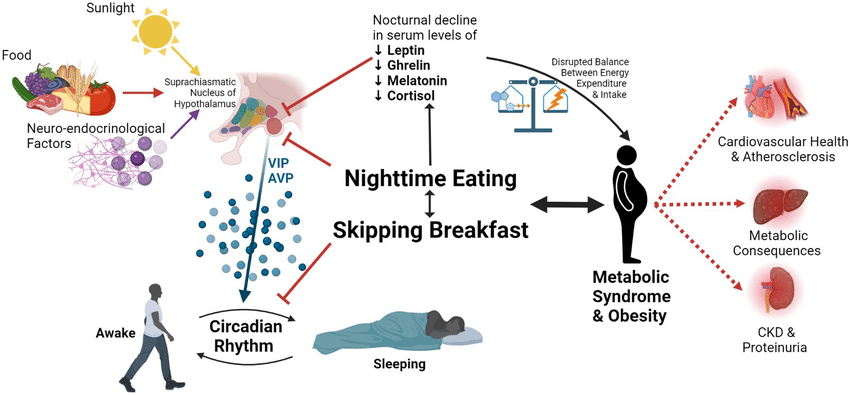
In a 6-year study, those who ate most of their calories at dinner had:
⚠️ 2x higher risk of obesity
🩺 1.5x higher risk of metabolic syndrome
🍔 1.6x higher risk of fatty liver disease
🧵 1/9
2
Researchers tracked non-obese, non-diabetic adults over 6 years.
Each person completed 3-day food logs, including when they ate each meal./2
Each person completed 3-day food logs, including when they ate each meal./2
3
Those in the highest tertile—eating ≥48% of daily calories at dinner—had:
• 11.4% obesity incidence (vs. 4.7% in lowest group)
• 16.1% metabolic syndrome (vs. 11.1%)
• 23.8% NAFLD (vs. 16.5%)
All differences were statistically significant. /3
• 11.4% obesity incidence (vs. 4.7% in lowest group)
• 16.1% metabolic syndrome (vs. 11.1%)
• 23.8% NAFLD (vs. 16.5%)
All differences were statistically significant. /3
4
After adjusting for age, sex, BMI, activity, breakfast skipping, and total calories:
🍽 Big dinner eaters still had higher risk of obesity, metabolic syndrome, and NAFLD /4
🍽 Big dinner eaters still had higher risk of obesity, metabolic syndrome, and NAFLD /4
5
Importantly, these risks held even after adjusting for diet quality, physical activity, restaurant food, sleep, eating frequency, and other confounders.
Timing—not just quantity—mattered. /5
Timing—not just quantity—mattered. /5
6
Interestingly, skipping breakfast also doubled the risk of obesity and was more common in those who ate large dinners.
But both skipping breakfast and eating a big dinner were independently linked to poor outcomes. /6
But both skipping breakfast and eating a big dinner were independently linked to poor outcomes. /6
7
The authors speculate that eating late may impair metabolism via:
• Reduced insulin sensitivity at night
• Lower thermic effect of food
• Altered satiety hormones
• Disrupted circadian rhythms
These biological mechanisms are backed by prior studies. /7
link.springer.com/article/10.100…
• Reduced insulin sensitivity at night
• Lower thermic effect of food
• Altered satiety hormones
• Disrupted circadian rhythms
These biological mechanisms are backed by prior studies. /7
link.springer.com/article/10.100…
8
This was one of the first prospective human studies linking meal timing to obesity, NAFLD, and metabolic syndrome. While observational, the results were consistent and controlled for many variables. /8
9
In summary, WHEN you eat matters. Prioritizing meals earlier in the day—especially reducing dinner calories—may help prevent long-term weight gain and metabolic issues.
Don’t just watch what you eat. Watch when you eat. /9
journals.plos.org/plosone/articl…
Don’t just watch what you eat. Watch when you eat. /9
journals.plos.org/plosone/articl…
