"Tunneling Nanotubes" in the Brain (Now with more mind-blowing...

Nick Norwitz MD PhD@nicknorwitz
27 views
Jan 30, 2025
~3 min read
Advertisement
1
"Tunneling Nanotubes" in the Brain (Now with more mind-blowing detail 🤯)
1/5) Question⁉️: Could microscopic tunnels in your brain hold the secret to preventing Alzheimer’s and Parkinson’s?
Sounds like science fiction, right? But it’s real!
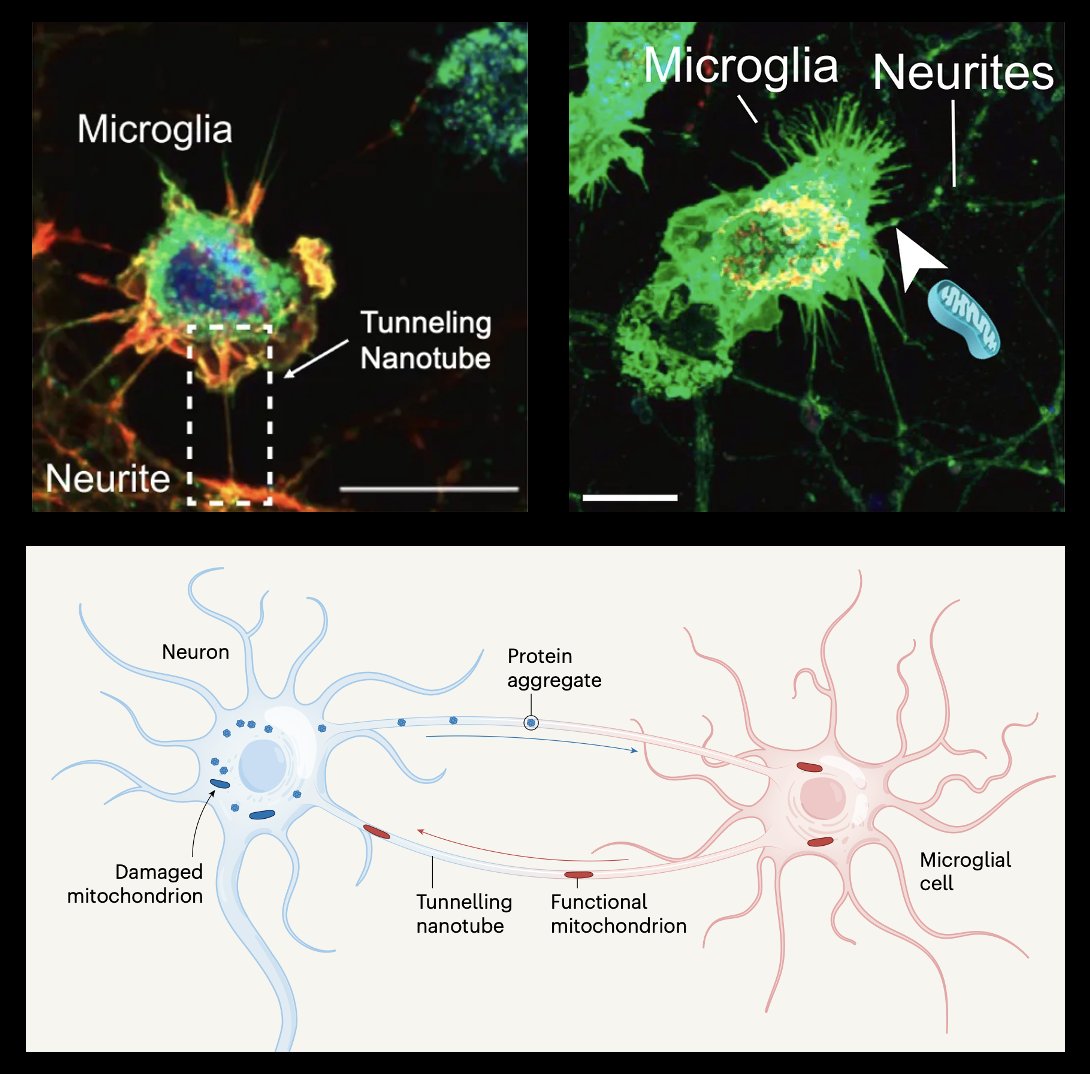
New study, published in @NeuroCellPress builds upon prior research about the fascinating topic of tunneling nanotubes, literal tunnels between cells – including cells of different types – that allow them to exchange internal components.

1/5) Question⁉️: Could microscopic tunnels in your brain hold the secret to preventing Alzheimer’s and Parkinson’s?
Sounds like science fiction, right? But it’s real!
New study, published in @NeuroCellPress builds upon prior research about the fascinating topic of tunneling nanotubes, literal tunnels between cells – including cells of different types – that allow them to exchange internal components.
Nick Norwitz MD PhD@nicknorwitz
🤯Nothing Short of Stunning! In the brain 🧠, immune cells called microglia and 'suck up' harmful protein aggregates AND 'donate' healthy mitochondria through "bidirectional tunneling nanotubes" -- literal microscopic tunnels. I'm constantly in AWE of biology.
#StayCurious
🤓RT this if you want a full length video breaking down the Science. Show me your nerd-thusiasm! #BrainHealth #Alzheimers #BrainEnergy #Neuroscience
🤓Were you aware of this fellow neuro nerds? @hubermanlab @maxlugavere @ChrisPalmerMD @neuranne @Metabolic_Mind @NeuroWoodworks
Ref, @NeuroCellPress Sept 2024. PMID: 39059388.
2
2/5) Why is this important for brain health?
In this study, the researchers looked specifically at tunneling nanotubes formed between neurons and microglia, the resident immune cells in the brain. Simply, microglia are the clean-up crew.
But, as we will find out, they are also much more than that.
Now, what they found first is that microglia can form tunneling nanotubes with neurons, and through these nanotubes suck up harmful protein aggregates that play roles in Alzheimer’s disease, tau, and Parkinson’s disease, alpha-synuclein.
The microglia use these nanotubes to suck these toxic proteins out of neurons, and then destroy them. Pretty amazing, right?
But that’s not all...
3
3/5) The microglia also replenish the mitochondria, donating healthy mitochondria to neurons through the nanotubes!
So, at a high level, imagine microglia extending one nanotube arm to suck out the poisonous proteins harming mitochondria and extending one nanotube arm to supply a new supply of fresh, healthy mitochondria. How incredible is that?!
And, indeed, they show in this study that this has functional consequences — with nanotubes formed between neurons and microglia leading to improvements in neuron metabolism, reduced oxidative stress, and better mitochondrial function when the neurons were metabolically challenged.
4
4/5) Now, I’m sure you want to know: How do you increase the formation of nanotubes in your brain to improve your brain health?
Well, it’s a bit complicated. First and foremost, the formation of nanotubes seems to be part of a stress response. In other words, it’s the presence of things like alpha synuclein and tau that provoke the need for the nanotubes in the first place. And you definitely don’t want more misfolded proteins.
🌟Furthermore, it’s not just about quantity, but also quality! 🌟
Indeed, in this study, they show that a common mutation in the LRRK2 gene that contributes to Parkinson’s disease in humans doesn’t decrease mitochondrial transfer but, more likely, decreases the quality of transferred mitochondria, such that neurons get "less metabolic support."
The lesson here is you want to do what you can to keep your mitochondrial pool healthy.
Fundamentally, this is everything you should do to maintain good overall metabolic health:
- Exercise regularly including a mix of resistance training and cardio.
- Eat a whole food carbohydrate-appropriate diet.
- For the brain, at least occasional bouts of ketosis may be beneficial, achieved either through carbohydrate restriction or intermittent fasting.
😴And – of course – sleep! 😴
In fact, some research even shows that melatonin, the sleep hormone, increases the formation of nanotubes. I’m not suggesting you should supplement melatonin to look for benefits. But I am saying this is one more reason to prioritize sleep and a healthy circadian pattern.
5
5/5) The discovery of tunneling nanotubes in the brain is nothing short of mind-blowing. These microscopic bridges between neurons and microglia act as both a clean-up crew and an energy-support system. For more details, see today's Newsletter: open.substack.com/pub/staycuriou…
