Your engineering background is a superpower for writing PRDs. But...

George from 🕹prodmgmt.world@nurijanian
12 views
Jan 29, 2025
~4 min read
1
Your engineering background is a superpower for writing PRDs.
But only if you know how to translate technical depth into business impact.
After reviewing probably about ~ 100 technical PRDs last year, here's what separates great ones from the rest 🧠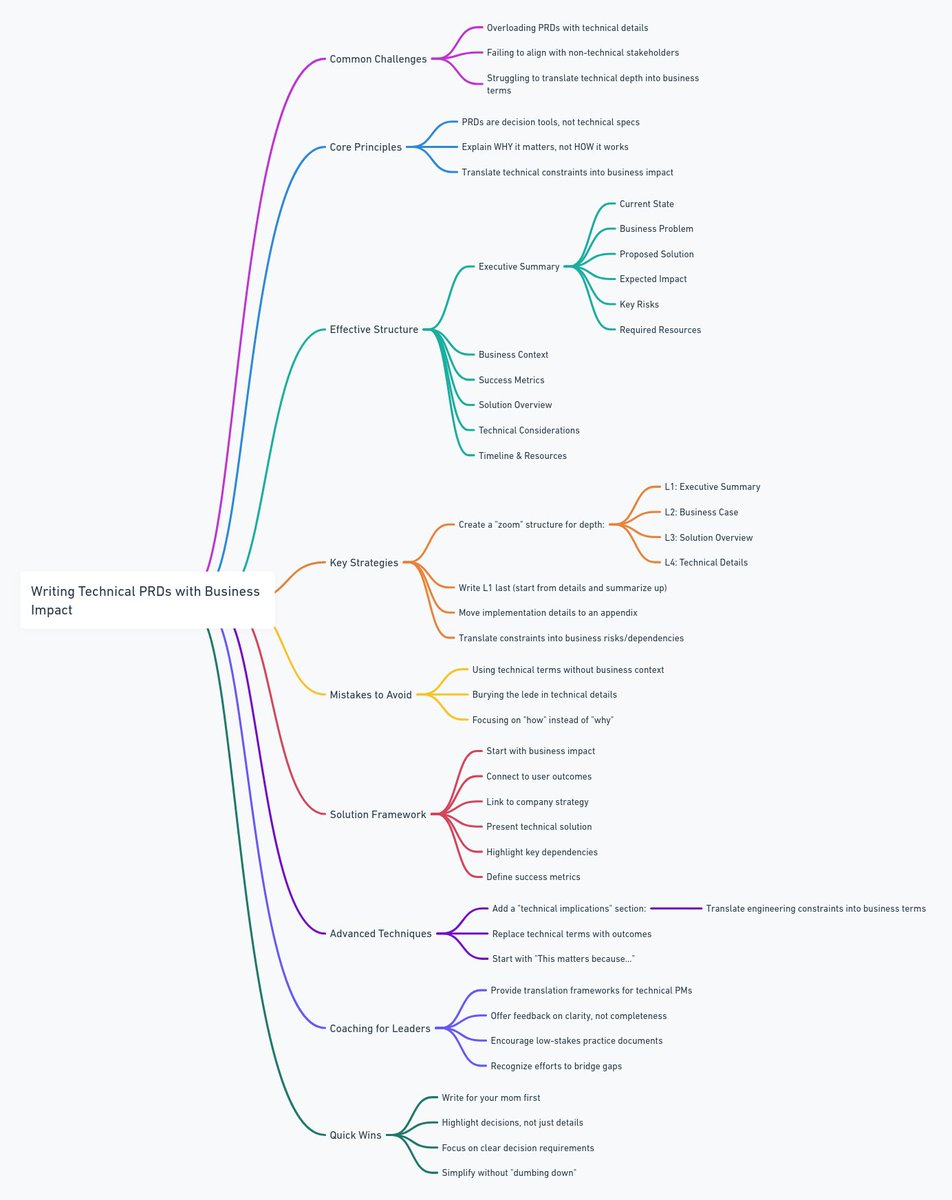
But only if you know how to translate technical depth into business impact.
After reviewing probably about ~ 100 technical PRDs last year, here's what separates great ones from the rest 🧠
2
1/ First, a hard truth:
Your technical expertise can actually work against you when writing PRDs for non-technical stakeholders.
The more you know, the harder it becomes to explain simply.
This is why senior engineers often struggle more than juniors when becoming PMs.
Your technical expertise can actually work against you when writing PRDs for non-technical stakeholders.
The more you know, the harder it becomes to explain simply.
This is why senior engineers often struggle more than juniors when becoming PMs.
3
2/ The root cause isn't your technical knowledge.
It's approaching PRDs like technical specifications.
Engineering docs optimize for completeness.
Business docs optimize for decisions.
Different tools for different jobs.
It's approaching PRDs like technical specifications.
Engineering docs optimize for completeness.
Business docs optimize for decisions.
Different tools for different jobs.
4
3/ Here's your new mental model:
Think of yourself as a translator between two worlds, not a technical writer.
Your job isn't to explain HOW something works.
Your job is to explain WHY it matters.
Think of yourself as a translator between two worlds, not a technical writer.
Your job isn't to explain HOW something works.
Your job is to explain WHY it matters.
5
4/ The Structure That Works:
- Executive Summary (1 page max)
- Business Context
- Success Metrics
- Solution Overview
- Technical Considerations
- Timeline & Resources
Engineers can dive deeper into linked technical docs.
- Executive Summary (1 page max)
- Business Context
- Success Metrics
- Solution Overview
- Technical Considerations
- Timeline & Resources
Engineers can dive deeper into linked technical docs.
6
5/ Executive Summary Formula:
1. Current State
2. Business Problem
3. Proposed Solution
4. Expected Impact
5. Key Risks
6. Required Resources
One paragraph each. No technical terms.
Think newspaper article, not academic paper.
1. Current State
2. Business Problem
3. Proposed Solution
4. Expected Impact
5. Key Risks
6. Required Resources
One paragraph each. No technical terms.
Think newspaper article, not academic paper.
7
6/ But what about technical details?
Create a "zoom" structure:
- L1: Executive Summary
- L2: Business Case
- L3: Solution Overview
- L4: Technical Details
Let stakeholders choose their depth.
Create a "zoom" structure:
- L1: Executive Summary
- L2: Business Case
- L3: Solution Overview
- L4: Technical Details
Let stakeholders choose their depth.
8
7/ Pro tip: Write L1 last
Start with technical details (your comfort zone).
Then progressively summarize up.
It's easier to simplify than to add depth.
I've collected ready-to-use prompts in tiny.cc/ai-prompts for this exact workflow.
Start with technical details (your comfort zone).
Then progressively summarize up.
It's easier to simplify than to add depth.
I've collected ready-to-use prompts in tiny.cc/ai-prompts for this exact workflow.
9
8/ Common Objection:
"But if I simplify too much, we'll miss critical technical considerations!"
Reality:
Technical details don't disappear when simplified.
They transform into business risks and dependencies.
"But if I simplify too much, we'll miss critical technical considerations!"
Reality:
Technical details don't disappear when simplified.
They transform into business risks and dependencies.
10
9/ Example:
❌ "We need to refactor the authentication service"
✅ "Current user login system limits our ability to:
- Launch in new markets (compliance)
- Partner with enterprise clients (SSO)
- Reduce customer support load (self-service)"
❌ "We need to refactor the authentication service"
✅ "Current user login system limits our ability to:
- Launch in new markets (compliance)
- Partner with enterprise clients (SSO)
- Reduce customer support load (self-service)"
11
10/ For Product Leaders:
Your technical PMs aren't struggling with documentation.
They're struggling with translation.
Give them tools for converting technical depth into business impact.
Start with low-stakes documents to build confidence.
Your technical PMs aren't struggling with documentation.
They're struggling with translation.
Give them tools for converting technical depth into business impact.
Start with low-stakes documents to build confidence.
12
11/ The mistakes that kill technical PRDs:
- Diving into implementation details first
- Using technical terms without business context
- Focusing on how instead of why
- Burying the lede in technical details
- Missing clear business outcomes
- Diving into implementation details first
- Using technical terms without business context
- Focusing on how instead of why
- Burying the lede in technical details
- Missing clear business outcomes
13
12/ The Solution Framework:
1. Start with business impact
2. Connect to user outcomes
3. Link to company strategy
4. Present technical solution
5. Highlight key dependencies
6. Define success metrics
Each level adds detail progressively.
1. Start with business impact
2. Connect to user outcomes
3. Link to company strategy
4. Present technical solution
5. Highlight key dependencies
6. Define success metrics
Each level adds detail progressively.
14
13/ Real talk for technical PMs:
Your technical knowledge is valuable.
But it's worthless if stakeholders can't understand it.
Learning to translate isn't "dumbing it down."
It's making your expertise actionable.
Your technical knowledge is valuable.
But it's worthless if stakeholders can't understand it.
Learning to translate isn't "dumbing it down."
It's making your expertise actionable.
15
14/ Quick wins for your next PRD:
- Write for your mom first
- Replace technical terms with outcomes
- Move implementation details to appendix
- Start with "This matters because..."
- End with clear decision requirements
- Write for your mom first
- Replace technical terms with outcomes
- Move implementation details to appendix
- Start with "This matters because..."
- End with clear decision requirements
16
15/ Advanced move:
Create a "technical implications" section that translates engineering constraints into business terms:
"Choosing X means we can't do Y for Z months because..."
This builds trust with both technical and business stakeholders.
Create a "technical implications" section that translates engineering constraints into business terms:
"Choosing X means we can't do Y for Z months because..."
This builds trust with both technical and business stakeholders.
17
16/ Resources that helped me:
- Minto Pyramid Principle
- Made to Stick framework
- PRD World templates (especially the platform ones: tiny.cc/prd-world)
- Amazon 6-pager format
Combine these with your technical expertise.
- Minto Pyramid Principle
- Made to Stick framework
- PRD World templates (especially the platform ones: tiny.cc/prd-world)
- Amazon 6-pager format
Combine these with your technical expertise.
18
17/ For stakeholders reading this:
Your technical PMs need:
- Clear decision criteria
- Feedback on clarity, not completeness
- Space to develop their translation skills
- Recognition when they bridge the gap
Your technical PMs need:
- Clear decision criteria
- Feedback on clarity, not completeness
- Space to develop their translation skills
- Recognition when they bridge the gap
19
18/ Next steps for technical PMs:
1. Review your last PRD
2. Identify technical terms
3. Translate each into business impact
4. Restructure using this framework
5. Get feedback from non-technical stakeholder
1. Review your last PRD
2. Identify technical terms
3. Translate each into business impact
4. Restructure using this framework
5. Get feedback from non-technical stakeholder
20
19/ If you're serious about improving your PRD game:
I've collected AI prompts specifically for technical-to-business translation in my latest project (DM for access).
Let me know if these frameworks help you bridge the gap! 🎯
I've collected AI prompts specifically for technical-to-business translation in my latest project (DM for access).
Let me know if these frameworks help you bridge the gap! 🎯
21
20/ Remember:
Your technical depth is an asset.
Your translation skills make it valuable.
Master both, and you'll never struggle with stakeholder alignment again.
Save this for your next PRD 🔖
Your technical depth is an asset.
Your translation skills make it valuable.
Master both, and you'll never struggle with stakeholder alignment again.
Save this for your next PRD 🔖
22
I hope you've found this thread helpful.
Follow me @nurijanian for more.
Like/Repost the quote below if you can:
x.com/99905661006335…
Follow me @nurijanian for more.
Like/Repost the quote below if you can:
x.com/99905661006335…