A 4-phase approach to plyometric training. While the broad...

Eamonn Flanagan@EamonnFlanagan
46 views
Feb 17, 2025
~2 min read
Advertisement
1
A 4-phase approach to plyometric training.
While the broad differentiation between extensive & intensive methods can be useful, a more granular approach is often needed
Here's the 4-phase approach for plyometric training I use 🧵
While the broad differentiation between extensive & intensive methods can be useful, a more granular approach is often needed
Here's the 4-phase approach for plyometric training I use 🧵
2
We cover the rationale for this 4-phase approach, in detail, in our course on @SportsmithHQ
To check out the course, reply below 💥 for details direct to you....
Or go to my profile and all details are in the first pinned tweet
To check out the course, reply below 💥 for details direct to you....
Or go to my profile and all details are in the first pinned tweet
3
Here's the broad defining features of extensive and plyometric training
But there's many instances where we need a more remedial approach OR a different approach in our intensification of plyometrics
Here's where having 4 distinct phases to guide prescription can be useful
But there's many instances where we need a more remedial approach OR a different approach in our intensification of plyometrics
Here's where having 4 distinct phases to guide prescription can be useful
4
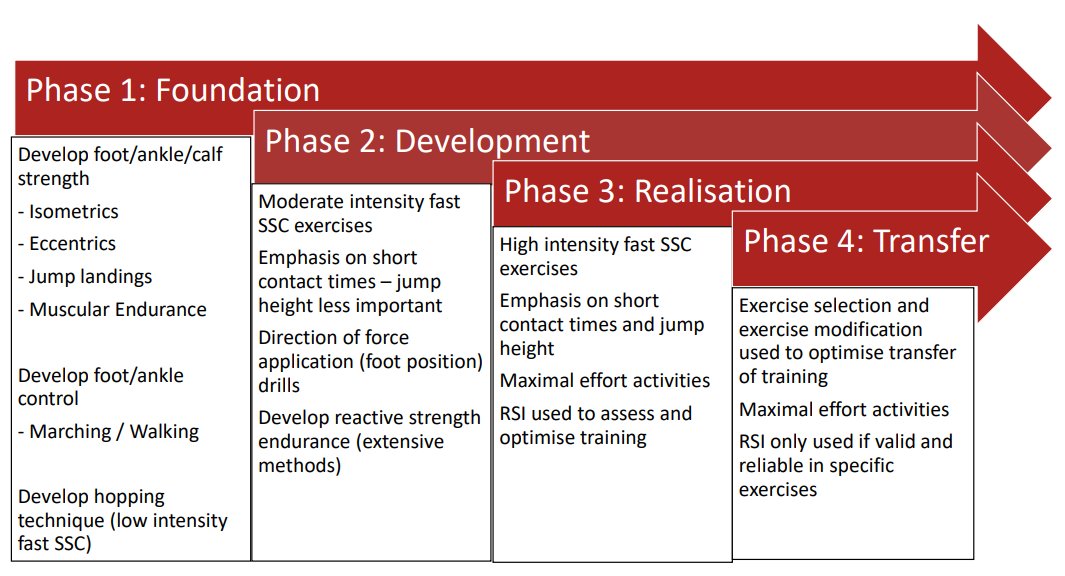
Phase 1: Foundation
Introduce correct technique in jumping, landing & skipping
Focus is on short contact times, springiness rather than maximal efforts.
Useful in early development or after detraining periods
More on key benefits here 👇
Introduce correct technique in jumping, landing & skipping
Focus is on short contact times, springiness rather than maximal efforts.
Useful in early development or after detraining periods
More on key benefits here 👇
Eamonn Flanagan@EamonnFlanagan
Are low-level, extensive plyometrics enough to drive meaningful adaptation? Are they even plyometrics?
Does it matter?
Here's my plyometric progression model 👇
I'm not convinced work in phase 1&2 "prep tendons" or create specific significant adaptation at the tendon - but they do "protect" tendons (in indirect ways) & give best possibility for success in future intensive phases.
Here's why (I think)....
1️⃣ Complementary training modalities
Low level "plyos" are likely not intense enough (high strain) to ↑ meaningful tendon adaptation. But early phases are typically paired w/ traditional heavy STR work or active near maximal isometrics which will promote stiff/healthy tendon
2️⃣ Explore individual (& group) volume bandwidths
Early phase plyos = low-risk way to establish appropriate volumes of work. Rate of tendon loading will not be high enough to trigger tendinopathy - we can incrementally assess what individuals & groups will tolerate as we intensify
3️⃣ Calf capacity / strength endurance
Early phase, extensive plyos build basic strength endurance at the calf (and likely quads and across hips). This strength may be protective in the more intensive training which follows - allowing greater volumes or same volume at lower relative cost
On points 2 & 3:
We can establish these volumes & build endurance across a great variety of exercises. When we intensify we typically ↓ variation of exercise selection
↑ variability = ↓ liklihood of tendon overload
"Variation is the mother of injury prevention" @BooSchex
4️⃣ Technique development
Early phase plyos allow us to effectively and efficiently apply force to the ground. Plyos are about "how much force" AND "direction of force". If we can refine "direction" in early phases we will likely have safer & more effective intensification later. This is ideal work to drill (preferred) foot positioning on ground contact, pelvic positioning in the air etc.
So while low level / early phase plyos may not have the requisite strain to drive tendon adaptation - these early phases "prep the tendons", the athlete and other surrounding structures in a number of other ways.
Does it matter?
Here's my plyometric progression model 👇
I'm not convinced work in phase 1&2 "prep tendons" or create specific significant adaptation at the tendon - but they do "protect" tendons (in indirect ways) & give best possibility for success in future intensive phases.
Here's why (I think)....
1️⃣ Complementary training modalities
Low level "plyos" are likely not intense enough (high strain) to ↑ meaningful tendon adaptation. But early phases are typically paired w/ traditional heavy STR work or active near maximal isometrics which will promote stiff/healthy tendon
2️⃣ Explore individual (& group) volume bandwidths
Early phase plyos = low-risk way to establish appropriate volumes of work. Rate of tendon loading will not be high enough to trigger tendinopathy - we can incrementally assess what individuals & groups will tolerate as we intensify
3️⃣ Calf capacity / strength endurance
Early phase, extensive plyos build basic strength endurance at the calf (and likely quads and across hips). This strength may be protective in the more intensive training which follows - allowing greater volumes or same volume at lower relative cost
On points 2 & 3:
We can establish these volumes & build endurance across a great variety of exercises. When we intensify we typically ↓ variation of exercise selection
↑ variability = ↓ liklihood of tendon overload
"Variation is the mother of injury prevention" @BooSchex
4️⃣ Technique development
Early phase plyos allow us to effectively and efficiently apply force to the ground. Plyos are about "how much force" AND "direction of force". If we can refine "direction" in early phases we will likely have safer & more effective intensification later. This is ideal work to drill (preferred) foot positioning on ground contact, pelvic positioning in the air etc.
So while low level / early phase plyos may not have the requisite strain to drive tendon adaptation - these early phases "prep the tendons", the athlete and other surrounding structures in a number of other ways.
5
Phase 2: Development
Conservative intensification of plyos & technical development of bounding/hopping techniques. Build foundational levels of reactive strength
Extensive methods used to develop lower limb conditioning
Athletes are well prepared for fuure high intensity work
Conservative intensification of plyos & technical development of bounding/hopping techniques. Build foundational levels of reactive strength
Extensive methods used to develop lower limb conditioning
Athletes are well prepared for fuure high intensity work
0:07
6
Phase 3: Realisation
Realisation & Transfer are both “intensification” phases. They harness plyometrics in different ways
With realisation we seek to drive the strength qualities required for the sport. It is a general, high-intensity approach w/ focus on high output training
Realisation & Transfer are both “intensification” phases. They harness plyometrics in different ways
With realisation we seek to drive the strength qualities required for the sport. It is a general, high-intensity approach w/ focus on high output training
7
Phase 4: Transfer
Here we use increased dynamic correspondence of the exercises relative to the sport's demands
Exercises which will assist with the transfer of physical qualities to the sport actions
Ideal for athletes with existing high levels of reactive strength
Here we use increased dynamic correspondence of the exercises relative to the sport's demands
Exercises which will assist with the transfer of physical qualities to the sport actions
Ideal for athletes with existing high levels of reactive strength
8
We cover the rationale for this 4-phase approach, in detail, in our course on @SportsmithHQ
To check out the course, reply below 💥 for details direct to you....
Or go to my profile and all details are in the first pinned tweet
To check out the course, reply below 💥 for details direct to you....
Or go to my profile and all details are in the first pinned tweet