Bit of a change of topic, but let's talk about cancer. What causes...

Arijit Chakravarty@arijitchakrav
19 views
Jun 10, 2024
~5 min read
Advertisement
1
Bit of a change of topic, but let's talk about cancer.
What causes cancer? We learned in high school that it's mutations in oncogenes- "cancer is not one disease, it's many different diseases, each driven by a different oncogenic mutation." (1/)
What causes cancer? We learned in high school that it's mutations in oncogenes- "cancer is not one disease, it's many different diseases, each driven by a different oncogenic mutation." (1/)
2
It's an attractive paradigm, because it makes it all very simple. All you have to do is find the driver mutation for any given cancer & target it to make the cancer disappear.
Someday, the vision goes, every cancer will have a personalized cure. (2/)
Someday, the vision goes, every cancer will have a personalized cure. (2/)
3
Pharma & biotech have poured billions of $ into making this vision a reality over the past two decades. Unfortunately, the money was wasted, because the vision is wrong.
I've been in pharma/biotech for 20yrs- was the Discovery team lead on 5 "Oncogene addiction" programs.(3/)
I've been in pharma/biotech for 20yrs- was the Discovery team lead on 5 "Oncogene addiction" programs.(3/)
4
Experimental data in cancer doesn't line up with the pretty "magic pathway diagram" figures in reviews.
Real cancers are messy. The vast majority of cancers haven't gotten the memo that they're supposed to disappear with targeted treatments. (4/)
Real cancers are messy. The vast majority of cancers haven't gotten the memo that they're supposed to disappear with targeted treatments. (4/)
5
They have multiple mutations, refuse to respond when they should & change their mutational profiles. Most cancers grow back upon treatment, with a different mutational profile than they started.
Gee, that kinda sounds like evolution, doesn't it?(5/)
Gee, that kinda sounds like evolution, doesn't it?(5/)
6
As it so happens, not only does it sound like evolution, it is evolution.
There are three elements to Darwinian evolution- heritable variation, selective pressure and differential fitness. Cancers in the clinical context demonstrate all three elements. (6/)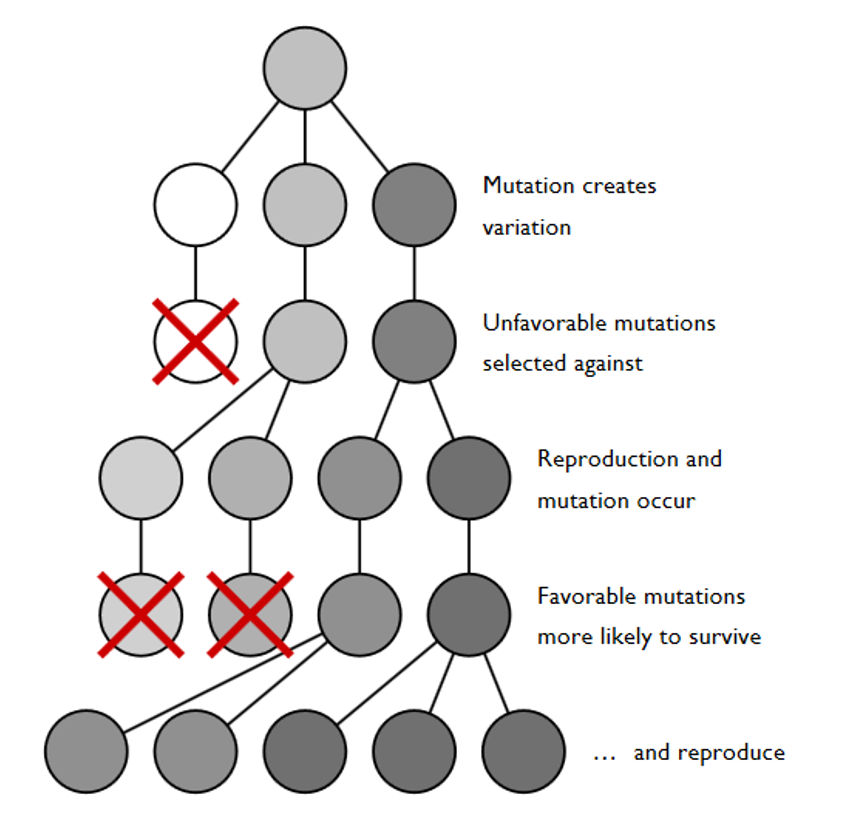
There are three elements to Darwinian evolution- heritable variation, selective pressure and differential fitness. Cancers in the clinical context demonstrate all three elements. (6/)
7
A typical tumor cell genome looks like a bomb hit it.
Heritable variation arises from genomic instability- cancer cells are constantly reshuffling their genomic material, most commonly as a result of chromosomal instability (CIN). (7/)
Heritable variation arises from genomic instability- cancer cells are constantly reshuffling their genomic material, most commonly as a result of chromosomal instability (CIN). (7/)
8
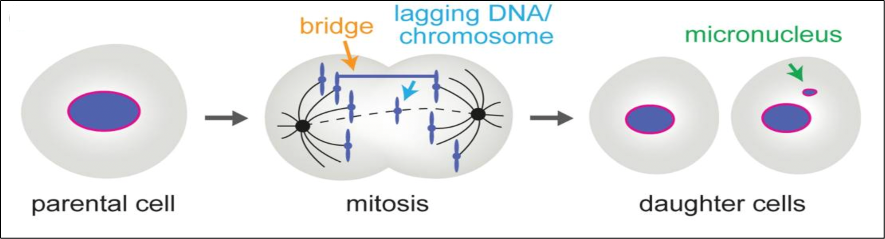
CIN is the process of cancer cells gaining or losing chromosomes with each cell division (as in the example below, from my grad lab).
This continuous genetic reshuffling creates heritable variability within the somatic cells of a tumor. (8/)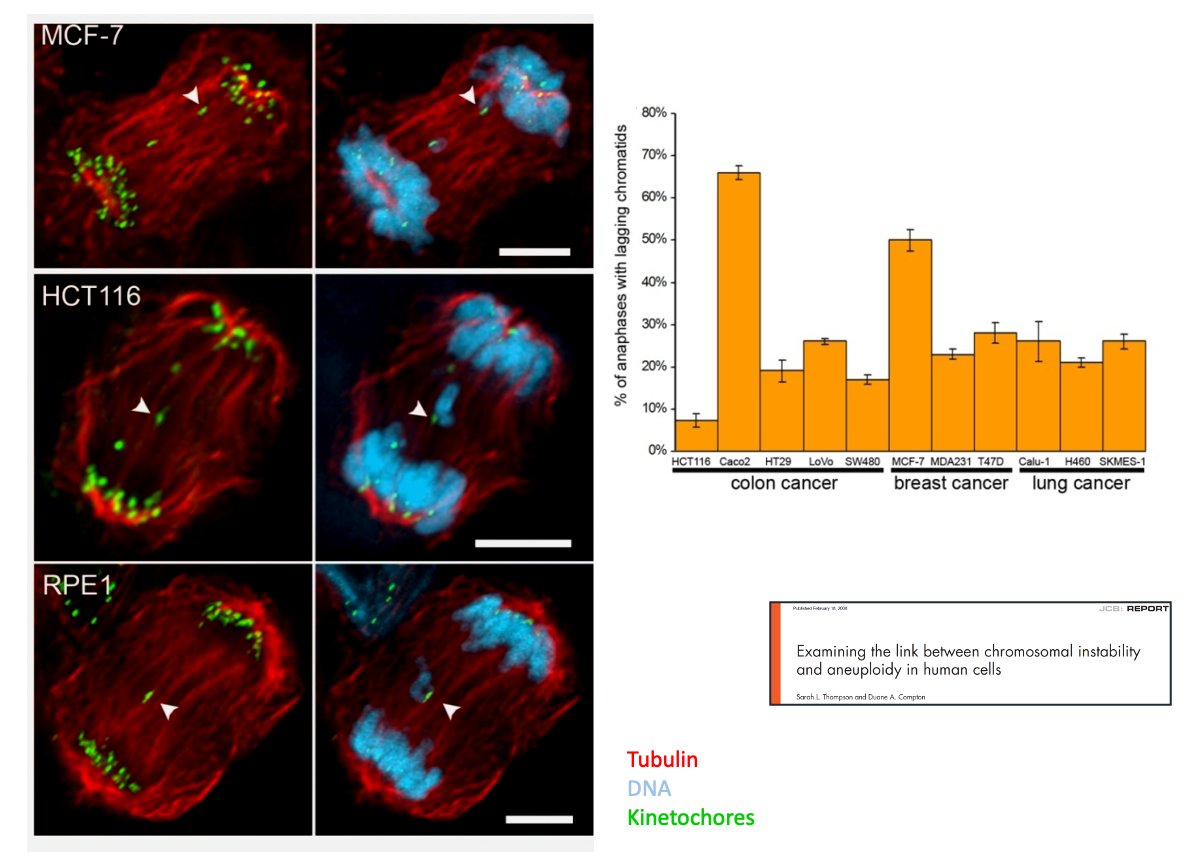
This continuous genetic reshuffling creates heritable variability within the somatic cells of a tumor. (8/)
9
Genetically heterogeneous tumor subclones grow at different rates- people have shown Darwinian selection in action in tissue culture using live-cell microscopy.
(I'll share refs for this & other statements in upcoming blog posts & YouTube presentations, so stay tuned!) (9/)
(I'll share refs for this & other statements in upcoming blog posts & YouTube presentations, so stay tuned!) (9/)
10
Clinical tumors have been shown to be genetically heterogeneous within the same patient (see example on left).
Many cancers have been shown to rebound with different mutational profiles upon targeted treatment (see example on right). (10/)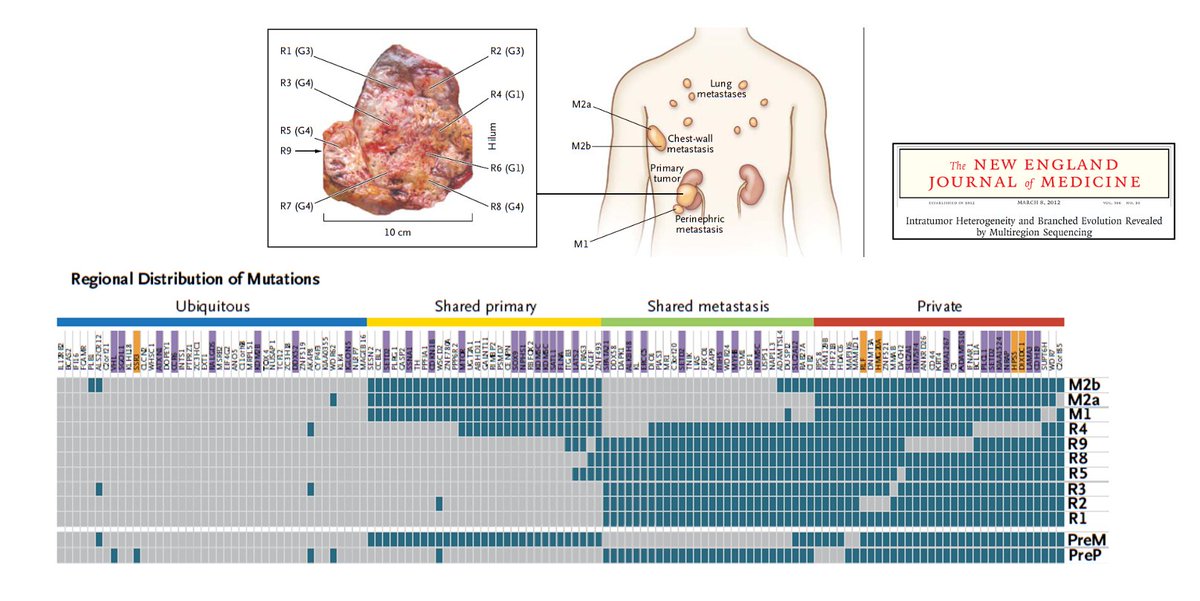
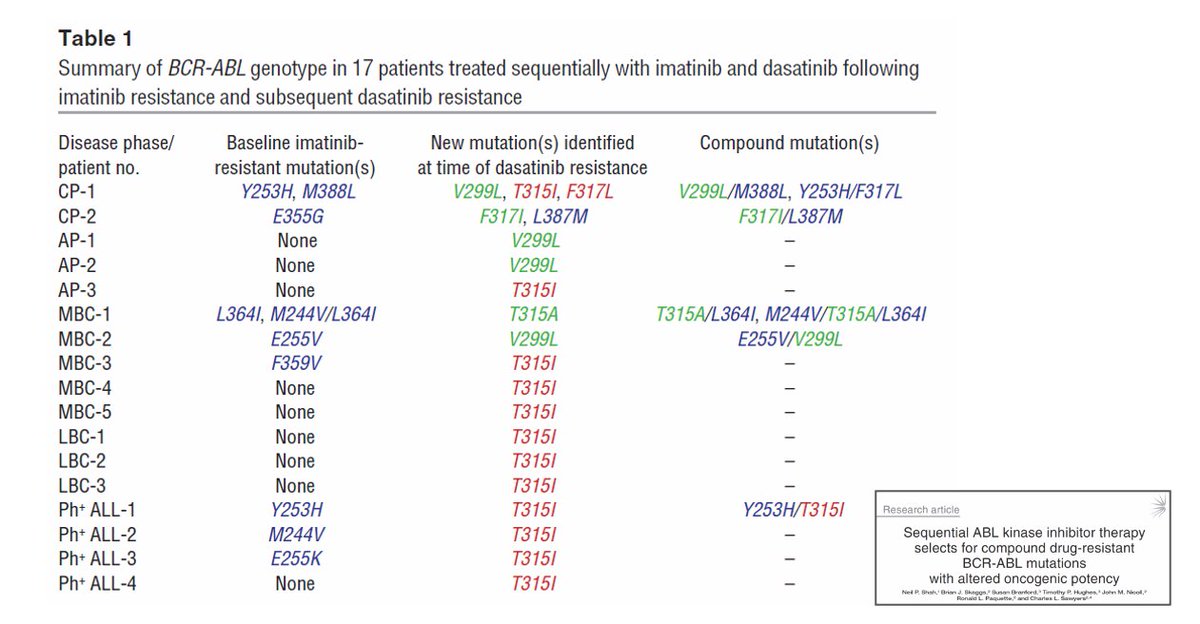
Many cancers have been shown to rebound with different mutational profiles upon targeted treatment (see example on right). (10/)
11
My team and I, over the years, have written extensively on applying an evolutionary framework for modeling clinical tumors- turns out it works really well! See example below: (11/)
(researchgate.net/publication/30…)
(researchgate.net/publication/30…)
12
Okay, cancers evolve. So what? Well, it turns out that the oncogene addiction hypothesis is quite incompatible with the evolutionary paradigm of carcinogenesis and cancer progression. (12/)


13
Crucially, the evolutionary paradigm means that carcinogenesis can be hit-and-run (i.e., the mutation doesn't have to be present any more after the cancer is initiated).
Carcinogenesis occurs with the onset of CIN. After that, tumor progression happens via evolution. (13/)
Carcinogenesis occurs with the onset of CIN. After that, tumor progression happens via evolution. (13/)
14
So, in contrast to the "oncogenes are the accelerator and tumor suppressors are the brakes" metaphor, it's that the onset of CIN is like releasing the handbrake on a car parked on a hill. It sets in motion a chain of events that leads to progressive genetic changes. (14/)

15
What causes CIN?
It turns out there are many different routes to it, but most involve a few key elements- mitotic failure and/or the initiation of unrepaired DNA double strand breaks (DSBs) followed by the failure or suppression of DNA damage response (DDR) checkpoints. (15/)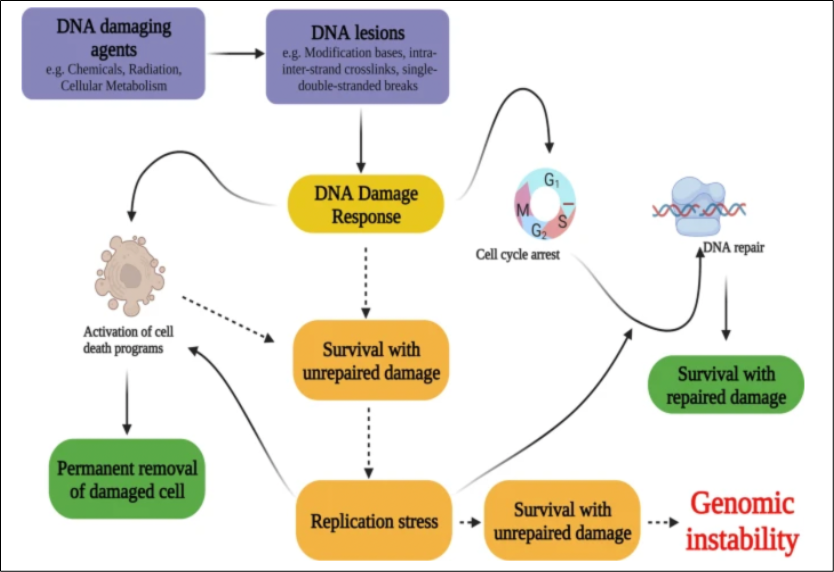
It turns out there are many different routes to it, but most involve a few key elements- mitotic failure and/or the initiation of unrepaired DNA double strand breaks (DSBs) followed by the failure or suppression of DNA damage response (DDR) checkpoints. (15/)
16
The formation of tiny "micronuclei" inside cells is commonly associated with CIN- these are quite literally DNA fragments or missegregated chromosomes. Micronucleus formation is a cause of, contributor to, and biomarker of CIN (refs to follow in blog post/webinar). (16/)
17
Micronuclei frequently rupture inside cells, triggering the cGAS-STING pathway, which sends immune cells rushing to the area to kill the nascent (often precancerous) cells.
This immune surveillance is a second barrier to tumor formation. (17/)
This immune surveillance is a second barrier to tumor formation. (17/)
18
The first line of defense, of course, is the genes we know as "tumor suppressors".
It turns that the vast majority of these genes (e.g. p53, p16, Rb, APC) have very well described roles in cell-cycle (esp. DDR) checkpoints , DNA repair and apoptosis. (18/)
It turns that the vast majority of these genes (e.g. p53, p16, Rb, APC) have very well described roles in cell-cycle (esp. DDR) checkpoints , DNA repair and apoptosis. (18/)
19
And what about those "oncogenes" then?
It turns out that the vast majority of these genes (e.g. Ras, Raf, PI-3K, Myc) have well characterized roles in initiating CIN, either via unrepaired DSBs or via direct induction of chromosome missegregation. (19/)
frontiersin.org/journals/oncol…
It turns out that the vast majority of these genes (e.g. Ras, Raf, PI-3K, Myc) have well characterized roles in initiating CIN, either via unrepaired DSBs or via direct induction of chromosome missegregation. (19/)
frontiersin.org/journals/oncol…
20
(That's an excellent review from my grad advisor's lab mapping the CIN framework to oncogenes and TS genes).
BTW, this 🧵 is the Cliff's notes version of a complex topic, which I'll revisit in more depth in blog posts & YouTube webinars (collabs with @TRyanGregory &others) (20/)
BTW, this 🧵 is the Cliff's notes version of a complex topic, which I'll revisit in more depth in blog posts & YouTube webinars (collabs with @TRyanGregory &others) (20/)
21
Viewing cancer through the CIN paradigm instead of the Oncogene Addiction paradigm allows us to bring an evolutionary framework to bear on the problem. There's a hundred years of evolution & ecology theory that can and should be applied. Story for another day. (21/)
22
But it also has a ton of practical implications when it comes to understanding carcinogens. Cancer initiation is stochastic and delayed - this makes sense in terms of the evolutionary paradigm of cancer, but it is different from our casual understanding of causality. (22/)
23
Carcinogens are neither deterministic nor instant. Nor would you expect them to be, given an evolutionary process for carcinogenesis.
This matters a lot when we're talking about specific carcinogens… say, for example, viruses? (23/)
This matters a lot when we're talking about specific carcinogens… say, for example, viruses? (23/)
24
In my next thread, I'll go into how viruses cause cancer, and why the Oncogene Addiction hypothesis has created problems for the field of viral carcinogenesis for decades. (Guess where I'm going with all this?) (24/)
25
H/T @TRyanGregory @SGriffin_Lab @white_bite @0bj3ctivity @kasza_leslie @DavidJoffe64 @Falseflag
@lisa_iannattone @DaniBeckman @ToshiAkima @FdAdF66 @WesleyWilson @_Lisa_LJ @RolandBakerIII @RS_Rose_Sauvage @calirunnerdoc @ejustin46 @RadCentrism @bronterDoc @tohmes1 @DrGrahamLJ
@lisa_iannattone @DaniBeckman @ToshiAkima @FdAdF66 @WesleyWilson @_Lisa_LJ @RolandBakerIII @RS_Rose_Sauvage @calirunnerdoc @ejustin46 @RadCentrism @bronterDoc @tohmes1 @DrGrahamLJ
26
@TRyanGregory @SGriffin_Lab @white_bite @0bj3ctivity @kasza_leslie @DavidJoffe64 @Falseflag @lisa_iannattone @DaniBeckman @ToshiAkima @FdAdF66 @WesleyWilson @_Lisa_LJ @RolandBakerIII @RS_Rose_Sauvage @calirunnerdoc @ejustin46 @RadCentrism @bronterDoc @tohmes1 @DrGrahamLJ Part 2 is here:
Arijit Chakravarty@arijitchakrav
How do viruses cause cancer? (Thread #2 of a 5 part series).
There's been a fair bit of twitter-chatter about this topic lately, so let's talk about it. Understanding the process of viral carcinogenesis is key to managing the risk of viral infections. (1/)
There's been a fair bit of twitter-chatter about this topic lately, so let's talk about it. Understanding the process of viral carcinogenesis is key to managing the risk of viral infections. (1/)
27
@TRSTNGLRD Yes, that’s a valid way to frame it.
Franziska Michor, one of the pioneers in applying evo theory to cancer, gave a ted talk a while back where she described cancer as “betraying the covenant of multicellularity”.
Franziska Michor, one of the pioneers in applying evo theory to cancer, gave a ted talk a while back where she described cancer as “betraying the covenant of multicellularity”.