My website written by ChatGPT made €1,700+ in December. I created...

Paul Couvert@itsPaulAi
34 views
Dec 29, 2023
~4 min read
Advertisement
1
My website written by ChatGPT made €1,700+ in December.
I created it in November 2022 and haven't touched it since.
All traffic comes from Google search engine optimization (SEO) so I don't do any advertising.
Here's how I created each part of the website: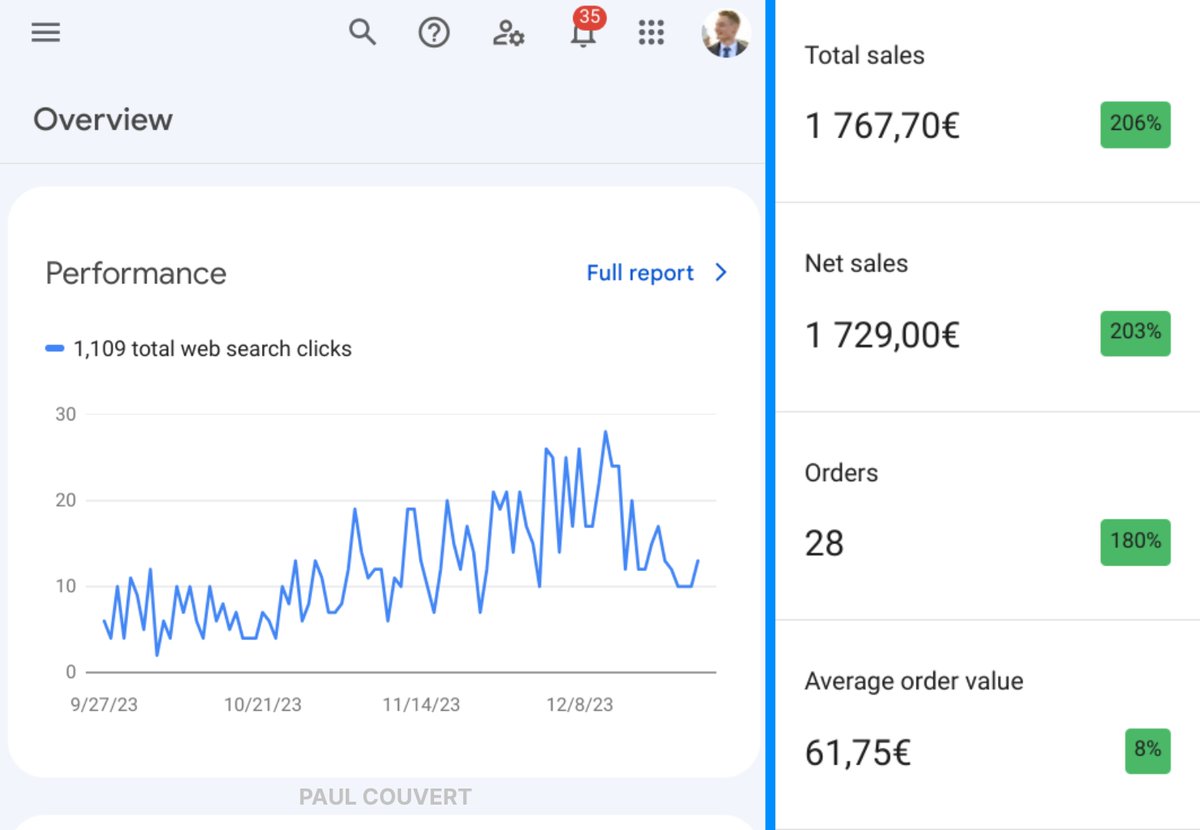
I created it in November 2022 and haven't touched it since.
All traffic comes from Google search engine optimization (SEO) so I don't do any advertising.
Here's how I created each part of the website:
2
I have already talked about this ecommerce site in a previous guide.
If you want more details on choosing products to sell, take a look at my previous guide.
Today we will focus on how to write SEO content.
If you want more details on choosing products to sell, take a look at my previous guide.
Today we will focus on how to write SEO content.
Paul Couvert@itsPaulAi
1. Find an SEO market
→ SEO is the art of getting your website into Google's top positions.
→ Your website will receive visitors automatically every month.
→ Find the keywords that are being searched for on Google using Keyword Surfer, Ubersuggest or Semrush (paid).
→ SEO is the art of getting your website into Google's top positions.
→ Your website will receive visitors automatically every month.
→ Find the keywords that are being searched for on Google using Keyword Surfer, Ubersuggest or Semrush (paid).
3
1. Landing page
The first step is to write an optimized homepage for your website.
It must target a specific keyword related to your niche.
Here is a prompt template you can use:
"You are a seasoned digital marketing expert with extensive experience in SEO and e-commerce. Create a comprehensive SEO-optimized landing page for a niche e-commerce website specializing in [Niche].
Focus on incorporating SEO keywords (the main one for this page is [Main Keyword]) effectively to enhance search engine rankings and attract the target audience of [Persona].
Include sections such as "Introduction to Our Brand," "Featured Products," "Customer Testimonials," and "Blog Highlights," and other SEO paragraphs. The page should have distinct sections, each with a clear heading, engaging content, and strategically placed call-to-action buttons. Ensure the tone is inviting, informative, and aligned with the values of the brand."
0:13
4
2. Product description
To get traffic with Google SEO, you need to write product descriptions with as much content as possible.
This is usually very long but you can save a lot of time with a prompt like this:
"You're an experienced SEO copywriter with a flair for crafting compelling e-commerce content. Develop a detailed SEO-optimized product description for a [Describe your Product] available on a niche e-commerce website catering to [Persona].
Emphasize the unique features of the [product], such as its [Unique Value], using SEO keywords like [Keywords of your Niche] to improve search engine visibility and appeal to the target audience. The description should be structured with an engaging opening, detailed features, user benefits, and a persuasive closing statement.
Write one H1, two H2 and 2 paragraphs below each H2. Adopt a tone that is informative, enthusiastic, and aligns with values of the target audience.
Additionally, write a meta title and meta description."
Important :
Each product page should target a primary keyword that is being searched for.
Take a look at my previous guide (in the second post of the thread) to find out how to do it.
0:10
5
3. Legal pages
Legal pages are mandatory and important.
Having them written by a specialist from scratch can quickly become very expensive.
This prompt does not replace a professional but provides a solid basis that you can have read by a lawyer:
"You are a legal expert specializing in e-commerce law with extensive knowledge of the specific legal requirements in [Country]. Draft the necessary legal pages for an e-commerce website based in [Country], operated as a [Form of Business], such as a Limited Liability Company.
Include compliance with [Country]'s e-commerce regulations, consumer protection laws, and data privacy standards, ensuring that all legal bases are covered for this type of business entity. The pages should include "Terms and Conditions," "Privacy Policy," "Returns and Refunds Policy," and "Shipping Policy," reflecting the legal standards and practices similar to other successful e-commerce websites in [Country] you have advised.
Each legal document should be clearly sectioned with headings, subheadings, and bullet points where appropriate, making them easily navigable and understandable for the website's users. Write in a formal and precise tone, ensuring clarity and legal accuracy."
0:10
6
Note:
I advise you to use GPT-4 or Gemini Pro (with Bard) to write your content.
These are the most advanced and suitable AI models for these tasks.
Check each time that the information written by the AI is consistent with your website, products, etc.
And most importantly: don't hesitate to rephrase certain passages. The more relevant your content is to the user, the better it will rank on Google.
7
One last thing:
I send one free email a week to teach you how to do more with AI.
If you're interested, you can subscribe right here:
paulcouvert.com
I send one free email a week to teach you how to do more with AI.
If you're interested, you can subscribe right here:
paulcouvert.com
8
And of course, you can like the first post to share it and ask me your questions in comments!
Paul Couvert@itsPaulAi
My website written by ChatGPT made €1,700+ in December.
I created it in November 2022 and haven't touched it since.
All traffic comes from Google search engine optimization (SEO) so I don't do any advertising.
Here's how I created each part of the website:
I created it in November 2022 and haven't touched it since.
All traffic comes from Google search engine optimization (SEO) so I don't do any advertising.
Here's how I created each part of the website: